
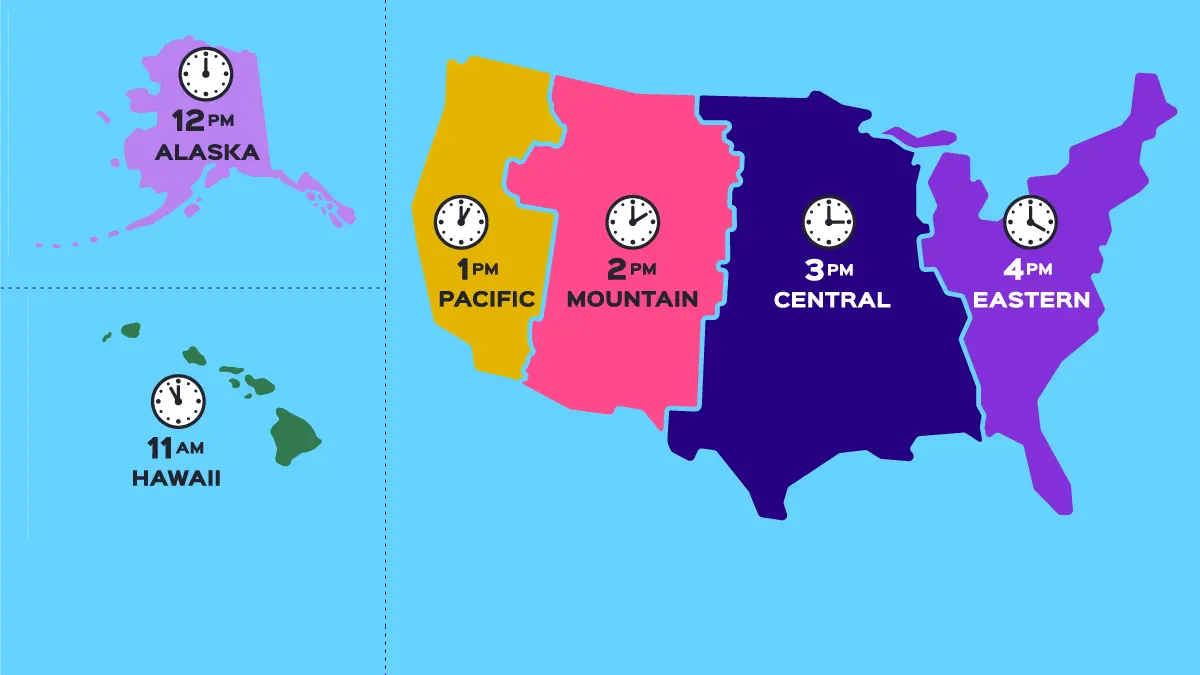
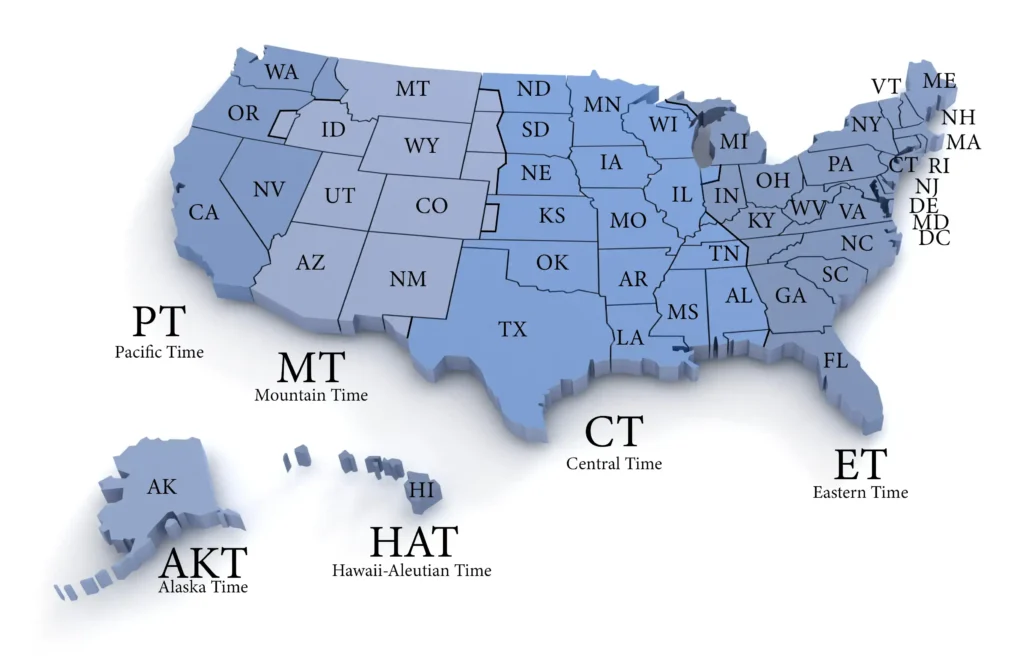
In the interconnected landscape of modern technology, time is more than just a measurement; it is a fundamental data point that governs synchronization, database integrity, and user experience. For developers, IT professionals, and digital collaborators, understanding the relationship between Eastern Time (ET) and Central Time (CT) is a primary lesson in temporal logic. At its simplest, Eastern Time is exactly one hour ahead of Central Time. When it is 12:00 PM in New York (ET), it is 11:00 AM in Chicago (CT).
However, in the realm of technology, this one-hour offset is the tip of the iceberg. From server-side configurations to the complexities of Daylight Saving Time (DST) in code, managing the “ET to CT” conversion requires a deep understanding of digital architecture and global standards. This article explores the technical frameworks that make this one-hour gap seamless across the digital world.

The Digital Architecture of North American Time Zones
To understand how software interprets Eastern and Central time, we must first look at the underlying standards that define them. Digital systems do not “see” time in names like “Eastern” or “Central.” Instead, they rely on offsets from Coordinated Universal Time (UTC).
Understanding the One-Hour Offset: UTC-5 vs. UTC-6
Eastern Standard Time (EST) is defined as UTC-5, while Central Standard Time (CST) is UTC-6. When the clocks shift for Daylight Saving Time, Eastern Daylight Time (EDT) becomes UTC-4, and Central Daylight Time (CDT) becomes UTC-5.
The technical challenge arises because the offset is not static. For a software system, “Eastern Time” is not a single constant; it is a rule-based identifier. Most modern operating systems and programming languages utilize the IANA Time Zone Database (often called the Olson database). This database maps geographic locations to their historical and current offset rules. For example, the identifier America/New_York encompasses all the rules for Eastern Time, ensuring that a system knows exactly when to switch from UTC-5 to UTC-4, maintaining that precise one-hour lead over America/Chicago.
The Role of the IANA Time Zone Database
The IANA database is the backbone of global time synchronization. It is a collaborative compilation of data that tracks every change in time zone boundaries and daylight saving rules since the dawn of Unix time (January 1, 1970).
When a user in the Central Time zone schedules a meeting with a participant in the Eastern Time zone, the calendar application queries the IANA database. It verifies if both regions are currently observing Daylight Saving Time. Because the U.S. generally synchronizes these transitions, the one-hour gap remains consistent. However, the technical logic must account for the rare legislative changes that could theoretically move a county or state from one zone to another, illustrating why hardcoding a “+1 hour” calculation is a cardinal sin in software engineering.
Implementing Time Zone Logic in Software Development
For developers, converting Eastern Time to Central Time involves more than basic arithmetic. It requires a strategy for data persistence and user interface rendering that prevents “temporal drift.”
Managing State and Persistence with UTC
The gold standard in technical architecture is to store all timestamps in UTC within the database. Whether a transaction occurs in Miami (ET) or Dallas (CT), the server records the event in UTC.
The conversion to Eastern or Central time happens at the “presentation layer.” When a user in Nashville (CT) requests their transaction history, the application retrieves the UTC timestamp and applies the America/Chicago offset. If the recipient of that data is in Boston (ET), the system applies the America/New_York offset. By keeping the core data in UTC, developers avoid the “double-conversion” errors that occur when a system tries to calculate Central Time directly from an Eastern Time string.
Handling Daylight Saving Time (DST) Transitions Programmatically
The most significant technical hurdle in the ET/CT relationship is the “Spring Forward” and “Fall Back” events. In the spring, at 2:00 AM, the hour between 2:00 and 3:00 “disappears.” In the autumn, the hour between 1:00 AM and 2:00 AM repeats.
If a developer writes a script to perform a task every day at 1:30 AM Central Time, the script might run twice in November if the logic isn’t “DST-aware.” Modern libraries like Python’s pytz, JavaScript’s Luxon, or the Java java.time package are designed to handle these anomalies. They recognize that while the gap between Eastern and Central remains 60 minutes, the absolute “wall clock” time behaves non-linearly twice a year. High-availability systems often use “T-minus” logic or Unix Epoch timestamps (seconds since 1970) to ensure that background tasks remain synchronized regardless of local clock shifts.
Tech Tools for Seamless Cross-Zone Collaboration
In the era of remote work, the one-hour difference between Eastern and Central time is a daily reality for millions. Technology has evolved to bridge this gap through sophisticated scheduling algorithms and real-time synchronization.
Scheduling Algorithms in Modern Calendar Apps
Tools like Google Calendar, Microsoft Outlook, and Calendly have revolutionized how we manage the ET/CT divide. These platforms use “Time Zone Detection” APIs to identify the user’s current location via IP address or system settings.
When a team lead in Atlanta (ET) creates an invite for 3:00 PM, the calendar server stores that event as a specific point in UTC. For a developer in Austin (CT), the calendar algorithm automatically renders that same point as 2:00 PM. This “automatic normalization” prevents the friction of manual calculation. Furthermore, “Find a Time” features in enterprise software use matrix algorithms to scan the availability of users across different zones, identifying overlapping “working hours” (e.g., 9:00 AM – 5:00 PM ET overlapping with 8:00 AM – 4:00 PM CT).
Communication Latency and Real-Time Data Sync
In high-frequency environments—such as collaborative coding on GitHub or real-time document editing in Google Docs—the one-hour difference between ET and CT must be invisible. This is achieved through Operational Transformation (OT) or Conflict-free Replicated Data Types (CRDTs).
These technologies ensure that when two people are typing simultaneously, the system understands the chronological order of their inputs based on a centralized server clock, not their local ET or CT clocks. Even though the users see different local times on their taskbars, the technology ensures that “User A (ET)” and “User B (CT)” are perfectly synced in the digital “now.”
The Impact of Time Zones on Server Infrastructure and Cloud Computing
The physical location of servers often mirrors the Eastern and Central time zones, which has significant implications for cloud architecture and latency.
Edge Computing and Data Residency
Major cloud providers like Amazon Web Services (AWS) and Microsoft Azure maintain massive “Regions” in both zones. AWS, for example, has us-east-1 (Northern Virginia) and us-east-2 (Ohio) in the Eastern zone, and us-central-1 (typically in the Midwest) for Central.
Architects must decide where to deploy resources based on the proximity to the user base. A fintech app serving users primarily in Chicago and St. Louis will benefit from “Central” servers to minimize “Round Trip Time” (RTT). However, because the ET/CT gap is only one hour, many companies use these zones for “High Availability” (HA) setups. If a power outage hits the Eastern seaboard, traffic can be rerouted to Central Time zone data centers with minimal latency impact, ensuring 99.99% uptime.
Log Standardization and Security Auditing Across Zones
From a digital security perspective, the one-hour difference between ET and CT can be a source of confusion during a forensic investigation. If a server in New York logs a “failed login” at 10:00 PM and a server in Chicago logs a “database breach” at 9:05 PM, which happened first?
To solve this, professional IT environments enforce the use of Network Time Protocol (NTP). NTP ensures that all hardware clocks are synchronized to within milliseconds of a reference clock (usually an atomic clock). Furthermore, security professionals mandate that all system logs be recorded in UTC. This provides a “Single Source of Truth.” During an audit, an analyst can look at a unified timeline and see that the Chicago event (9:05 PM CT / 03:05 UTC) actually occurred five minutes after the New York event (10:00 PM ET / 03:00 UTC). Without this technical rigor, the one-hour offset could allow malicious actors to hide their tracks in the confusion of local time conversions.
Conclusion: The Precision of Temporal Technology
While the question “what is Eastern Time in Central Time?” has a simple answer—it is one hour later—the technology required to maintain that answer across billions of devices is incredibly complex. Through the use of UTC as a universal constant, the IANA database as a rulebook, and cloud infrastructure for geographic redundancy, the tech world ensures that the 60-minute gap remains a helpful guide rather than a technical hurdle. As we move further into a world of distributed systems and edge computing, the precision with which we manage the Eastern and Central time zones will continue to be a cornerstone of digital reliability and global collaboration.
aViewFromTheCave is a participant in the Amazon Services LLC Associates Program, an affiliate advertising program designed to provide a means for sites to earn advertising fees by advertising and linking to Amazon.com. Amazon, the Amazon logo, AmazonSupply, and the AmazonSupply logo are trademarks of Amazon.com, Inc. or its affiliates. As an Amazon Associate we earn affiliate commissions from qualifying purchases.