
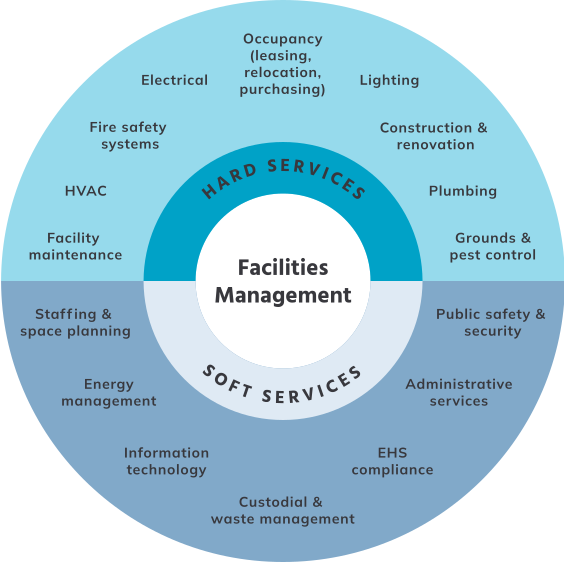
In the contemporary corporate landscape, the answer to the question “what is a facilities department” has evolved far beyond the traditional image of janitorial services and basic building maintenance. Today, a facilities department is the high-tech nerve center of an organization, responsible for integrating people, place, and process through the strategic application of technology. It is the department that manages the complex ecosystem of a “smart” workspace, ensuring that the physical environment and the digital infrastructure work in seamless harmony to drive productivity and operational excellence.
The Evolution of Facility Management: From Manual Upkeep to PropTech Leadership
Historically, facilities management was viewed as a reactive, manual function. When a pipe leaked or a lightbulb flickered, the facilities team was called. However, the rise of Property Technology (PropTech) has fundamentally redefined this role. The modern facilities department is now a data-driven entity that leverages sophisticated software to predict failures before they occur and optimize environments for peak human performance.
The Shift from Reactive to Predictive Maintenance
In a tech-focused facilities department, the “wait-until-it-breaks” mentality has been replaced by predictive maintenance. By utilizing Computerized Maintenance Management Systems (CMMS), departments can track the lifecycle of every asset—from server room cooling units to automated entry systems. Sensors embedded in machinery relay real-time performance data to a central dashboard, allowing technicians to intervene based on actual wear and tear rather than arbitrary schedules. This shift represents a move from analog mechanical work to high-level technical oversight.
The Role of Computer-Aided Facility Management (CAFM)
CAFM software is the foundational tool of the modern facilities tech stack. It allows the department to map out every square inch of a physical space in a digital format. These platforms provide a holistic view of floor plans, asset locations, and technical documentation. By centralizing this data, the facilities department can manage complex move-management tasks and spatial optimization with surgical precision, ensuring that the physical footprint of the company is utilized as efficiently as any cloud server.
Digital Transformation of the Workplace Experience
As companies embrace hybrid work models, the facilities department has become the primary architect of the digital workplace experience. They manage the apps that employees use to book desks, reserve meeting rooms, and navigate large campuses. This integration of software into the physical office environment ensures that the “facility” is not just a building, but a dynamic, tech-enabled service that supports a flexible workforce.
The Facilities Tech Stack: Essential Software and Systems
To understand what a facilities department is today, one must look at the sophisticated software ecosystem they manage. They are no longer just managing bricks and mortar; they are managing integrated platforms that communicate with each other to create an “intelligent” environment.
Integrated Workplace Management Systems (IWMS)
The IWMS is the “ERP” of the facilities world. It is a comprehensive software suite that integrates five key areas: real estate management, project management, facilities management, sustainability, and service management. For a tech-savvy facilities department, the IWMS is the single source of truth. It allows for the cross-referencing of data, such as how energy consumption (sustainability) correlates with occupancy levels (facilities management), providing insights that were impossible in the pre-digital era.
Building Information Modeling (BIM) and Digital Twins
One of the most advanced frontiers for the facilities department is the use of Building Information Modeling (BIM). BIM creates 3D virtual representations of the physical and functional characteristics of a facility. When these models are updated in real-time with sensor data, they become “Digital Twins.” A facilities department using a Digital Twin can simulate various scenarios—such as the impact of a hardware upgrade on power consumption—without touching the physical infrastructure, significantly reducing risk and downtime.
Enterprise Asset Management (EAM) Solutions
While CMMS focuses on maintenance, EAM software takes a broader view of the entire lifecycle of an organization’s physical technology. This includes acquisition, installation, performance monitoring, and eventual decommissioning. The facilities department uses EAM to manage the technical lifecycle of critical infrastructure, ensuring that high-value equipment like uninterruptible power supplies (UPS) and HVAC systems are optimized for maximum return on investment and reliability.
IoT and the Rise of the Smart Building Infrastructure
The “Internet of Things” (IoT) has effectively turned the modern facility into a giant computer. The facilities department is tasked with deploying, managing, and interpreting the data from thousands of IoT devices that monitor everything from air quality to occupancy patterns.

Sensor Networks and Real-time Data Analytics
Modern facilities are embedded with vast networks of sensors. Occupancy sensors detect which meeting rooms are actually in use, allowing the facilities department to automate lighting and climate control. Air quality sensors monitor CO2 levels and humidity, automatically adjusting ventilation systems to ensure a healthy environment. The facilities team acts as the data analysts of this ecosystem, interpreting heat maps and usage trends to make informed decisions about space utilization and infrastructure upgrades.
Automated HVAC and Energy Management Systems (EMS)
Energy management is one of the most tech-heavy responsibilities of the department. Smart Energy Management Systems (EMS) use algorithms to balance comfort with efficiency. These systems can autonomously adjust to peak demand times, integrate with renewable energy sources like solar arrays, and participate in “smart grid” programs. The facilities department manages these algorithms, ensuring that the building’s carbon footprint is minimized through automated, high-precision control of the mechanical systems.
Enhancing Physical Security through AI-Integrated Surveillance
Security is no longer just about locks and keys; it is about integrated digital security systems. The facilities department manages AI-driven surveillance cameras that can perform facial recognition or detect unusual movements after hours. They oversee biometric access control systems and ensure that the physical security hardware is integrated with the company’s internal network, creating a multi-layered defense system that protects both physical and intellectual property.
Digital Security and Connectivity in Facility Operations
Because modern facilities are so deeply integrated with software and the internet, the facilities department now plays a critical role in digital security. The convergence of Information Technology (IT) and Operational Technology (OT) means that the facilities team must be well-versed in cybersecurity protocols.
Protecting the Industrial Internet of Things (IIoT)
Every smart thermostat, connected elevator, and networked light switch represents a potential entry point for cyber threats. The facilities department works closely with the IT security team to ensure that the Industrial Internet of Things (IIoT) is properly segmented and encrypted. They manage the patching and firmware updates of building systems, ensuring that the physical infrastructure does not become a vulnerability in the company’s digital perimeter.
Managing Vendor Access and Cloud Infrastructure
Many modern facility systems are cloud-based, requiring constant communication with external vendors for software updates and remote monitoring. The facilities department manages these high-tech partnerships, ensuring that third-party access to building systems is strictly controlled and that data privacy standards are maintained. They are the gatekeepers of the “digital keys” to the building’s most critical operational systems.
Redundancy and Disaster Recovery for Technical Systems
In a tech-driven facility, a power outage or a network failure isn’t just an inconvenience; it can halt business operations. The facilities department designs and manages the redundancy systems—such as backup generators, data center cooling redundancies, and secondary internet lines—that ensure “five nines” (99.999%) of uptime. They treat the building as a critical piece of hardware that requires a robust disaster recovery plan.
The Future of Facilities: AI, Robotics, and Sustainable Tech
Looking forward, the facilities department will continue to evolve as it adopts even more cutting-edge technologies. The integration of Artificial Intelligence (AI) and robotics is the next frontier in how these departments operate.
Generative AI in Maintenance and Logistics
Artificial Intelligence is beginning to take over the complex task of scheduling and logistics within facilities. AI can analyze decades of building data to suggest the most efficient route for a maintenance technician or to predict exactly when a specific component in an elevator will fail based on vibration patterns. The facilities department of the future will use Generative AI to draft technical manuals, automate service ticket responses, and optimize complex supply chains for facility supplies.
Robotics and Automated Service Delivery
We are already seeing the introduction of autonomous robots for cleaning, security patrols, and even delivery within large corporate campuses. The facilities department is responsible for the “fleet management” of these robots—ensuring they have the necessary mapping data, charging infrastructure, and network connectivity to function safely alongside human employees. This shifts the facilities role from performing manual tasks to managing a robotic workforce.
The Push for “Net Zero” Through High-Tech Sustainability
As corporate sustainability goals become more ambitious, the facilities department is the primary driver of “Net Zero” initiatives. This involves deploying sophisticated tech like smart glass that tints automatically to reduce heat gain, gray-water recycling systems controlled by AI, and advanced carbon-tracking software. The facilities department ensures that the organization’s physical presence is as “green” as its digital brand, using technology to bridge the gap between corporate responsibility and operational reality.
In conclusion, a facilities department is the technological backbone of any modern organization. It is a multi-disciplinary team of tech experts, data analysts, and systems engineers who ensure that the physical environment is an asset rather than a liability. By leveraging CAFM, IoT, AI, and robust cybersecurity measures, the facilities department creates the high-tech foundation upon which all other business functions rely.
aViewFromTheCave is a participant in the Amazon Services LLC Associates Program, an affiliate advertising program designed to provide a means for sites to earn advertising fees by advertising and linking to Amazon.com. Amazon, the Amazon logo, AmazonSupply, and the AmazonSupply logo are trademarks of Amazon.com, Inc. or its affiliates. As an Amazon Associate we earn affiliate commissions from qualifying purchases.