
The mystery of Oak Island has captivated treasure hunters, historians, and engineers for over two centuries. Located off the coast of Nova Scotia, this small, tree-covered island is home to the infamous “Money Pit,” a site rumored to hold everything from pirate gold and Shakespearean manuscripts to the Holy Grail. However, for decades, the search was defined by manual labor, rudimentary tools, and tragic failures.
In recent years, the narrative of Oak Island has shifted. What was once a battle of brawn and shovels has evolved into a masterclass in the application of cutting-edge technology. When we ask, “What have they found at Oak Island?” the answer is no longer just “old wood and coconut fiber.” The real discovery is a sophisticated suite of technological breakthroughs that are redefining the field of historical exploration.
1. Advanced Subsurface Imaging and LiDAR Technology
The first hurdle in solving the Oak Island mystery was the terrain itself. Before a single hole is dug, researchers must understand the geological and man-made anomalies hidden beneath the surface. This is where modern remote sensing technology has proven invaluable.
LiDAR: Stripping Away the Canopy
One of the most significant technological “finds” on Oak Island was the deployment of Light Detection and Ranging (LiDAR). By using laser pulses emitted from an aircraft, researchers were able to create a highly accurate 3D map of the island’s topography. This technology “stripped away” the dense vegetation, revealing subtle depressions, ancient roadbeds, and structural outlines that were invisible to the naked eye. This data provided the first comprehensive digital blueprint of the island, allowing the team to identify target areas with surgical precision.
Ground Penetrating Radar (GPR) and Muon Tomography
Beyond the surface, Ground Penetrating Radar (GPR) has been utilized to detect subsurface structures. By sending high-frequency radio waves into the ground and measuring the reflections, technicians have located potential tunnels and “voids” deep within the Money Pit area. More recently, the exploration has looked toward Muon Tomography—a tech used in the Great Pyramids of Giza. This involves using cosmic-ray particles to “X-ray” the island, searching for high-density objects or large chambers that traditional drilling might miss.
2. Sonic Drilling and Precision Excavation Tools
Once the imaging identifies a target, the challenge becomes reaching it. Oak Island is notorious for its unstable soil and the “flood tunnels”—ingenious booby traps designed to fill the pits with seawater. To overcome these obstacles, the modern hunt has turned to industrial-grade engineering solutions.
The Rise of Sonic Drilling
Traditional rotary drilling often destroys the very artifacts it seeks to find. To solve this, the Oak Island team implemented sonic drilling technology. Unlike standard drills, a sonic drill uses high-frequency vibrations to liquefy the soil around the drill bit. This allows for the extraction of a continuous, relatively undisturbed core sample. These cores are essentially “time capsules” of earth, allowing archaeologists to see the exact stratification of the soil and identify man-made debris—such as bits of parchment, gold links, or ancient pottery—at specific depths.
Oscillating Shaft Sinking
When larger-scale excavation is required, the team employs massive oscillators. These machines drive steel casings several feet in diameter deep into the earth, bypassing the flood tunnels by creating a watertight seal. This technology, typically reserved for high-stakes civil engineering projects like subway tunnels or bridge foundations, represents the pinnacle of modern excavation tech. It has allowed the team to explore the Money Pit at depths exceeding 150 feet, a feat that was physically impossible for previous generations of treasure hunters.
3. Underwater Exploration and ROV Integration
Oak Island’s mystery extends far beneath the water table. Boreholes like “10-X” and the coastal areas of Smith’s Cove have required tools that can withstand high pressure and zero-visibility environments.
Remotely Operated Vehicles (ROVs)
The “finds” at the bottom of deep boreholes have been made possible by sophisticated Remotely Operated Vehicles (ROVs). These underwater drones are equipped with high-definition cameras, 360-degree sonar imaging, and robotic manipulators. In the murky, sediment-heavy water of the Oak Island shafts, traditional cameras are often useless. Modern ROVs utilize “BlueView” sonar technology to create acoustic images of the environment, allowing operators to “see” through the silt and identify man-made structures or potential treasure chests.
Divers and Technical Diving Gas Mixtures
Even with ROVs, human intuition is sometimes necessary. However, the depths of Oak Island shafts pose significant risks for nitrogen narcosis and decompression sickness. To facilitate human exploration, the team utilizes technical diving equipment, including rebreathers and specialized gas mixtures (like Trimix). This technology extends bottom time and ensures that divers can safely document the flooded chambers that have remained hidden for centuries.
4. Digital 3D Modeling and Data Analytics
Perhaps the most underrated “find” on Oak Island is the sheer volume of data collected. The challenge in modern treasure hunting is not just finding the needle in the haystack, but organizing the haystack itself.
Predictive Modeling and GIS Mapping
Geographic Information Systems (GIS) are used to overlay historical maps—some dating back to the 1700s—with modern LiDAR and GPR data. By using data analytics, researchers can identify patterns that suggest where the original “Money Pit” was located before years of chaotic digging blurred the lines. This digital “time-travel” allows the team to correct for historical errors and focus their resources on the most statistically probable locations.
X-Ray Fluorescence (XRF) and Material Analysis
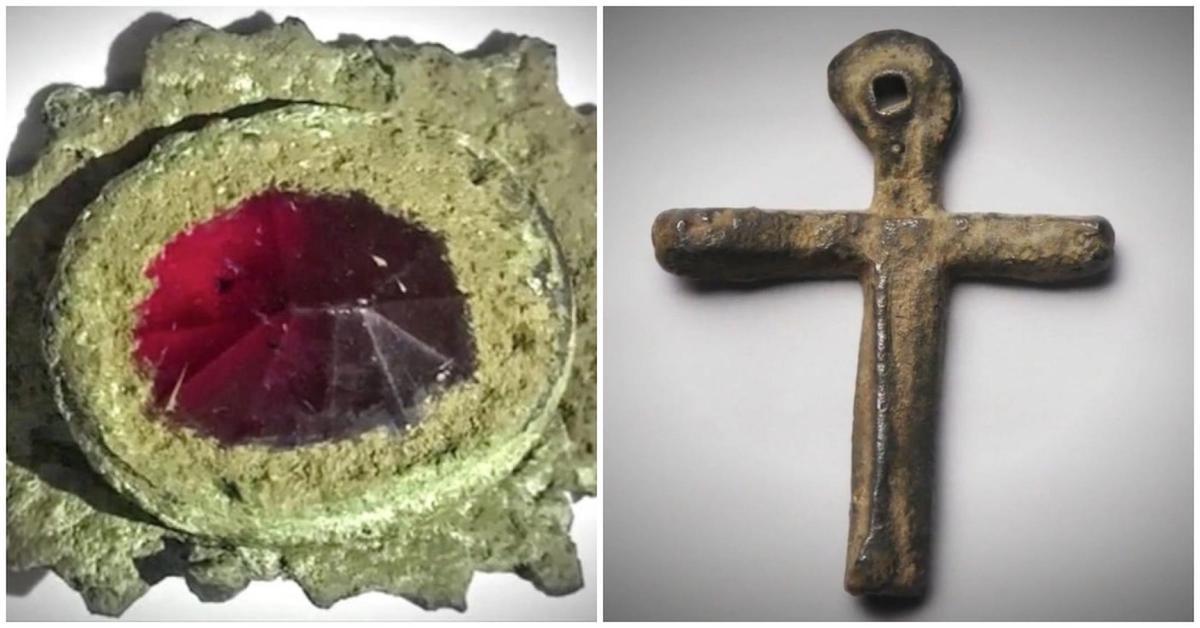
When small metallic artifacts are found—such as the “Spanish Galleon” spike or the “Lead Cross”—the team doesn’t rely on guesswork. They use X-Ray Fluorescence (XRF) scanners. This handheld tech provides a non-destructive chemical analysis of the object’s elemental composition. By identifying the specific trace elements in a piece of metal, researchers can determine its point of origin (e.g., a specific mine in Europe) and its age, providing empirical data to support various historical theories.
5. The Future of Archaeology: AI and Pattern Recognition
As the Oak Island project continues, the role of Artificial Intelligence (AI) is becoming increasingly prominent. The “finds” of the future will likely be driven by algorithms capable of processing data faster than any human researcher.
AI in Manuscript and Artifact Analysis
There is a long-standing theory that the Money Pit contains hidden manuscripts. If fragments are found, AI-powered image recognition software can be used to reconstruct degraded text or identify the unique “fingerprint” of the paper and ink. This tech has already been used to decode scorched scrolls from Pompeii and is a vital tool in the Oak Island arsenal.
Seismic Data Processing
The team is currently utilizing large-scale seismic surveys, where thousands of “geophones” are placed across the island to record vibrations from a surface source. The resulting data is so massive that it requires high-performance computing to process. AI algorithms are used to filter out the “noise” and identify the “signal”—the specific vibration patterns that indicate a hollow vault or a metallic mass. This represents the ultimate convergence of tech and treasure hunting: using the power of the cloud to find what is hidden in the dirt.
Conclusion: A New Era of Discovery
When we ask, “What have they found at Oak Island?” we must look beyond the physical objects. While gold coins, lead crosses, and ancient parchment are tantalizing, the true discovery is the methodology. Oak Island has become a living laboratory for the most advanced technology on the planet.
The transition from “hunting” to “science” has been fueled by LiDAR, sonic drilling, ROVs, and AI. These tools have turned a 200-year-old myth into a data-driven investigation. Whether the team eventually finds a massive hoard of gold or simply the remains of a sophisticated 18th-century industrial site, the technology used in the process has already changed the face of archaeology forever. The mystery of Oak Island is being solved, byte by byte and laser pulse by laser pulse, proving that in the modern age, the most powerful tool for finding the past is the technology of the future.
aViewFromTheCave is a participant in the Amazon Services LLC Associates Program, an affiliate advertising program designed to provide a means for sites to earn advertising fees by advertising and linking to Amazon.com. Amazon, the Amazon logo, AmazonSupply, and the AmazonSupply logo are trademarks of Amazon.com, Inc. or its affiliates. As an Amazon Associate we earn affiliate commissions from qualifying purchases.