
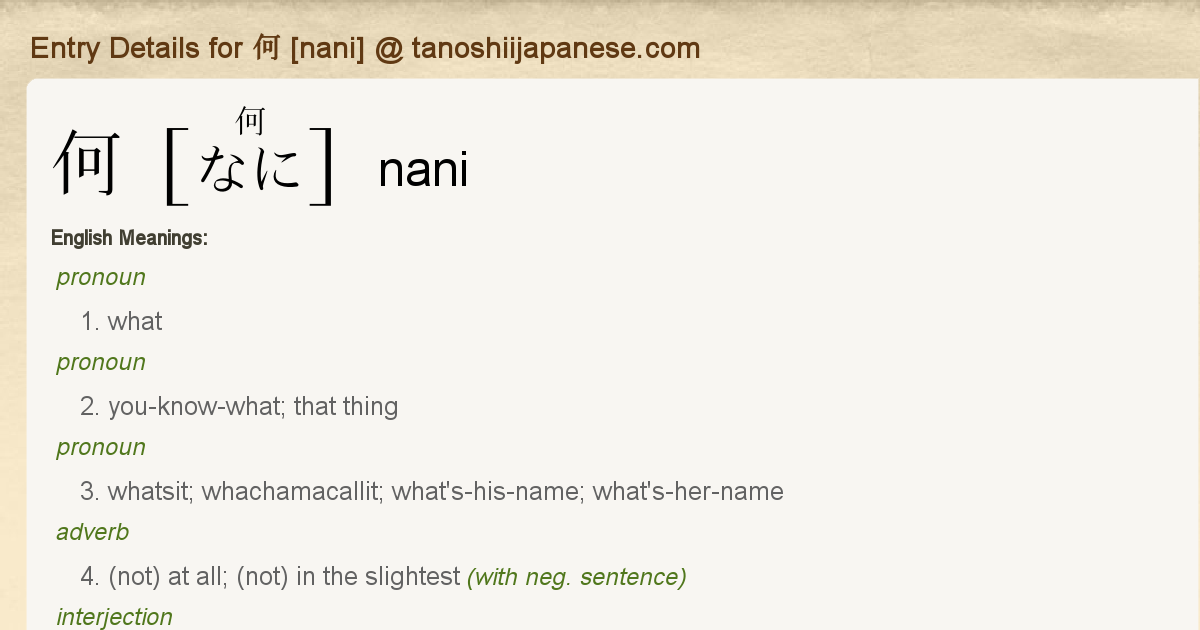
In the landscape of global digital culture, few words have transcended their linguistic origins as effectively as the Japanese word “nani” (何). While a literal translation reveals it simply means “what,” its journey through the pipes of the internet, from early message boards to sophisticated AI-driven social media algorithms, represents a fascinating case study in technical localization and the evolution of Natural Language Processing (NLP). For technologists, developers, and digital strategists, understanding the trajectory of “nani” is not just about learning a foreign vocabulary word; it is about understanding how tech platforms facilitate the birth of a globalized digital dialect.

The proliferation of Japanese terminology within Western tech circles wasn’t an accident. It was the result of a perfect storm: the rise of high-speed internet, the globalization of media via streaming platforms, and the algorithmic prioritization of high-engagement content. Today, “nani” serves as a bridge between traditional linguistics and modern data science, challenging our current AI models to interpret nuance, tone, and cultural context in real-time.
The Digital Evolution of Japanese Slang in Global Tech Ecosystems
The integration of “nani” into the global digital lexicon began in niche tech communities and gaming forums. Long before it became a mainstream meme, it was a staple of IRC (Internet Relay Chat) and early BBS (Bulletin Board Systems). This migration from a specific geographic language to a global digital asset highlights the power of software-mediated communication.
From Anime Subtitles to Algorithmic Trends
In the early 2000s, the “fansubbing” community—groups of tech-savvy individuals who subtitled Japanese media for global audiences—played a pivotal role. These digital pioneers utilized specialized software like Aegisub to hard-code translations. However, they often left words like “nani” untranslated or used them in specific contexts that highlighted their expressive power. As these files were shared over peer-to-peer (P2P) networks and later uploaded to platforms like YouTube, the word began to enter the training sets of early search engines.
Today’s algorithms, particularly on platforms like TikTok and Instagram, recognize the phonetic signature of “nani” in audio tracks. When a creator uses a “nani” sound effect, the recommendation engine categorizes the content within specific high-engagement niches, such as gaming, tech reviews, or reaction videos. This represents a shift where a word moves from being a semantic unit to a functional metadata tag used by discovery algorithms.
The “Omaewa Mou Shindeiru” Effect: Meme Culture as a Data Point
The most famous technical explosion of “nani” occurred through the viral “Omaewa Mou Shindeiru” (You are already dead) meme. This soundbite, often accompanied by a high-pitched “Nani?!” response, became a benchmark for viral engineering. For data scientists studying viral coefficients, this meme provided a wealth of data on how audio-visual synchronization drives engagement. The technical architecture of platforms like Vine and later TikTok allowed for the “sampling” of this linguistic unit, turning a Japanese interrogative into a universal digital shorthand for shock or confusion.
Challenges in Natural Language Processing (NLP) and Machine Translation
For AI developers, “nani” represents a “high-context” challenge. Japanese is a language where meaning is heavily dependent on the relationship between the speaker and the listener, as well as the atmosphere (the “kuuki” or air). Translating “nani” through a standard Large Language Model (LLM) requires more than a dictionary look-up; it requires an understanding of digital pragmatics.

Contextual Ambiguity in Japanese-to-English AI Models
When a user types “nani” in a chat application, a basic translation engine might provide “what.” However, in a tech-driven context, “nani” can mean “I don’t understand this code,” “That’s an unexpected bug,” or “Are you serious?” Advanced NLP models, such as Google’s BERT or OpenAI’s GPT-4, have had to be trained on massive datasets of informal web text to understand these shifts. The technical difficulty lies in “disambiguation”—the process by which an AI determines which version of “what” is being used based on the surrounding tokens in the data string.
Sentiment Analysis and the Evolution of Informal Japanese Online
Sentiment analysis tools used by corporations to monitor brand health must account for “nani.” In a vacuum, “nani” is neutral. However, in the tech world, its usage is often associated with “surprise” or “technical failure.” Developers working on sentiment analysis must build custom lexicons that recognize the phonetic spelling of Japanese words in Latin script (Romaji). This necessitates a more robust approach to tokenization, where the software identifies “nani” not as a typo or a nonsense word, but as a high-sentiment marker.
The Role of “Nani” in the Gaming and Streaming Technology Landscape
The gaming industry has been the primary engine for the technical adoption of Japanese terminology. With Japan being a powerhouse in hardware (Sony, Nintendo) and software development, the cross-pollination of language was inevitable.
Real-Time Translation Tools for Live Streamers
On platforms like Twitch, streamers often interact with global audiences. This has led to the development of sophisticated “Live Translation” overlays and bots. These tools use Speech-to-Text (STT) APIs to listen to the streamer’s audio and provide real-time captions. When a streamer shouts “Nani!”, the software must decide whether to translate it literally or keep the Japanese term for stylistic consistency. Modern streaming plugins now allow for “Slang Preservation,” a technical setting that recognizes popular loanwords and leaves them in their original form to maintain the “vibe” of the digital community.
Haptic Feedback and Audio Integration in Interactive Media
In game development, the “Nani” moment is a recognized design pattern. Sound designers and UI/UX engineers use localized audio cues to signal to the player that an unexpected event has occurred. The technical integration of these cues involves sophisticated spatial audio engines. If a character says “Nani,” the audio middleware (like Wwise or FMOD) might trigger specific haptic feedback in a controller or adjust the dynamic range of the game’s soundtrack to emphasize the moment of confusion. This shows how a single word can influence the entire technical stack of an interactive experience.
Future Outlook: AI-Driven Cross-Cultural Communication
As we look toward the future of communication technology, the role of “nani” and similar cross-cultural linguistic units will only grow. We are moving toward a “Post-Translation” era where AI doesn’t just swap one word for another, but blends cultures into a new form of digital “Creole.”
The Rise of Neural Machine Translation (NMT)
Neural Machine Translation (NMT) uses deep learning to predict the likelihood of a sequence of words. NMT models are increasingly being trained on “Internet-speak,” which includes a heavy dose of Japanese. This means that future communication tools—such as AR glasses that provide real-time subtitles for face-to-face conversations—will likely treat “nani” as a universal term rather than a foreign one. The technical goal is “seamless latency,” where the AI understands the cultural weight of the term instantly, providing the user with the emotional context behind the word.
Preserving Linguistic Nuance in a Hyper-Connected Digital World
One of the greatest technical challenges for the next decade is “Cultural Preservation in Code.” As AI models become more dominant, there is a risk of “Linguistic Leveling,” where the nuances of languages like Japanese are flattened into a standardized English-centric format. To combat this, developers are working on “Culturally Aware AI.” These systems are designed to recognize when a word like “nani” carries a specific weight that a literal translation would lose. By utilizing “Zero-Shot Learning” techniques, these AIs can learn to respect the original Japanese context even when operating in an English-speaking environment.
In conclusion, “nani” is more than just a Japanese word for “what.” It is a digital artifact that has navigated the complex journey from 1980s anime to the cutting edge of 21st-century AI. For those in the tech industry, it serves as a reminder that language is a fluid technology in itself—one that requires constant updates, patches, and a deep understanding of the “users” who speak it. As our tools for translation and communication become more sophisticated, the focus will move away from literal meaning and toward the complex, high-speed, and deeply human nuances that “nani” represents in our shared digital future.
aViewFromTheCave is a participant in the Amazon Services LLC Associates Program, an affiliate advertising program designed to provide a means for sites to earn advertising fees by advertising and linking to Amazon.com. Amazon, the Amazon logo, AmazonSupply, and the AmazonSupply logo are trademarks of Amazon.com, Inc. or its affiliates. As an Amazon Associate we earn affiliate commissions from qualifying purchases.