
In the rapidly evolving landscape of high-performance engineering, green energy, and advanced computing, the term “isentropic” has moved from the dusty pages of thermodynamics textbooks into the heart of cutting-edge technological development. While the word itself sounds like a relic of 19th-century physics, it represents the absolute “gold standard” of efficiency for the systems powering our digital world.
To understand what isentropic means is to understand the quest for the perfect machine—a device that operates without waste, without friction, and without the degradation of energy. For tech innovators, aerospace engineers, and data center architects, isentropic efficiency is the benchmark against which all modern hardware is measured.
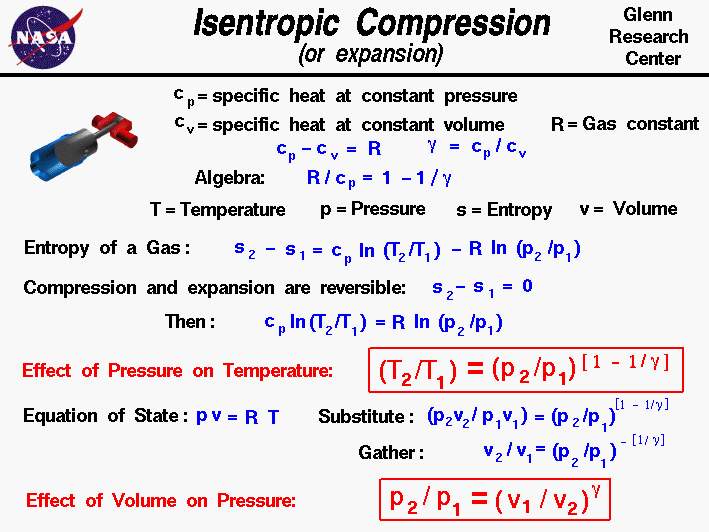
Understanding the Core Concept: Thermodynamics in the Digital Age
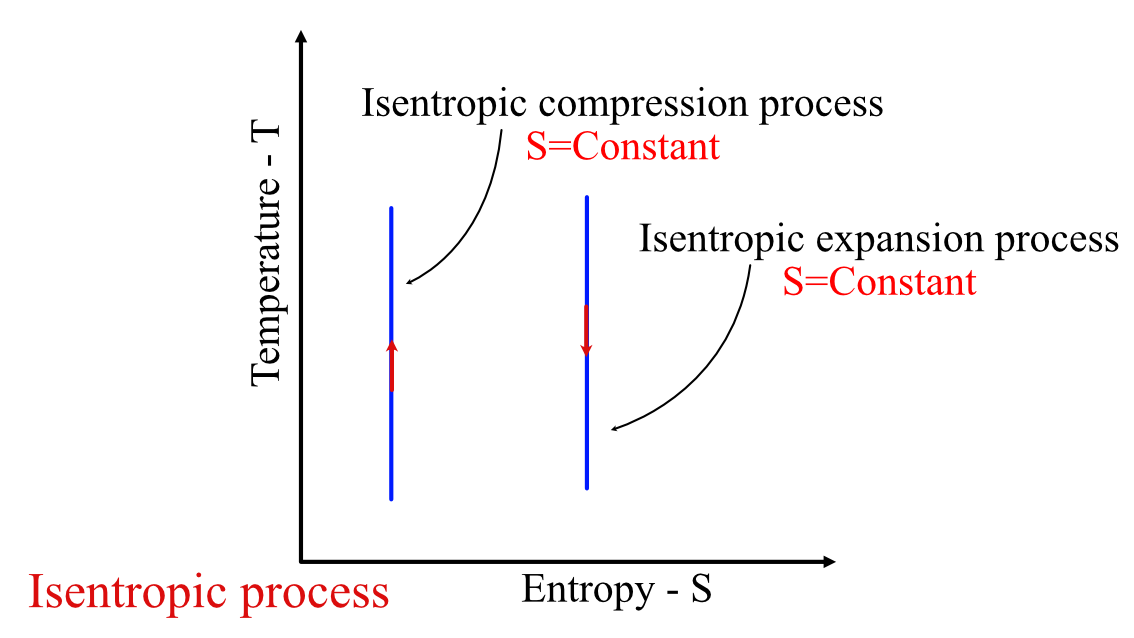
At its most fundamental level, “isentropic” is a compound of two Greek words: iso (equal) and entropy. In a technical sense, an isentropic process is one in which the entropy of the system remains constant. To grasp why this matters for technology, we must first look at the mechanics of heat and work.
The Definition of Isentropic
In the world of physics and engineering, an isentropic process is defined as one that is both adiabatic and reversible.
- Adiabatic means that no heat is transferred into or out of the system.
- Reversible means that the process happens so smoothly and perfectly that the system could be returned to its original state without leaving any trace on the environment.
When these two conditions are met, entropy—the measure of disorder or “wasted” energy—does not increase. While a perfectly isentropic process is a theoretical ideal (it is impossible to achieve in the real world due to the laws of thermodynamics), it serves as a critical mathematical model. Tech developers use “isentropic efficiency” to calculate how close a real-world component, like a microprocessor cooling unit or a SpaceX Merlin engine, comes to perfection.
Reversibility and the Fight Against Friction
In software and hardware optimization, “friction” is a metaphor for anything that slows down performance. In thermodynamics, friction is literal. Every time a mechanical part moves or an electron travels through a circuit, some energy is lost as heat. This heat represents an increase in entropy.
An isentropic system would be “frictionless” in the most absolute sense. By aiming for isentropic standards, tech companies are essentially trying to build systems where every joule of energy put into the system is converted into useful work, rather than being bled off into the atmosphere as useless heat.
Engineering the Future: Isentropic Efficiency in Hardware and Engines
The most visible applications of isentropic principles are found in hardware engineering, specifically in propulsion and energy conversion. Whether it is the turbines generating the electricity that powers our servers or the engines launching satellites into orbit, isentropic modeling is the key to performance breakthroughs.
Aerospace and Jet Propulsion
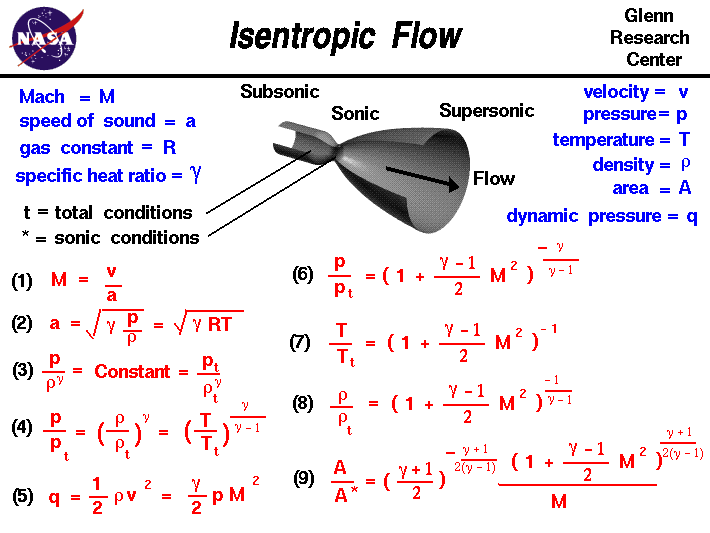
In aerospace tech, the Isentropic Flow theory is foundational. When air moves through a jet engine or over a supersonic wing, engineers want that air to change pressure and temperature without creating turbulence or heat loss.
For instance, in the design of nozzles for rockets, engineers strive for isentropic expansion. If the gas expands isentropically, the rocket achieves the maximum possible thrust for every kilogram of fuel burned. Modern tech firms like Blue Origin and Virgin Galactic rely on complex fluid dynamics software to simulate isentropic conditions, allowing them to shave off weight and increase the “specific impulse” of their vehicles.
Turbines and Green Energy Systems
As the tech industry shifts toward sustainable energy, isentropic efficiency has become a metric for the “Green Tech” revolution. Wind turbines, hydroelectric dams, and even the cooling systems for large-scale solar arrays are designed to minimize entropy production.
A “perfect” turbine would be an isentropic one, where the kinetic energy of the wind or water is converted entirely into electrical energy. By analyzing the “isentropic efficiency” of a power plant, engineers can identify exactly where energy is being lost—whether through mechanical vibration, sound, or heat—and use AI-driven design to mitigate those losses.
The Computing Challenge: Heat Management and Data Centers
Perhaps the most pressing application of isentropic concepts today is in the realm of High-Performance Computing (HPC) and data center management. As we push toward exascale computing and more complex AI model training, the “entropy problem” has become a literal wall that tech companies must overcome.
From Chips to Cooling
Every calculation performed by a computer chip generates a tiny amount of heat. In a data center with tens of thousands of CPUs and GPUs, this heat becomes a massive energy drain. Currently, nearly 40% of the energy consumed by data centers goes not toward computing, but toward cooling the hardware.
Tech giants like Google and Microsoft are looking at isentropic cooling cycles to solve this. Traditional air conditioning is highly “anisentropic” (it creates a lot of disorder). New liquid immersion cooling and phase-change cooling systems are designed to mimic isentropic processes more closely. By moving heat away from chips through a closed-loop system that minimizes temperature gradients, these companies can operate their hardware at much higher speeds without the risk of thermal throttling.
The Pursuit of “Reversible Computing”
Looking further into the future of tech, there is a growing field known as “Reversible Computing.” In a standard computer, when a bit of information is erased (changing a 1 to a 0), that information is lost to the universe, which, according to Landauer’s Principle, must release a specific amount of heat. This is an increase in entropy.
If we could develop isentropic logic gates—where no information is ever truly “erased” but rather repurposed—we could theoretically build computers that generate zero heat. This would be the ultimate “isentropic” technology. While still in the experimental stage, reversible computing is a major area of research for quantum computing and next-generation semiconductor tech, as it would allow for a level of miniaturization and speed that is currently blocked by the “heat wall.”
Why Isentropic Standards Matter for Sustainable Tech
Beyond the pure physics, “isentropic” has become a philosophy for the “Circular Tech” movement. It represents a shift from a “waste-heavy” tech economy to a “waste-neutral” one.
Measuring Waste in Global Systems
When we talk about the “Isentropic Efficiency” of a tech ecosystem, we are looking at the ratio of actual work performed to the work that would have been performed by an ideal system. Currently, the global tech infrastructure is far from this ideal. However, by setting isentropic benchmarks, the industry can create standardized “Efficiency Scores” for everything from cloud storage to blockchain verification.
For example, a “Green” blockchain might be marketed based on its isentropic profile—how little energy is wasted on “useless” calculations (Proof of Work) compared to the actual value of the transaction being recorded.
The Future of Energy Storage
One of the biggest hurdles in tech today is energy storage. Batteries lose charge over time and generate heat when charging/discharging. Isentropic energy storage—such as Compressed Air Energy Storage (CAES) systems that use heat exchangers to keep the temperature constant—is a burgeoning field.
In these systems, air is compressed to store energy and expanded to release it. If the process is kept near-isentropic, the energy recovery rate is significantly higher than traditional chemical batteries. For tech companies building independent power grids for their data centers, these isentropic storage solutions offer a way to store renewable energy with almost zero loss.
Conclusion: The Quest for Perfect Efficiency
In the tech world, “isentropic” is more than just a word for “constant entropy.” It is a vision of a future where our machines are in perfect harmony with the laws of physics. It represents the boundary of what is possible in engineering, from the way we cool our gaming PCs to the way we launch missions to Mars.
As we continue to demand more power, more speed, and more data, our ability to approach isentropic efficiency will determine the limits of our growth. By minimizing entropy and striving for reversibility, the tech industry isn’t just saving money on electricity—it is unlocking the next phase of human innovation. Whether through the development of reversible logic gates or the perfection of jet propulsion, the isentropic ideal remains the north star for every engineer aiming to build a more efficient, sustainable, and powerful digital future.
aViewFromTheCave is a participant in the Amazon Services LLC Associates Program, an affiliate advertising program designed to provide a means for sites to earn advertising fees by advertising and linking to Amazon.com. Amazon, the Amazon logo, AmazonSupply, and the AmazonSupply logo are trademarks of Amazon.com, Inc. or its affiliates. As an Amazon Associate we earn affiliate commissions from qualifying purchases.