
For many investors, opening a brokerage app to see a sea of red can be a visceral, unsettling experience. When the share market experiences a significant downturn, the immediate reaction is often one of concern: “Why is this happening today?” While the stock market is often viewed as a barometer of economic health, it is, in reality, a complex ecosystem influenced by a myriad of factors ranging from global politics to the psychological nuances of individual traders.
Understanding why the market is down today requires peeling back the layers of macroeconomic data, corporate performance, and geopolitical shifts. Rather than viewing a market dip as a singular event, it is more productive to view it as the result of various converging forces. This article explores the primary drivers behind market declines and offers a framework for how investors can navigate these turbulent waters without losing sight of their long-term financial goals.
The Macroeconomic Drivers: Interest Rates and Inflationary Pressure
The most common reason for a broad market sell-off is rooted in the “macro” environment—the high-level economic factors that affect all businesses. Chief among these are inflation and the subsequent reactions from central banks, such as the Federal Reserve in the United States or the European Central Bank.
The Role of Central Banks and the “Hawkish” Stance
Central banks have a dual mandate: to promote maximum employment and to keep prices stable. When inflation rises too quickly, central banks use their primary tool—interest rates—to cool the economy. If the market is down today, it may be because of “hawkish” signals from central bankers. When interest rates rise, the cost of borrowing increases for both consumers and corporations.
For a business, higher interest rates mean higher interest expenses on debt, which directly eats into net profits. For consumers, it means more expensive mortgages and credit card payments, leading to reduced discretionary spending. Investors often sell stocks in anticipation of these tighter financial conditions, as the discounted present value of future corporate earnings becomes less attractive when compared to the rising yields of “risk-free” assets like government bonds.
Inflationary Data and Its Impact on Consumer Spending
Inflation is more than just a headline number; it is a weight on the entire economic engine. When the Consumer Price Index (CPI) or the Producer Price Index (PPI) comes in higher than expected, the market often reacts negatively. Persistent inflation erodes the purchasing power of consumers. If people are spending more on “needs” like gas and groceries, they have less to spend on “wants” like electronics, travel, or dining out.
This shift in spending patterns leads to lower revenue for companies across various sectors. When investors see data suggesting that inflation is not “sticky” or is rising faster than wages, they begin to price in a recessionary environment, leading to the downward pressure we see on stock tickers today.
Geopolitical Uncertainty and Global Supply Chain Disruptions
Markets hate uncertainty. While the economy can adapt to known challenges, it struggles to price in “black swan” events or escalating geopolitical tensions. In a globalized economy, a conflict or a policy shift in one corner of the world can have a ripple effect that touches every portfolio.
Conflict and Trade Relations as Market Catalysts
War and geopolitical instability are major catalysts for market downturns. Conflict in energy-rich regions can lead to a sudden spike in oil and gas prices, which acts as a hidden tax on both businesses and consumers. Beyond direct conflict, trade wars and the imposition of tariffs can disrupt the flow of goods and services.
When two major economies engage in trade disputes, it increases the cost of doing business and creates a climate of unpredictability. Investors react to this by shifting capital out of “risk-on” assets like stocks and into “safe-haven” assets like gold or treasury bonds. The downward movement today might simply be a flight to safety as the world monitors a developing international crisis.
Energy Prices and Commodity Volatility
The cost of energy is a fundamental input for almost every industry. If the price of crude oil or natural gas spikes due to geopolitical supply constraints, the cost of manufacturing and shipping goods rises. Airlines, logistics companies, and manufacturers feel the pinch immediately. Even digital companies are affected indirectly as the overall economy slows down. When commodity prices become volatile, it creates a “cost-push” inflation scenario that is particularly difficult for the market to digest, often leading to broad-based selling.
Corporate Performance and the Impact of Earnings Season
While macroeconomic trends provide the backdrop, individual company performance provides the specifics. We are currently in an era where the market is hyper-focused on corporate “guidance”—what companies expect to happen in the future—rather than just what happened in the past.
Missed Estimates and Downward Revisions
During earnings season, the market’s direction is often dictated by the reports of “bellwether” companies—large, influential corporations like Apple, Microsoft, or JP Morgan. If these giants report earnings that miss analyst expectations, or if they offer “weak guidance” for the next quarter, it can drag down the entire index.
A downward revision in guidance is a signal to investors that the growth story may be slowing. If a company that was expected to grow at 20% suddenly announces it only expects 10% growth due to “headwinds,” investors will repriced the stock immediately. Because many stocks are held in massive Exchange Traded Funds (ETFs), a sell-off in a few large-cap stocks can cause the entire market to slide.
Sector-Specific Slumps: When One Domino Falls
Sometimes, the market is down not because of a systemic failure, but because of a crisis in a specific sector. For example, a sudden decline in the banking sector due to liquidity concerns or a slump in the tech sector due to overvaluation can create a contagion effect. When one sector begins to crumble, institutional investors may sell off positions in other sectors to cover losses or to maintain their desired asset allocation. This “cross-asset” selling can make a localized problem feel like a market-wide catastrophe.
The Psychology of a Market Sell-Off: Sentiment and Algorithmic Trading
The share market is not just a collection of numbers; it is a collection of human emotions and programmed responses. Fear and greed are the two primary drivers of price action, and when fear takes hold, the downward momentum can become self-fulfilling.
Fear, Panic, and the “Herd Mentality”
Behavioral finance teaches us that humans are biologically wired to avoid loss more than they are to seek gain—a concept known as loss aversion. When the market begins to dip, the fear of losing capital can trigger a “herd mentality.” Retail investors, seeing their portfolio values drop, may panic-sell to “save” what is left. This influx of sell orders further drives prices down, which triggers more panic, creating a feedback loop. Today’s downturn might be less about economic fundamentals and more about a collective psychological reaction to a perceived threat.
The Role of High-Frequency Trading (HFT) and Stop-Loss Triggers
In the modern era, a significant portion of market volume is driven by algorithms and high-frequency trading (HFT) systems. These programs are designed to react to price movements in milliseconds. Many investors set “stop-loss” orders—automatic instructions to sell a stock if it hits a certain price. When the market hits a certain threshold, thousands of these stop-loss orders can trigger simultaneously. This creates a “flash” effect where prices drop rapidly and sharply, often disconnected from the actual value of the underlying companies.
Strategic Responses: How to Manage Your Investments During a Dip
While it is important to understand why the market is down, it is even more important to know how to respond. For the disciplined investor, a market downturn is not a disaster; it is a phase of the cycle that requires a steady hand and a long-term perspective.
The Importance of Diversification and Asset Allocation
The best defense against a market downturn happens before the downturn even starts. Diversification—spreading your investments across different asset classes like stocks, bonds, real estate, and cash—ensures that you aren’t over-exposed to a single point of failure. If your portfolio is down today, it is an excellent time to review your asset allocation. Are you too heavy in speculative tech stocks? Do you have enough “defensive” holdings like utilities or consumer staples that tend to hold their value during recessions? Rebalancing your portfolio during a dip can actually set you up for greater gains during the eventual recovery.
Focusing on the Long-Term: The Trap of Market Timing
One of the most dangerous mistakes an investor can make is trying to “time the market.” This involves selling stocks when you think they’ve hit a peak and trying to buy them back at the bottom. History shows that missing just a few of the market’s best days can drastically reduce your long-term returns.
Instead of exiting the market, many successful investors practice “dollar-cost averaging”—investing a fixed amount of money at regular intervals regardless of the price. When the market is down, your fixed investment buys more shares. When the market recovers, those extra shares contribute significantly to your wealth.
Conclusion
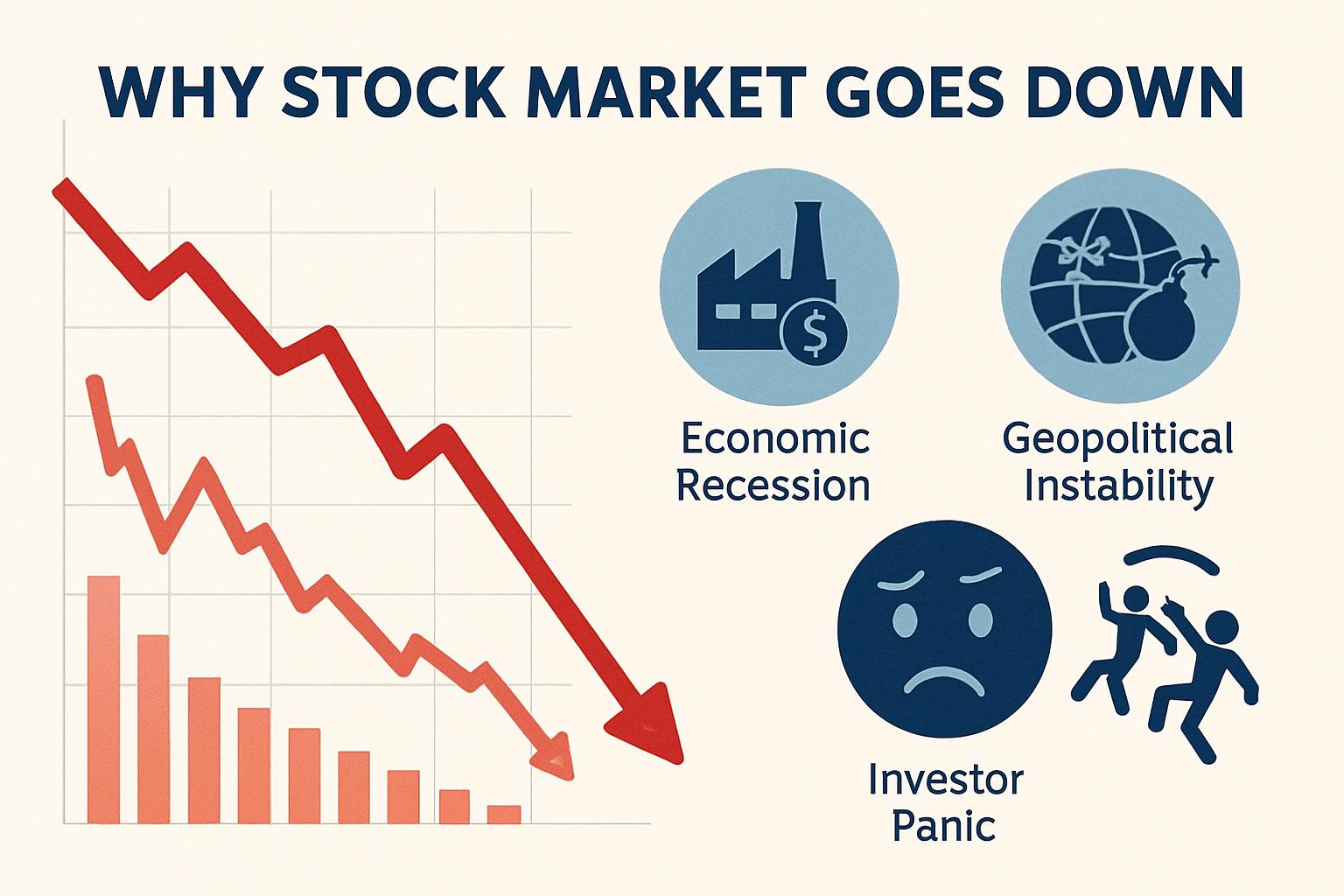
A downward move in the share market is rarely the result of a single factor. It is usually a confluence of rising interest rates, geopolitical tension, corporate earnings shifts, and the inherent volatility of human psychology. While the “red” on the screen can be intimidating, it is essential to remember that market corrections are a healthy and necessary part of the financial ecosystem. They clear out overvalued assets and provide opportunities for patient, long-term investors to build positions in quality companies at a discount. By understanding the “why” behind the move, you can move past the emotion of the moment and focus on the disciplined strategies that lead to long-term financial independence.
aViewFromTheCave is a participant in the Amazon Services LLC Associates Program, an affiliate advertising program designed to provide a means for sites to earn advertising fees by advertising and linking to Amazon.com. Amazon, the Amazon logo, AmazonSupply, and the AmazonSupply logo are trademarks of Amazon.com, Inc. or its affiliates. As an Amazon Associate we earn affiliate commissions from qualifying purchases.