
For many investors, opening a brokerage account to find a sea of red can be a jarring experience. The stock market is often described as a “manic-depressive” entity, swinging from exuberant highs to sobering lows, sometimes within the span of a single trading session. When the major indices—the S&P 500, the Dow Jones Industrial Average, and the Nasdaq—stumble simultaneously, it is rarely the result of a single event. Instead, it is typically a confluence of macroeconomic pressures, shifting monetary policies, and psychological shifts among market participants.
Understanding why the market is down today requires looking beyond the immediate price tickers and examining the underlying structural forces that govern global finance. By dissecting these factors, investors can move from a state of emotional reaction to one of informed perspective.
The Macroeconomic Landscape: Interest Rates and Inflation
The most significant driver of market movement in the modern era is the cost of money. Equity markets do not exist in a vacuum; they are constantly competing with other asset classes and reacting to the broader health of the economy. When the stock market experiences a broad sell-off, the primary culprit is often found in the latest data from the labor department or the central bank.
The Federal Reserve and Monetary Policy
Central banks, particularly the U.S. Federal Reserve, act as the “conductors” of the financial markets. Their primary tool for controlling the economy is the federal funds rate. When inflation runs too high, the Fed raises interest rates to cool down economic activity. Higher rates mean it becomes more expensive for companies to borrow money for expansion, and more expensive for consumers to finance homes and cars.
When the market drops today, it may be because investors are pricing in a “hawkish” stance from the Fed. If recent economic data suggests that the Fed will keep rates higher for longer, stock valuations—especially those of high-growth companies—tend to contract. This is because the “discount rate” used to value future cash flows increases, making those future profits worth less in today’s dollars.
Inflationary Pressures and the CPI
Inflation is the silent killer of purchasing power and a major antagonist for the stock market. Investors closely watch the Consumer Price Index (CPI) and the Producer Price Index (PPI). If these reports come in “hotter” than expected, it signals that the Fed may need to be more aggressive in its tightening cycle. Inflation also squeezes corporate profit margins; as the cost of raw materials and labor rises, companies must either raise prices—potentially lowering demand—or settle for lower earnings. The market often sells off in anticipation of these tighter margins.
Geopolitical Instability and Global Supply Chains
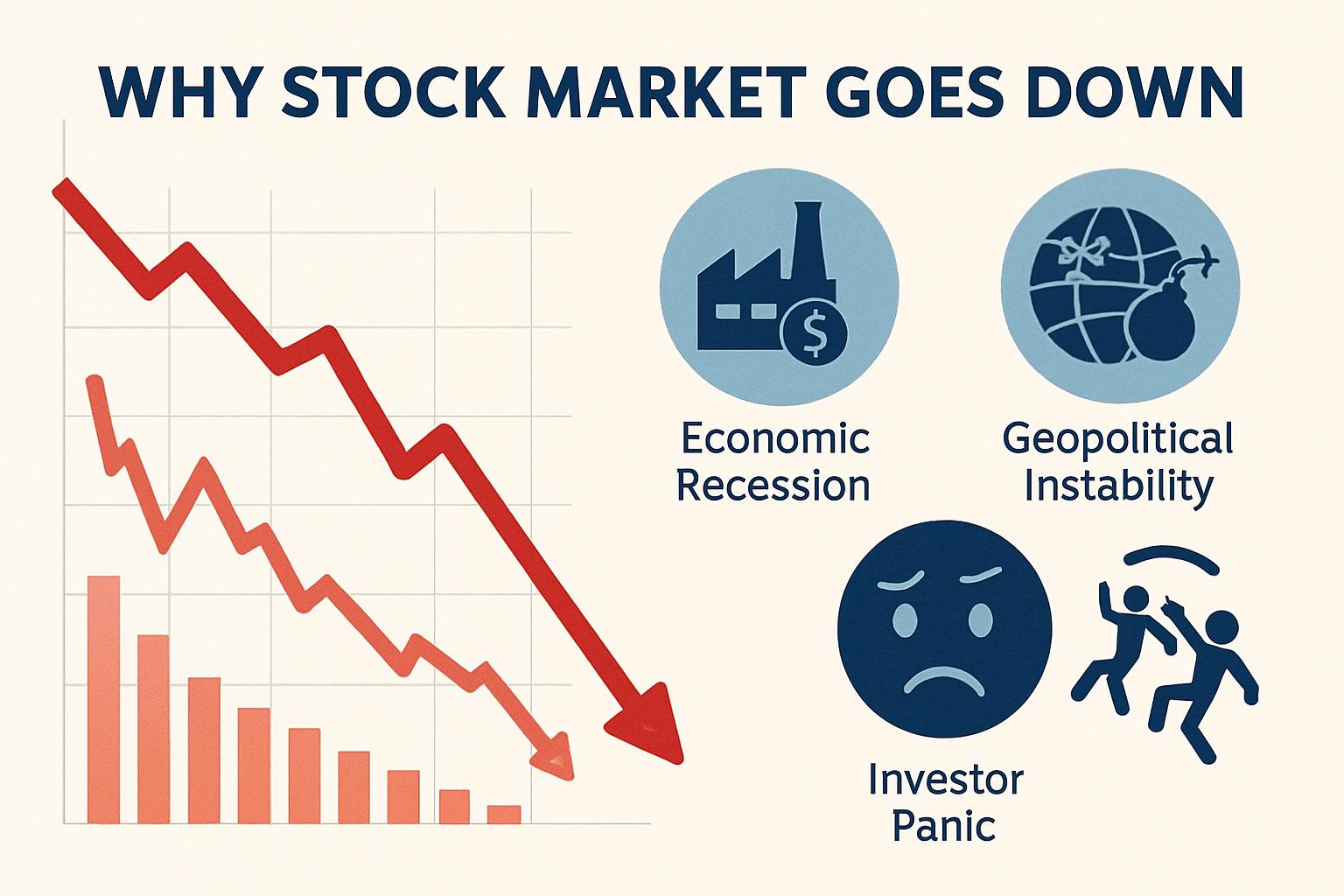
Markets loathe uncertainty. Geopolitical tensions, such as conflicts in oil-producing regions or trade disputes between major economies, can cause immediate downward pressure. These events often disrupt global supply chains, leading to shortages and increased costs. Furthermore, geopolitical unrest often triggers a “flight to safety,” where investors sell “risk-on” assets like stocks and move their capital into “safe havens” like U.S. Treasuries or gold.
Corporate Earnings and Sector Rotations
While the macro picture sets the stage, the individual performance of companies provides the script. The stock market is, at its core, a collection of businesses. When a significant portion of those businesses reports bad news, the entire market can feel the weight.
Earnings Misses and Forward Guidance
Four times a year, during earnings season, publicly traded companies report their financial health. A market downturn today could be triggered by several “bellwether” companies missing their revenue or profit estimates. However, the market is often more concerned with “guidance”—the company’s forecast for the future. If a tech giant reports record profits but warns that growth will slow in the coming quarters, its stock price will likely tumble, dragging its respective sector and the broader index down with it.
The Impact of High Valuation Multiples
Sometimes, the market is down not because the economy is failing, but because stocks simply became too expensive. This is often measured by the Price-to-Earnings (P/E) ratio. If the market average P/E ratio climbs significantly above its historical mean, it becomes vulnerable to a “correction.” In this scenario, even slightly negative news can serve as a catalyst for a massive sell-off as investors realize they have paid too much for future growth that may not materialize.
Sector Rotation and Liquidity Drains
Investors frequently move money out of one sector and into another based on the economic cycle. For example, if investors fear a recession, they may sell “Cyclical” stocks (like travel, luxury retail, and tech) and move into “Defensive” sectors (like utilities and consumer staples). If the selling in the high-growth sectors is aggressive enough, it can outweigh the buying in defensive sectors, resulting in a net negative day for the major indices.
Investor Psychology and Technical Triggers
The stock market is a reflection of human emotion, governed by the dual forces of fear and greed. While fundamental data provides the “why,” psychology often provides the “how fast” regarding a market decline.
The Fear and Greed Index and Panic Selling
When a downward trend begins, it can become a self-fulfilling prophecy. As prices drop, investors’ portfolios shrink, triggering fear. This leads to panic selling, where investors exit positions regardless of the company’s long-term value simply to “stop the bleeding.” This emotional response can decouple a stock’s price from its intrinsic value, leading to sharp, sudden drops that seem irrational to the objective observer.
Technical Analysis and Support Levels
Traders and institutional algorithms often use “technical analysis” to make decisions. They look at historical price charts to identify “support levels”—price points where a stock or index has historically stopped falling and started rising. If the market breaks below a key support level (such as a 200-day moving average), it can trigger a wave of automated selling. Many institutional investors have “stop-loss” orders in place that automatically sell a position once it hits a certain price, which can accelerate a market slide.
The Role of Algorithmic and High-Frequency Trading
In the modern era, a significant portion of daily trading volume is executed by computers. High-frequency trading (HFT) algorithms are designed to react to news and price movements in milliseconds. When negative news breaks, these bots can execute thousands of trades before a human investor can even finish reading the headline. This often results in “flash” volatility, where the market drops significantly in a very short window of time, often overshooting the actual fundamental impact of the news.
Navigating the Red: Strategies for Long-Term Investors
While a down market can be stressful, it is a natural and necessary part of the economic cycle. For the disciplined investor, these periods offer opportunities rather than just threats. Understanding how to manage your finances during a downturn is what separates successful investors from those who lose capital.
The Power of Dollar-Cost Averaging
One of the most effective ways to handle a down market is through Dollar-Cost Averaging (DCA). By investing a fixed amount of money at regular intervals, you automatically buy more shares when prices are low and fewer shares when prices are high. Over time, this lowers your average cost per share and removes the emotional burden of trying to “time the bottom” of the market. On days when the market is down, DCA investors can view the decline as a “sale” on high-quality assets.
Portfolio Diversification and Rebalancing
A market downturn often exposes the weaknesses in an undiversified portfolio. If your entire net worth is tied up in a single sector—such as technology or cryptocurrency—a downturn in that specific niche can be devastating. Proper diversification across different asset classes (stocks, bonds, real estate, cash) and different sectors helps mitigate risk. Furthermore, a down day is an excellent time to “rebalance.” If your stock allocation has shrunk because of the market drop, you might sell some of your bonds (which may have held their value) to buy more stocks at a discount, maintaining your target risk profile.
Maintaining a Long-Term Perspective
The history of the stock market is a story of resilience. Despite world wars, depressions, pandemics, and financial crises, the long-term trajectory of the market has historically been upward. Market downturns are the “price of admission” for the superior returns that equities offer over the long term. For those with a time horizon of five, ten, or twenty years, today’s market drop is a mere blip on a much larger chart. The key to building wealth is not avoiding the “down” days, but remaining invested through them to capture the “up” days that inevitably follow.
In conclusion, when the stock market is down today, it is rarely the result of a single factor. It is a complex interaction between central bank policy, corporate performance, and the collective psychology of millions of traders. By staying focused on fundamentals and maintaining a disciplined financial strategy, investors can weather the volatility and stay on track toward their long-term financial goals.
aViewFromTheCave is a participant in the Amazon Services LLC Associates Program, an affiliate advertising program designed to provide a means for sites to earn advertising fees by advertising and linking to Amazon.com. Amazon, the Amazon logo, AmazonSupply, and the AmazonSupply logo are trademarks of Amazon.com, Inc. or its affiliates. As an Amazon Associate we earn affiliate commissions from qualifying purchases.