
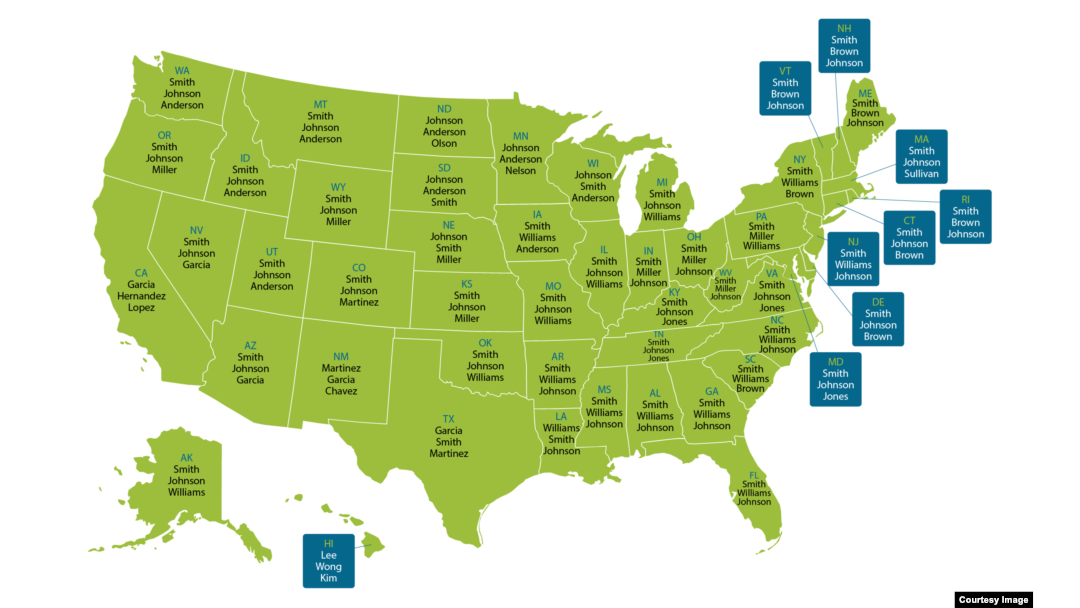
When we ask, “What is the most common last name in the United States?” the answer is statistically straightforward: Smith. However, beneath the surface of this simple demographic fact lies a complex web of data science, algorithmic processing, and digital security challenges. In the modern era, a surname is no longer just a familial marker; it is a data point in a massive, interconnected digital ecosystem.
As of the latest decennial census data and ongoing American Community Survey (ACS) updates, “Smith” remains the reigning champion, followed closely by Johnson, Williams, Brown, and Jones. But for technologists, the interest isn’t just in the names themselves, but in how technology captures, categorizes, and secures the identities of millions of individuals who share these identical labels.

The Algorithms of Identity: How the U.S. Census Uses Tech to Map Surnames
The process of determining the most common last names in a nation of over 330 million people is a feat of high-performance computing. The U.S. Census Bureau has transitioned from manual tabulations to sophisticated digital processing pipelines that handle petabytes of demographic data.
From Paper to Petabytes: The Digitization of the Census
The shift toward digital-first data collection has revolutionized how we understand surname frequency. In recent cycles, the use of Optical Character Recognition (OCR) and Natural Language Processing (NLP) has allowed the Census Bureau to digitize handwritten responses with unprecedented accuracy. These technologies utilize deep learning models to recognize variations in handwriting, ensuring that a “Smith” written in cursive is categorized correctly alongside a “Smith” typed into an online portal.
The “Surname File” and Data Cleaning
Once the data is ingested, it undergoes a rigorous “cleaning” phase. Data engineers use probabilistic record linkage and deduplication algorithms to ensure that the same individual isn’t counted twice. The “Frequently Occurring Surnames” list is generated by querying massive SQL databases where names are indexed and ranked. This isn’t just a list; it’s a structured dataset used by researchers, genealogists, and software developers to understand American demographics.
Computational Challenges in Name Matching
One of the primary technical hurdles in mapping last names is the “fuzzy matching” problem. Surnames often have variants (e.g., Smith vs. Smyth). Tech frameworks like Soundex or the Metaphone algorithm are employed to group names by their phonetic sounds rather than just their spelling. This allows data scientists to analyze naming trends even when data entry errors occur, providing a more robust picture of the American linguistic landscape.
Data Privacy and the “Smith” Problem: Security Implications of Common Surnames
While having a common name like Smith might seem anonymous, it creates significant challenges in the realm of digital security and database management. For cybersecurity professionals, common last names represent a unique set of vulnerabilities and technical hurdles.
The Collision Course: Database Indexing and Unique Identifiers
In a database containing millions of users, “Smith” is a high-collision value. If a software architect relies too heavily on names for indexing, the system’s performance can degrade. This is why modern tech infrastructure relies on Universally Unique Identifiers (UUIDs) or GUIDs. A “Smith” in a digital banking system is not identified by their name, but by a 128-bit number. Without this technological abstraction, the risk of “account bleed” or administrative error would be catastrophic.
Identity Theft and the “Common Name” Vulnerability
From a digital security standpoint, individuals with common last names are often targets of specific types of fraud. Synthetic identity theft—where a criminal combines a real Social Security number with a common name to create a “ghost” identity—is easier to hide when the name is as ubiquitous as Johnson or Williams. Security protocols, therefore, must implement multi-factor authentication (MFA) and behavioral biometrics to distinguish between the thousands of “John Smiths” accessing a network at any given time.
The Metadata Layer: Protecting Demographic Privacy
When the government releases data on common surnames, it must apply “Differential Privacy” algorithms. This is a mathematical framework that adds “noise” to the data to prevent hackers from reverse-engineering the dataset to identify specific individuals. Even though we know “Smith” is the most common name, the tech ensuring that this data doesn’t compromise individual privacy is one of the most advanced fields in modern cryptography.
AI and Predictive Demographics: What Surnames Tell Machine Learning Models
The prevalence of certain last names provides a rich dataset for machine learning models. Silicon Valley and academic institutions use this data to train AI that can predict everything from urban sprawl to shifting consumer behaviors.
Demographic Shifting and Neural Networks
By analyzing the growth rates of surnames like Garcia and Rodriguez—which have surged into the top 10 over the last few decades—AI models can predict demographic shifts with high precision. Machine learning algorithms analyze the geographical distribution of these names to help tech companies optimize their infrastructure. For instance, a cloud service provider might use surname density data to decide where to build their next edge computing node to better serve a growing population center.
Bias and Ethics in Algorithmic Sorting
There is a darker side to the tech of naming. AI models trained on surname data can inadvertently inherit human biases. If a recruitment algorithm is trained to favor certain “traditional” sounding names, it may unfairly filter out qualified candidates with diverse surnames. Tech ethics boards are currently working on “algorithmic auditing” tools to ensure that the frequency of a name doesn’t lead to automated discrimination in lending, hiring, or law enforcement software.
Natural Language Processing and Surname Etymology
Advanced NLP models, like those powering Large Language Models (LLMs), use the frequency of last names to improve their contextual understanding of text. By recognizing “Smith” as a common English surname and “Nguyen” as a common Vietnamese-American surname, the AI can better parse the cultural context of a document, leading to more accurate translations and content generation.
The Future of Digital Identity: Moving Beyond Surnames to Biometrics and Blockchain
As we look toward the future, the importance of the “last name” in a technical sense may begin to wane. The tech industry is moving toward a “passwordless” and “nameless” verification era where your surname is secondary to your digital footprint.
Blockchain and Decentralized Identity (DID)
In the world of Web3, your identity is a cryptographic key, not a name. Decentralized Identity (DID) protocols allow users to verify their age, citizenship, or creditworthiness without ever revealing that their last name is Smith. This technology aims to solve the “common name” collision problem once and for all by giving every human a unique, immutable digital hash that exists independently of government databases.
Biometric Integration
The integration of facial recognition, iris scanning, and fingerprinting into our gadgets means that the “Smith” at the keyboard is identified by their biology, not their genealogy. From a technical perspective, this is the ultimate solution to identity fragmentation. Your smartphone doesn’t care if there are 2.4 million other Smiths; it only cares that your unique facial geometry matches the encrypted template stored in its “Secure Enclave.”
The Persistent Role of Data
Despite these advancements, the “Most Common Last Name” metric will always be a vital pulse-check for data scientists. It serves as a benchmark for the accuracy of our data collection tools. If a new census algorithm suddenly claimed “Xylophone” was the most common name, engineers would know there was a bug in the code. Smith, therefore, remains the “Control Group” of American data science—a constant in an ever-changing digital landscape.

Conclusion
Understanding that “Smith” is the most common last name in the U.S. is just the beginning of a much larger conversation about technology and identity. From the high-powered servers of the Census Bureau to the encrypted vaults of modern fintech, the way we handle common names defines the efficiency and security of our digital world.
As AI continues to map our demographics and blockchain redefines our sense of “self,” the humble last name remains a critical bridge between our analog history and our digital future. Whether you are a Smith, a Garcia, or a Zhang, you are part of a massive data narrative that is being written, one line of code at a time. The tech behind these names ensures that even in a sea of millions, every individual can—at least theoretically—be uniquely identified and protected in the digital age.
aViewFromTheCave is a participant in the Amazon Services LLC Associates Program, an affiliate advertising program designed to provide a means for sites to earn advertising fees by advertising and linking to Amazon.com. Amazon, the Amazon logo, AmazonSupply, and the AmazonSupply logo are trademarks of Amazon.com, Inc. or its affiliates. As an Amazon Associate we earn affiliate commissions from qualifying purchases.