
In the landscape of digital audio workstations (DAWs), generative artificial intelligence, and sophisticated signal processing, the “Circle of Fifths” is often mistaken for a relic of classical music theory. However, for the modern software engineer, app developer, and digital music producer, the Circle of Fifths represents much more than a pedagogical tool for piano students. It is a geometric, mathematical, and algorithmic blueprint that underpins the logic of music technology.
Understanding the Circle of Fifths through a technical lens reveals why certain software plugins feel intuitive, how AI models predict the next chord in a sequence, and why digital harmonic mixing has become the gold standard for global streaming platforms. This article explores the Circle of Fifths as a foundational pillar of music technology, examining its role in software architecture, digital signal processing, and the future of automated composition.

The Digital Architecture of Harmony: From Geometry to Code
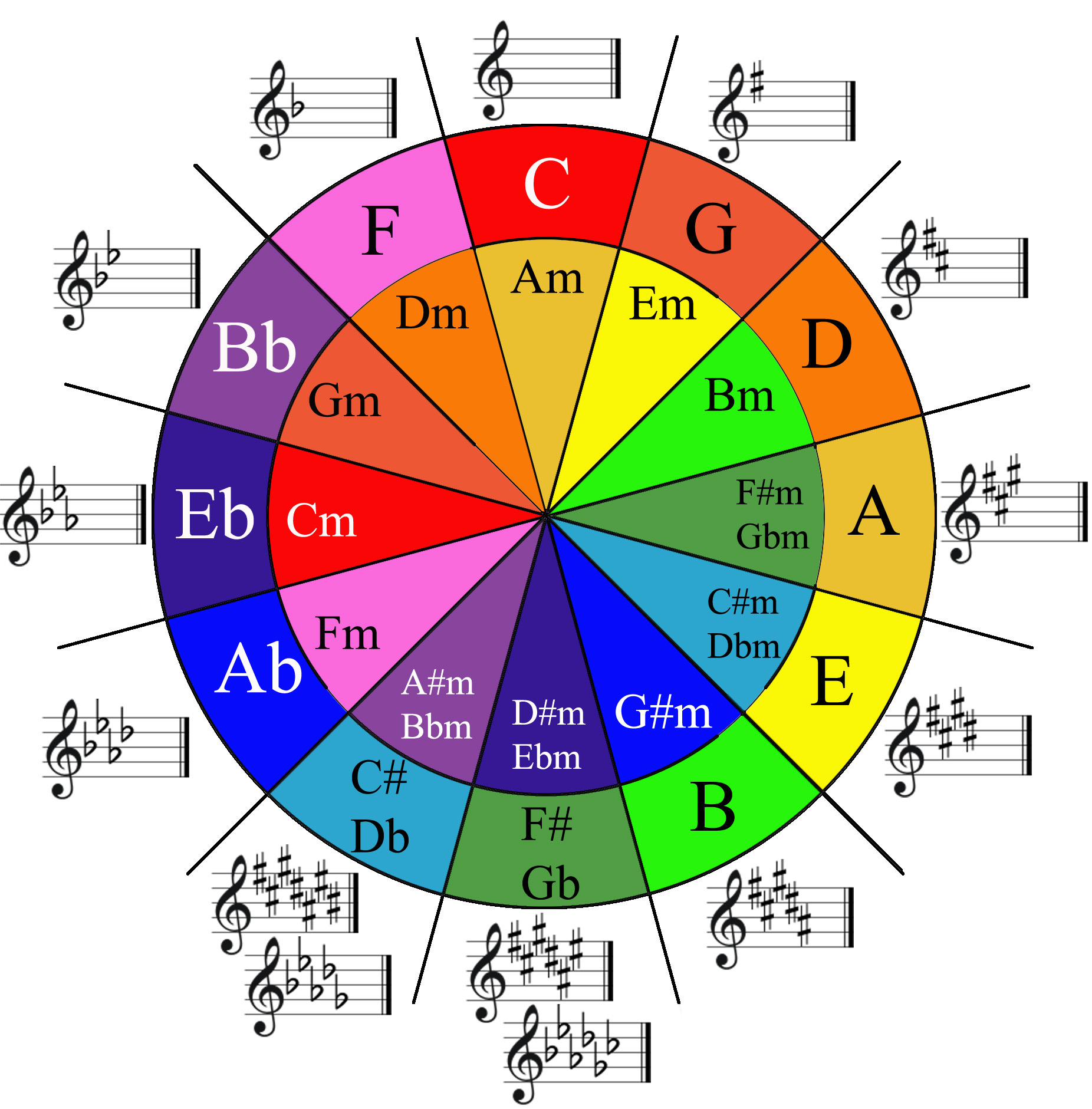
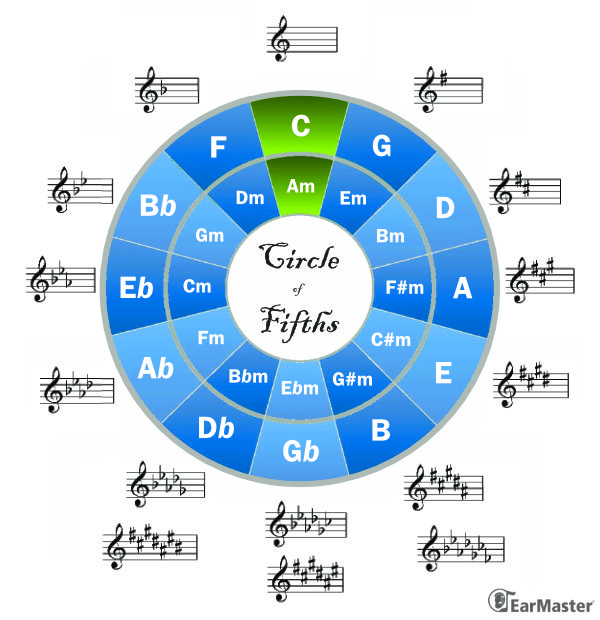
At its core, the Circle of Fifths is a visual representation of the relationship between the 12 tones of the chromatic scale. In a technological context, this circle serves as a map for data structures that govern harmonic movement. By moving clockwise, each note is a perfect fifth above the previous one; moving counter-clockwise, they are a perfect fourth apart. This predictable, mathematical intervals-based system is what allows developers to translate subjective “musicality” into objective code.
From Euclidean Geometry to Digital Algorithms
The Circle of Fifths is essentially a modulo-12 system. In computer science terms, the 12 notes of the Western scale can be mapped to integers 0 through 11. The “fifth” is an interval of seven semitones. Therefore, moving around the circle is an operation of $(n + 7) pmod{12}$. This simple mathematical consistency allows software developers to build “key-aware” features into their applications. Whether it is a pitch-correction plugin like Auto-Tune or a MIDI sequencer, the software utilizes these modular arithmetic properties to ensure that a digital signal remains within a specific harmonic boundary.
The Role of MIDI in Visualizing Musical Relationships
Musical Instrument Digital Interface (MIDI) is the universal language of music tech. When we look at how MIDI data is visualized in a DAW’s “piano roll,” we see a linear representation. However, the most advanced MIDI tools incorporate the Circle of Fifths to provide a “Harmonic Overlook.” Modern plugins like Scaler 2 or Captain Chords use the Circle of Fifths to suggest “mathematically related” chords to a user. Instead of showing a list of 128 MIDI notes, the software uses the logic of the circle to filter the data, presenting only the notes that are computationally relevant to the user’s selected key.
Implementing the Circle of Fifths in Modern DAWs
The integration of music theory into software has transitioned from passive reference to active assistance. Today’s Digital Audio Workstations (DAWs) such as Ableton Live, FL Studio, and Logic Pro utilize the Circle of Fifths to streamline the creative workflow, reducing the cognitive load on the producer through intelligent automation.
Chord Suggestion Engines and Harmonic Intelligence
One of the most significant breakthroughs in music production software is the development of harmonic intelligence engines. These are essentially subroutines that reference the Circle of Fifths to provide real-time suggestions. When a producer selects a C Major key, the software identifies its neighbors on the circle—F Major and G Major—as the most consonant transitions.
This isn’t just a convenience; it’s a technical implementation of “Voice Leading” algorithms. By calculating the shortest distance between MIDI note values across the circle, the software can automatically invert chords to ensure smooth transitions. This allows even those without formal training to leverage complex music theory through high-level software abstractions.
Key Detection Algorithms and Metadata
For DJs and streaming services like Spotify or SoundCloud, the Circle of Fifths is a vital component of metadata analysis. Software like Mixed In Key uses Fast Fourier Transform (FFT) algorithms to analyze the frequency content of an audio file and determine its musical key.
This data is then often converted into the “Camelot Wheel” format—a tech-centric adaptation of the Circle of Fifths that replaces key names (like E-flat minor) with alphanumeric codes (like 2A). This abstraction allows for “Harmonic Mixing,” where software can instantly tell a DJ which tracks will blend seamlessly based on their numerical proximity on the wheel. This is a prime example of how a 300-year-old theory has been refactored into a modern digital utility.
AI and the Automation of Musical Logic
The current frontier of music technology is dominated by Generative AI. Models like Google’s Magenta, Suno, and Udio are trained on vast datasets of musical scores. The Circle of Fifths acts as a critical constraint for these machine learning models, ensuring that the output remains coherent to the human ear.
Generative AI and the Constraints of the Circle
Machine learning models often struggle with “hallucinations” or lack of structure. To combat this, developers of music-generating AI implement “Theory Layers.” By hard-coding the relationships found in the Circle of Fifths into the model’s reward function, the AI learns that moving from a tonic to a dominant (a fifth) is a “high-probability” successful move.
Without the mathematical framework of the circle, an AI might generate random chromatic sequences that lack emotional resonance. By using the circle as a set of logical “guardrails,” developers ensure that AI-generated melodies and harmonies follow the established patterns of human psychoacoustics.
Machine Learning in Harmonic Progression Analysis
Beyond generation, AI is being used for music discovery and analysis. Advanced algorithms can now “deconstruct” a hit song to see how it moves across the Circle of Fifths. This tech is used by record labels and A&R software to identify trends. For instance, if data shows that the top 10% of viral tracks on TikTok utilize a specific “Circle of Fifths jump” (e.g., moving from 12 o’clock to 2 o’clock on the circle), software can flag similar upcoming tracks for promotional investment. This turns the Circle of Fifths from a creative tool into a predictive analytics asset.
Sonic Engineering and Digital Signal Processing (DSP)
At the lowest level of music technology lies Digital Signal Processing (DSP). Here, the Circle of Fifths intersects with the physics of sound and the limits of digital sampling. The relationships defined by the circle are not arbitrary; they are based on the physics of overtones and frequency ratios.
Frequency Relationships and Mathematical Precision
A “Perfect Fifth” corresponds to a frequency ratio of approximately 3:2. In the world of DSP, this ratio is critical for designing synthesizers and audio effects. When an engineer develops a “Harmonizer” plugin, the code must calculate the exact sample shift required to create a fifth.
If the fundamental frequency is 440Hz (A4), the software must generate a signal at roughly 660Hz (E5). The Circle of Fifths provides the roadmap for these frequency relationships. In digital FM synthesis (Frequency Modulation), the “operators” are often tuned to intervals derived from the circle to create harmonically rich and pleasing timbres rather than dissonant noise.
Toolsets for the Modern Technologist-Musician
The convergence of music theory and tech has birthed a new category of “Smart Tools.” We are seeing the rise of:
- Visualizers: Plugins that map audio input onto a 3D Circle of Fifths in real-time to show the “harmonic spread” of a mix.
- Smart EQs: Equalizers that use the circle to identify “key-resonant frequencies,” allowing engineers to cut or boost frequencies that correspond exactly to the notes of the song’s key.
- Collaborative Clouds: Platforms that allow producers to share “Harmonic Maps” based on the circle, ensuring that a vocalist in London and a producer in Tokyo are working within the same mathematical framework.
Conclusion: The Circle as a Universal Protocol
The Circle of Fifths is far more than a diagram; it is a universal protocol for harmonic data. In the tech industry, where standardization is key to interoperability, the circle provides a set of rules that allow different softwares, hardware, and AI models to “speak” the same musical language.
As we move further into the age of AI-assisted creativity and spatial audio, the Circle of Fifths will continue to serve as the underlying operating system for music technology. For the developer, it is an algorithm; for the producer, it is a shortcut to professional sound; and for the listener, it is the hidden logic that makes digital music feel deeply, essentially human. By mastering this circle, the modern technologist does not just understand music—they master the code of sound itself.
aViewFromTheCave is a participant in the Amazon Services LLC Associates Program, an affiliate advertising program designed to provide a means for sites to earn advertising fees by advertising and linking to Amazon.com. Amazon, the Amazon logo, AmazonSupply, and the AmazonSupply logo are trademarks of Amazon.com, Inc. or its affiliates. As an Amazon Associate we earn affiliate commissions from qualifying purchases.