
The contrapositive is a fundamental concept in logic that has significant implications and applications within the field of geometry. While geometry primarily deals with shapes, sizes, and positions, understanding logical structures like the contrapositive is crucial for proving theorems, constructing arguments, and grasping the deeper relationships between geometric statements. This article delves into what the contrapositive is, how it’s formed, why it’s so important in geometric reasoning, and provides illustrative examples.
Understanding Logical Implication and Its Variations
At its core, the contrapositive is derived from the logical structure of an “if-then” statement, also known as a conditional statement. In mathematics, and particularly in geometry, many statements are expressed in this form. Understanding the relationship between a conditional statement and its related logical forms – the converse, inverse, and contrapositive – is key to mastering deductive reasoning.
The Conditional Statement: P Implies Q
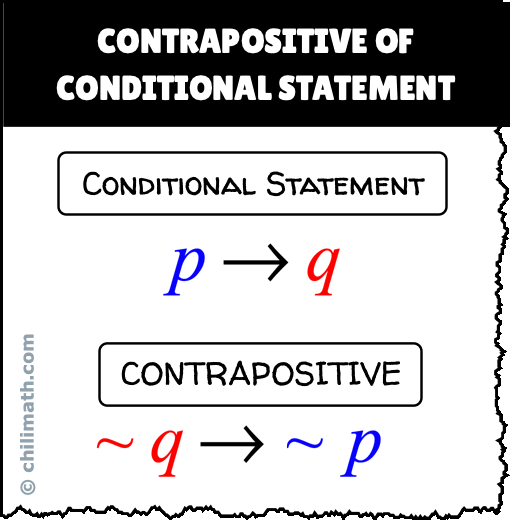
A conditional statement is typically represented as “If P, then Q,” or symbolically as $P rightarrow Q$. Here, P is called the antecedent or hypothesis, and Q is called the consequent or conclusion. The statement asserts that if the condition P is true, then the condition Q must also be true.
For example, in geometry, a common conditional statement is: “If a quadrilateral is a square, then it is a rectangle.”
Here, P is “a quadrilateral is a square,” and Q is “it is a rectangle.” This statement is true because all squares possess the properties of rectangles (four right angles and opposite sides equal and parallel).
The Converse: Q Implies P
The converse of a conditional statement is formed by switching the antecedent and the consequent. It is represented as “If Q, then P,” or symbolically as $Q rightarrow P$.
Using our previous example, the converse would be: “If a quadrilateral is a rectangle, then it is a square.”
This statement is not necessarily true. While all squares are rectangles, not all rectangles are squares (a rectangle can have unequal adjacent sides). The converse does not inherit the truth value of the original conditional statement.
The Inverse: Not P Implies Not Q
The inverse of a conditional statement is formed by negating both the antecedent and the consequent. It is represented as “If not P, then not Q,” or symbolically as $neg P rightarrow neg Q$.
In our geometric example, the inverse would be: “If a quadrilateral is not a square, then it is not a rectangle.”
This statement is also not necessarily true. A shape could be a rhombus but not a square, and it would also not be a rectangle. The inverse, like the converse, does not necessarily have the same truth value as the original conditional statement.
The Contrapositive: Not Q Implies Not P
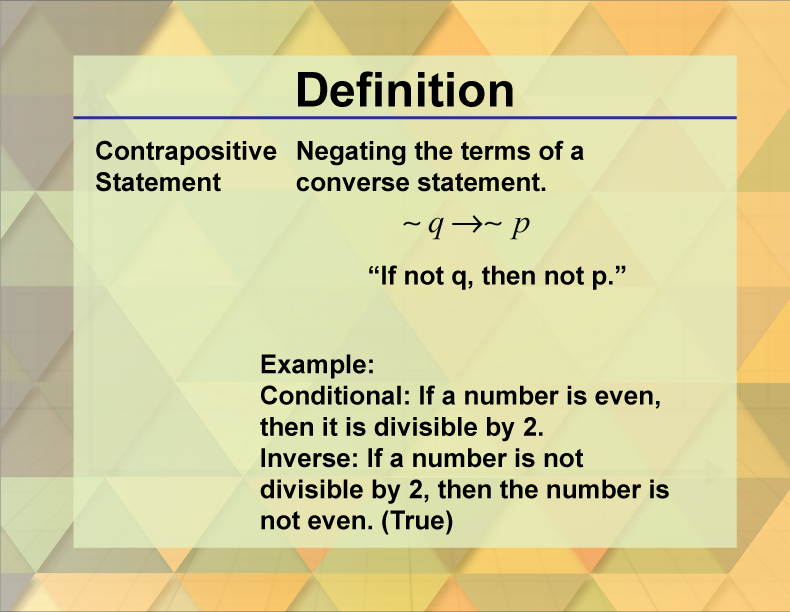
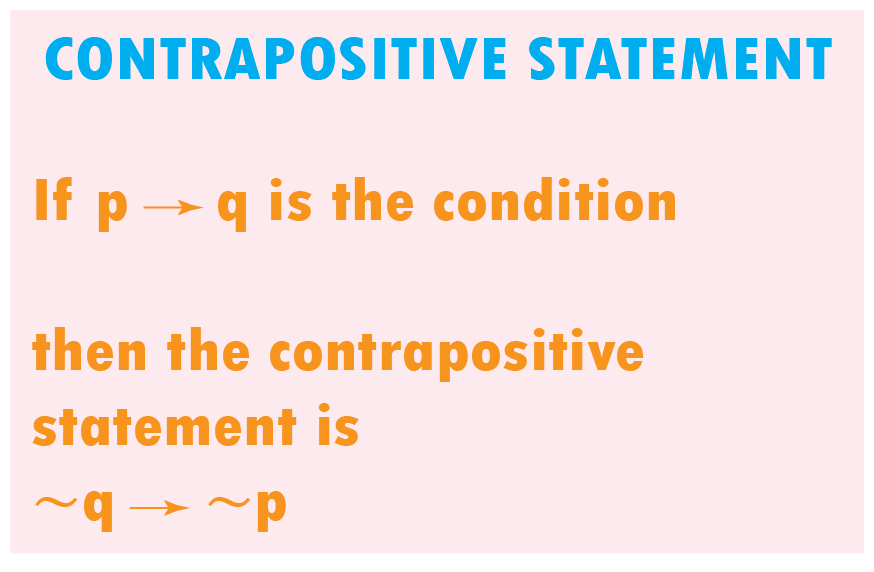
The contrapositive of a conditional statement is formed by switching the antecedent and the consequent and negating both. It is represented as “If not Q, then not P,” or symbolically as $neg Q rightarrow neg P$.
For our geometric example: “If a quadrilateral is not a rectangle, then it is not a square.”
This statement is logically equivalent to the original conditional statement. If the original statement “If P, then Q” is true, then its contrapositive “If not Q, then not P” is also true, and vice versa. This is a crucial property that makes the contrapositive incredibly useful in geometric proofs.
The Power of Equivalence: Why the Contrapositive Matters in Geometry
The fact that a conditional statement and its contrapositive are logically equivalent is the cornerstone of their utility in geometry. This equivalence means that if you can prove a statement to be true, you can also prove its contrapositive to be true without needing a separate proof. Conversely, if you can disprove a statement by finding a counterexample, you can also disprove its contrapositive.
Proving Theorems Through Indirect Proofs
One of the most powerful applications of the contrapositive is in constructing indirect proofs, also known as proof by contradiction. In an indirect proof, instead of directly proving a statement P, we assume that P is false (i.e., we assume $neg P$) and then show that this assumption leads to a logical contradiction or an impossibility within the established geometric framework.
However, a more direct use of the contrapositive lies in proving a statement by proving its contrapositive. Consider a theorem you want to prove, stated as $P rightarrow Q$. If it’s difficult to directly show that P implies Q, you can instead try to prove its contrapositive, $neg Q rightarrow neg P$. If you successfully prove that the negation of the conclusion implies the negation of the hypothesis, you have effectively proven the original statement.
Avoiding Difficult Direct Proofs
Sometimes, a direct proof might involve a convoluted series of steps or require a deep understanding of a complex geometric property. By rephrasing the problem in terms of its contrapositive, the path to a solution might become clearer and more manageable. This often happens when the negation of a conclusion is easier to work with or leads to a more obvious contradiction.
Enhancing Understanding of Geometric Relationships
The contrapositive helps to solidify our understanding of the necessary and sufficient conditions within geometric definitions and theorems. When we say “If a shape has property A, then it has property B,” its contrapositive tells us “If a shape does not have property B, then it cannot have property A.” This reinforces the idea that property B is a necessary consequence of property A.
Practical Examples in Geometric Reasoning
Let’s explore some concrete examples of how the contrapositive is used in geometry.
Example 1: Angles in a Triangle
Consider the following statement about triangles:
“If two sides of a triangle are unequal, then the angles opposite those sides are unequal.”
Let P be “two sides of a triangle are unequal.”
Let Q be “the angles opposite those sides are unequal.”
The statement is $P rightarrow Q$.
The contrapositive of this statement is:
“If the angles opposite two sides of a triangle are equal, then the sides opposite those angles are equal.”
Symbolically, $neg Q rightarrow neg P$.
This contrapositive statement is the well-known Isosceles Triangle Theorem: “If two angles of a triangle are equal, then the sides opposite those angles are equal.” This is a fundamental theorem in Euclidean geometry. The ability to derive this theorem directly from the contrapositive of a related statement highlights the interconnectedness of geometric truths and the power of logical manipulation.
Example 2: Parallel Lines and Transversals
Consider a scenario involving parallel lines and a transversal.
Statement: “If two lines are parallel, then consecutive interior angles are supplementary.”
Let P be “two lines are parallel.”
Let Q be “consecutive interior angles are supplementary.”
The statement is $P rightarrow Q$.
The contrapositive is:
“If consecutive interior angles are not supplementary, then the two lines are not parallel.”
Symbolically, $neg Q rightarrow neg P$.
This contrapositive is often used in proofs to establish that lines are not parallel. If you can demonstrate that a pair of consecutive interior angles are not supplementary, you have definitively proven that the lines are not parallel, without needing to directly prove the initial parallel line condition.
Example 3: Properties of Quadrilaterals
Let’s consider another quadrilateral property:
Statement: “If a parallelogram has diagonals that bisect each other, then it is a parallelogram.”
This statement is somewhat tautological as the definition of a parallelogram includes diagonals bisecting each other. Let’s refine it to a more illustrative property.
Statement: “If a quadrilateral has opposite sides that are equal and parallel, then it is a parallelogram.”
Let P be “a quadrilateral has opposite sides that are equal and parallel.”
Let Q be “it is a parallelogram.”
The statement is $P rightarrow Q$.
The contrapositive is:
“If a quadrilateral is not a parallelogram, then it does not have opposite sides that are equal and parallel.”
Symbolically, $neg Q rightarrow neg P$.
This contrapositive is less commonly stated directly but underpins the understanding of what it means not to be a parallelogram. If a shape fails to meet the criteria of a parallelogram (e.g., if its opposite sides are not equal or not parallel, or both), then it cannot simultaneously satisfy both conditions of having opposite sides equal and parallel.
Conclusion: A Cornerstone of Geometric Logic
The contrapositive is more than just a logical curiosity; it is an indispensable tool in the geometer’s arsenal. Its logical equivalence to the original conditional statement provides a powerful avenue for proving theorems, especially through indirect reasoning and by offering alternative, often simpler, proof strategies. By mastering the concept of the contrapositive, students and practitioners of geometry gain a deeper appreciation for the logical underpinnings of their discipline, enabling them to construct more robust arguments and achieve a more profound understanding of the intricate relationships that define geometric space. Its ability to simplify complex proofs and to clarify the boundaries of geometric properties solidifies its place as a cornerstone of geometric logic.
aViewFromTheCave is a participant in the Amazon Services LLC Associates Program, an affiliate advertising program designed to provide a means for sites to earn advertising fees by advertising and linking to Amazon.com. Amazon, the Amazon logo, AmazonSupply, and the AmazonSupply logo are trademarks of Amazon.com, Inc. or its affiliates. As an Amazon Associate we earn affiliate commissions from qualifying purchases.