
In the fast-evolving world of technology, clarity and conciseness are the dual pillars of effective communication. Whether you are developing a white paper for a new blockchain protocol, publishing a peer-reviewed study on neural network architectures, or drafting a comprehensive software manual, the “appendix” serves as a critical structural element. Often relegated to the end of a document, the appendix is far more than an afterthought; it is a repository for the granular detail that supports a thesis without cluttering the narrative flow.
In a technical context, an appendix allows the author to maintain a high-level, engaging narrative for decision-makers while providing the raw data and technical proofs required by engineers and researchers. This article explores the definition, utility, and best practices of the appendix within the technology niche.

Understanding the Appendix in the Modern Tech Landscape
In its simplest form, an appendix is a section at the end of a paper that contains supplementary information. However, in the tech industry—ranging from digital security to AI development—the appendix takes on a more functional role. It acts as a bridge between the conceptual framework of a paper and the practical, verifiable evidence behind it.
The Purpose and Core Function
The primary purpose of an appendix in a tech paper is to host content that is too detailed or too long to be included in the main body. If a researcher is discussing a new AI tool, the main paper should focus on the methodology, the results, and the implications. Including fifty pages of raw training data or exhaustive hyperparameter logs in the middle of the discussion would disrupt the reader’s focus. The appendix provides a designated space for these items, ensuring that the main argument remains streamlined and readable while still being fully substantiated.
Distinguishing the Appendix from the Main Body
One of the most common challenges in technical writing is deciding what belongs in the main text and what should be moved to the appendix. The rule of thumb in technology documentation is “necessity vs. utility.” If a piece of information is essential for understanding the fundamental logic of the paper, it stays in the body. If the information is useful for verification, replication, or deeper dive by a niche specialist, it belongs in the appendix. For instance, a summary table of performance metrics belongs in the results section, but the raw JSON output files from which those metrics were derived should be placed in an appendix.
Essential Components of a Tech-Focused Appendix
What actually goes into a technical appendix? Depending on the sub-field—whether it’s software engineering, hardware reviews, or digital security audits—the contents vary significantly.
Raw Data and Large Datasets
In the era of Big Data and AI, transparency is paramount. Tech papers often rely on massive datasets to prove their points. An appendix may contain samples of these datasets, data cleaning protocols, or descriptions of data features. While the full dataset might be hosted on a cloud repository (like AWS or Google Cloud), the appendix provides the contextual documentation necessary for others to interpret that data.
Source Code and Technical Schematics
For software tutorials and reviews, the appendix is the traditional home for code snippets that are too long to be embedded in-line. While modern platforms often link to GitHub repositories, providing critical snippets of code or configuration files (like .yaml or .env templates) within an appendix ensures that the paper remains a standalone resource. Similarly, for hardware reviews or tutorials, circuit diagrams, CAD drawings, and detailed parts lists are standard appendix fare.
Mathematical Proofs and Algorithm Details
AI and cryptography papers are built on complex mathematics. Including every step of a multi-page proof in the main text can alienate all but the most specialized readers. By placing the rigorous mathematical derivations and the step-by-step logic of a new algorithm in the appendix, authors can cater to both the executive-level reader who wants to understand the “what” and the engineer who needs to understand the “how.”
Digital Integration: How Tech Tools Manage Appendices
The transition from printed journals to digital-first platforms has revolutionized how we view the appendix. In the tech niche, an appendix is no longer just static text; it is an integrated digital experience.
Hyperlinking and Navigation in Digital Papers
Modern PDF viewers and web-based documentation tools (like GitBook or ReadTheDocs) allow for seamless internal linking. A well-constructed tech paper will include “anchor links” that allow a reader to jump from a mention of “System Architecture” in the introduction directly to the detailed technical schematics in Appendix B. This non-linear reading experience is essential for technical professionals who need to move quickly between high-level summaries and low-level details.
Using Version Control Systems as Extended Appendices
In the world of software development, the “Appendix” has evolved to include external repositories. It is now common practice to see a “Digital Appendix” in the form of a link to a GitHub or GitLab repository. This allows the appendix to be dynamic. While the white paper remains a static PDF, the associated code, scripts, and additional documentation in the repository can be updated as the software evolves. This practice enhances the longevity and relevance of the original paper.
Automated Documentation and AI Tools
The rise of AI has simplified the creation of appendices. Tools like Doxygen or Sphinx can automatically generate technical appendices from comments within the source code. For researchers, AI-powered bibliography and reference managers can organize supplemental materials into formatted appendices with minimal manual effort. This automation ensures that the appendix is accurate and perfectly synchronized with the main body of the work.
Best Practices for Formatting Technical Appendices
Organization is the key to a functional appendix. If a reader cannot navigate your supplemental material, the data might as well not exist.
Organizing Multiple Appendices
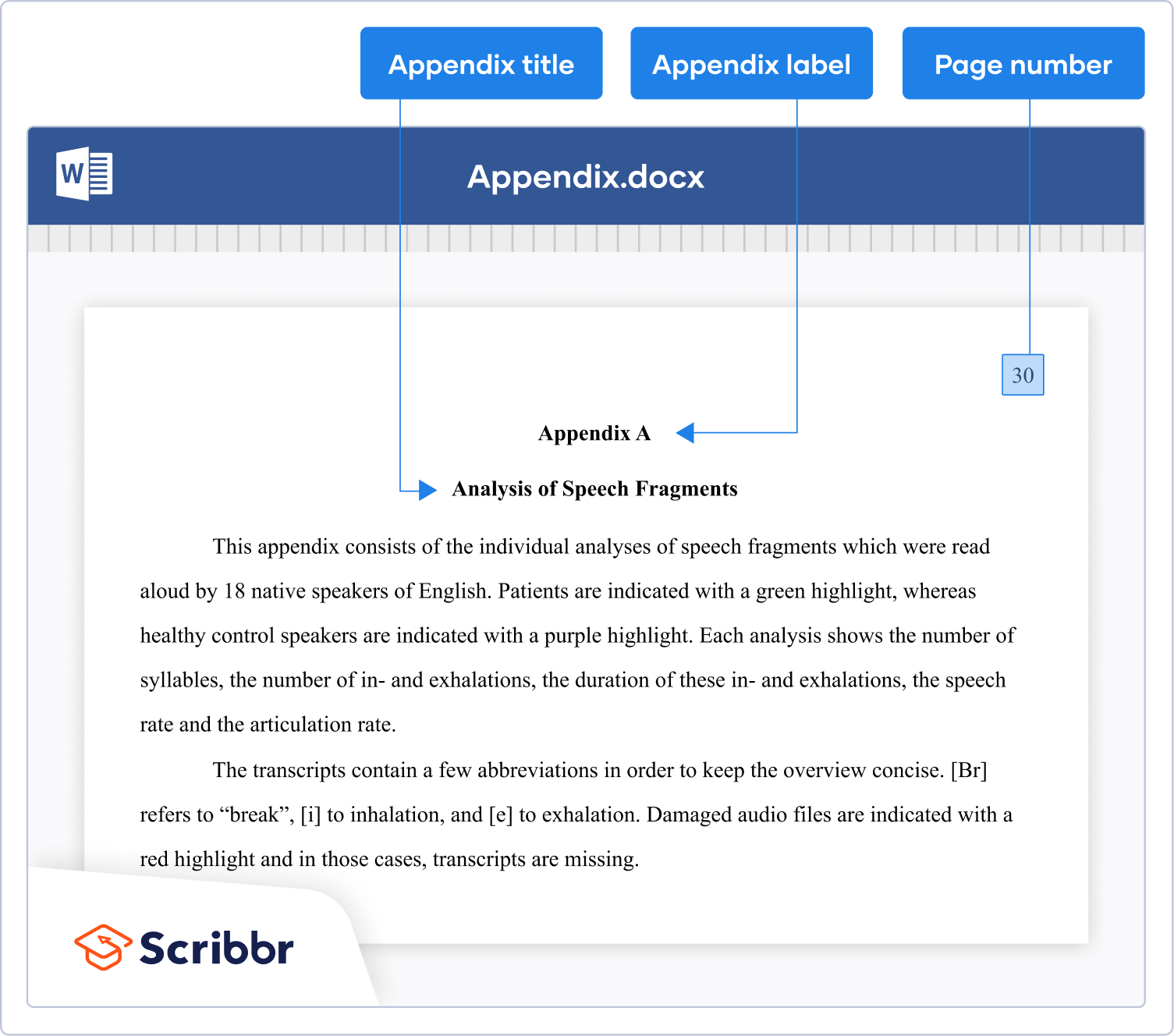
If your paper contains several different types of supplemental material—such as code, data tables, and interview transcripts—you should use multiple appendices. These are typically labeled “Appendix A,” “Appendix B,” and so on. In tech documentation, it is helpful to give each appendix a descriptive title, such as “Appendix A: Software Configuration Settings” or “Appendix B: Security Audit Methodology.” This allows the reader to scan the table of contents and find exactly what they need.
Maintaining Readability and Accessibility
Even though the appendix contains “raw” information, it should still be formatted for readability. Use clear headings, consistent font sizes, and accessible color palettes for charts and graphs. For digital security or software papers, ensure that any code included in the appendix uses a monospaced font to distinguish it from standard text. Accessibility is also key; ensuring that images have alt-text and tables are properly tagged allows assistive technologies to interpret your technical data.
Referencing Strategies within the Main Document
An appendix should never be a “surprise” at the end of the document. Every item in your appendix must be mentioned at least once in the main body of the paper. For example, a sentence might read: “The full breakdown of the latency tests across different server regions can be found in Appendix C.” This cross-referencing provides a roadmap for the reader, signaling that more evidence is available if they wish to verify the claims made in the text.

The Future of the Appendix in Technical Communication
As we move further into a world dominated by AI, the concept of the appendix is expanding. We are seeing the rise of “interactive appendices” where readers can manipulate data variables or run code snippets directly within the browser. In the niche of technology, the appendix is moving away from being a passive list of charts and toward being an active, functional extension of the research itself.
In conclusion, an appendix in a tech paper is a powerful tool for maintaining the balance between depth and brevity. By delegating the heavy lifting of raw data, source code, and complex proofs to the appendix, tech writers can ensure their papers are both accessible to a broad audience and rigorous enough for the most demanding technical experts. Whether you are writing about the latest gadget or a breakthrough in digital security, the appendix is where your work’s credibility is truly cemented.
aViewFromTheCave is a participant in the Amazon Services LLC Associates Program, an affiliate advertising program designed to provide a means for sites to earn advertising fees by advertising and linking to Amazon.com. Amazon, the Amazon logo, AmazonSupply, and the AmazonSupply logo are trademarks of Amazon.com, Inc. or its affiliates. As an Amazon Associate we earn affiliate commissions from qualifying purchases.