
The world of digital electronics is built upon a foundation of fundamental logic gates. These gates, performing simple logical operations, are the building blocks of virtually every digital device we use today, from our smartphones and computers to complex industrial control systems. Among these essential components, the XOR gate, also known as the “exclusive OR” gate, holds a unique and vital position. Its distinctive behavior and applications make it indispensable in a wide range of digital circuits. This article will delve into the essence of what an XOR gate is, exploring its truth table, symbol, implementation, and its crucial role in various technological domains.
Understanding the Fundamentals of Logic Gates
Before diving into the specifics of the XOR gate, it’s essential to grasp the broader concept of logic gates. In digital electronics, logic gates are the basic digital circuits that perform a logical operation on one or more binary inputs and produce a single binary output. Binary, meaning having two possible states (typically represented as 0 and 1, or low and high voltage levels), is the language of computers. All data processing within digital systems is ultimately reduced to manipulations of these binary values.
The Core Binary System
The binary system is a positional numeral system. Each position represents a power of 2. For instance, the binary number 1011 is equivalent to (1 * 2^3) + (0 * 2^2) + (1 * 2^1) + (1 * 2^0) = 8 + 0 + 2 + 1 = 11 in decimal. This simple yet powerful system allows computers to represent and process all kinds of information, from text and images to complex calculations.
Basic Logic Gates: AND, OR, NOT
The fundamental logic gates are the AND, OR, and NOT gates, which form the bedrock of digital logic design.
- AND Gate: An AND gate produces an output of 1 only if all of its inputs are 1. Otherwise, the output is 0. It represents logical conjunction.
- OR Gate: An OR gate produces an output of 1 if at least one of its inputs is 1. The output is 0 only if all inputs are 0. It represents logical disjunction.
- NOT Gate (Inverter): A NOT gate has a single input and a single output. It inverts the input; if the input is 1, the output is 0, and vice versa. It represents logical negation.
These basic gates can be combined in countless ways to create more complex logic functions. The XOR gate, while seemingly a simple variation, introduces a new dimension of logical operation that is particularly useful.
The XOR Gate: Definition and Behavior
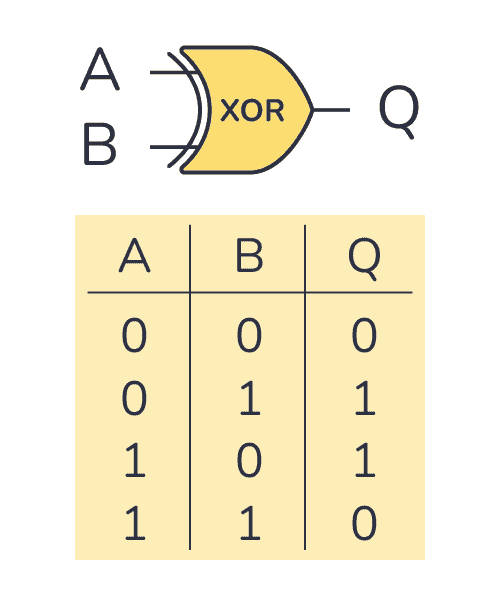
The XOR gate’s defining characteristic is its output: it produces a 1 if and only if the inputs are different. If the inputs are the same (both 0 or both 1), the output is 0. This is why it’s called “exclusive” OR – it’s an OR operation, but it excludes the case where both inputs are true.
The XOR Truth Table
A truth table is a mathematical table that shows the output of a logic gate for all possible combinations of its inputs. For a two-input XOR gate, the truth table is as follows:
| Input A | Input B | Output (A XOR B) |
|---|---|---|
| 0 | 0 | 0 |
| 0 | 1 | 1 |
| 1 | 0 | 1 |
| 1 | 1 | 0 |
As you can see, the output is 1 only when Input A is different from Input B. This “difference detector” nature is what makes the XOR gate so versatile.
The XOR Symbol
In circuit diagrams, the XOR gate is represented by a specific symbol. For a two-input XOR gate, the symbol typically looks like an OR gate symbol with an additional curved line on the input side.
- Standard ANSI/IEEE Symbol: This symbol is widely used in North America and features a curved input side and a pointed output side.
- IEC Symbol: The International Electrotechnical Commission (IEC) symbol is a rectangle with “2XOR1” inscribed within, indicating a two-input XOR function.
Understanding these symbols is crucial for reading and designing electronic circuit schematics.
Boolean Expression for XOR
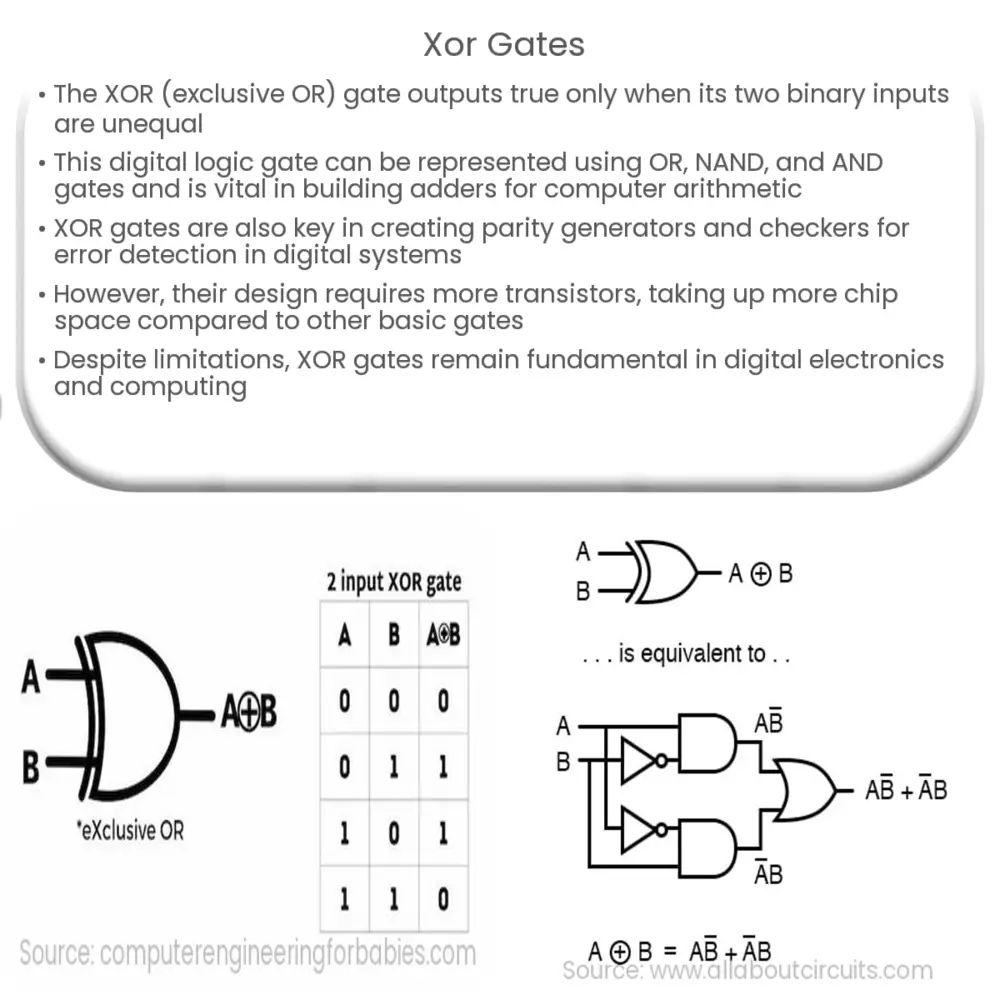
The XOR operation can also be represented using Boolean algebra. For two inputs A and B, the XOR operation is often denoted by the symbol $oplus$. The Boolean expression for an XOR gate is:
$A oplus B = (A text{ AND NOT } B) text{ OR } (text{NOT } A text{ AND } B)$
This can be written more concisely as:
$A oplus B = Aoverline{B} + overline{A}B$
Where:
- $A$ and $B$ are the inputs.
- $overline{A}$ and $overline{B}$ represent the logical NOT of A and B, respectively.
- The dot ($cdot$) represents the logical AND operation.
- The plus sign ($+$) represents the logical OR operation.

This algebraic representation shows that the XOR gate can be constructed using combinations of AND, OR, and NOT gates, further illustrating its relationship to other fundamental logic operations.
Implementing and Utilizing XOR Gates
The theoretical understanding of the XOR gate is one thing, but its practical implementation and use in real-world circuits are where its significance truly shines. XOR gates can be built using various semiconductor technologies, and their unique properties lead to a wide array of applications.
Hardware Implementation
In integrated circuits (ICs), XOR gates are typically implemented using transistors. The most common approach is to use CMOS (Complementary Metal-Oxide-Semiconductor) technology. A two-input CMOS XOR gate can be constructed using six transistors. The specific arrangement of these transistors ensures that the output follows the defined truth table, providing a reliable and efficient way to perform the exclusive OR logic.
Building Complex Circuits with XOR
While the XOR gate performs a simple operation, its ability to detect differences makes it a crucial component in more complex digital systems. For example, when combined with other logic gates, XOR can be used to build arithmetic circuits, such as adders.
- Half Adder: A half adder is a digital circuit that performs the addition of two binary digits. It produces a sum bit and a carry bit. The sum bit is generated by an XOR gate, and the carry bit is generated by an AND gate.
- Full Adder: A full adder is a more advanced circuit that adds three binary digits: two input bits and a carry-in bit from a previous stage. It also produces a sum bit and a carry-out bit. A full adder can be constructed using two half adders and an OR gate, with XOR gates playing a central role in calculating the sum.
This ability to build complex arithmetic functions highlights the foundational importance of the XOR gate in the design of processors and other computational units.
Programming Logic Controllers (PLCs) and Embedded Systems
Beyond the realm of general-purpose computing, XOR gates are fundamental to embedded systems and Programmable Logic Controllers (PLCs). PLCs are used in industrial automation to control machinery and processes. They rely on logic gates to make decisions based on sensor inputs and programmed logic. The XOR gate’s ability to perform tasks like parity checking and data encryption makes it invaluable in these systems where reliability and precise control are paramount.
Key Applications of the XOR Gate in Technology
The XOR gate’s distinctive behavior makes it suitable for a variety of specialized applications that are critical in modern technology. Its ability to distinguish between different input states and its role in arithmetic operations are consistently leveraged.
Data Encryption and Cryptography
One of the most significant applications of the XOR gate is in data encryption. The XOR operation is reversible: if you XOR a piece of data with a key, you get the encrypted data. To decrypt it, you simply XOR the encrypted data with the same key again, and you get the original data back.
$A oplus K = E$ (Encryption)
$E oplus K = A$ (Decryption)
This property makes it a cornerstone of many encryption algorithms. For instance, the one-time pad, theoretically the most secure encryption method, relies solely on XORing plaintext with a truly random key of the same length. While true one-time pads are impractical due to key management challenges, the XOR operation is fundamental to more complex and widely used cryptographic techniques like stream ciphers and block cipher modes.
Parity Checking and Error Detection
In digital communication and data storage, ensuring data integrity is crucial. Errors can occur during transmission or storage, corrupting the data. The XOR gate is instrumental in implementing parity checking, a simple yet effective method for detecting single-bit errors.
A parity bit is an extra bit added to a binary string to make the total number of 1s either even (even parity) or odd (odd parity). For example, to create even parity for the binary number 1011, we would XOR the bits: $1 oplus 0 oplus 1 oplus 1 = 1$. Since the result is 1, we need to add another 1 to make the total count of 1s even. The parity bit would be 1, making the transmitted data 10111 (four 1s, which is an even number). If an error occurs during transmission, the received data will no longer have the correct parity, indicating that an error has taken place. The XOR gate is used to calculate the parity bit efficiently.
Digital Arithmetic and Data Manipulation
As mentioned earlier, XOR gates are essential for building adders, which are the core of arithmetic logic units (ALUs) in processors. Beyond simple addition, they are used in various data manipulation tasks.
- Swapping Variables without a Temporary Variable: A clever programming trick utilizes XOR gates to swap the values of two variables without needing a third temporary variable. This is achieved by performing a sequence of XOR operations on the variables.
- Generating Pseudo-Random Numbers: XOR operations are often part of algorithms used to generate pseudo-random numbers, which are essential for simulations, games, and various computational tasks.
Implementing Multiplexers and Decoders
Multiplexers (MUX) and decoders are fundamental digital circuits used for data routing and signal selection. XOR gates can be used in the construction of these circuits. For example, in some decoder designs, XOR logic is employed to generate specific output lines based on input combinations.
Conclusion: The Enduring Importance of the XOR Gate
The XOR gate, with its simple yet powerful “exclusive OR” logic, stands as a testament to the elegance of digital design. From its fundamental role in binary arithmetic and data comparison to its critical contributions to modern cryptography and error detection, the XOR gate is an indispensable component in the vast landscape of technology. Its ability to detect differences, perform reversible operations, and serve as a building block for complex functions ensures its continued relevance in an ever-evolving digital world. Understanding the XOR gate is not just about grasping a single logic gate; it’s about appreciating the foundational principles that drive the digital devices and systems that shape our modern lives. As technology continues to advance, the humble XOR gate will undoubtedly remain a key player in shaping its future.
aViewFromTheCave is a participant in the Amazon Services LLC Associates Program, an affiliate advertising program designed to provide a means for sites to earn advertising fees by advertising and linking to Amazon.com. Amazon, the Amazon logo, AmazonSupply, and the AmazonSupply logo are trademarks of Amazon.com, Inc. or its affiliates. As an Amazon Associate we earn affiliate commissions from qualifying purchases.