
The seemingly simple question, “What is a size 10 shoe in Europe?” opens a Pandora’s Box of complexities for both consumers and, more importantly, brands operating on a global scale. Far from being a uniform standard, shoe sizing is a nuanced landscape shaped by historical development, regional traditions, and the strategic branding efforts of footwear manufacturers. For brands aiming for international market penetration and a seamless customer experience, understanding and effectively communicating these variations is not just a logistical challenge, but a critical component of their brand identity and marketing strategy.

The discrepancy in shoe sizing systems across continents is a persistent hurdle in the e-commerce era. A consumer in the United States who reliably wears a size 10 might find themselves bewildered when faced with European sizing charts, a situation that can lead to frustration, returns, and ultimately, a damaged brand perception. This article will delve into the intricacies of European shoe sizing, explore the origins of these differences, and examine how brands navigate this complex terrain to ensure consistency, build trust, and foster strong global brand equity.
The Anatomy of European Shoe Sizing: Beyond a Single Standard
While many often refer to “European sizing” as a singular entity, the reality is more layered. The most prevalent system, often referred to as the “Continental” or “Paris Point” system, is the dominant one in much of continental Europe. However, even within this broad category, there are subtle variations and other regional systems that contribute to the overall confusion.
The Paris Point System: The Dominant Continental Standard
The Paris Point system, used widely across countries like France, Germany, Italy, and Spain, is characterized by its measurement in centimeters, or more accurately, in two-thirds of a centimeter. One Paris Point is equivalent to 6.67 millimeters. Crucially, this system measures the last of the shoe – the mold around which the shoe is constructed – rather than the foot itself. This distinction is vital. A size 42 shoe, for instance, corresponds to a last length of approximately 26.7 cm.
However, it’s essential to understand that the stated shoe size in the Paris Point system does not directly correspond to the wearer’s foot length. There’s an inherent “allowance” built into the shoe’s construction to accommodate comfort, toe room, and the thickness of the sole. This means a size 42 shoe is designed for a foot that is slightly smaller than the last it is built upon. This allowance can vary between shoe types (e.g., athletic shoes versus formal wear) and, significantly, between brands, further complicating direct comparisons.
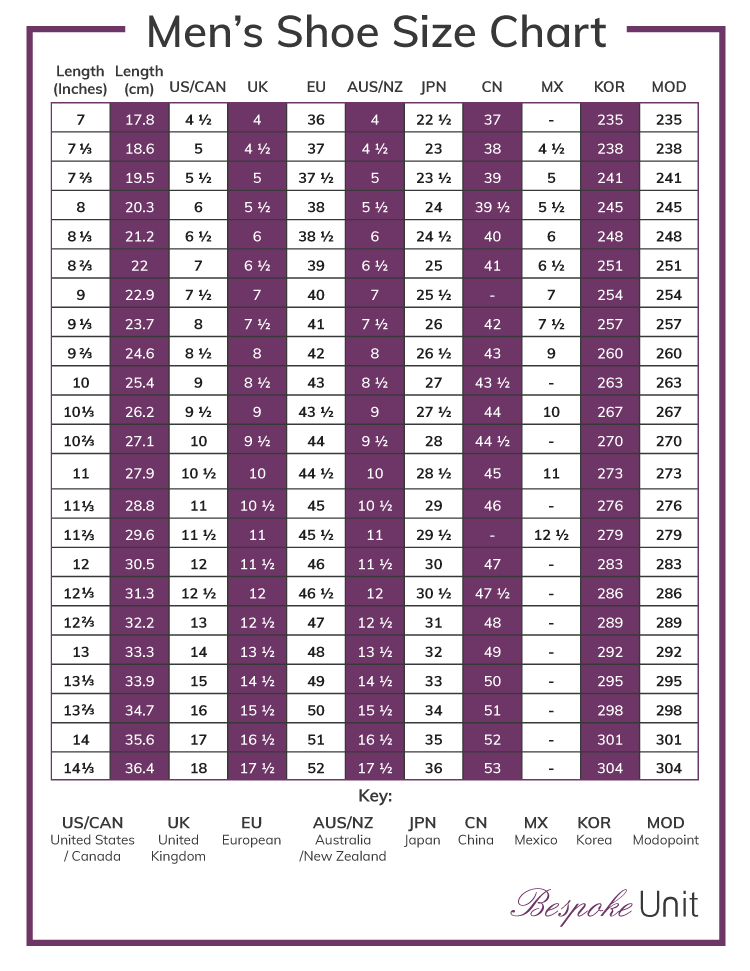
A common misconception is that European sizes are simply larger than US sizes. While there’s often a numerical difference, the underlying measurement principle is distinct. A US size 10, for example, generally corresponds to a foot length of around 26-27 cm. Translating this to the Paris Point system, a US size 10 would typically fall into the range of a European size 43 or 44. This is not a precise conversion but a general approximation, as different brands and even different shoe models within the same brand will have slight variations in their last construction and sizing.
Beyond Paris: Other European Sizing Nuances
While the Paris Point system is widespread, it’s not the sole standard. The United Kingdom, for instance, utilizes its own distinct sizing system, which is based on barleycorns. One barleycorn is approximately one-third of an inch. UK sizing typically starts with a size 0 for infants and progresses upwards. A UK size 8, for example, is a common adult size, and it bears little direct numerical resemblance to its continental European counterpart. A US size 10 typically aligns with a UK size 8 or 8.5.
Furthermore, some countries might have their own historical or niche sizing conventions, though these are often subsumed by the dominance of the Paris Point system for international brands. The presence of these multiple systems underscores the challenge for brands: how to present a unified and understandable sizing guide to a diverse global customer base.
The Brand’s Perspective: From Sizing Charts to Global Marketing Strategy
For footwear brands, the multiplicity of sizing systems is not merely an inconvenience; it’s a strategic branding challenge that impacts everything from product design and manufacturing to marketing and customer service. Brands must invest heavily in creating clear, consistent, and accessible sizing information to build trust and facilitate sales across different markets.
Crafting Consistent Sizing Charts: A Cornerstone of Brand Trust
The creation of accurate and user-friendly sizing charts is a critical brand touchpoint. A well-designed chart serves as a bridge between the consumer’s understanding of their size and the brand’s specific sizing convention. This involves:
- Clear Labeling: Using universally understood terminology (e.g., US Men’s, US Women’s, UK, EU) alongside the brand’s own internal sizing system.
- Visual Aids: Incorporating diagrams that illustrate how to measure foot length accurately, emphasizing the importance of measuring both feet and using the larger measurement.
- Conversion Tables: Providing comprehensive conversion tables that clearly map common sizing systems to the brand’s own. This requires meticulous research and validation to ensure accuracy.
- Model-Specific Guidance: Recognizing that even within a single brand, different shoe models might have slightly different fits. Some brands will offer model-specific sizing recommendations, further enhancing the customer’s confidence.
- Customer Support Integration: Ensuring that customer service representatives are well-trained to assist with sizing queries and can confidently guide customers through the brand’s sizing system.
A brand that consistently provides accurate sizing information, minimizes errors, and offers helpful resources fosters a sense of reliability. This reliability is a fundamental aspect of brand equity. When a customer knows they can trust a brand’s sizing, they are more likely to make a purchase, especially online, where the tactile experience of trying on shoes is absent. Conversely, inconsistent or confusing sizing can lead to a perception of carelessness or a lack of attention to detail, which can erode brand loyalty.
Marketing Across Borders: Bridging the Sizing Divide
The challenge of shoe sizing is deeply integrated into a brand’s international marketing efforts. Effectively communicating the brand’s value proposition requires ensuring that the product itself is accessible and understandable to the target audience.
- Localized Marketing Materials: When marketing in different regions, brands must ensure that their advertising and product descriptions accurately reflect local sizing conventions. Using the correct terminology and referencing familiar sizing systems builds immediate rapport with the local consumer.
- E-commerce Optimization: For online retailers, the website experience is paramount. Clear, prominent, and accurate sizing information on product pages is non-negotiable. This includes offering drop-down menus for selecting size in various systems and implementing interactive tools that help customers determine their correct size based on their measurements.
- Brand Storytelling: Some brands leverage the nuances of sizing as part of their brand story, highlighting their commitment to global reach and inclusive design. This can be subtly communicated through their website’s “about us” section or through campaigns that emphasize their international presence.
- Addressing Returns: A robust returns policy is a necessary safety net when dealing with sizing uncertainties. However, a well-executed sizing strategy aims to minimize the need for returns. A brand’s approach to handling returns related to sizing can also impact its reputation. A hassle-free and understanding process can turn a potentially negative experience into a positive brand interaction.
The goal is to make the purchase decision as frictionless as possible. If a customer has to spend an excessive amount of time deciphering a sizing chart or worrying about ordering the wrong size, the overall brand experience suffers. Brands that excel in this area understand that good sizing communication is a form of customer service and a testament to their commitment to customer satisfaction.
The Impact on Consumer Behavior and Brand Loyalty
The confusion surrounding international shoe sizing directly influences consumer behavior and, consequently, their relationship with a brand. When sizing is a barrier, it can deter potential customers, lead to dissatisfaction, and ultimately impact brand loyalty.
The Friction of Uncertainty: Hesitation and Abandonment
For consumers, the prospect of ordering shoes online from an international brand can be fraught with anxiety. The fear of receiving a pair that doesn’t fit, the hassle of returning them, and the potential for financial loss can lead to hesitation. This uncertainty can cause consumers to abandon their carts or opt for local brands where sizing is more familiar. This is particularly true for brands that are new to a market or those that haven’t established a strong reputation for sizing accuracy.
A brand’s investment in clear, accurate sizing information directly combats this friction. When a brand provides multiple sizing options, detailed measurement guides, and clear conversion charts, it signals to the consumer that their comfort and satisfaction are a priority. This reduces perceived risk and makes the purchasing decision easier.
Building Trust Through Consistency: The Foundation of Loyalty
Brand loyalty is built on a foundation of trust and positive experiences. When a customer consistently receives products that fit as expected, regardless of where they purchase them, their trust in the brand grows. This consistency in sizing becomes an implicit promise from the brand.
Conversely, a brand that is known for its erratic sizing can become synonymous with frustration. This negative association can be difficult to overcome, even if the quality of the product or its style is appealing. In today’s competitive market, where consumers have a plethora of choices, a brand that fails to deliver on fundamental expectations like accurate sizing risks losing its customer base to more reliable competitors.

The Power of a Seamless Experience: Repeat Purchases and Advocacy
Ultimately, a seamless and positive customer experience, which includes accurate sizing, encourages repeat purchases and can even lead to brand advocacy. A delighted customer who finds the perfect fit is more likely to become a loyal patron. They are also more likely to recommend the brand to friends and family, effectively becoming a brand ambassador.
In the context of global e-commerce, where a brand’s reach extends far beyond its physical borders, mastering the art of international sizing communication is no longer a secondary concern. It is a critical element of brand strategy that directly impacts market penetration, customer satisfaction, and long-term brand success. The question “What is a size 10 shoe in Europe?” might be simple on the surface, but its answer reveals the complex and vital role that consistent sizing plays in the global branding landscape.
aViewFromTheCave is a participant in the Amazon Services LLC Associates Program, an affiliate advertising program designed to provide a means for sites to earn advertising fees by advertising and linking to Amazon.com. Amazon, the Amazon logo, AmazonSupply, and the AmazonSupply logo are trademarks of Amazon.com, Inc. or its affiliates. As an Amazon Associate we earn affiliate commissions from qualifying purchases.