
The term “nebula” evokes images of celestial artistry, swirling cosmic clouds painted across the vast canvas of the universe. But beyond their breathtaking visual appeal, nebulae are fundamental components of cosmic evolution, playing a critical role in the birth and death of stars, and consequently, the very elements that make up our world. Understanding what a nebula is requires delving into the intricate processes of stellar lifecycles and the physical phenomena that govern them. In essence, a nebula is a vast interstellar cloud composed of dust, hydrogen, helium, and other ionized gases. These cosmic nurseries are where stars are born, and they are also the remnants of stars that have reached the end of their lives. The diverse forms and behaviors of nebulae offer astronomers invaluable insights into the dynamics of the cosmos.

The Genesis of Stars: Nebulae as Stellar Nurseries
The most captivating aspect of nebulae is their role as stellar birthplaces. These vast clouds are not static entities; they are dynamic environments where gravity, pressure, and shockwaves interact to initiate the process of star formation. Understanding this process requires an appreciation for the initial conditions within these nebulae and the subsequent gravitational collapse that leads to protostar formation.
Interstellar Medium: The Raw Material
The interstellar medium (ISM) is the diffuse matter and radiation that exists in the space between the star systems of a galaxy. It is the fundamental building block from which nebulae, and subsequently stars and planets, are formed. The ISM is primarily composed of gas, with hydrogen (about 75%) and helium (about 24%) being the most abundant elements, along with trace amounts of heavier elements, often referred to by astronomers as “metals.” Interspersed within this gas are tiny solid particles known as interstellar dust. These dust grains, typically only a few micrometers in size, are crucial for the formation of molecules and play a significant role in absorbing and scattering starlight, giving many nebulae their characteristic colors and opacity.
The density and temperature of the ISM vary dramatically. While some regions are extremely tenuous and hot, others are significantly denser and cooler, creating the conditions necessary for gravitational collapse. These denser, colder regions within the ISM are the precursors to nebulae. They can be triggered into becoming nebulae by various events, such as the shockwaves from nearby supernova explosions, collisions with other molecular clouds, or the gravitational influence of passing stars.
Gravitational Collapse and Protostar Formation
Once a region within the ISM becomes sufficiently dense and cool, gravity begins to dominate over the outward pressure of the gas and dust. This leads to a process of gravitational collapse, where the cloud starts to contract under its own weight. As the cloud collapses, its density increases, and its internal temperature begins to rise due to the conversion of gravitational potential energy into thermal energy.
This collapsing, heating core of gas and dust is known as a protostar. The protostar continues to accrete material from the surrounding nebula, growing in mass. During this phase, the protostar is not yet a true star because nuclear fusion has not yet begun in its core. However, it is radiating energy, primarily in the infrared spectrum, due to the ongoing gravitational contraction. The protostar is often shrouded by a thick envelope of gas and dust, making direct observation difficult, but the energy it emits can be detected. The surrounding material often forms a rotating disk around the protostar, from which planets may eventually form.
Stellar Birth: Ignition of Fusion
The protostar continues to contract and heat up until the temperature and pressure in its core reach critical levels. At approximately 10 million Kelvin, nuclear fusion ignites. This is the process where hydrogen atoms fuse together to form helium, releasing an enormous amount of energy in the form of light and heat. This energy creates an outward pressure that counteracts the inward pull of gravity, halting the collapse. At this point, the protostar has officially become a star, entering the main sequence phase of its life, where it will spend the majority of its existence. The remnants of the original nebula, now cleared of much of its material by the young star’s radiation and stellar winds, often form planetary nebulae or are dispersed, contributing to the enrichment of the interstellar medium with heavier elements.
The Diverse Tapestry of Nebulae: Types and Classifications
Nebulae are not uniform entities; they manifest in a stunning array of forms and originate from different cosmic processes. Astronomers classify nebulae based on their composition, their interaction with starlight, and their origin. This classification helps us understand the diverse roles these celestial clouds play in the universe.
Emission Nebulae: Illuminated by Stellar Light
Emission nebulae are clouds of ionized gas that emit their own light. This ionization is typically caused by ultraviolet radiation from nearby hot, young stars. The intense ultraviolet photons strip electrons from the atoms in the nebula, and when these electrons recombine with the ions, they emit light at specific wavelengths, resulting in characteristic colors.
The most famous example of an emission nebula is the Orion Nebula (M42), a vast stellar nursery visible to the naked eye. The vibrant red color often seen in emission nebulae is due to the emission of hydrogen-alpha photons. Other elements present, such as oxygen and sulfur, can produce green and blue hues, respectively. These nebulae are often the sites of active star formation, with the radiation from the newly formed stars energizing the surrounding gas.
Reflection Nebulae: Scattering Starlight
Reflection nebulae are clouds of dust that do not emit their own light but instead reflect the light of nearby stars. The dust particles in these nebulae scatter the starlight, and because blue light is scattered more effectively than red light, reflection nebulae often appear blue.
A classic example is the Pleiades star cluster, where the faint nebulosity surrounding the stars is a reflection nebula. The brightness of a reflection nebula depends on the luminosity of the illuminating star and the density and composition of the dust. These nebulae can provide valuable information about the properties of interstellar dust, such as its size distribution and chemical makeup. They also highlight the prevalence of dust in interstellar space, which is essential for the formation of stars and planets.
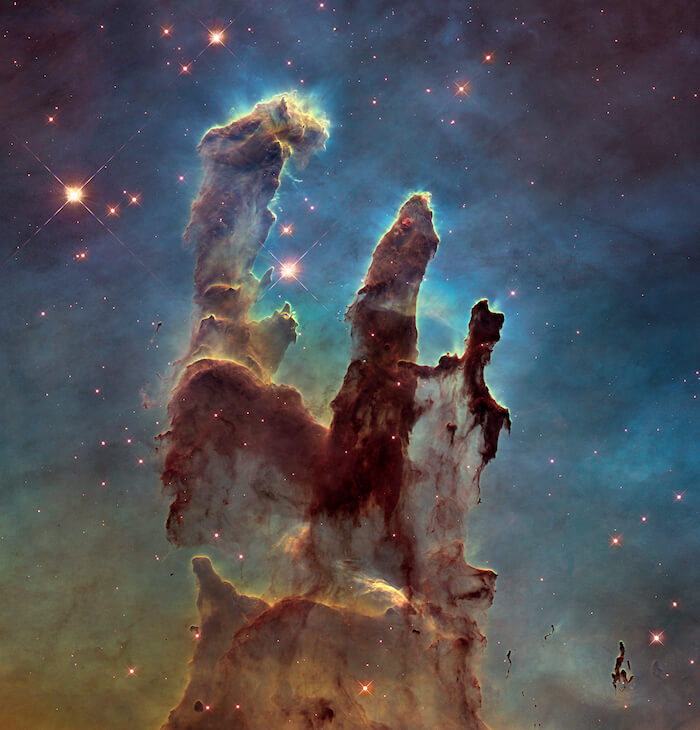
Dark Nebulae: Obscuring the View
Dark nebulae, also known as absorption nebulae, are dense clouds of gas and dust that are so opaque that they block out the light from stars behind them. They appear as dark patches against the brighter backdrop of the Milky Way or distant galaxies.
The Horsehead Nebula, a prominent feature in the constellation Orion, is a classic example of a dark nebula silhouetted against a more luminous emission nebula. These nebulae are often the densest and coldest regions of the ISM and are prime candidates for future star formation. By studying the patterns of obscuration, astronomers can map the distribution of interstellar dust and infer the presence of unseen stars or galaxies.
Planetary Nebulae: The End of a Stellar Life
Despite their name, planetary nebulae have nothing to do with planets. They are the glowing shells of gas ejected by low- to intermediate-mass stars (like our Sun) in the final stages of their lives. As these stars exhaust their nuclear fuel, they expand into red giants and then shed their outer layers. The exposed, hot core of the star emits ultraviolet radiation, which ionizes the ejected gas, causing it to glow.
Planetary nebulae are relatively short-lived phenomena, lasting only tens of thousands of years. They are often beautifully intricate and diverse in shape, displaying rings, lobes, and bipolar structures. Examples include the Ring Nebula and the Dumbbell Nebula. These nebulae play a crucial role in enriching the interstellar medium with heavier elements synthesized within the star, which can then be incorporated into new generations of stars and planets.
Supernova Remnants: Explosive Endings
Supernova remnants are the expanding shells of gas and debris ejected by a star that has undergone a supernova explosion. This is the dramatic and violent death of massive stars. The shockwaves from the supernova can compress the surrounding interstellar medium, triggering new star formation in some regions, while simultaneously dispersing heavy elements forged in the star’s core into the cosmos.
These remnants can be incredibly energetic, emitting radiation across the electromagnetic spectrum, from radio waves to X-rays. The Crab Nebula is a famous example, formed from the supernova observed in 1054 AD. Supernova remnants are essential for understanding the synthesis of heavy elements and the distribution of these elements throughout galaxies. They also serve as powerful sources of cosmic rays.
Nebulae in the Cosmic Ecosystem: Their Significance and Impact
Nebulae are far more than just aesthetic wonders; they are integral to the grand cosmic narrative. Their existence and evolution are intimately linked to the formation of stars and planetary systems, the chemical enrichment of galaxies, and our very understanding of the universe’s origins and future.
Stellar Evolution and Galactic Recycling
The lifecycle of stars is inextricably tied to nebulae. Nebulae provide the raw material for new stars to form, initiating the process of stellar birth. As stars evolve and eventually die, they return enriched material back into the interstellar medium, forming new nebulae. This continuous cycle of birth, life, and death of stars, mediated by nebulae, is the engine of galactic evolution.
When stars like our Sun reach the end of their lives, they shed their outer layers to form planetary nebulae. These nebulae disperse elements like carbon, oxygen, and nitrogen, which were created through nuclear fusion in the star’s core. More massive stars explode as supernovae, scattering even heavier elements like iron, gold, and uranium, forged during the star’s life and the explosive event itself. This recycled material becomes incorporated into subsequent generations of nebulae, leading to the formation of stars and planets with a progressively higher abundance of heavier elements. This process is fundamental to the existence of rocky planets and the complex chemistry that underpins life as we know it. Without nebulae acting as cosmic recycling centers, the universe would be a much simpler place, lacking the diverse elements necessary for the formation of complex structures and organic molecules.
Understanding the Universe’s Origins and Composition
The study of nebulae provides astronomers with a unique window into the fundamental composition of the universe and the processes that shaped it. By analyzing the light emitted or absorbed by nebulae, scientists can determine their chemical composition, temperature, and density. This information allows them to trace the origins of elements and understand how the early universe evolved.
The abundance of hydrogen and helium in nebulae, for instance, reflects the conditions in the Big Bang. The presence of heavier elements in nebulae formed from stellar remnants reveals the history of star formation and nucleosynthesis within a galaxy. Furthermore, the study of nebulae helps astronomers understand the physical processes that govern the universe, such as gravity, radiation pressure, and magnetic fields. These cosmic clouds are laboratories for studying fundamental physics on scales far beyond what can be replicated on Earth.

The Search for Exoplanets and Life Beyond Earth
The dust and gas within nebulae are not only the building blocks of stars but also the raw materials for forming planetary systems. The disks of gas and dust that surround young stars, which are often the remnants of the parent nebula, are where planets are born. By studying nebulae and the processes of star and planet formation within them, astronomers gain crucial insights into the prevalence and diversity of exoplanets.
The discovery and characterization of exoplanets have become a major focus of modern astronomy. Understanding the conditions within nebulae that favor planet formation and the types of planets that emerge from these environments is essential for assessing the potential for life elsewhere in the universe. Moreover, the chemical composition of nebulae, particularly the presence of organic molecules, can offer clues about the potential for the emergence of life. Some nebulae have been found to contain complex organic molecules, suggesting that the ingredients for life are widespread in the cosmos, awaiting the right conditions to coalesce into living organisms. Therefore, nebulae are not just cosmic wonders; they are fertile grounds for the ongoing story of cosmic evolution, holding clues to our past, our present, and our potential future in the vast expanse of space.
aViewFromTheCave is a participant in the Amazon Services LLC Associates Program, an affiliate advertising program designed to provide a means for sites to earn advertising fees by advertising and linking to Amazon.com. Amazon, the Amazon logo, AmazonSupply, and the AmazonSupply logo are trademarks of Amazon.com, Inc. or its affiliates. As an Amazon Associate we earn affiliate commissions from qualifying purchases.