
In the realm of mathematics, functions are fundamental building blocks that describe relationships between sets. We encounter them daily, from calculating the cost of multiple items to predicting the trajectory of a projectile. However, not all functions are created equal. Some possess unique properties that make them particularly powerful and useful in various technical applications. One such class of functions is the bijective function.
Understanding bijective functions is not merely an academic exercise; it’s crucial for grasping core concepts in areas like computer science, data science, cryptography, and even the design of efficient algorithms. This article will delve into the definition, properties, and practical implications of bijective functions, offering a comprehensive overview for anyone seeking to deepen their understanding of these essential mathematical tools within a technological context.

The Core Definition: One-to-One and Onto
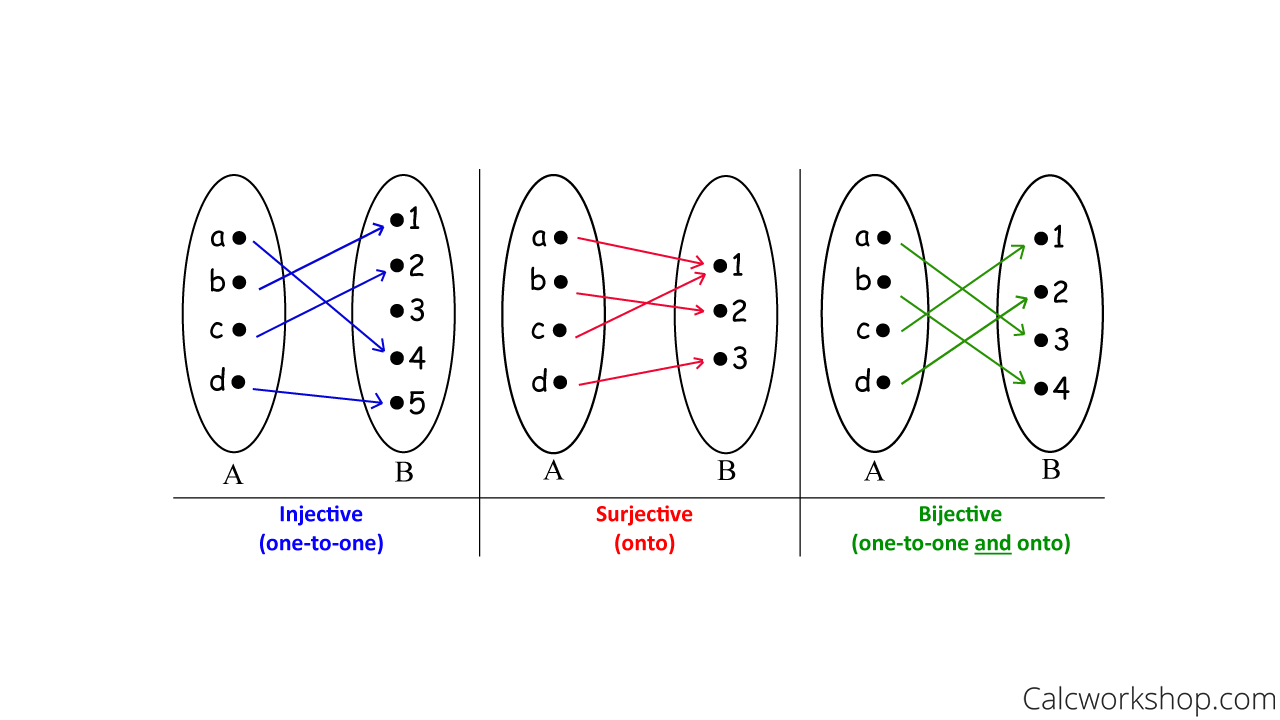
At its heart, a function maps elements from one set, called the domain, to elements in another set, called the codomain. A bijective function, also known as a one-to-one correspondence or a bijection, is a function that satisfies two crucial conditions simultaneously: it must be both injective (one-to-one) and surjective (onto).
Injective Functions: No Two Inputs Map to the Same Output
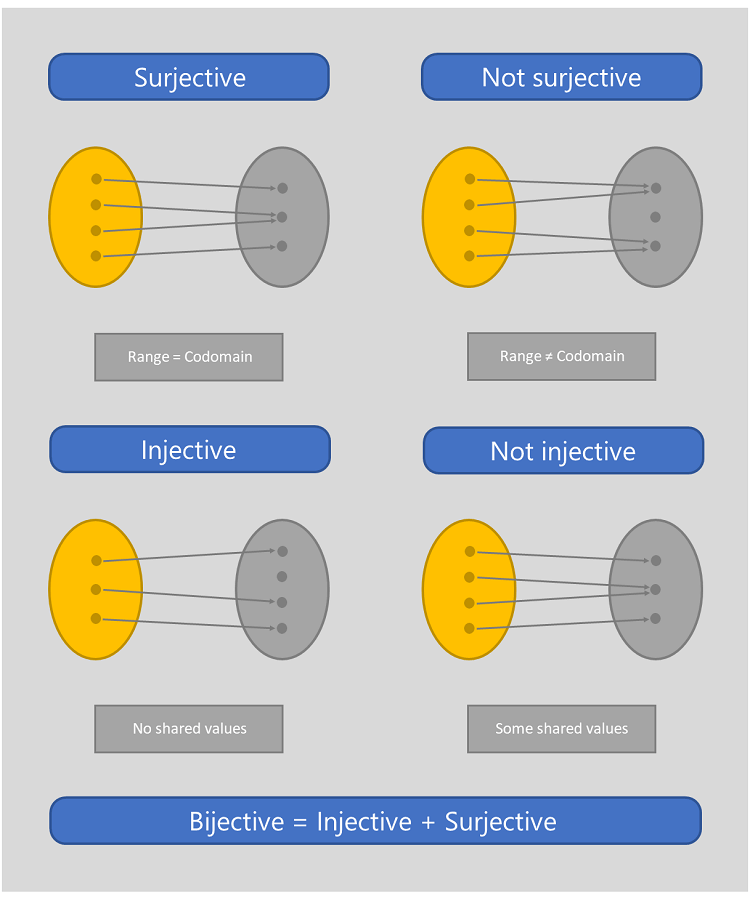
An injective function, or one-to-one function, ensures that each distinct element in the domain maps to a unique element in the codomain. In simpler terms, if you have two different inputs, they will always produce two different outputs. There are no “collisions” of outputs.
Mathematically, a function $f: A to B$ is injective if for any two elements $x1, x2 in A$, if $f(x1) = f(x2)$, then it must be that $x1 = x2$. Alternatively, and often more intuitively, if $x1 neq x2$, then $f(x1) neq f(x2)$.
Why is this important in technology?
- Data Integrity and Uniqueness: In databases, ensuring that each record has a unique identifier is paramount. A function that maps a conceptual entity (like a user ID) to a physical record identifier should ideally be injective to prevent duplicate entries or ambiguity.
- Hashing Algorithms: Cryptographic hash functions are designed to be collision-resistant, meaning it’s computationally infeasible to find two different inputs that produce the same output. While not strictly injective (as the domain is infinitely larger than the possible output space), the principle of avoiding collisions is a direct application of injectivity.
- Data Compression: In some lossless compression techniques, unique data patterns are mapped to shorter codes. An injective mapping ensures that no information is lost during the encoding process.
Surjective Functions: Every Element in the Codomain is Reached
A surjective function, or onto function, guarantees that every element in the codomain is the image of at least one element in the domain. This means that the range of the function (the set of all actual outputs) is exactly equal to its codomain. No element in the codomain is left “unmapped.”
Mathematically, a function $f: A to B$ is surjective if for every element $y in B$, there exists at least one element $x in A$ such that $f(x) = y$.
Why is this important in technology?
- Resource Allocation and Mapping: Consider a system where you are allocating a finite set of resources (codomain) to a potentially larger number of tasks or users (domain). A surjective mapping ensures that all available resources are utilized.
- Encoding and Decoding: In communication systems, a surjective mapping from a set of signals to a set of symbols ensures that every possible symbol can be represented and therefore received.
- Completeness in Transformations: When transforming data from one format to another, a surjective mapping might be desired to ensure that all possible target states or representations are achievable.
Bijective Functions: The Perfect Pairing
A function is bijective if and only if it is both injective and surjective. This dual property makes bijective functions incredibly powerful because they establish a perfect, one-to-one correspondence between the elements of the domain and the elements of the codomain.
- Every element in the domain maps to exactly one element in the codomain. (Injectivity)
- Every element in the codomain is mapped to by exactly one element in the domain. (Surjectivity)
This means that for every output, there is a unique input, and for every input, there is a unique output. This perfect pairing has profound implications in many technological areas.
Key Properties and Implications of Bijective Functions
The bijective nature of a function confers several critical properties that are highly valued in computer science and related fields.
The Existence of an Inverse Function
Perhaps the most significant consequence of a function being bijective is that it possesses a unique inverse function. If $f: A to B$ is bijective, then there exists a function $f^{-1}: B to A$ such that for all $x in A$ and $y in B$:
$f^{-1}(f(x)) = x$ and $f(f^{-1}(y)) = y$.
The inverse function effectively “undoes” the original function. If $f$ maps $x$ to $y$, then $f^{-1}$ maps $y$ back to $x$. This is a direct result of both injectivity (ensuring each $y$ comes from a single $x$) and surjectivity (ensuring every $y$ is indeed mapped to).
Technological Relevance of Inverse Functions:
- Cryptography: Encryption and decryption are prime examples of inverse functions. An encryption function (e.g., AES) is designed to be bijective (or at least practically so for practical key spaces). The decryption function is its inverse, allowing us to recover the original plaintext from the ciphertext. The security of modern cryptography relies heavily on the difficulty of finding the inverse function without the key.
- Data Transformation and Reversibility: In data processing pipelines, if a transformation is bijective, it guarantees that the original data can be perfectly reconstructed. This is crucial for debugging, auditing, and certain types of data recovery.
- Algorithmic Reversibility: In algorithms that involve complex state changes, if these changes can be represented by bijective functions, it simplifies the process of backtracking or undoing operations. This is common in areas like game development (undo functionality) or formal verification.
- Mapping and Translation: In systems that translate between different representations (e.g., character encoding, protocol translation), a bijective mapping ensures a complete and lossless translation in both directions.
Preserving Structure and Cardinality
Bijective functions not only map elements but also preserve the “structure” and “size” of sets. This means that if two sets are in a bijective relationship, they are considered to have the same cardinality (number of elements), even if the elements themselves are different. This concept is fundamental to understanding infinite sets in set theory.
Technological Relevance of Structure Preservation:
- Data Structures: When converting between different data structures (e.g., from a list to a set, or from an array to a linked list), if the conversion is bijective, it implies that the fundamental information content is preserved, and the original structure can be perfectly rebuilt.
- Formal Languages and Automata Theory: In theoretical computer science, bijections are used to prove equivalences between different models of computation, such as finite automata and regular expressions. If a bijection exists between the set of strings recognized by two formalisms, it implies they have the same expressive power.
- Network Topologies and Graph Isomorphisms: In graph theory, a bijective mapping between the vertices and edges of two graphs that preserves adjacency is called an isomorphism. This concept is used to determine if two networks or structures are structurally identical, which is vital for tasks like network analysis or pattern recognition in data.
Bijective Functions and Efficiency
While not a direct property of bijectivity itself, bijective functions are often associated with efficiency in computational contexts. This is because they often represent optimal mappings where no redundant steps are taken, and all possibilities are accounted for.
Technological Relevance and Efficiency:
- Algorithm Design: Algorithms that rely on bijective mappings can often be more efficient. For instance, if you can bijectively map a problem instance to a simpler problem whose solution can then be mapped back bijectively, it can lead to elegant and performant solutions.
- Memory Management: In some advanced memory management techniques, bijective mappings between logical addresses and physical addresses (or memory pages) are used to ensure efficient access and translation without unnecessary overhead.
- Permutations: A specific type of bijective function over a finite set is a permutation. Permutations are fundamental in many algorithms, including sorting, searching, and combinatorial optimization problems. Their bijective nature ensures that every arrangement of elements is unique and accessible.
Examples of Bijective Functions in Technology
To solidify the understanding of bijective functions, let’s consider some concrete examples within technological contexts.
String to Integer Mapping (with caveats)
Consider a simple scenario where we have a set of unique configuration keys (strings) and we want to map them to a finite set of integer IDs for efficient lookup in a configuration table.
Let the domain be the set of valid configuration key strings, $S = {text{“timeout”}, text{“retries”}, text{“buffer_size”}}$.
Let the codomain be a set of integers, $I = {1, 2, 3}$.
We can define a function $f: S to I$ as follows:
$f(text{“timeout”}) = 1$
$f(text{“retries”}) = 2$
$f(text{“buffer_size”}) = 3$
This function is:
- Injective: Each distinct string maps to a distinct integer.
- Surjective: Every integer in the codomain ${1, 2, 3}$ is mapped to by a string from the domain.
Therefore, this function is bijective. The inverse function, $f^{-1}: I to S$, would be:
$f^{-1}(1) = text{“timeout”}$
$f^{-1}(2) = text{“retries”}$
$f^{-1}(3) = text{“buffer_size”}$
Caveat: This is only bijective if the domain and codomain are finite and perfectly matched. In a real-world scenario, if our set of configuration keys were much larger than the set of available integer IDs, the function would not be surjective. Conversely, if we had more IDs than keys, it would not be injective if we tried to map multiple keys to the same ID, or it would have unused IDs if we mapped each key to a unique ID. The key is that the mapping must be one-to-one and cover all possibilities in both sets.
Hash Table Indexing (Conceptual Bijectivity)
In a hash table, a hash function maps keys (e.g., strings, objects) to indices in an array. Ideally, a good hash function aims to distribute keys as uniformly as possible across the array.
Let the domain be the set of all possible keys, $K$.
Let the codomain be the indices of the hash table array, $H = {0, 1, ldots, m-1}$, where $m$ is the size of the array.
A hash function $h: K to H$.
While hash functions are generally not strictly bijective (because the number of possible keys is usually vastly larger than the number of array indices, meaning collisions are inevitable), the ideal theoretical scenario for perfect mapping without collisions would be bijective. In scenarios where the number of unique keys is guaranteed to be less than or equal to the number of available indices, and a collision-free hash function exists, the mapping would be bijective. This concept of a perfect hash function, which is bijective for a specific set of keys, is highly desirable for performance-critical applications.
Permutations in Cryptography and Algorithms
A permutation is a bijective function from a set to itself. For example, consider a set of 5 distinct data blocks ${A, B, C, D, E}$. A permutation might rearrange these blocks.
Let the set be $S = {A, B, C, D, E}$.
A permutation $p: S to S$:
$p(A) = C$
$p(B) = E$
$p(C) = A$
$p(D) = B$
$p(E) = D$
This is bijective because:
- Each element maps to a unique element (e.g., $A$ maps to $C$, no other element maps to $C$).
- Every element in the set is mapped to by exactly one element (e.g., $A$ is the image of $C$, $B$ is the image of $D$).
The inverse permutation $p^{-1}$ would restore the original order:
$p^{-1}(A) = C$
$p^{-1}(B) = D$
$p^{-1}(C) = A$
$p^{-1}(D) = E$
$p^{-1}(E) = B$
Permutations are fundamental in:
- Substitution Ciphers: Simple substitution ciphers can be viewed as applying a permutation to the alphabet.
- Transposition Ciphers: These ciphers rearrange the order of characters based on a permutation.
- Sorting Algorithms: Many sorting algorithms implicitly or explicitly utilize permutations to achieve ordered arrangements.
- Random Number Generation: Certain pseudo-random number generators rely on permutations of sequences.
Conclusion: The Power of Perfect Correspondence
Bijective functions represent a perfect correspondence between two sets. They are more than just mathematical curiosities; they are powerful tools that underpin critical aspects of modern technology. Their ability to ensure one-to-one mapping and complete coverage, leading to the existence of a unique inverse, makes them invaluable for maintaining data integrity, enabling secure communication, building efficient algorithms, and transforming data reliably.
When working with functions in technical domains, recognizing the properties of injectivity and surjectivity, and understanding when a function achieves both (i.e., becomes bijective), can unlock deeper insights into the functionality, security, and efficiency of the systems we design and utilize. The concept of a bijective function is a cornerstone for anyone navigating the intricate landscape of computer science, mathematics, and their profound intersection with technology.
aViewFromTheCave is a participant in the Amazon Services LLC Associates Program, an affiliate advertising program designed to provide a means for sites to earn advertising fees by advertising and linking to Amazon.com. Amazon, the Amazon logo, AmazonSupply, and the AmazonSupply logo are trademarks of Amazon.com, Inc. or its affiliates. As an Amazon Associate we earn affiliate commissions from qualifying purchases.