
In the rapidly evolving landscape of enterprise software, few companies have maintained as steady a presence as MicroStrategy. Founded in 1989, the company has survived multiple technological paradigm shifts—from the rise of the internet to the mobile revolution and now the era of Artificial Intelligence. While it often makes headlines for its corporate treasury strategies, its core identity remains rooted in high-end technology.
At its heart, MicroStrategy is a global provider of enterprise analytics and mobility software. It provides the digital “nervous system” for some of the world’s largest organizations, allowing them to transform raw data into actionable insights. This article explores the technical architecture, the flagship “MicroStrategy ONE” platform, and the company’s aggressive integration of Generative AI.

The Evolution of MicroStrategy: From Data Warehousing to AI-Powered Intelligence
MicroStrategy began its journey during the early days of relational databases. Its founding mission was to help businesses navigate the complexities of data stored in vast digital warehouses. Unlike many of its competitors who focused on simple visualization, MicroStrategy built its reputation on the “Semantic Layer”—a technical architecture that ensures data consistency across an entire organization.
The Core Philosophy: Relational OLAP
The company’s early success was driven by its proprietary Relational Online Analytical Processing (ROLAP) technology. While other tools required data to be moved into specialized “cubes” for analysis, MicroStrategy’s engine could query massive relational databases directly. This allowed for greater scalability and the ability to handle larger datasets than almost any other software on the market. This focus on “big data” before the term became a buzzword positioned the company as the tool of choice for Fortune 500 companies with complex data needs.
Transitioning to the Cloud (MicroStrategy Cloud Environment)
As the tech industry pivoted toward Cloud Computing, MicroStrategy underwent a significant structural transformation. The MicroStrategy Cloud Environment (MCE) was developed to provide the same robust analytics capabilities via a managed service model. By partnering with major infrastructure providers like Amazon Web Services (AWS) and Microsoft Azure, the company enabled its clients to deploy analytics environments in minutes rather than months. This transition was crucial for maintaining technical relevance in a world where hardware-agnostic software-as-a-service (SaaS) is the standard.
MicroStrategy ONE: The Flagship Platform
Today, all of the company’s technological innovations are consolidated into a single, unified platform known as MicroStrategy ONE. This platform represents a shift from traditional business intelligence (BI) to what the company calls “Intelligent Applications.”
HyperIntelligence: Bringing Data to Every Application
One of the most distinctive technical features of MicroStrategy is “HyperIntelligence.” Traditional BI requires a user to open a specific dashboard or report to find an answer. HyperIntelligence flips this model by injecting data directly into the user’s existing workflow.
Technically, this is achieved through browser extensions and mobile integrations that recognize keywords on a screen. When a user hovers over a customer name or product ID in an email, CRM, or website, a “HyperCard” appears. This card displays real-time data pulled from the enterprise’s central databases. This eliminates “toggle tax”—the lost productivity caused by switching between apps—and ensures that data is accessible to non-technical employees who may never intentionally open an analytics tool.
Dossiers and Interactive Visualizations
While the platform supports standard reports, its primary interface for data storytelling is the “Dossier.” A Dossier is more than a dashboard; it is an interactive, page-based layout that mimics a digital book or a sophisticated website. From a developer perspective, Dossiers are built using a responsive design framework, ensuring that a single piece of content looks and functions perfectly across desktops, tablets, and smartphones. This focus on mobile-first design has been a hallmark of MicroStrategy’s engineering for over a decade.
Embedding Analytics into Third-Party Apps
MicroStrategy is not just a standalone tool; it is a powerful backend for other software. Through its “Embedded Analytics” capabilities, developers can use MicroStrategy’s APIs and SDKs to build data visualizations directly into their own custom applications. This is particularly popular in the fintech and healthcare sectors, where companies want to provide their customers with sophisticated data portals without building a complex analytics engine from scratch.
The AI Revolution: MicroStrategy’s Integration of Generative AI
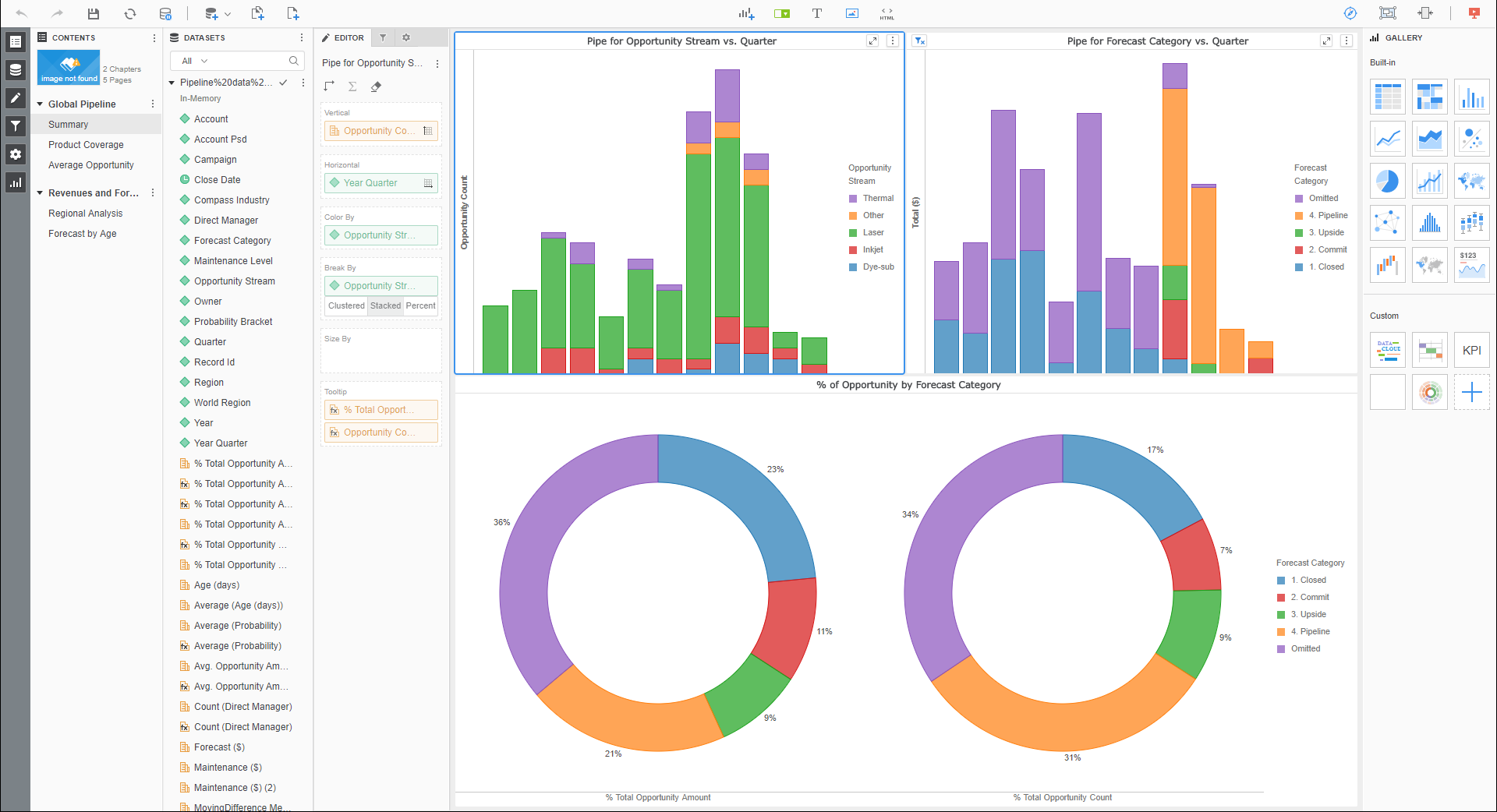
The most significant technological shift in the company’s recent history is its pivot toward “MicroStrategy AI.” Recognizing that the primary barrier to data-driven decision-making is the complexity of SQL and data modeling, MicroStrategy has integrated Large Language Models (LLMs) directly into its platform.
Auto Answers: Conversational Data Querying
The “Auto Answers” feature allows users to talk to their data using natural language. Instead of dragging and dropping fields to create a chart, a manager can type, “Show me our highest-performing regions for the last quarter compared to the previous year.”
The underlying technology translates this natural language prompt into a precise query against the company’s semantic layer. Because it queries the semantic layer—not the raw database—the AI avoids the “hallucination” problem common in other AI tools. It uses the pre-defined business logic of the organization to ensure that “Revenue” or “Profit” is calculated exactly how the company defines it.
Auto Dashboard and Auto SQL
MicroStrategy has also automated the “heavy lifting” for data scientists and developers:
- Auto Dashboard: This feature uses AI to automatically design an entire dashboard based on a data description, selecting the most appropriate charts and layouts for the specific dataset.
- Auto SQL: For technical users, this tool acts as a co-pilot, translating natural language into optimized SQL code. This accelerates the development of complex data transformations and allows analysts to focus on strategy rather than syntax.
Ensuring Data Security and Governance in AI
A major concern with AI in the enterprise is data privacy. MicroStrategy’s AI architecture is designed with “privacy by design.” It allows organizations to use LLMs (like GPT-4 via Azure OpenAI) while ensuring that sensitive corporate data is never used to train the public model. This technical safeguard is essential for highly regulated industries like banking and defense, where data leakage is a catastrophic risk.
Technical Architecture and Security Standards
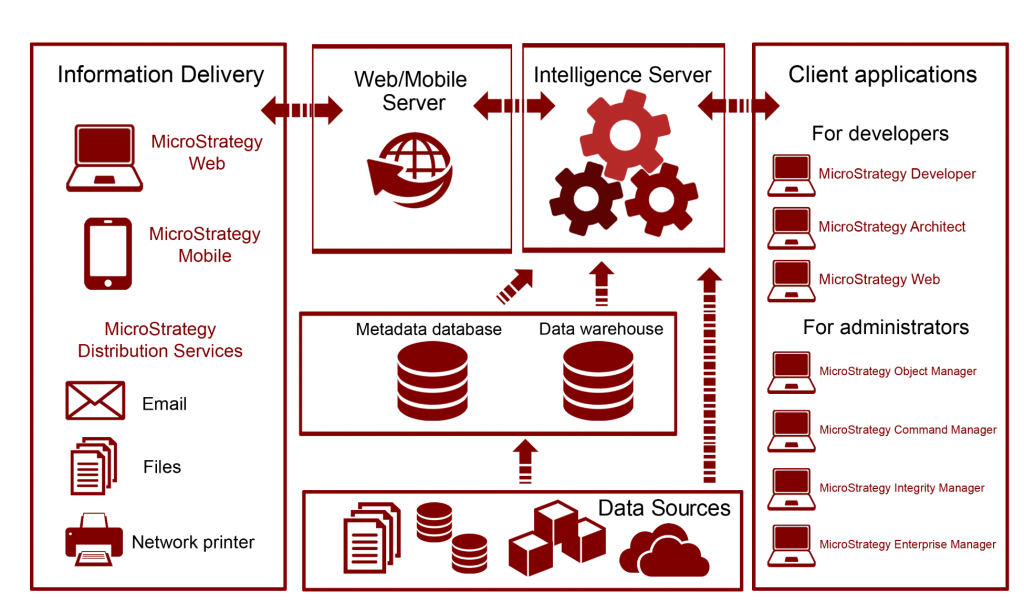
Beyond the flashy AI features, MicroStrategy’s longevity is due to its “Enterprise-Grade” foundation. While many modern “lite” BI tools struggle with security and data governance, MicroStrategy was built for the most demanding environments.
The Semantic Layer: A Single Version of Truth
The “Secret Sauce” of the MicroStrategy tech stack is its Metadata and Semantic Layer. In many organizations, the marketing department and the finance department might use different formulas to calculate “Churn.” This leads to conflicting reports and confusion.
MicroStrategy forces a “Single Version of the Truth.” An administrator defines a metric once in the semantic layer, and every user across the entire company uses that same definition. This central governance is what separates an enterprise-grade platform from a simple visualization tool.
Enterprise-Grade Security and Compliance
The platform supports sophisticated security protocols, including row-level and column-level security. This means that two different users looking at the same report will see different data based on their permissions (e.g., a regional manager only sees their region’s sales). It also supports advanced authentication methods like SAML, OIDC, and various biometric integrations for mobile devices, ensuring that data remains secure even in a distributed workforce.
The Future of MicroStrategy in the Tech Ecosystem
As we look toward the future, MicroStrategy is positioning itself as an “AI + Analytics” powerhouse. Its technical roadmap is focused on making data “invisible”—embedding it so deeply into the tools people use every day that “doing analytics” no longer feels like a separate task.
Competing in the Era of Big Data
The challenge for MicroStrategy is the increasing competition from cloud-native giants like Google (Looker), Microsoft (Power BI), and Salesforce (Tableau). To stay ahead, MicroStrategy is doubling down on its “open” philosophy. It has developed connectors that allow users to view MicroStrategy-governed data inside Power BI or Excel. This “MicroStrategy as a Service” approach acknowledges that large enterprises use multiple tools and positions MicroStrategy as the reliable, governed source of data that feeds them all.
The Role of Open Standards and APIs
The company is increasingly moving toward an “API-first” development model. By exposing almost every platform capability through REST APIs, MicroStrategy allows developers to build entirely custom interfaces or automate administrative tasks via Python scripts. This flexibility is vital for the modern DevOps environment, where automation and integration are the keys to efficiency.
In conclusion, MicroStrategy is much more than a legacy software company. It is a sophisticated technology provider that has successfully bridged the gap between old-school data warehousing and the new world of Generative AI. By focusing on the “Semantic Layer” and “HyperIntelligence,” it continues to provide a level of data governance and accessibility that remains the gold standard for large-scale enterprise analytics.
aViewFromTheCave is a participant in the Amazon Services LLC Associates Program, an affiliate advertising program designed to provide a means for sites to earn advertising fees by advertising and linking to Amazon.com. Amazon, the Amazon logo, AmazonSupply, and the AmazonSupply logo are trademarks of Amazon.com, Inc. or its affiliates. As an Amazon Associate we earn affiliate commissions from qualifying purchases.