
The dream of homeownership often begins with a crucial question: “How much can I borrow for a mortgage?” This isn’t just a simple query; it’s the gateway to understanding your purchasing power, shaping your property search, and ultimately, determining your financial future as a homeowner. While many online calculators offer quick estimates, the actual amount a lender is willing to offer is the result of a complex evaluation of your financial health, risk profile, and the prevailing economic conditions.
Understanding your mortgage borrowing capacity goes beyond just knowing a number. It’s about demystifying the intricate factors that lenders consider, from your income and existing debts to your credit history and the size of your down payment. Equipping yourself with this knowledge empowers you to not only accurately assess your financial standing but also to strategically improve your eligibility and secure the most favorable loan terms. This comprehensive guide will walk you through the core components of mortgage qualification, the lender’s perspective, and actionable steps you can take to maximize your borrowing potential responsibly.

Understanding the Core Factors Influencing Your Borrowing Power
Lenders are essentially assessing risk when they evaluate a mortgage application. Their primary goal is to determine your ability and willingness to repay the loan reliably. This assessment is based on several key financial indicators, each playing a critical role in shaping the final loan amount they are prepared to offer.
Income and Employment Stability
Your income is, naturally, the cornerstone of your borrowing capacity. Lenders need to be confident that you have a consistent and sufficient cash flow to cover your monthly mortgage payments, along with all your other financial obligations.
- Types of Income Considered: Lenders typically look at verifiable and stable sources of income. This includes your regular salary from employment, but can also extend to bonuses, commissions (often averaged over two years), self-employment income (requiring two years of tax returns), retirement income, alimony, child support, and even certain disability benefits. Unstable or irregular income streams may be discounted or require more extensive documentation.
- Employment History: Stability is key. Lenders prefer to see a consistent employment history, ideally with the same employer for at least two years, or within the same industry. Frequent job changes or gaps in employment can raise red flags, signaling potential instability in your income stream. For self-employed individuals, a track record of profitability and stable business operations is crucial.
Debt-to-Income (DTI) Ratio
The Debt-to-Income (DTI) ratio is one of the most critical metrics lenders use. It’s a comparison of your total monthly debt payments to your gross monthly income, expressed as a percentage. It effectively tells lenders how much of your income is already being consumed by existing debt obligations.
- What It Is and Why It Matters: Your DTI ratio is divided into two parts: the “front-end” ratio (or housing ratio) and the “back-end” ratio (or total debt ratio).
- Front-End Ratio: This looks at your proposed monthly housing expenses (mortgage principal and interest, property taxes, homeowner’s insurance, and homeowners association (HOA) fees) as a percentage of your gross monthly income.
- Back-End Ratio: This is more comprehensive, adding all your other monthly debt payments (car loans, student loans, minimum credit card payments, etc.) to your proposed housing expenses, then dividing that total by your gross monthly income.
- Calculating DTI: To calculate your back-end DTI, sum up all your monthly minimum debt payments (including the potential new mortgage payment), then divide by your gross monthly income.
- Common DTI Thresholds: While these can vary by lender and loan program, a common maximum DTI for conventional loans is 43%. Some programs, like FHA loans, may allow slightly higher DTIs (e.g., up to 50% in certain circumstances), but generally, a lower DTI indicates less financial risk and stronger borrowing power.
Credit Score and History
Your credit score and the underlying credit history are powerful indicators of your reliability as a borrower. They reflect your past behavior in managing debt and fulfilling financial obligations.
- Impact of Good vs. Bad Credit: A higher credit score (e.g., FICO scores typically ranging from 300-850) signifies a lower risk to lenders. This generally translates into better loan terms, including lower interest rates and potentially a larger borrowing amount. Conversely, a lower credit score often leads to higher interest rates, stricter loan requirements, or even outright denial.
- Credit Report Errors: It’s imperative to review your credit report from all three major bureaus (Experian, Equifax, TransUnion) annually. Errors can negatively impact your score, so identifying and disputing them can be crucial for improving your borrowing power.
- Payment History and Credit Utilization: Your payment history (paying bills on time) is the most significant factor in your credit score. Credit utilization (the amount of credit you’re using compared to your total available credit) is another key element; keeping this below 30% is generally recommended.
Down Payment Amount
The size of your down payment is a direct reflection of your financial commitment and can significantly influence how much a lender is willing to lend.
- Impact on Loan-to-Value (LTV) Ratio: Your down payment determines your Loan-to-Value (LTV) ratio, which is the amount of the loan compared to the home’s appraised value. A larger down payment results in a lower LTV, indicating less risk for the lender.
- Private Mortgage Insurance (PMI): If your down payment is less than 20% of the home’s purchase price, most conventional lenders will require you to pay for Private Mortgage Insurance (PMI). PMI protects the lender in case you default on your loan and adds to your monthly housing expense, which can affect your DTI and overall affordability. FHA loans have their own equivalent, called Mortgage Insurance Premium (MIP).
- Larger Down Payment = Lower Risk: A substantial down payment not only reduces your monthly mortgage payment but also signals to lenders that you are financially responsible and have a significant personal stake in the property. This can open doors to more competitive interest rates and larger loan amounts.
The Mortgage Qualification Process: What Lenders Look At
Once you understand the core factors, it’s helpful to see how lenders integrate these into their qualification process. It’s a structured approach designed to verify your financial information and match you with a suitable loan product.
Verifying Your Financial Standing
Lenders don’t just take your word for it; they meticulously verify every piece of financial information you provide.
- Pay Stubs, Tax Returns, Bank Statements: You’ll need to supply recent pay stubs (typically 30-60 days), W-2 forms (for the past two years), and federal tax returns (for the past two years, especially if self-employed or earning significant commissions/bonuses). Bank statements (60-90 days) will be required to verify assets, show consistent income deposits, and ensure you have sufficient funds for your down payment and closing costs.
- Asset Verification: Beyond your down payment, lenders want to see that you have reserves – accessible funds that could cover several months of mortgage payments in case of an unexpected financial setback. These assets might include savings, checking accounts, investment accounts, and retirement funds (though typically only a portion is considered liquid).
Types of Mortgages and Their Requirements
Different loan products cater to various borrower profiles and come with distinct qualification criteria.
- Conventional Loans: These are the most common type, offered by private lenders and not backed by a government agency. They often require good to excellent credit (typically 620+ FICO), can require as little as 3% down (though 20% avoids PMI), and adhere to specific loan limits set by government-sponsored enterprises like Fannie Mae and Freddie Mac.
- FHA Loans: Insured by the Federal Housing Administration, these loans are popular for first-time homebuyers or those with less-than-perfect credit. They typically allow lower credit scores (sometimes as low as 580 with 3.5% down, or 500-579 with 10% down) and require a smaller down payment (3.5%). However, they always come with mortgage insurance premiums (MIP), both upfront and annual, regardless of the down payment amount.
- VA Loans: Backed by the U.S. Department of Veterans Affairs, these loans offer exceptional benefits to eligible service members, veterans, and surviving spouses, including no down payment requirements, no private mortgage insurance, and competitive interest rates. Strict eligibility criteria apply.
- USDA Loans: Guaranteed by the U.S. Department of Agriculture, these loans are designed for low-to-moderate income borrowers purchasing homes in eligible rural areas. They also offer zero down payment options and competitive rates, but income and property location restrictions are stringent.
- Jumbo Loans: For properties that exceed the conventional loan limits, jumbo loans are necessary. These typically come with more stringent qualification requirements, including higher credit scores, larger down payments (often 10-20% or more), and lower DTI ratios, due to the higher risk involved for the lender.
Lender-Specific Criteria and Underwriting
While general guidelines exist, each lender has its own internal policies and risk assessment models.
- Internal Scoring Models: Beyond your FICO score, many lenders use proprietary scoring models that combine various data points to create a more nuanced risk profile.
- Risk Assessment: Underwriters meticulously review your entire financial picture to ensure consistency, identify any red flags, and determine if you meet the specific requirements for their loan products. This can involve asking for letters of explanation for unusual bank deposits, employment gaps, or derogatory credit marks.
Calculating Your Potential Borrowing Capacity
While online calculators provide a starting point, understanding how lenders perform their calculations offers a clearer picture.
Common Lender Formulas
Lenders primarily use variations of the DTI rule, often referred to as the 28/36 rule or similar iterations.

- Front-End Ratio (Housing Costs): The standard guideline here is that your total monthly housing costs (principal, interest, taxes, insurance, HOA fees) should not exceed 28% of your gross monthly income.
- Back-End Ratio (All Debts): Your total monthly debt payments, including the new mortgage, should not exceed 36% of your gross monthly income.
- Example: If your gross monthly income is $5,000:
- Front-end: Max housing cost = $5,000 * 0.28 = $1,400.
- Back-end: Max total debt payment = $5,000 * 0.36 = $1,800.
- If your other monthly debts are $400 (car loan, student loan), then your maximum mortgage payment would be $1,800 – $400 = $1,400. In this scenario, the back-end ratio is the limiting factor. Lenders will always take the more conservative (lower) amount determined by either ratio.
It’s important to remember that these are general guidelines, and certain loan types (like FHA or VA) or specific lender programs may allow for higher percentages if other compensating factors (e.g., substantial reserves, excellent credit) are present.
Online Calculators vs. Pre-qualification/Pre-approval
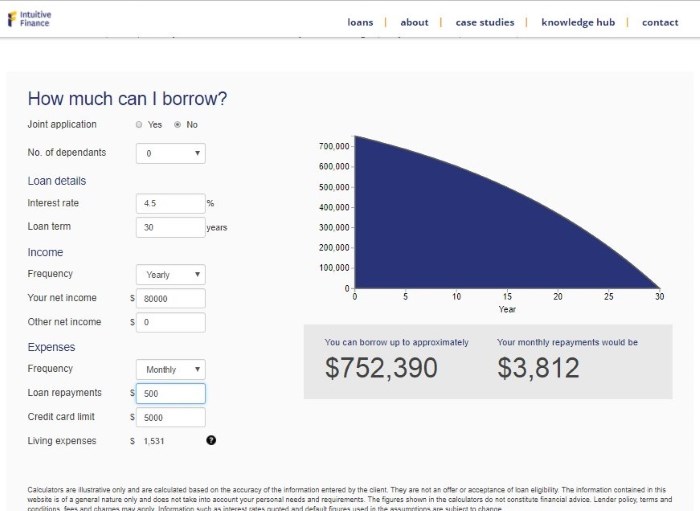
- Limitations of Online Tools: Online mortgage calculators are useful for quick estimates, but they are based on generalized inputs and don’t account for the specifics of your credit history, employment stability, or individual lender criteria. They provide a ballpark figure, not a definitive offer.
- Importance of Professional Assessment: The most accurate way to determine your borrowing capacity is through pre-qualification or, even better, pre-approval from a lender.
- Pre-qualification: A preliminary estimate based on self-reported financial information. It’s a good starting point but not a commitment from the lender.
- Pre-approval: A much more thorough process where the lender verifies your income, assets, and credit. They issue a conditional commitment for a specific loan amount, which makes your offer more attractive to sellers. This step is crucial before you start seriously house hunting.
Strategies to Maximize Your Mortgage Borrowing Power
If you’re not satisfied with your initial borrowing capacity estimate, or if you want to ensure you qualify for the best possible terms, there are several proactive steps you can take.
Improving Your Credit Score
A higher credit score signals less risk and can lead to lower interest rates and a larger loan amount.
- Pay Bills On Time: This is the single most important factor. Set up automatic payments to avoid missing due dates.
- Reduce Debt and Credit Utilization: Aim to keep your credit card balances below 30% of your available credit. Paying down existing debts improves your DTI and your credit score.
- Check Your Credit Report Regularly: Dispute any errors promptly.
- Avoid New Credit: Don’t open new credit accounts or make large purchases on credit in the months leading up to and during your mortgage application process, as this can temporarily lower your score and increase your DTI.
Reducing Existing Debt
A lower DTI ratio is consistently favored by lenders.
- Pay Off High-Interest Loans: Focus on eliminating credit card debt and personal loans first, as these often have high interest rates and contribute significantly to your monthly debt obligations.
- Minimize Credit Card Use: If you can’t pay off cards entirely, aim to pay more than the minimum to bring down balances.
- Consolidate Debt Wisely: If done strategically, consolidating high-interest debt into a lower-interest personal loan could reduce your monthly payments, but be cautious not to extend the repayment period excessively or incur new debt.
Increasing Your Income (or Demonstrating Stability)
While a sudden large income increase isn’t always feasible, demonstrating stable income is.
- Document Side Hustles: If you have reliable side income, ensure it’s properly documented through tax returns. Lenders typically need two years of consistent income from these sources.
- Maintain Stable Employment: Avoid job changes or career shifts just before or during the mortgage application process, unless it’s a clear promotion within the same field with a significant pay raise.
- Delay Major Career Changes: If you’re considering a big career move that might involve a probationary period or a change in pay structure, it might be wise to secure your mortgage first.
Saving a Larger Down Payment
This is one of the most impactful ways to increase your borrowing power and improve loan terms.
- Benefits of 20% or More: A 20% down payment (or more) helps you avoid PMI, reduces your monthly payment, and lowers your LTV ratio, making you a more attractive borrower. It also means you’re borrowing less principal.
- Gift Funds: If you receive a gift from a family member for your down payment, ensure you have a gift letter that meets lender requirements, as it’s typically required to prove the funds are not a loan.
Shopping Around for Lenders
Don’t settle for the first offer you receive. Different lenders have varying risk appetites, loan products, and fee structures.
- Compare Rates and Terms: Get quotes from multiple lenders – banks, credit unions, and mortgage brokers. A seemingly small difference in interest rate can save you tens of thousands of dollars over the life of the loan.
- Ask About Fees: Understand all closing costs and fees associated with each loan offer.
- Seek Pre-Approval from Multiple Lenders: This allows you to compare actual offers side-by-side without impacting your credit score significantly, provided you do it within a short window (typically 14-45 days).
Beyond Borrowing Capacity: Affordability vs. Qualification
It’s crucial to distinguish between what a lender says you can borrow and what you can comfortably afford. Just because a lender approves you for a certain amount doesn’t mean you should necessarily take the maximum.
Understanding Your True Monthly Budget
Homeownership comes with expenses far beyond just the mortgage principal and interest.
- Property Taxes: These are typically collected by the lender and held in an escrow account, but they are a significant ongoing cost.
- Homeowner’s Insurance: Mandatory to protect your property against damage, this is also often escrowed.
- HOA Fees: If your home is part of a homeowners association, these monthly or annual fees cover common area maintenance and amenities.
- Utilities: Budget for electricity, gas, water, sewer, internet, and trash collection.
- Maintenance and Repairs: This is an often-underestimated cost. Experts recommend budgeting 1-3% of your home’s value annually for maintenance, from routine landscaping to unexpected roof repairs.
- Opportunity Costs: Consider what else you might do with your money. Overextending yourself on a mortgage might mean sacrificing other financial goals like retirement savings or travel.
The Importance of a Financial Buffer
Having an emergency fund is vital, especially as a homeowner.
- Emergency Fund for Homeownership: Aim for at least three to six months’ worth of living expenses (including your mortgage payment) in an easily accessible savings account. This protects you from unforeseen job loss, medical emergencies, or major home repairs without jeopardizing your home.
- Maintaining Financial Flexibility: Avoid becoming “house poor” – where the majority of your income is consumed by housing costs, leaving little for other necessities, savings, or leisure. A comfortable mortgage payment allows for a balanced financial life.
Conclusion
Determining “how much can I borrow for a mortgage” is a pivotal step on your path to homeownership. It’s a multi-faceted calculation influenced by your income stability, debt load, credit health, and the size of your down payment. While lenders provide a ceiling based on their risk assessment, your personal affordability should be the ultimate determinant of your home buying budget.
By understanding the key factors, meticulously preparing your finances, and actively strategizing to improve your borrower profile, you can significantly enhance your borrowing power. However, always remember to prioritize your long-term financial well-being. A home that fits your budget comfortably, allowing for savings, emergencies, and other life goals, is far more valuable than one that stretches you to your financial limits. Engage with reputable lenders, ask plenty of questions, and make an informed decision that secures both your dream home and your financial peace of mind.
aViewFromTheCave is a participant in the Amazon Services LLC Associates Program, an affiliate advertising program designed to provide a means for sites to earn advertising fees by advertising and linking to Amazon.com. Amazon, the Amazon logo, AmazonSupply, and the AmazonSupply logo are trademarks of Amazon.com, Inc. or its affiliates. As an Amazon Associate we earn affiliate commissions from qualifying purchases.