
The Eagles’ 1976 hit, “Hotel California,” remains one of rock music’s most enduring and enigmatic anthems. Its haunting melody, vivid imagery, and cryptic lyrics have sparked decades of debate and speculation about its true meaning. While many interpret it as a straightforward narrative about a specific hotel or a personal experience, a deeper dive reveals a more profound and complex allegorical interpretation, particularly when viewed through the lens of Brand strategy and the seductive, often deceptive, nature of modern society and its aspirational promises.
The song’s enduring power lies in its masterful use of metaphor and symbolism, creating a powerful narrative that resonates on multiple levels. It’s not merely a story about a place, but a commentary on a pervasive cultural phenomenon. In understanding “Hotel California,” we can draw parallels to the allure and ultimate entrapment that can be experienced within any powerful brand, system, or ideology that promises more than it can deliver, ultimately consuming the individual who succumbs to its charm.

The Siren Song of Illusory Paradise: Crafting a Compelling Brand Narrative
The initial allure of the “Hotel California” is undeniably powerful, much like the carefully constructed narratives of successful brands. The lyrics paint a picture of an inviting and almost ethereal destination, a stark contrast to the dusty, mundane reality the traveler is escaping.
The Promises of Escape and Belonging
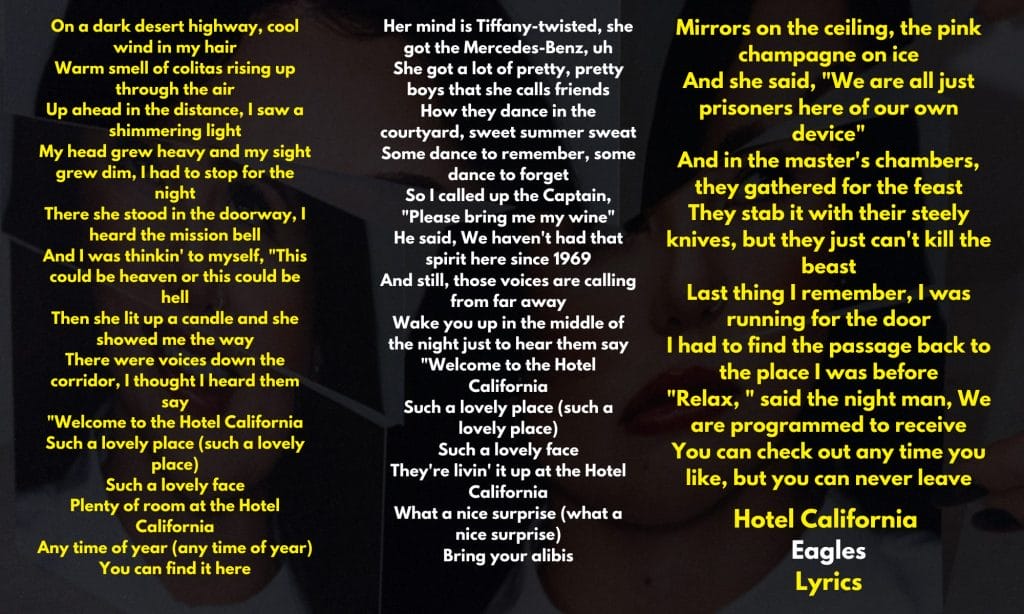
The opening lines, “On a dark desert highway, cool wind in my hair / Warm smell of colitas, rising up through the air,” immediately establish a sense of freedom and sensory pleasure. This is the quintessential marketing promise: escape from the ordinary, the mundane, the difficult. The “warm smell of colitas” (often interpreted as marijuana, but also as a more general sensory allure) is a subtle hint of indulgence, a taste of something beyond the everyday. This mirrors how brands meticulously craft their imagery to evoke feelings of desire, aspiration, and belonging. Whether it’s the sleek design of a luxury car, the curated lifestyle associated with a fashion label, or the perceived innovation of a tech gadget, the initial brand message is always about offering something better, something more fulfilling.
The lyrics continue, “Up ahead in the distance, I saw a shimmering light / My head grew heavy and my sight grew dim / I had to stop for the night.” This “shimmering light” is the beacon of the brand’s promise, drawing the individual in. The traveler, weary and seeking respite, is susceptible to this allure. Similarly, consumers are often drawn to brands during periods of vulnerability or dissatisfaction, seeking a solution or an enhancement to their lives. The ease with which the traveler “had to stop for the night” suggests a lack of conscious decision-making, a surrender to the prevailing current, mirroring how consumers can be swept up by trends and marketing campaigns without critical evaluation.
The Illusion of Perpetual Luxury
Once inside, the hotel’s description amplifies the illusion. “Her mind is Tiffany-twisted, she got the Mercedes bends / She got a lot of pretty, pretty boys she calls friends.” This imagery speaks to a world of material wealth, social status, and effortless sophistication. Tiffany & Co. and Mercedes-Benz are established symbols of luxury and success, reinforcing the idea that the Hotel California is a place where such ideals are not only achievable but commonplace. This is precisely how powerful brands leverage their associations and established identities to attract and retain customers. They sell not just products or services, but a vision of a life that aligns with the consumer’s deepest desires for status, comfort, and desirability.
The lyrics further emphasize this perpetual state of luxurious indulgence: “And in the master’s chambers / They gathered for the feast / They stab it with their steely knives / But they just can’t kill the beast.” This scene, though metaphorical, suggests a decadent and perhaps even predatory elite, enjoying the fruits of their position. The inability to “kill the beast” hints at the inherent power and self-perpetuating nature of this exclusive club. For brands, this translates to a loyal customer base that is deeply invested in the brand’s ecosystem, often to the point where disengaging becomes difficult, if not impossible.
The Unraveling: When Brand Promises Become Chains
The song masterfully transitions from seduction to entrapment, revealing the dark underbelly of the seemingly perfect paradise. This shift mirrors the experience of individuals who become too deeply enmeshed in a particular brand, ideology, or lifestyle, finding that the initial freedom has morphed into a form of subtle, or not so subtle, control.
The Loss of Agency and the Inescapable Nature of Commitment
The iconic chorus, “Welcome to the Hotel California / Such a lovely place (Such a lovely place) / Such a lovely face / Plenty of room at the Hotel California / Any time of year (Any time of year) / You can find it here,” shifts from a welcoming invitation to a chilling pronouncement. The repetition, initially reassuring, takes on a more sinister tone, suggesting a lack of genuine choice. The phrase “Any time of year, you can find it here” implies an omnipresence and inevitability, making escape seem futile. This is analogous to the sticky nature of many modern brands, which use loyalty programs, subscription models, and extensive product ecosystems to create dependencies that are difficult to break. Once you’re “in,” leaving can be a complex and costly endeavor.
The lyrics then introduce the unsettling realization of being trapped: “Mirrors on the ceiling / The pink champagne on ice / And she said, ‘We are all just prisoners here, of our own device.'” This is a critical turning point. The luxurious trappings are still present, but their context has changed. The “pink champagne on ice” no longer represents pure pleasure but a gilded cage. The admission that “we are all just prisoners here, of our own device” is crucial. It acknowledges that while external forces (the brand, the system) play a role, the individual’s own choices, desires, and initial willingness to embrace the illusion are what ultimately lead to their entrapment. Brands, through sophisticated marketing and by tapping into our desires, can indeed create a sense of “our own device” that leads to sustained engagement, often without us fully realizing the extent of our commitment.
The Rituals of Consumption and the Erosion of Identity
The song continues to depict a society consumed by its own self-created reality, where rituals and superficialities have replaced genuine connection and purpose. “And in the master’s chambers / They gathered for the feast / They stab it with their steely knives / But they can’t kill the beast.” This imagery suggests a group addicted to a cycle of consumption and superficial engagement, unable to break free from their habits. The “feast” is the constant influx of new experiences, products, or information offered by the brand, while the “steely knives” represent attempts to critique or escape, which ultimately prove ineffective against the ingrained “beast” of the system.
The chilling final verses solidify this sense of inescapable cyclical behavior: “Last thing I remember, I was running for the door / I had to find the passage back to the place I was before / ‘Relax,’ said the night man, ‘We are programmed to receive. / You can check out any time you like, but you can never leave!'” This definitive statement highlights the ultimate paradox of being caught within a powerful, self-sustaining system. The desire to escape is met with a resigned acceptance of the system’s pervasive control. “Relax, we are programmed to receive” implies that the system is designed to cater to, and perhaps exploit, our desires, making us passive recipients rather than active agents. The impossibility of truly leaving, despite the ability to “check out,” underscores the lasting impact of such engagements on one’s identity and freedom.
The Enduring Relevance: Branding, Consumerism, and the Pursuit of the Inevitable
“Hotel California” transcends its time and its immediate lyrical content to offer a timeless commentary on the human condition, particularly in relation to the pervasive influence of branding and consumer culture. The song’s enduring power lies in its ability to capture the seductive nature of aspirational promises and the eventual realization of their limitations, or even their deceptive nature.
The Allure of the “Brand Self” and the Trap of Aspiration
In an era defined by curated online personas and the relentless pursuit of aspirational lifestyles, the “Hotel California” serves as a potent metaphor. Brands, more than ever, are not just selling products; they are selling identities, lifestyles, and perceived happiness. Consumers are encouraged to align themselves with specific brands to project a desired image, to signal their status, and to feel a sense of belonging to a particular tribe. This process can lead to individuals adopting a “brand self” that is carefully constructed and maintained, often at the expense of their authentic identity. The “Hotel California” embodies the ultimate realization of this: the curated perfection becomes a prison, and the aspirational self becomes the very thing that binds them.
The song’s critique resonates deeply with the experience of consumerism. We are drawn to the shiny, the new, the advertised ideal. We invest our time, our money, and our emotional energy into acquiring and maintaining these aspirational markers. However, much like the guests at the Hotel California, we can find ourselves in a perpetual state of wanting, always chasing the next acquisition, the next experience, the next endorsement. The “feast” never truly satisfies, and the “beast” of perpetual desire remains unconquered. The song warns against mistaking the symbols of success and happiness for happiness itself, and against allowing external brands to dictate our internal sense of worth.
The Systemic Nature of Modern Entrapment
Ultimately, “Hotel California” can be interpreted as a critique of societal systems that, while offering initial allure and perceived benefits, ultimately serve to perpetuate themselves by trapping individuals within their structures. This can be applied to various aspects of modern life, from the pressures of corporate careers and the relentless pursuit of wealth to the addictive nature of social media and the entertainment industry. These systems, like the Hotel California, often present themselves as desirable destinations, promising fulfillment and belonging. However, once immersed, the individual can find it incredibly difficult to disengage, their agency gradually eroded by the very structures they initially sought to benefit from.
The song’s enduring legacy lies in its ability to provoke introspection. It encourages us to question the narratives we are sold, the desires that drive us, and the true cost of our commitments. It’s a cautionary tale about the seductive power of illusion and the importance of maintaining our autonomy in a world that constantly seeks to define and contain us through its carefully crafted brands and pervasive systems. The Hotel California, in its enigmatic grandeur, remains a potent reminder to always be mindful of the exit, even as we are drawn into its seemingly irresistible embrace.
aViewFromTheCave is a participant in the Amazon Services LLC Associates Program, an affiliate advertising program designed to provide a means for sites to earn advertising fees by advertising and linking to Amazon.com. Amazon, the Amazon logo, AmazonSupply, and the AmazonSupply logo are trademarks of Amazon.com, Inc. or its affiliates. As an Amazon Associate we earn affiliate commissions from qualifying purchases.