
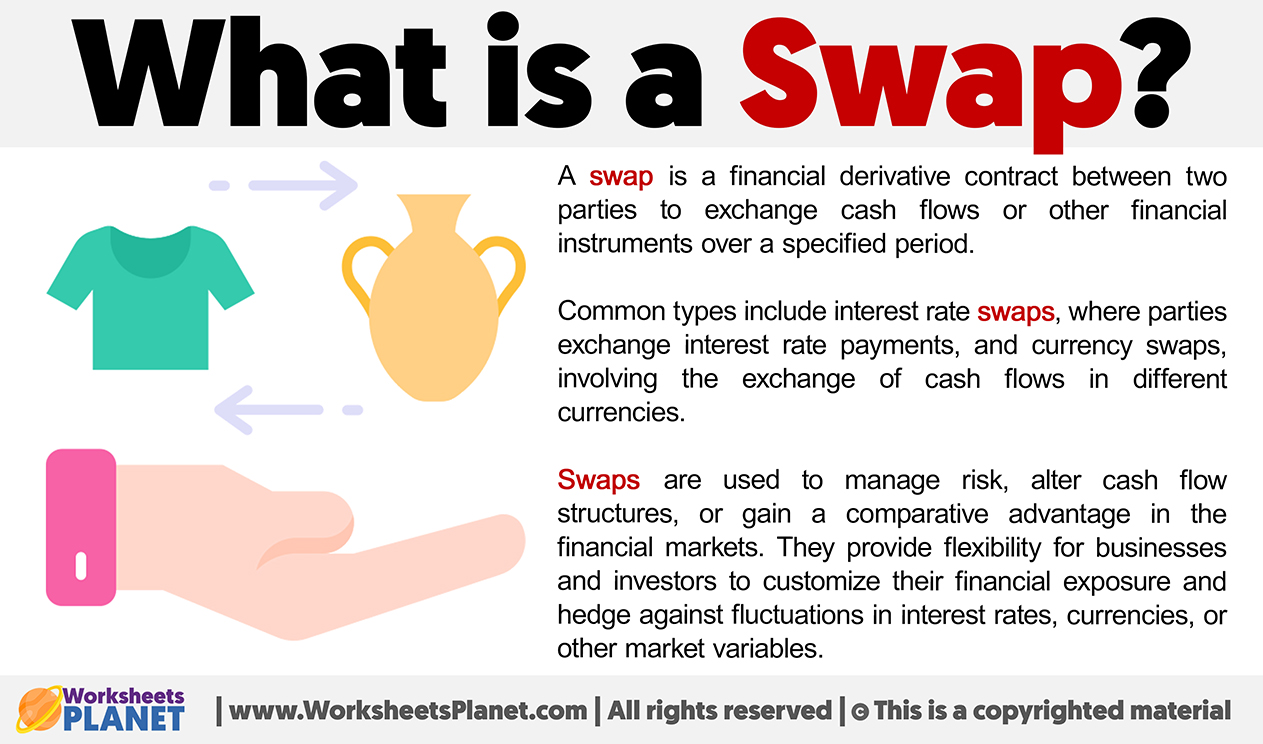
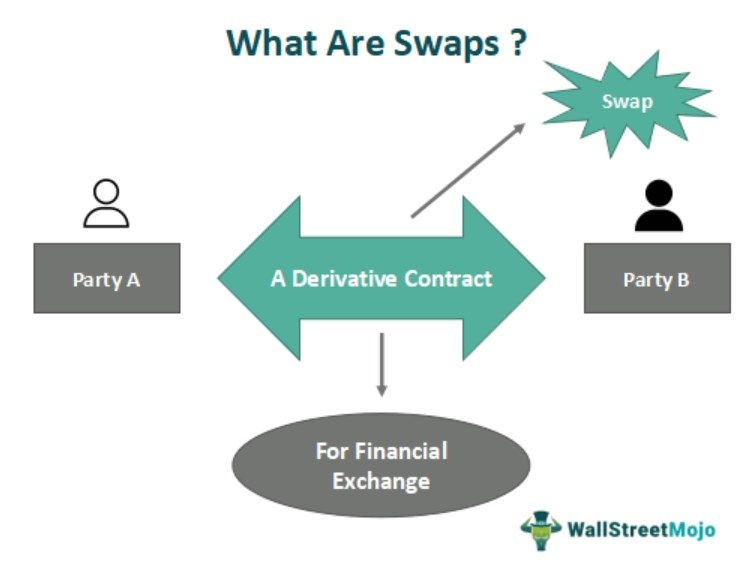
In the complex landscape of global finance, the term “swap” represents one of the most powerful and versatile instruments available to investors, corporations, and financial institutions. At its core, a swap is a derivative contract through which two parties exchange the cash flows or liabilities from two different financial instruments. While the word “swap” might sound like a simple trade of goods in a marketplace, in the world of money, it is a sophisticated mechanism used to manage risk, lower borrowing costs, and speculate on the movement of markets.
Understanding what a swap means is essential for anyone looking to navigate professional finance or the burgeoning world of digital assets. This guide explores the mechanics of swap agreements, the various types used in global markets, and the strategic reasons why they remain a cornerstone of modern financial engineering.
Understanding the Fundamentals of Financial Swaps
To understand what a swap means in a financial context, one must first view it as a customized contract. Unlike stocks or bonds, which are often standardized and traded on public exchanges, swaps are typically “over-the-counter” (OTC) agreements. This means they are private contracts tailored to the specific needs of the two parties involved, known as counterparties.
Definition and Core Mechanics
In a swap, the counterparties agree to exchange one stream of future cash flows for another. These streams are calculated based on a “notional principal amount.” It is important to note that in most interest rate swaps, the notional principal itself never actually changes hands; it exists only as a reference point to calculate the interest payments being exchanged.
For example, if two parties enter into a $10 million interest rate swap, they aren’t lending each other $10 million. Instead, they are agreeing to pay each other the interest that $10 million would accrue under different conditions (such as a fixed rate versus a floating rate). This allows both parties to change their financial exposure without having to renegotiate their original loans or asset holdings.
Why Institutions and Investors Use Swaps
The primary motivation behind any swap is the optimization of a financial position. There are three main reasons why a “Money” niche participant—be it a CFO of a corporation or a hedge fund manager—would engage in a swap:
- Risk Management (Hedging): If a company has a loan with a variable interest rate, they run the risk of rates rising, which would increase their costs. By entering a swap to “exchange” their variable rate for a fixed rate, they lock in their costs and gain predictability.
- Comparative Advantage: Sometimes, Company A can get a better deal on a fixed-rate loan, while Company B can get a better deal on a floating-rate loan. Through a swap, they can trade these advantages to ensure both parties pay less than they would have individually.
- Speculation: Traders may use swaps to bet on the direction of interest rates, currency fluctuations, or the creditworthiness of a third party.
Common Types of Swaps in Modern Finance
The term “swap” acts as an umbrella for several specific financial structures. Depending on the asset class being manipulated, a swap can take various forms, each serving a distinct purpose in a portfolio.
Interest Rate Swaps: Managing Debt Costs
The most common type of swap is the interest rate swap. In this arrangement, one party agrees to pay a “fixed” interest rate on a notional amount, while the other party pays a “floating” rate (usually tied to a benchmark like SOFR or the formerly dominant LIBOR).
Consider a real estate developer with a $50 million loan at a floating rate of “Benchmark + 1%.” If the developer fears that central banks will hike interest rates, they enter an interest rate swap. They agree to pay a bank a fixed 4% interest rate, and in return, the bank pays them the “Benchmark + 1%” rate. These two floating payments cancel each other out, effectively leaving the developer with a predictable 4% fixed-rate obligation.
Currency Swaps: Navigating Global Markets
In an increasingly globalized economy, corporations often operate in multiple countries. A currency swap involves exchanging the principal and interest payments of a loan in one currency for the principal and interest of a loan in another currency.
Unlike interest rate swaps, currency swaps usually involve an actual exchange of principal at the beginning and the end of the contract. This is a vital tool for multinational corporations (like Apple or Toyota) that need to fund operations in a foreign country but want to avoid the “exchange rate risk” that comes with fluctuating currency values. By using a swap, they can secure the currency they need today while locking in the rate at which they will trade it back in the future.
Credit Default Swaps (CDS): Insuring Against Risk
A Credit Default Swaps (CDS) is effectively an insurance policy on a debt instrument. If an investor owns a corporate bond and is worried the company might go bankrupt (default), they can buy a CDS from another party.
The buyer of the CDS makes periodic payments (like insurance premiums) to the seller. If the bond issuer defaults, the seller of the CDS compensates the buyer for the loss. While CDS gained a negative reputation during the 2008 financial crisis due to a lack of transparency, they remains an essential tool for managing credit risk in the bond market today.
The Rise of Token Swaps in the Digital Economy
As we move further into the era of digital finance and “Online Income,” the definition of a swap has expanded to include the world of cryptocurrency and Decentralized Finance (DeFi). In this context, “what does swap mean” refers to the immediate exchange of one digital asset for another without the need for a traditional intermediary like a bank.
How Cryptocurrency Swaps Differ from Traditional Finance
In traditional finance, a swap is a long-term agreement involving future cash flows. In the “Money” niche of crypto, a “swap” is often an instantaneous trade. For instance, an investor might “swap” Ethereum (ETH) for a stablecoin like USDC.
This is made possible by “Swap Protocols” or Decentralized Exchanges (DEXs). Unlike a traditional stock exchange that uses an order book to match buyers and sellers, these platforms allow users to swap assets directly against a “liquidity pool.”
The Role of Automated Market Makers (AMMs)
The technology behind these swaps is the Automated Market Maker (AMM). These are smart contracts that hold reserves of two or more tokens. When a user wants to swap Token A for Token B, the AMM uses a mathematical formula to determine the price and executes the trade instantly. For individuals looking for side hustles or yield-generating strategies, providing the “liquidity” that enables these swaps has become a popular way to earn passive income via “liquidity mining.”
Risks and Strategic Considerations in Swap Transactions
While swaps are powerful tools for financial optimization, they are not without significant risks. Anyone engaging in swap agreements—whether they are corporate treasurers or retail crypto investors—must understand the potential for loss.
Counterparty Risk and Regulation
The most significant risk in a traditional OTC swap is “counterparty risk.” Because these are private contracts, there is always a chance that the person or institution on the other side of the trade will fail to meet their obligations. If you are receiving payments in a swap and the other party goes bankrupt, your hedge disappears, leaving you exposed to the very market volatility you were trying to avoid.
Since the 2008 crisis, the financial industry has moved toward “central clearing” for many types of swaps. This introduces a middleman (a clearinghouse) that guarantees the trade, significantly reducing the risk of one party defaulting on the other.
Impact of Interest Rate Volatility and Liquidity
Swaps are highly sensitive to market conditions. In an interest rate swap, if you lock in a fixed rate of 5% and market rates drop to 2%, you are “out of the money,” meaning you are paying significantly more than the current market price.
Furthermore, “liquidity risk” can occur when a party wants to exit a swap agreement before its maturity date. Because swaps are customized, finding a third party to take over your position can be difficult and expensive. In the world of crypto swaps, this manifests as “slippage”—the difference between the expected price of a trade and the price at which the trade is actually executed, often caused by low liquidity in the pool.

Conclusion: The Strategic Value of Swapping
To answer “what does swap mean” is to describe the engine of modern financial flexibility. Whether it is a multi-billion dollar interest rate swap between a sovereign nation and a global bank, or a simple token swap performed by a retail investor on a smartphone, the goal remains the same: the efficient reallocation of value and risk.
For those focused on personal finance, investing, and business growth, swaps offer a way to navigate an uncertain world. They allow for the transformation of liabilities, the protection of assets, and the discovery of new yield opportunities in digital markets. By mastering the mechanics of swaps, one gains a deeper understanding of how money moves, how risks are mitigated, and how the global economy maintains its balance in an ever-changing financial climate.
aViewFromTheCave is a participant in the Amazon Services LLC Associates Program, an affiliate advertising program designed to provide a means for sites to earn advertising fees by advertising and linking to Amazon.com. Amazon, the Amazon logo, AmazonSupply, and the AmazonSupply logo are trademarks of Amazon.com, Inc. or its affiliates. As an Amazon Associate we earn affiliate commissions from qualifying purchases.