
High index lenses represent a significant technological advancement in eyewear, offering a superior solution for individuals requiring vision correction. Unlike conventional spectacle lenses, which can be thick and cumbersome, high index lenses are engineered using advanced materials that allow for a thinner, lighter, and often more aesthetically pleasing design. This innovation directly addresses common complaints about traditional eyeglasses, such as weight, bulk, and distortion, thereby enhancing both comfort and visual experience.
The core principle behind high index lenses lies in their refractive index. Refractive index is a measure of how much a material bends light. A higher refractive index means the material bends light more sharply. This increased bending power allows for a lens with a reduced curvature to achieve the same corrective power as a lens made from a material with a lower refractive index. Consequently, less material is needed to create the same prescription, resulting in thinner and lighter lenses, especially for stronger prescriptions.

For anyone seeking an upgrade from standard eyeglass lenses, understanding the technology, benefits, and considerations of high index lenses is crucial. This exploration will delve into the science behind their design, the advantages they offer, the different types available, and key factors to consider when choosing them, all within the realm of Tech.
The Science Behind High Index Lenses: Refraction and Materials
At the heart of high index lenses lies the fundamental principle of optics: refraction. Understanding this concept is key to appreciating why these lenses are a technological marvel.
Refractive Index: Bending Light with Precision
Every transparent material has a refractive index, a dimensionless number that describes how fast light travels through it. Light travels fastest in a vacuum, and its speed is assigned a refractive index of 1. When light enters a different medium, such as glass or plastic, it slows down and bends. The refractive index of a material quantifies the extent of this bending.
- Lower Refractive Index: Materials like standard polycarbonate or CR-39 plastic have refractive indices typically around 1.50 to 1.59. These materials require a thicker lens profile to achieve a significant degree of light bending needed for stronger prescriptions. Imagine trying to bend a stiff piece of wire – it requires more effort and a larger arc.
- Higher Refractive Index: High index lenses are made from specialized plastics or glass with significantly higher refractive indices, commonly ranging from 1.60 to 1.74, and even higher in some specialized applications. These materials are designed to bend light more effectively. Think of trying to bend a more flexible material; a smaller curve can achieve a substantial bend. This increased efficiency in bending light is what allows for thinner lenses.
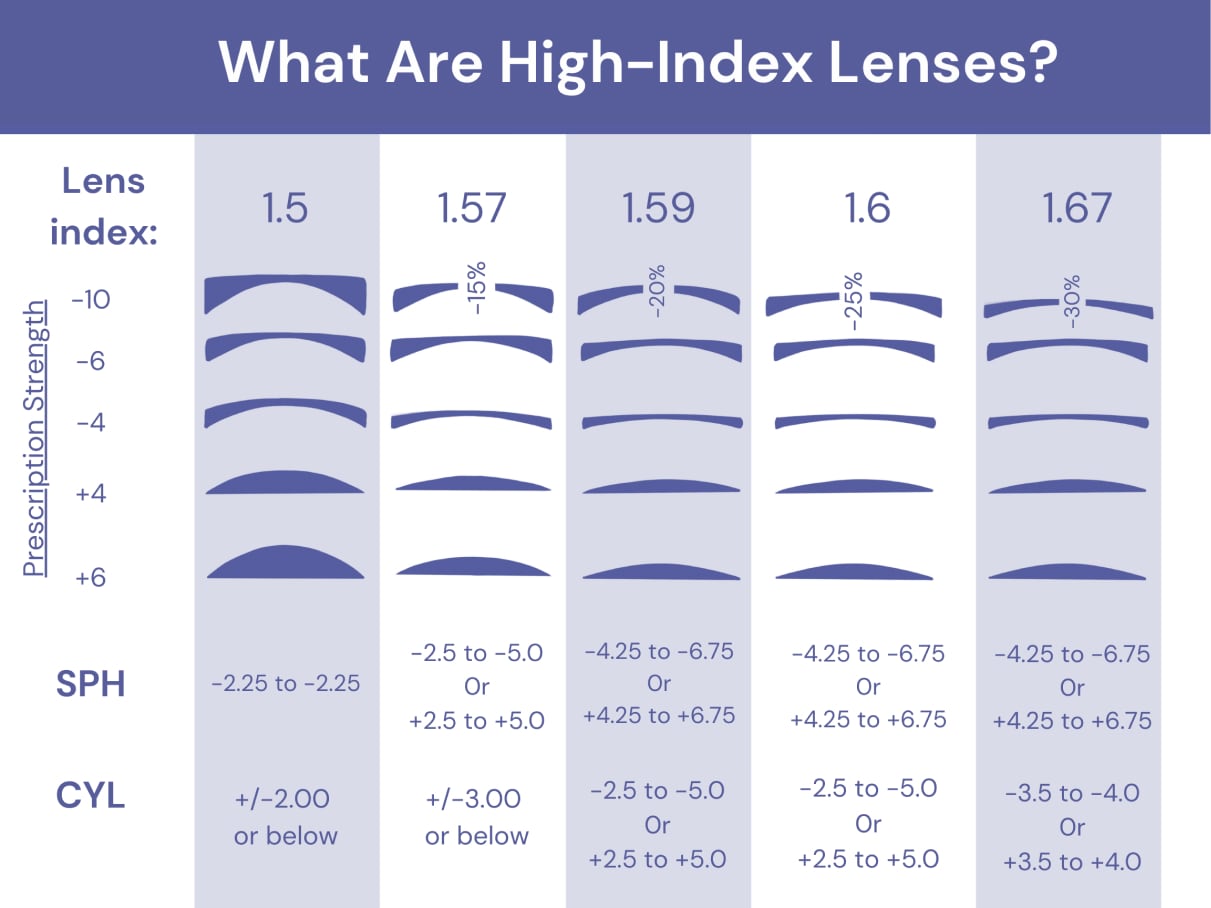
The formula that connects lens power, focal length, and refractive index is crucial. A lens’s power (measured in diopters) is inversely proportional to its focal length. To achieve a specific diopter correction, a lens made from a high index material can have a shorter radius of curvature (and thus be thinner) than a lens made from a lower index material for the same prescription. This means that for a prescription of, say, -5.00 diopters, a 1.74 index lens will be considerably thinner than a 1.50 index lens.
Advanced Material Composition: The Technological Core
The ability to achieve high refractive indices is not a matter of chance but a result of sophisticated material science and manufacturing processes. The development of these materials is a testament to ongoing technological innovation in the optical industry.
- Polycarbonate and Trivex Variations: While standard polycarbonate has a refractive index of 1.59, advanced manufacturing techniques and molecular restructuring have led to the development of higher index versions within this category, often falling in the 1.60 range. These maintain some of the inherent durability and impact resistance of polycarbonate.
- High-Index Plastics (Mid-Index Range): Lenses in the 1.60 to 1.67 refractive index range are typically made from specialized plastics. These materials often incorporate sulfur and bromine atoms into their molecular structure. These heavier elements have a higher electron density, which causes light to interact more strongly and bend more significantly as it passes through. The manufacturing processes for these plastics are precise, ensuring optical clarity and consistent refractive properties.
- Ultra-High Index Plastics (Premium Range): The highest index lenses, commonly found in the 1.70 to 1.74 range (and sometimes even higher for specialized applications), utilize even more advanced polymer compositions. These often involve heavier elements and complex molecular chains designed to maximize light bending. The manufacturing of these lenses is highly sophisticated, requiring specialized equipment and stringent quality control to achieve both high refractive index and optical purity.
The development of these materials is an ongoing area of research. Scientists and engineers continuously explore new compounds and molecular architectures to achieve higher refractive indices while maintaining essential optical qualities like clarity, minimal chromatic aberration, and durability. This dedication to material science is what underpins the significant advantages of high index lenses.
Advantages of High Index Lenses: A Leap in Eyewear Technology
The technological advancements embodied in high index lenses translate into tangible benefits for the wearer, revolutionizing the comfort, aesthetics, and practicality of prescription eyewear.
Enhanced Aesthetics: Thinner, Lighter, and More Attractive
One of the most immediately noticeable benefits of high index lenses is their appearance. For individuals with strong prescriptions, traditional lenses can be thick, protruding noticeably from the frame. This thickness can create a “coke-bottle” effect for myopic (nearsighted) individuals, making their eyes appear smaller, and a magnified, “bug-eye” look for hyperopic (farsighted) individuals.
- Reduced Lens Thickness: As explained by their higher refractive index, these lenses require less curvature to achieve the same prescription. This translates directly into significantly thinner lenses, especially at the edges for minus prescriptions and the center for plus prescriptions. This reduction in thickness is most pronounced for higher diopter prescriptions. For instance, a -6.00 diopter prescription in a 1.50 index lens might be quite thick, while the same prescription in a 1.74 index lens can be almost as thin as a credit card.
- Minimizing Magnification/Minification Effects: The reduced curvature of high index lenses also means less distortion of the wearer’s eyes as seen by others. This allows for a more natural appearance, enhancing the wearer’s confidence and the overall aesthetic appeal of the glasses. The eyes will look closer to their natural size, regardless of the prescription strength.
- Wider Frame Selection: The reduced thickness and weight of high index lenses make them compatible with a much broader range of eyeglass frames. Previously, individuals with strong prescriptions might have been limited to thicker, more robust frames to accommodate and hide lens thickness. With high index lenses, they can confidently choose from a wider array of fashionable, delicate, and minimalist frames, opening up a world of style possibilities.
Superior Comfort and Wearability: Less Weight, More Ease
Beyond aesthetics, the physical properties of high index lenses contribute significantly to user comfort. The reduction in material directly impacts the weight of the eyewear.
- Lightweight Design: The less material required for a high index lens means a lighter overall pair of glasses. This reduction in weight is particularly beneficial for individuals who wear their glasses all day. Heavy glasses can cause discomfort, pressure marks on the nose and ears, and even headaches. High index lenses alleviate these issues, making glasses feel almost unnoticeable.
- Reduced Pressure Points: The lighter weight distributes pressure more evenly across the bridge of the nose and behind the ears. This leads to a more comfortable fit, especially for those with sensitive skin or who find traditional glasses tend to slip down their nose due to their weight.
- Improved Durability (Often): While the primary driver for high index lenses is their refractive properties, many modern high index materials are also engineered for enhanced durability. They are often more impact-resistant than traditional glass lenses and can be treated with scratch-resistant coatings, further contributing to their longevity and practicality. However, it’s important to note that not all high index materials are inherently shatterproof like polycarbonate, so specific material choices and coatings are crucial.
Enhanced Visual Performance: Clarity and Reduced Aberrations
While often associated with cosmetic and comfort benefits, the technological sophistication of high index lenses also contributes to improved visual performance.
- Reduced Aberrations: While all lenses can exhibit optical aberrations, the precise manufacturing and advanced materials used in higher index lenses often lead to better optical quality. Chromatic aberration, a phenomenon where different colors of light are not focused at the same point, can be a concern with highly refractive materials. However, leading manufacturers employ advanced lens designs and coatings to minimize this effect, ensuring sharp and clear vision across the visible spectrum.
- Wider Field of Vision: The flatter curvature of high index lenses can sometimes lead to a slightly wider and more natural field of vision, especially when compared to very thick, highly curved traditional lenses. This can reduce the need for head movements to scan the surroundings, contributing to a more comfortable viewing experience.
Types of High Index Lenses: Navigating the Options
The category of “high index lenses” is not monolithic; it encompasses a range of materials with varying refractive indices, each offering a unique balance of benefits and cost. Understanding these distinctions is crucial for making an informed decision.
Mid-Index Lenses (1.60 – 1.67)
These lenses represent a popular entry point into the world of high index eyewear, offering a significant improvement over standard plastic or polycarbonate lenses without the highest cost.
- Refractive Index: Typically range from 1.60 to 1.67.
- Material Composition: Primarily made from specialized plastics incorporating heavier elements within their molecular structure.
- Target Prescription Range: Ideal for mild to moderate prescriptions, generally up to around -4.00 to -5.00 diopters. While they offer thinner lenses than basic options, very strong prescriptions might still show noticeable thickness.
- Benefits: Offer a noticeable reduction in lens thickness and weight compared to standard lenses. They are generally more impact-resistant than glass and are often more affordable than ultra-high index options.
- Considerations: While an improvement, they may not provide the ultra-thin profile desired for very high prescriptions or thin frame styles.
High-Index Lenses (1.70 – 1.74)
These lenses are considered premium options, providing the most significant reduction in thickness and weight for a wide range of prescriptions.
- Refractive Index: Typically range from 1.70 to 1.74. The 1.74 index is currently one of the highest commercially available.
- Material Composition: Utilize advanced polymer formulations with even higher concentrations of heavy elements, requiring highly sophisticated manufacturing techniques.
- Target Prescription Range: Excellent for moderate to very strong prescriptions, from around -4.00 diopters upwards. They are particularly beneficial for individuals with prescriptions exceeding -6.00 diopters.
- Benefits: Provide the thinnest and lightest lenses available for most common prescriptions. They offer the most significant aesthetic advantages, minimizing eye magnification/minification and allowing for a broader choice of frame styles.
- Considerations: Tend to be the most expensive option. They may also be slightly more prone to reflections and may require anti-reflective coatings to maximize clarity. Impact resistance can vary, so it’s essential to inquire about specific material properties.
Specialized Ultra-High Index Materials (Above 1.74)
Beyond the common 1.74 index, there are even higher index materials available, often for very specific and demanding applications.
- Refractive Index: Can exceed 1.74, reaching into the 1.80s and beyond.
- Material Composition: These are often proprietary materials developed for niche markets, sometimes incorporating glass-ceramic composites or other advanced optical materials.
- Target Prescription Range: Primarily designed for extremely high prescriptions that cannot be adequately addressed with standard high index options. They might also be used in specialized optical instruments.
- Benefits: Offer unparalleled thinness and lightness for the most extreme vision correction needs.
- Considerations: These are typically the most expensive and may have limitations in terms of coatings, durability, or availability. They are not commonly found in standard retail optometry practices.
Choosing the Right High Index Lenses: Key Considerations
Selecting high index lenses involves more than just picking the highest refractive index. A holistic approach, considering your prescription, lifestyle, and budget, is essential for maximizing the benefits of this advanced optical technology.
Prescription Strength and Type
The most significant factor influencing the need for high index lenses is the strength of your prescription.
- Myopia (Nearsightedness): For minus prescriptions, the edges of the lens are the thickest. Higher index materials dramatically reduce this edge thickness, making the lenses appear much thinner and more aesthetically pleasing. The higher your minus prescription, the more you will benefit from higher index lenses.
- Hyperopia (Farsightedness): For plus prescriptions, the center of the lens is the thickest. While less pronounced than with minus prescriptions, higher index materials still provide a noticeable reduction in center thickness, leading to lighter and more attractive lenses.
- Astigmatism: Astigmatism often coexists with myopia or hyperopia. The correction for astigmatism is incorporated into the lens design, and high index materials will still contribute to overall thinning and weight reduction, regardless of the astigmatism correction.
Lifestyle and Frame Choice
Your daily activities and aesthetic preferences play a vital role in determining the best high index lens for you.
- Active Lifestyles: If you lead an active or physically demanding lifestyle, consider the impact resistance of the lens material. While higher index lenses are generally durable, some materials may be more prone to chipping or breaking than others (e.g., polycarbonate). Discuss options with your optician that balance thinness with robust impact resistance, potentially with specialized coatings.
- Frame Style: If you have your heart set on a particular thin, rimless, or semi-rimless frame, high index lenses are almost a necessity to achieve the desired aesthetic. The reduced thickness ensures that the lenses integrate seamlessly with such frame designs without appearing bulky or detracting from the frame’s elegance.
- Occupational Needs: Certain professions might require specific lens properties. For example, if your work involves prolonged computer use, consider coatings that enhance visual comfort and protect against digital eye strain, which can be applied to high index lenses.

Coatings and Treatments
High index lenses often benefit from additional technological enhancements through coatings and treatments.
- Anti-Reflective (AR) Coating: This is perhaps the most crucial coating for high index lenses. Due to their higher refractive index, these lenses can reflect more light from their surfaces, leading to glare and diminished visual clarity, especially in low light conditions. An AR coating significantly reduces these reflections, enhancing light transmission, improving visual acuity, and making the lenses appear more transparent, allowing others to see your eyes more clearly.
- Scratch-Resistant Coating: While most modern lens materials have some inherent scratch resistance, a dedicated scratch-resistant coating adds an extra layer of protection against everyday wear and tear, prolonging the life and clarity of your lenses.
- Hydrophobic and Oleophobic Coatings: These repel water and oil, respectively, making the lenses easier to clean and preventing smudges from fingerprints. This is particularly beneficial for high index lenses, which can sometimes be more prone to showing smudges due to their optical properties.
- UV Protection: While most modern spectacle lenses offer UV protection, it’s a standard feature worth confirming, especially with advanced lens materials.
By understanding the science, appreciating the benefits, exploring the available types, and carefully considering these key factors, individuals can confidently choose high index lenses that provide not only superior vision correction but also unparalleled comfort and style, representing a significant technological leap in personal eyewear.
aViewFromTheCave is a participant in the Amazon Services LLC Associates Program, an affiliate advertising program designed to provide a means for sites to earn advertising fees by advertising and linking to Amazon.com. Amazon, the Amazon logo, AmazonSupply, and the AmazonSupply logo are trademarks of Amazon.com, Inc. or its affiliates. As an Amazon Associate we earn affiliate commissions from qualifying purchases.