
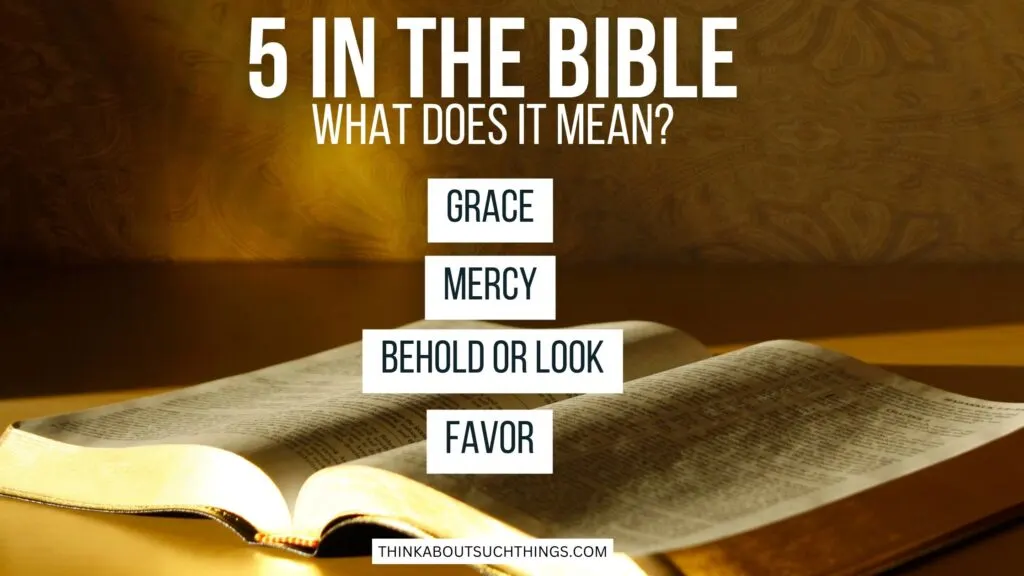
In the realm of biblical numerology, numbers are rarely accidental. They serve as a symbolic language that conveys deeper truths about the nature of existence, morality, and even economics. Among these, the number five holds a position of profound significance. Often referred to as the number of “God’s Grace” or “Divine Favor,” the number five appears throughout the scriptures in contexts that define how humans interact with resources, laws, and one another.
For the modern investor, entrepreneur, or professional, understanding the biblical significance of the number five offers more than just theological insight; it provides a framework for financial stewardship. In an era where “money” is often viewed through the lens of cold data and algorithmic trading, integrating the “Principle of Five”—favor, balance, and ethical responsibility—can transform a portfolio from a mere collection of assets into a tool for sustainable legacy and social impact.

The Principle of Grace in Financial Stewardship
In the biblical narrative, the number five is inextricably linked to grace. This is most notably seen in the tabernacle’s dimensions and the five types of offerings in Leviticus. In a financial context, grace translates to the realization that wealth is not merely the result of individual effort, but a gift or a “favor” that carries inherent responsibilities.
Redefining Wealth as a Gift, Not a Burden
Modern financial philosophy often emphasizes the “self-made” narrative. However, the biblical concept of five suggests that without divine favor or the “grace” of favorable circumstances, talent and hard work can only go so far. When we view our capital through this lens, our approach to risk and management shifts.
Instead of operating from a place of scarcity or fear, a grace-based financial mindset operates from a place of gratitude. This reduces the psychological stress associated with market volatility. If we believe that our ability to produce wealth is a gift (Deuteronomy 8:18), we become stewards rather than owners. This shift is essential for long-term financial health, as it encourages objective decision-making and discourages the emotional extremes of greed and panic.
The Ethical Compass: Leading with Integrity
The number five is also associated with the Pentateuch—the first five books of the Bible—which contain the foundational laws governing human conduct and commerce. These books outline the ethics of lending, the importance of fair weights and measures, and the prohibition of usury.
In contemporary business, applying the “Number 5” principle means prioritizing integrity over short-term gains. Whether it is a brand’s transparency in its ESG (Environmental, Social, and Governance) reporting or an individual’s honesty in tax filings, ethical stewardship is the bedrock of sustainable wealth. Grace does not mean an absence of law; rather, it provides the moral framework that makes commerce possible by fostering trust between parties.
The Five Pillars of a Biblical Wealth Strategy
To build a robust financial future, one must move beyond theory and into application. Using the number five as a structural guide, we can identify five key pillars that align biblical wisdom with modern investment strategies.
Diversification and the Fifth Portion
One of the most famous financial applications of the number five in the Bible is found in the story of Joseph in Egypt. Facing a global famine, Joseph implemented a “fifth part” rule (Genesis 41:34), requiring the land to save 20% of its harvest during the years of plenty. This 20% (one-fifth) served as a national reserve that ensured survival during the years of lack.
For modern personal finance, this “Fifth Portion” represents the ultimate blueprint for liquidity and emergency funds. While many financial advisors suggest a 10% savings rate, the biblical model of the fifth suggests a more aggressive 20% buffer. This creates a “margin of grace” that protects an individual or business from unforeseen market corrections, allowing them to remain buyers when everyone else is a forced seller.
Generosity as a Financial Catalyst
If the number five represents grace, that grace must flow outward to remain effective. In biblical economics, the “tithe” is well-known, but the “five” represents an extension of favor beyond the basic requirement. It is the concept of “the second mile” or the surplus given to help others thrive.
From a purely financial perspective, generosity acts as a psychological “reset” button. It breaks the “spirit of Mammon”—the obsessive pursuit of accumulation—and fosters a mindset of abundance. Furthermore, in the modern business world, philanthropy and social impact are increasingly linked to brand value. Companies that prioritize the well-being of their communities (extending favor) often see higher customer loyalty and employee retention, which directly impacts the bottom line.
Applying the ‘Number 5’ Mindset to Modern Business Growth
Scaling a business or a career requires more than just capital; it requires a strategy that respects the human element. The biblical number five reminds us that growth must be balanced by the human hand (which has five fingers) and human effort, guided by ethical principles.
Scaling with Grace: The Human Element in ROI
In the Bible, the “Five Talents” parable (Matthew 25) highlights the expectation of multiplication. The servant given five talents worked to produce five more. This is a clear endorsement of investment and growth. However, the “Number 5” context suggests that this growth should be achieved through “favor” and “grace” in how we treat our human capital.
For a CEO or a business owner, “scaling with grace” means investing in employees. When a company provides a living wage, professional development, and a healthy work-life balance, it is extending favor. This isn’t just “good” behavior; it’s a high-ROI strategy. High-performance cultures are built on the “grace” shown by leadership, which is then reciprocated by employee dedication and innovation.
Risk Management and Divine Favor
The number five is often seen as a symbol of protection (as in the five smooth stones David took to face Goliath). In the financial markets, David’s stones represent a concentrated but well-prepared approach to risk. He didn’t take a thousand pebbles; he took five specific tools.
In portfolio management, this translates to “concentrated diversification.” Instead of spreading resources so thin that no significant gains are possible, an investor should identify five core sectors or asset classes they understand deeply. By focusing on these “five stones,” and applying rigorous due diligence (the preparation), they can confront the “Goliaths” of inflation, market crashes, and economic shifts with confidence.
Legacy and the Multiplication of Resources
True wealth is not measured by what one accumulates, but by what one leaves behind. The number five, representing the grace of God, points toward a future-oriented perspective on money.
Passing Down the ‘Five Talents’ Mindset
Financial literacy is perhaps the greatest inheritance one can provide. Just as the five books of the Torah provided a roadmap for generations, parents and mentors should provide a “financial Torah” to their heirs. This involves teaching the “Five Talents” mindset: the responsibility to invest, the courage to take calculated risks, the discipline to save a fifth, the joy of generosity, and the commitment to ethical dealings.
A legacy built on these five pillars ensures that the wealth will not be squandered. Statistics show that 70% of wealthy families lose their wealth by the second generation. This usually happens because the capital was passed down without the “grace” and “wisdom” (the symbolic five) required to manage it.
Sustainability and Long-Term Impact
Finally, the number five in the Bible points toward the concept of the “Year of Jubilee,” which occurs after seven cycles of seven years, but the principles of debt release and restoration are rooted in the grace of the law. In our modern economy, this translates to sustainable investing.
Are your investments making the world a better place for the next generation? Using the “Number 5” as a guide, investors should look for companies that promote flourishing. This is the ultimate expression of grace in the marketplace: a financial system that does not just extract value but creates it. Whether through micro-lending, green energy, or ethical tech, wealth management should aim for a “grace-filled” impact that resonates long after the initial investment is made.

Conclusion
The number five in the Bible is a powerful symbol of grace, favor, and the foundational laws of God. When applied to the world of money and finance, it offers a refreshing and robust alternative to the often-greedy or fear-driven narratives of the secular market.
By embracing the “Principle of Five,” we recognize that wealth is a gift to be stewarded with integrity. We learn to save “the fifth portion” for times of need, to scale our businesses with a “grace-first” approach to human capital, and to use our resources as “five stones” to overcome economic challenges. Ultimately, financial success through this biblical lens is not just about the size of one’s bank account, but about the depth of one’s impact and the grace with which one manages the resources they have been entrusted with. In the intersection of faith and finance, the number five reminds us that while we work for the money, it is the favor and wisdom we apply to it that truly makes us wealthy.
aViewFromTheCave is a participant in the Amazon Services LLC Associates Program, an affiliate advertising program designed to provide a means for sites to earn advertising fees by advertising and linking to Amazon.com. Amazon, the Amazon logo, AmazonSupply, and the AmazonSupply logo are trademarks of Amazon.com, Inc. or its affiliates. As an Amazon Associate we earn affiliate commissions from qualifying purchases.