
Takt time is a fundamental concept in lean manufacturing and production management, representing the heartbeat of a production line. It dictates the pace at which a product must be completed to meet customer demand. In essence, it answers the critical question: “How often do we need to finish one unit to satisfy our customers without overproducing or falling behind?” While originating in manufacturing, the principles of takt time have found increasing relevance in various fields, including project management, software development, and even personal productivity, highlighting its universal applicability in achieving efficiency and flow.
The Core Calculation and Its Significance
At its heart, takt time is a simple calculation that holds profound implications for operational efficiency. Understanding this core formula is the first step in grasping its power and how it can transform production processes.
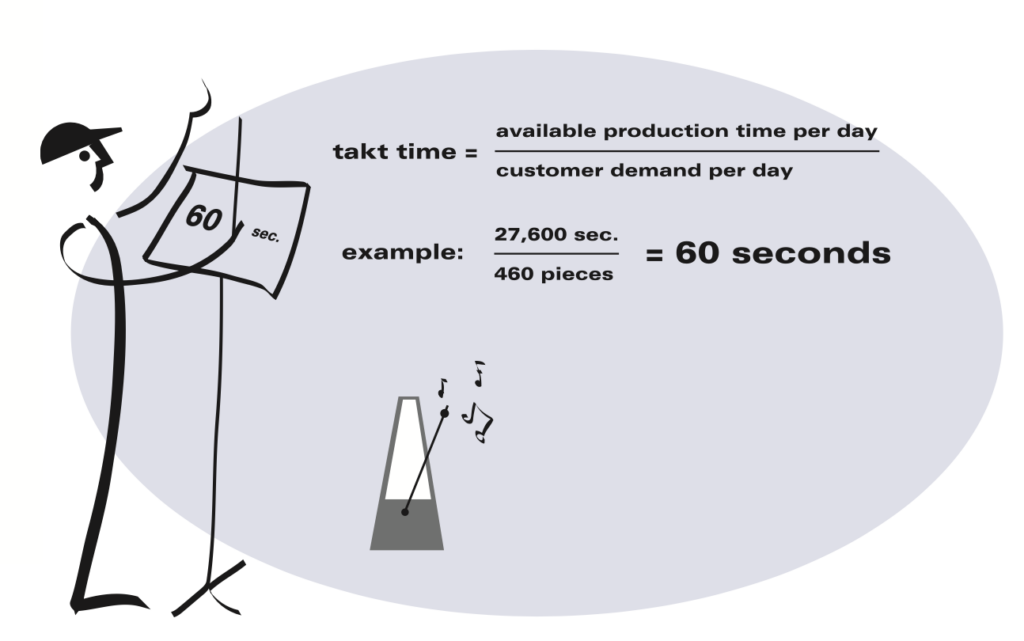
Calculating Takt Time
The fundamental formula for calculating takt time is:
Takt Time = Available Production Time / Customer Demand
Let’s break down each component:
-
Available Production Time: This refers to the total time your production system is actively operating. It’s crucial to consider this realistically. This isn’t just the 8-hour workday. You need to subtract non-productive time such as scheduled breaks (lunch, coffee breaks), maintenance periods, shift changes, and any planned downtime. For example, if you have an 8-hour shift (480 minutes) and plan for 30 minutes of breaks and 15 minutes for shift change, your available production time is 435 minutes. If you’re operating in a multi-shift environment, you would aggregate the available production time across all shifts.
-
Customer Demand: This is the number of units your customers require within a specific period. This demand must be aligned with the same timeframe as your available production time. If your available production time is measured in minutes per day, your customer demand should be expressed as units per day. For instance, if a customer requires 100 units per day, and your available production time is 435 minutes, your takt time would be 435 minutes / 100 units = 4.35 minutes per unit. This means that, on average, a finished unit must roll off the production line every 4.35 minutes to meet demand.
It’s important to ensure consistency in units. If demand is weekly, then available production time should also be calculated weekly. Accuracy in both these inputs is paramount. Inaccurate demand forecasts or an overly optimistic view of available production time will lead to an unrealistic takt time, which can then create bottlenecks or excess inventory.
Why Takt Time Matters: The Pursuit of Flow
The significance of takt time extends far beyond a mere mathematical exercise. Its primary purpose is to establish a steady, predictable rhythm for production, often referred to as “flow.” When a production process operates at takt time, it signifies that it is precisely synchronized with customer demand.
-
Eliminating Waste: One of the core tenets of lean manufacturing is the elimination of waste. Takt time directly combats several forms of waste:
- Overproduction: Producing more than is currently needed leads to excess inventory, storage costs, and the risk of obsolescence. Operating at takt time ensures you produce only what is required, when it is required.
- Waiting: When one stage of production is faster than the next, it creates waiting time for subsequent stages. Takt time helps balance the line so that each process step can keep pace.
- Inventory: Holding excessive raw materials, work-in-progress, or finished goods ties up capital and obscures problems. Synchronizing with takt time minimizes the need for large buffer stocks.
- Defects: Rushing to meet unrealistic deadlines can lead to errors and quality issues. Takt time encourages a steady pace, allowing for focus on quality at each step.
-
Creating a Predictable Rhythm: A consistent takt time creates a predictable operational rhythm. This allows for better planning, scheduling, and resource allocation. Employees understand the expected pace, and managers can more accurately forecast output. This predictability reduces stress and improves overall operational control.
-
Enabling Continuous Improvement: Takt time serves as a benchmark against which performance can be measured. If a process consistently takes longer than the takt time, it indicates a bottleneck that needs to be addressed. Conversely, if a process consistently finishes much faster, it might be an opportunity to reallocate resources or further streamline. This constant comparison fuels a culture of continuous improvement (Kaizen).
-
Customer Focus: Ultimately, takt time is intrinsically linked to customer satisfaction. By meeting demand precisely, businesses can reduce lead times, improve delivery reliability, and avoid the frustration of stockouts or delays. It shifts the focus from “how fast can we make it?” to “how fast do customers need it?”
Implementing Takt Time in Practice
Calculating takt time is the first step, but its true value lies in its application. Implementing takt time requires a structured approach, focusing on understanding your current processes and making necessary adjustments to achieve the desired rhythm.
Analyzing and Balancing the Production Line
Before you can achieve takt time, you need a clear understanding of how your production process actually works. This involves mapping out every step, from raw material input to finished product output, and identifying the time it takes for each individual task or operation.
-
Process Mapping (Value Stream Mapping): This is a crucial exercise. Value Stream Mapping (VSM) is a lean-management method for analyzing the current state and designing a future state for the series of events that take a product or service from its beginning through to the customer. It visually represents the flow of materials and information required to bring a product or service to a customer. During VSM, you meticulously document each step, its duration, the resources involved, and any waiting times or non-value-adding activities. The goal is to identify all the discrete tasks that contribute to producing one unit.
-
Work Element Time Study: Once the process is mapped, you need to accurately measure the time it takes to perform each specific work element. This involves observing the operators, using stopwatches, and collecting data. It’s important to time the actual value-adding work, excluding any interruptions or idle time. This data will form the basis for understanding how much time is spent on each operation.
-
Line Balancing: The essence of achieving takt time is to balance the workload across different stations or operators. Ideally, the time required for each step in the production process should be as close as possible to the calculated takt time.
- Bottleneck Identification: The VSM and time studies will reveal bottlenecks – the slowest steps in the process that dictate the overall throughput. These are the areas that will prevent you from meeting your takt time.
- Workload Reallocation: Once bottlenecks are identified, you can balance the line by reallocating tasks. This might involve:
- Splitting Tasks: If a task is too long, it can be split into smaller, more manageable sub-tasks that can be performed by different operators or at different stations.
- Combining Tasks: If several short tasks can be logically grouped and performed efficiently by one operator, they can be combined to free up resources elsewhere.
- Task Reassignment: Moving a time-consuming task from a slower station to a faster one, or vice versa, to distribute the workload more evenly.
- Adding Resources: In some cases, if a task is inherently long, you might need to add more resources (e.g., another operator, a specialized tool) to that station to bring its cycle time closer to takt time.
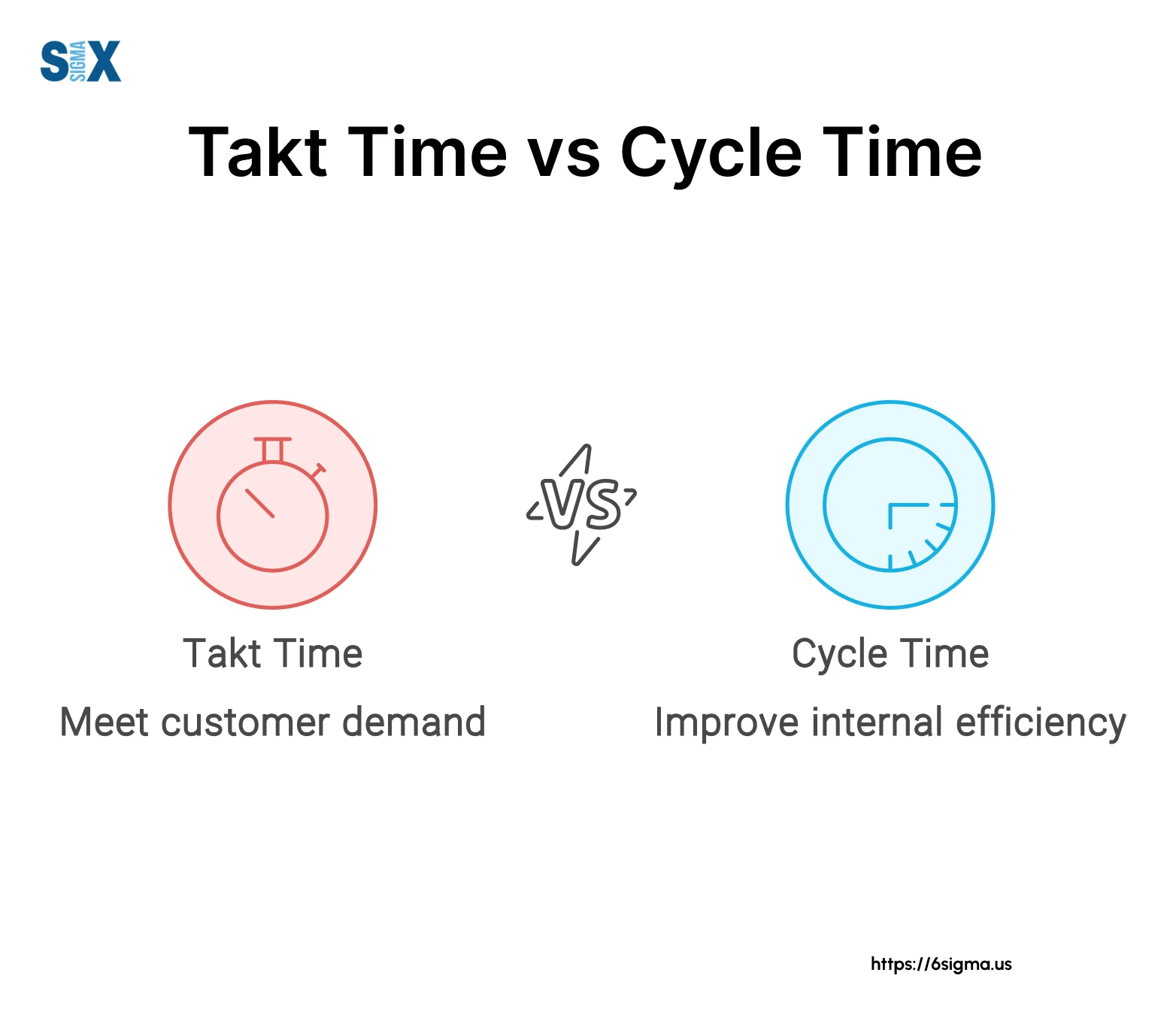
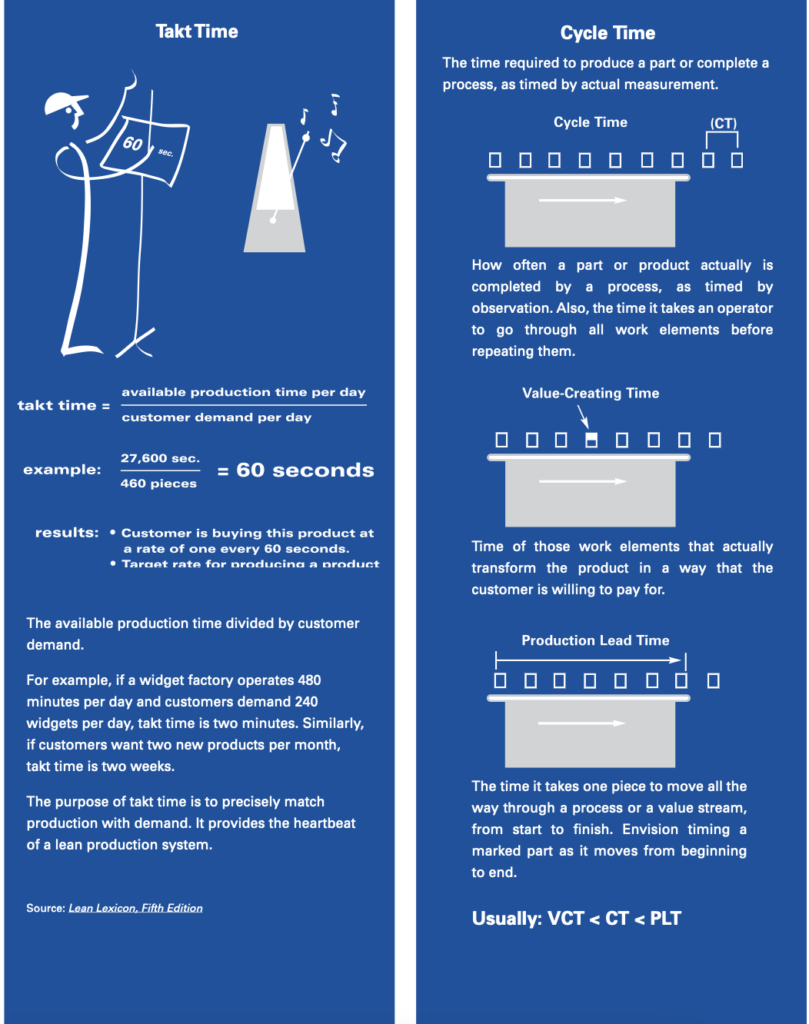
The goal of line balancing is to create a sequence of operations where the “cycle time” of each station (the time it takes to complete its assigned tasks) is equal to or less than the takt time.
Strategies for Achieving and Maintaining Takt Time
Achieving takt time is an ongoing journey, not a one-time fix. It requires a proactive approach to process management and a commitment to continuous improvement.
-
Standardized Work: Implementing standardized work is crucial for consistency. This means documenting the best, most efficient, and safest way to perform each task. Standardized work ensures that every operator performs their tasks in the same way, reducing variability and making it easier to identify deviations from the desired pace. It forms the basis for training new employees and serves as a reference point for improvement.
-
Visual Management: Visual cues are essential for communicating takt time and the status of the production line. This can include:
- Takt Time Boards: These boards can display the target takt time, the current demand, and real-time output.
- Andon Systems: These are visual signals (lights, sounds) that alert operators and supervisors to problems on the production line. They can indicate when a line is falling behind takt time, when there’s a quality issue, or when equipment needs attention.
- Workstation Layouts: Clear labeling of workstations and materials helps ensure efficient workflow and reduces confusion.
-
Continuous Improvement (Kaizen): Takt time is a dynamic target. Customer demand can change, processes can evolve, and new opportunities for efficiency can emerge. A commitment to Kaizen, the philosophy of continuous improvement, is vital. This involves regularly reviewing processes, soliciting feedback from operators, identifying areas for improvement, and implementing changes to refine the workflow and maintain takt time. This might involve small, incremental changes or more significant process redesigns.
-
Flexibility and Adaptability: While takt time provides a structured pace, real-world production environments often face disruptions. Building flexibility into the system is important. This might involve cross-training employees so they can move between different stations, having contingency plans for equipment breakdowns, and developing quick changeover procedures (SMED – Single-Minute Exchange of Die) to minimize downtime.
-
Data Collection and Analysis: Ongoing collection and analysis of production data are critical. Track cycle times, output rates, downtime, and defect rates. Use this data to monitor performance against takt time, identify trends, and make informed decisions about where to focus improvement efforts. Regularly review performance metrics to ensure that the production line remains synchronized with evolving customer needs.
Beyond Manufacturing: Takt Time in Modern Workflows
While born in the manufacturing halls, the principles of takt time are proving increasingly valuable in a wider array of modern business functions. Its core idea – synchronizing output with demand to optimize flow and minimize waste – translates effectively to knowledge work and service industries.
Takt Time in Project Management
In project management, “demand” is often represented by project deadlines, client milestones, or the release schedule for a new feature. “Available production time” can be the team’s available working hours after accounting for meetings, administrative tasks, and unexpected issues.
-
Defining Project Pace: Takt time can help define the required pace for different project phases. For instance, if a project needs to deliver a specific feature every two weeks to meet a market launch, the team’s work should be paced accordingly. This translates into breaking down the project into smaller, manageable tasks that can be completed within that defined rhythm.
-
Resource Allocation and Team Velocity: Understanding the “takt time” of a project can inform resource allocation. If a certain phase requires a faster output, more resources might need to be dedicated to it. It also ties into the concept of “team velocity” in agile methodologies, where the team measures how much work they can complete in a sprint. Ideally, velocity should be consistent and predictable, reflecting a controlled pace similar to takt time.
-
Risk Management: By setting a clear pace, project managers can identify potential delays earlier. If a team consistently falls behind the project’s “takt time,” it signals a problem that needs immediate attention, preventing larger schedule overruns.
Takt Time in Software Development
Software development, especially within agile frameworks, is another fertile ground for takt time principles. Here, demand can be seen as the rate at which new features are requested by users or stakeholders, or the frequency of software releases.
-
Feature Delivery Cadence: Takt time can guide the desired cadence for delivering new software features. If a company aims to release new functionalities every sprint (e.g., every two weeks), then the development and testing processes must be structured to meet that rhythm. This influences how stories are broken down, how development tasks are prioritized, and how testing is integrated.
-
Streamlining the Development Lifecycle: Applying takt time thinking encourages developers to look for bottlenecks in the software development lifecycle (SDLC). This could be slow code reviews, lengthy build times, or delays in testing environments. By identifying these points and striving to bring their cycle times closer to the desired takt time, teams can significantly improve their overall delivery speed and efficiency.
-
Continuous Integration and Continuous Delivery (CI/CD): Concepts like CI/CD are inherently aligned with takt time. By automating the build, test, and deployment processes, CI/CD pipelines aim to create a smooth, predictable, and rapid flow of code from development to production, directly supporting a consistent delivery rhythm.
Takt Time in Personal Productivity
Even in individual work, the principles of takt time can enhance efficiency and reduce stress. Here, “demand” is the personal or professional goals you need to achieve within a given timeframe, and “available production time” is your actual working time.
-
Goal Setting and Prioritization: By understanding the pace required to achieve your goals, you can better prioritize tasks. If you need to complete a major report by Friday, and you have 20 hours of focused work time available, your “takt time” for sections of that report becomes clearer.
-
Time Blocking and Task Management: Time blocking, a technique where you schedule specific blocks of time for particular tasks, is a practical application of takt time for individuals. It helps ensure that you dedicate sufficient time to each task at a pace that allows for completion within your overall deadlines.
-
Avoiding Procrastination and Burnout: A clear understanding of the required pace can help combat procrastination. Knowing that you need to complete X amount of work by Y time can motivate you to start earlier and work steadily. Conversely, it also helps prevent burnout by encouraging realistic pacing rather than constant last-minute rushes.
By embracing takt time, individuals and teams across various disciplines can move beyond reactive task completion to a proactive, flow-oriented approach, leading to greater efficiency, predictability, and ultimately, better outcomes.
aViewFromTheCave is a participant in the Amazon Services LLC Associates Program, an affiliate advertising program designed to provide a means for sites to earn advertising fees by advertising and linking to Amazon.com. Amazon, the Amazon logo, AmazonSupply, and the AmazonSupply logo are trademarks of Amazon.com, Inc. or its affiliates. As an Amazon Associate we earn affiliate commissions from qualifying purchases.