
When Jeff Bezos founded Amazon in 1994, it was a modest online bookstore operating out of a garage. Today, it is a trillion-dollar global conglomerate with a business strategy that has redefined modern capitalism. To understand the sheer scale of Amazon, one must look beyond its primary e-commerce platform and examine its massive portfolio of subsidiaries.
From a business finance perspective, Amazon’s growth is a masterclass in capital allocation and aggressive mergers and acquisitions (M&A). By reinvesting its profits into diverse sectors—ranging from high-end groceries to healthcare and entertainment—Amazon has built an ecosystem where every acquisition serves to strengthen its core Prime membership and data-collection capabilities. This article explores the major companies under the Amazon umbrella and the financial logic driving these multi-billion-dollar investments.

The Strategic Philosophy of Amazon’s Mergers and Acquisitions
Amazon’s investment strategy is rarely about buying a company just for its existing revenue. Instead, the leadership team looks for “force multipliers”—businesses that can be integrated into the Amazon ecosystem to lower operational costs or increase the lifetime value of a customer.
Scaling via Capital Injection
One of the primary reasons Amazon acquires companies is to provide the capital necessary for rapid scaling that the target company could not achieve independently. When Amazon acquires a business, it doesn’t just provide a payout to shareholders; it integrates the brand into its world-class logistics and cloud computing (AWS) infrastructure. This allows the subsidiary to lower its overhead and focus on market capture.
Entry into New Market Verticals
Entering a new industry from scratch is expensive and risky. Amazon often uses its massive cash reserves to buy its way into market leadership. Whether it is the grocery industry, the pharmaceutical space, or Hollywood production, Amazon’s acquisitions serve as a shortcut to gaining institutional knowledge, established supply chains, and a pre-existing customer base.
The Billion-Dollar Heavyweights: Amazon’s Largest Subsidiaries
Amazon has spent tens of billions of dollars over the last decade to acquire “anchor” companies. These are large-scale enterprises that operate as semi-autonomous units while feeding data and traffic back to the parent company.
Whole Foods Market: The Grocery Revolution
In 2017, Amazon sent shockwaves through the financial markets by acquiring Whole Foods Market for approximately $13.7 billion. This remains Amazon’s largest acquisition to date. From a financial standpoint, this wasn’t just about selling organic kale. It was a strategic real estate move. Whole Foods provided Amazon with hundreds of physical locations in high-income neighborhoods, serving as localized distribution hubs for “last-mile” delivery and grocery pickup.
Metro-Goldwyn-Mayer (MGM): Investing in Content IP
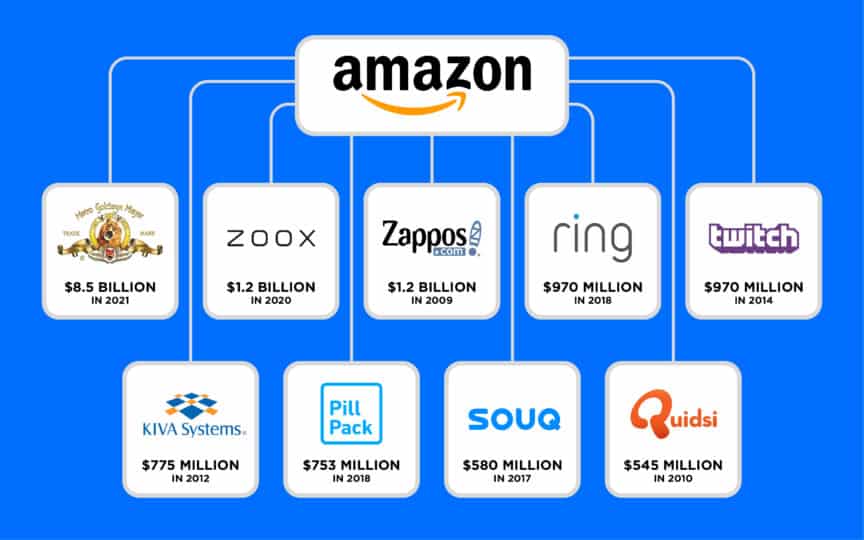
In 2022, Amazon finalized its $8.5 billion acquisition of the legendary film studio MGM. In the “streaming wars,” content is the primary asset. By owning MGM, Amazon secured a library of over 4,000 films (including the James Bond and Rocky franchises) and 17,000 TV shows. This acquisition was a calculated move to increase the perceived value of Amazon Prime, reducing churn rates and ensuring that subscribers remain locked into the ecosystem for their entertainment needs.
One Medical: The Healthcare Expansion
One of Amazon’s more recent and telling moves was the $3.9 billion acquisition of 1Life Healthcare, the operator of One Medical. This signaled Amazon’s serious intent to disrupt the trillion-dollar healthcare industry. By combining One Medical’s primary care clinics with Amazon’s logistics prowess and the PillPack pharmacy acquisition, Amazon is positioning itself to be a primary provider of both telehealth and physical medical services.
Digital and Media Assets: Diversifying Revenue Streams
While physical goods are Amazon’s bread and butter, its digital acquisitions focus on high-margin revenue streams and capturing the attention of younger demographics.
Twitch Interactive: Monetizing the Creator Economy
In 2014, Amazon acquired the live-streaming platform Twitch for $970 million. At the time, many analysts questioned the price tag for a site where people watched others play video games. However, from an investment perspective, Twitch has become a cornerstone of Amazon’s advertising business. It provides a direct line to Gen Z and Millennial consumers, offering high-value ad placements and a subscription model that integrates directly with Prime Gaming.
Audible: Dominating the Audio Market
Acquired in 2008 for $300 million, Audible has become the undisputed leader in the audiobook and spoken-word content market. This acquisition allowed Amazon to monopolize the digital book space across all formats—physical, E-book (Kindle), and audio. Financially, Audible operates on a high-margin subscription model, providing steady recurring revenue that is less susceptible to the supply chain fluctuations seen in physical retail.
Logistics and Future-Tech Investments
Amazon’s “Money” strategy often involves betting on the future of automation and transportation to reduce its largest operating expense: shipping and fulfillment.
Zappos: A Study in Corporate Culture and Market Share
In 2009, Amazon acquired Zappos for $1.2 billion. While Zappos continues to operate as a distinct brand known for its exceptional customer service, the acquisition allowed Amazon to eliminate its biggest competitor in the online shoe and apparel space. It also allowed Amazon to study and implement Zappos’ highly efficient warehouse management and customer loyalty strategies across its broader platform.
Zoox and PillPack: Betting on Automation and Wellness
Amazon acquired the autonomous vehicle startup Zoox in 2020 for an estimated $1.2 billion. This is a long-term play in the “Business Finance” of logistics. If Amazon can successfully deploy a fleet of autonomous delivery vehicles, it could eventually eliminate billions of dollars in annual labor costs associated with third-party shipping carriers like UPS or FedEx. Similarly, the acquisition of PillPack ($753 million) allowed Amazon to enter the prescription drug market, leveraging its existing delivery network to ship medications directly to consumers’ doors.
The Investor’s Perspective: How Amazon’s Holdings Drive Stock Value
For investors, Amazon is no longer just a “retail stock”; it is a diversified holding company. The value of Amazon’s stock is intrinsically linked to how well these various subsidiaries perform and, more importantly, how they interact.
Synergies and Ecosystem Locking
The financial brilliance of Amazon’s portfolio lies in its “Flywheel” effect. A customer joins Prime to get free shipping on a toaster. They then start watching MGM-produced movies on Prime Video, use their Prime discount at Whole Foods, and listen to an Audible book during their commute. Each acquisition is designed to increase the number of touchpoints Amazon has with a consumer’s wallet. From a business finance perspective, this reduces the “Cost Per Acquisition” (CPA) for new services, as the customer is already within the system.
Risk Management Through Diversification
By owning companies in cloud computing (AWS), grocery (Whole Foods), entertainment (MGM), and healthcare (One Medical), Amazon has built a hedge against sector-specific economic downturns. If e-commerce growth slows down, the high margins of AWS or the recurring revenue from healthcare and subscriptions can stabilize the company’s balance sheet.
In conclusion, Amazon’s list of subsidiaries is a roadmap of where the global economy is headed. Through strategic M&A, Amazon has transformed from a distributor of goods into an indispensable infrastructure provider for modern life. For the business-minded observer, these acquisitions represent more than just corporate expansion—they represent a calculated effort to own the platforms upon which the future of commerce, health, and entertainment are built.
aViewFromTheCave is a participant in the Amazon Services LLC Associates Program, an affiliate advertising program designed to provide a means for sites to earn advertising fees by advertising and linking to Amazon.com. Amazon, the Amazon logo, AmazonSupply, and the AmazonSupply logo are trademarks of Amazon.com, Inc. or its affiliates. As an Amazon Associate we earn affiliate commissions from qualifying purchases.