
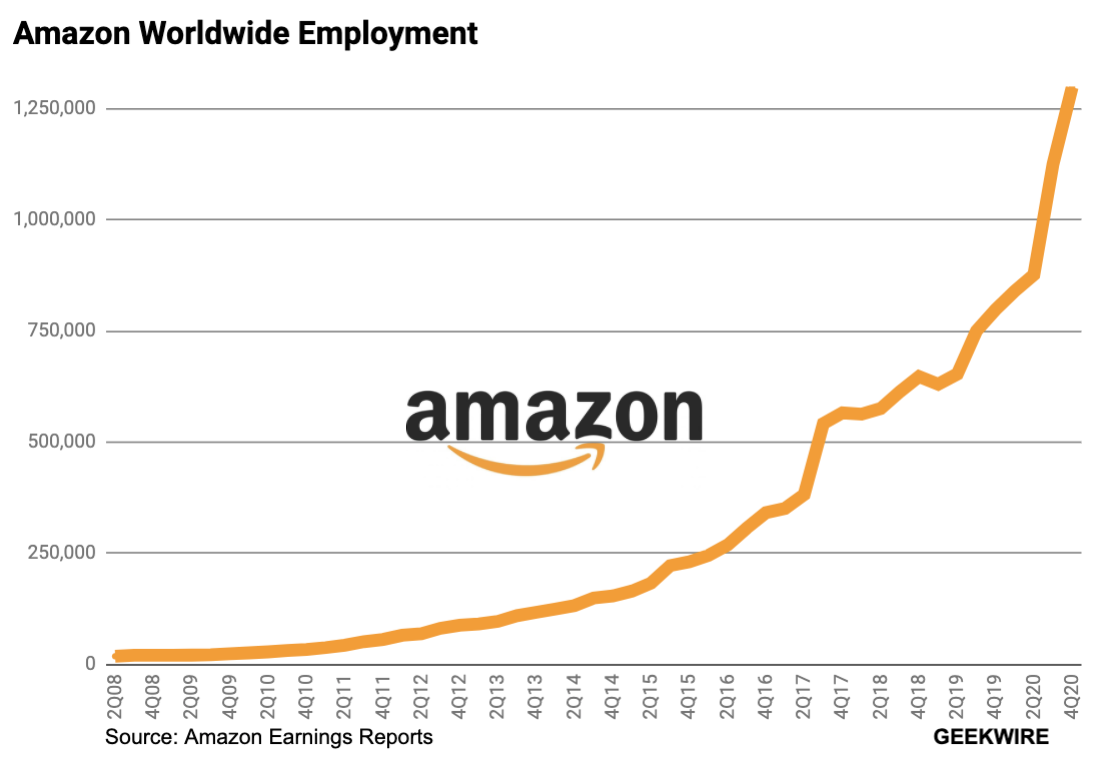
In the landscape of modern global commerce, few metrics are as staggering as the headcount of Amazon.com, Inc. To ask “how many people work for Amazon” is to delve into a complex financial narrative that spans logistics, cloud computing, and high-level artificial intelligence. As of 2024, Amazon remains the second-largest private employer in the United States and one of the largest in the world, maintaining a workforce that fluctuates between 1.5 million and 1.6 million full-time and part-time employees.
From a business and financial perspective, this figure is not merely a number; it represents a massive operational expenditure, a significant driver of the global labor market, and a central pillar of the company’s valuation. Understanding the scale of Amazon’s human capital provides critical insights into the company’s long-term sustainability, its ability to scale operations, and its ongoing battle between human labor and robotic efficiency.

The Financial Scale of a Global Workforce
The sheer volume of Amazon’s staff is a reflection of its aggressive expansion strategy. Unlike other “Big Tech” peers like Google or Meta, which maintain lean operations focused primarily on software, Amazon’s hybrid identity as a retail giant and a technology provider requires a physical army. This massive headcount is the engine behind its “Prime” delivery promises and its expansive global distribution network.
The Post-Pandemic Growth and Correction
Between 2020 and 2022, Amazon underwent a hiring spree that was unprecedented in corporate history. To meet the surge in e-commerce demand during global lockdowns, the company nearly doubled its workforce. However, from a financial management standpoint, this rapid expansion led to overcapacity as the world returned to physical retail. In 2023, Amazon initiated the largest layoffs in its history, cutting over 27,000 corporate roles to lean out its operations. This “correction” was a strategic move to improve profit margins and appease investors concerned about rising operating expenses (OpEx).
Labor Costs as a Business Driver
For a company of Amazon’s scale, labor is often the single largest line item on the balance sheet. Managing the payroll for 1.5 million individuals involves navigating diverse international labor laws, fluctuating minimum wages, and the rising costs of healthcare and benefits. Analysts monitor Amazon’s “Revenue per Employee” as a key performance indicator. While this metric is lower than that of software-only firms, Amazon’s ability to optimize labor productivity through proprietary management software is what allows it to maintain its competitive edge in the thin-margin world of retail.
Diversification of Human Capital: Corporate vs. Operations
When discussing the workforce, it is essential to distinguish between the two primary “classes” of Amazon employees. This distinction is vital for investors and business analysts because the ROI (Return on Investment) for these groups differs significantly.
Investing in high-value Tech Talent (AWS)
A significant portion of Amazon’s high-salary workforce is concentrated within Amazon Web Services (AWS) and its various R&D departments (such as Alexa and Project Kuiper). While these employees represent a smaller percentage of the total headcount, they generate the lion’s share of the company’s operating income. In the world of business finance, these are “high-margin” employees. The cost of acquiring and retaining a software engineer in Seattle or Dublin is high, but the scalable nature of cloud services means these workers contribute exponentially more to the bottom line than their counterparts in fulfillment.
The Logistics Engine: Warehouse and Delivery
The vast majority of Amazon’s 1.5 million employees work within the Global Operations division. These are the individuals in fulfillment centers, sortation centers, and delivery stations. From a financial perspective, this segment of the workforce is treated as a high-volume, high-churn operation. Amazon’s business model relies on its ability to move goods through this human network with surgical precision. The financial health of the company’s retail arm is inextricably linked to the efficiency of these workers, making warehouse safety and labor relations a top-tier financial risk factor for the organization.
Economic Impact and Labor Market Influence
Amazon’s hiring decisions have a “gravity” that shifts local and national economies. When Amazon enters a new market with a fulfillment center, it often becomes the largest employer in that region overnight, influencing wage floors and labor availability for all other local businesses.
The $15 Minimum Wage Floor and Market Competition
In 2018, Amazon set a $15 per hour minimum wage for all U.S. employees—a move that was as much a strategic business decision as it was a public relations one. By raising its internal floor, Amazon forced competitors in the retail and logistics sectors to raise their wages to remain competitive. Financially, this move helped Amazon stabilize its massive hiring needs, though it increased the baseline cost of operations. Today, the average starting wage for front-line roles has moved closer to $20 per hour in many regions, reflecting the inflationary pressures of the current economy.
Automation vs. Human Labor: The ROI of Robotics
A central theme in Amazon’s financial future is the “Human-to-Robot” ratio. Currently, Amazon employs over 750,000 robots across its facilities. From a capital expenditure (CapEx) perspective, investing in robotics like the “Proteus” autonomous mobile robot is a strategy to reduce the long-term dependency on human labor. Investors view automation as a way to hedge against rising labor costs and potential unionization efforts. While robots cannot yet replace the dexterity of human hands in all picking and packing tasks, the gradual shift toward a more automated workforce is a key part of Amazon’s strategy to improve long-term profitability and operational throughput.
Comparative Analysis: Amazon vs. The Competition
To truly grasp the significance of Amazon’s 1.5 million employees, one must look at its competitors. In the realm of retail, Amazon’s only true peer in terms of scale is Walmart, which employs approximately 2.1 million people worldwide. However, the financial structures of these two workforces differ significantly.
Efficiency Ratios and Revenue per Employee
Walmart’s workforce is largely concentrated in brick-and-mortar retail, where human interaction is a core part of the service. Amazon, being “digital-first,” uses its 1.5 million employees primarily for the “back-end” of commerce. Consequently, Amazon’s revenue per employee tends to be higher than traditional retailers but lower than “pure” tech firms like Apple. For the fiscal year 2023, Amazon generated roughly $574 billion in revenue. Dividing this by a 1.5 million headcount gives a revenue-per-employee figure of approximately $380,000. For comparison, a company like Apple can exceed $2 million per employee, highlighting the heavy “labor-drag” inherent in Amazon’s logistics-heavy model.
The Seasonal Factor: Contractors and Temporary Staff
It is important to note that the 1.5 million figure often excludes the hundreds of thousands of seasonal workers and third-party contractors. During the Q4 holiday “peak,” Amazon frequently hires an additional 200,000 to 250,000 temporary workers. Furthermore, the Amazon Delivery Service Partner (DSP) program involves thousands of independent businesses that employ drivers who are not technically Amazon employees. From a business finance perspective, this allows Amazon to scale its delivery capacity “off-balance-sheet,” reducing its direct liability while maintaining control over its delivery ecosystem.

Conclusion: The Future of the Amazonian Workforce
The question of how many people work for Amazon is a moving target that reflects the company’s broader financial health and strategic pivots. As we look toward the next decade, the composition of this workforce is likely to shift. We will likely see a stabilization of the total headcount as AI and robotics take over repetitive tasks, while the “value” of the remaining human roles—particularly in tech and high-level management—continues to rise.
For investors and market analysts, Amazon’s workforce remains a double-edged sword. It is the company’s greatest strength, providing the physical infrastructure to dominate global e-commerce. Yet, it is also its greatest financial challenge, presenting ongoing risks related to labor costs, regulatory scrutiny, and operational efficiency. As Amazon continues to innovate, its ability to manage this 1.5-million-person engine will be the primary determinant of its fiscal success in an increasingly automated world.
aViewFromTheCave is a participant in the Amazon Services LLC Associates Program, an affiliate advertising program designed to provide a means for sites to earn advertising fees by advertising and linking to Amazon.com. Amazon, the Amazon logo, AmazonSupply, and the AmazonSupply logo are trademarks of Amazon.com, Inc. or its affiliates. As an Amazon Associate we earn affiliate commissions from qualifying purchases.