
The term “snake draft” is likely to appear in conversations related to fantasy sports, particularly those involving fantasy football, baseball, basketball, or hockey. In these contexts, a snake draft refers to a specific method of selecting players for a fantasy team. Unlike a traditional linear draft where each owner selects players in a predetermined, fixed order for every round, a snake draft reverses the selection order in alternating rounds. This creates a “snake-like” pattern where the owner who picks last in one round picks first in the next, and vice versa.
While the term “snake draft” is most prevalent in the realm of fantasy sports, the underlying principle of alternating selection orders has applications and parallels in other areas where resource allocation or team formation occurs. Understanding the mechanics, strategies, and implications of a snake draft is crucial for anyone participating in leagues that utilize this format, as it significantly influences team building and overall draft success.
The Mechanics of a Snake Draft
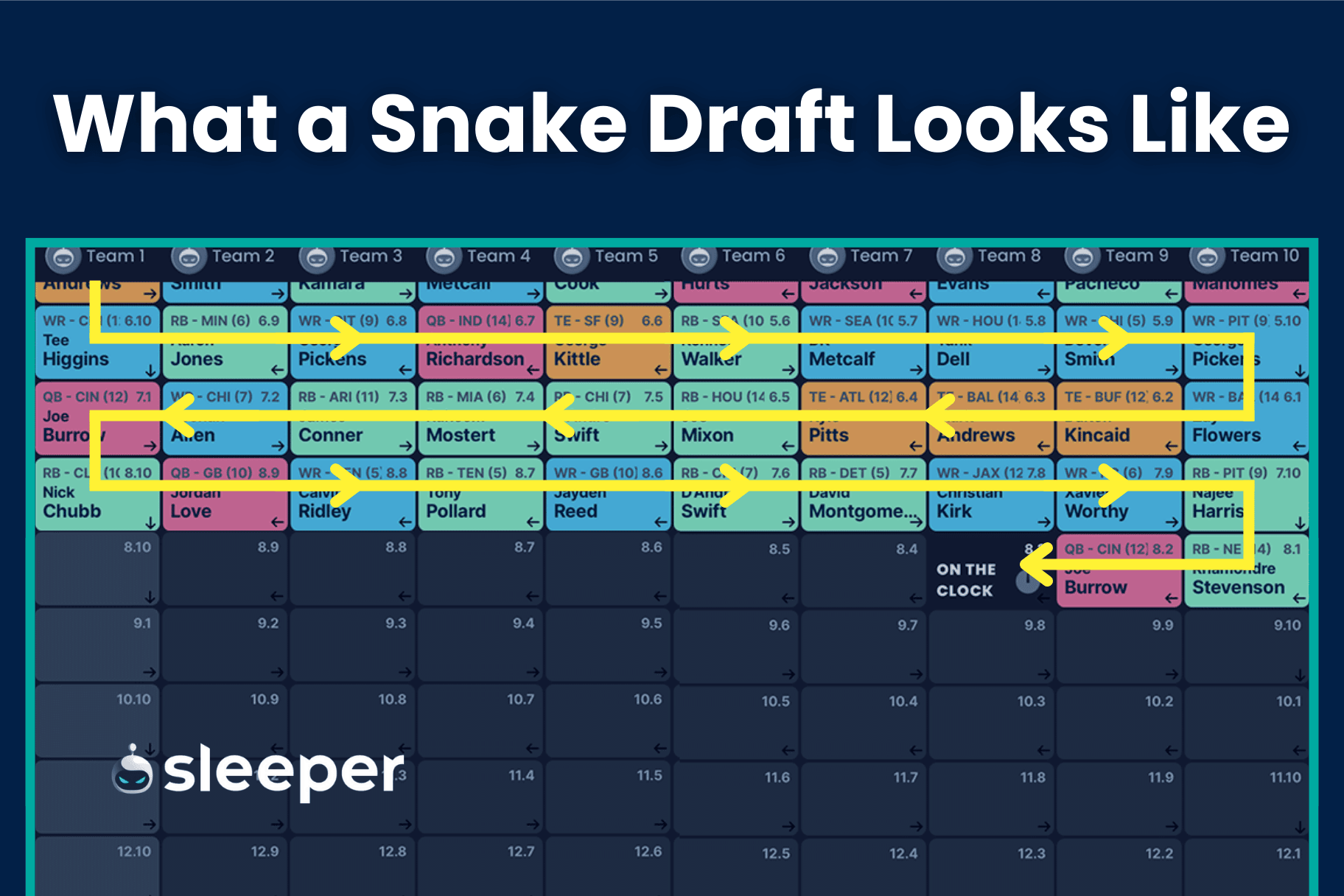
At its core, the snake draft is designed to introduce a unique dynamic to player selection, aiming to balance the perceived advantage of picking early or late in the draft. The fundamental rule is the reversal of the draft order after each round.
Understanding the Order of Selection
Let’s illustrate with a common scenario of an eight-team fantasy league. In a standard linear draft, the order might be:
- Round 1: Team 1, Team 2, Team 3, Team 4, Team 5, Team 6, Team 7, Team 8
- Round 2: Team 1, Team 2, Team 3, Team 4, Team 5, Team 6, Team 7, Team 8
- Round 3: Team 1, Team 2, Team 3, Team 4, Team 5, Team 6, Team 7, Team 8
- And so on…
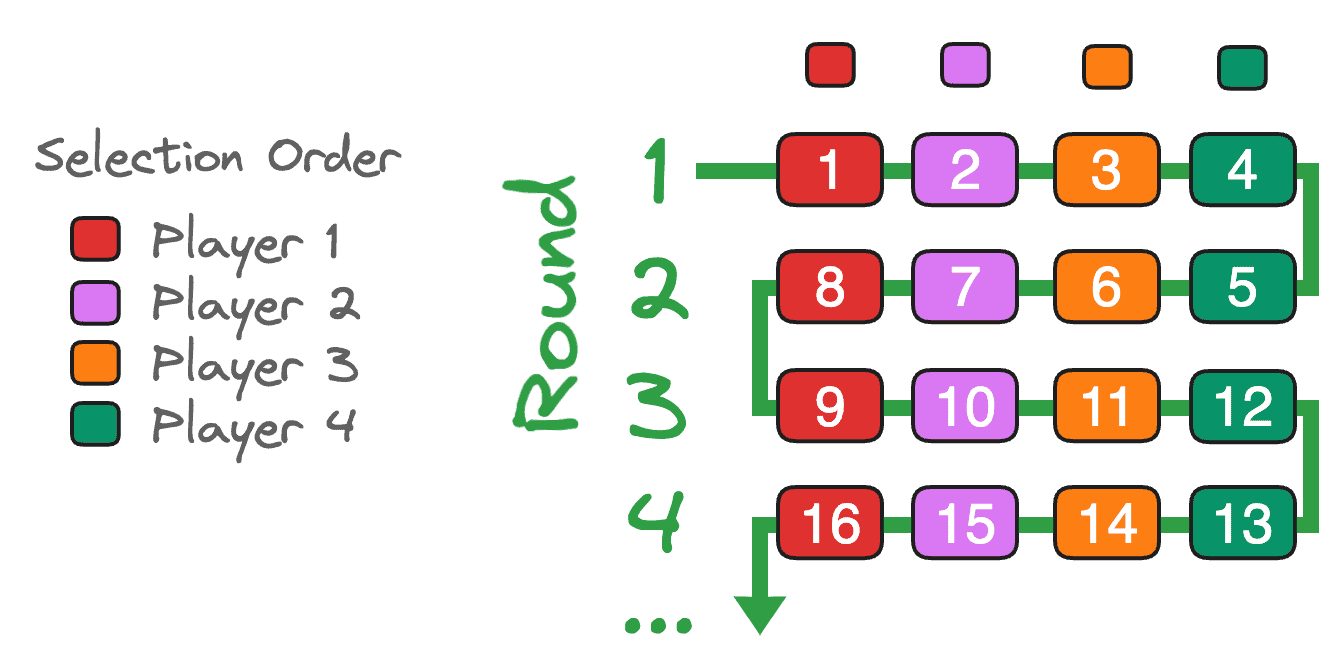
In a snake draft, the order changes as follows:
- Round 1: Team 1, Team 2, Team 3, Team 4, Team 5, Team 6, Team 7, Team 8
- Round 2: Team 8, Team 7, Team 6, Team 5, Team 4, Team 3, Team 2, Team 1
- Round 3: Team 1, Team 2, Team 3, Team 4, Team 5, Team 6, Team 7, Team 8
- Round 4: Team 8, Team 7, Team 6, Team 5, Team 4, Team 3, Team 2, Team 1
- And so forth, alternating the direction of selection with each completed round.
This alternating pattern gives the owner picking last in an odd-numbered round (e.g., Round 1) the first pick in the subsequent even-numbered round (e.g., Round 2). Conversely, the owner picking first in an odd-numbered round has the last pick in the following even-numbered round.
The Purpose and Perceived Fairness
The primary goal behind the snake draft format is to create a more equitable distribution of draft position advantages. In a linear draft, the owner with the first overall pick often has a significant advantage, being able to select the consensus top player. As the draft progresses, those picking later in each round face a steeper challenge in acquiring elite talent.
The snake draft attempts to mitigate this by giving the “end” picks (last in round 1, first in round 2) a chance to grab two highly rated players in quick succession. Similarly, the “middle” picks in a linear draft, who might feel like they are always picking between declining tiers of talent, get two consecutive picks at a different part of the draft board.
While intended to be fairer, it’s important to note that no draft format is perfectly fair. Each has its own set of strategic nuances and potential advantages/disadvantages depending on the league’s commissioner, the players involved, and the specific draft board.
Strategic Considerations in a Snake Draft
The unique structure of a snake draft necessitates a distinct strategic approach compared to a linear draft. Owners must not only consider the best available player at their pick but also anticipate the availability of players when their next pick comes around, often just a few selections away.
Leveraging Consecutive Picks
The most significant strategic advantage of the snake draft lies in the consecutive picks. This allows an owner to potentially “reach” for a player they highly value without worrying about another owner snapping them up before their next turn. It also enables the formation of player pairings or thematic team builds that might be difficult in a linear draft.
- Targeting “Tiers” of Talent: Owners can identify distinct tiers of players at certain positions. With consecutive picks, they can aim to secure two players from the same high tier, ensuring a strong foundation at a particular position. For example, if a player is confident they can get two top-tier quarterbacks in consecutive picks, they might prioritize that over securing a single elite player at another position.
- “Reaching” for Value: If an owner has a player they believe is significantly undervalued or a critical piece of their strategy, they can afford to draft them even if it’s slightly earlier than they might in a linear draft. The knowledge that their next pick is imminent provides a safety net.
- Building “Stacks” or Pairings: In some sports, particularly fantasy football, owners might aim to “stack” players from the same team or the same division. For example, selecting a star quarterback and one of his top wide receivers in consecutive picks. This strategy is more feasible with the consecutive selections offered by the snake draft.
Adapting to the Draft Flow
The dynamic nature of the snake draft requires constant vigilance and adaptability. The perceived value of players can shift rapidly as the draft progresses, and understanding where you are in the flow is crucial.
- Anticipating Runs: Owners need to be aware of “runs” on specific positions or types of players. If multiple owners are prioritizing quarterbacks, a run is happening. With consecutive picks, an owner might decide to grab their target before the run intensifies, or they might pivot to a different position if their preferred players are being taken off the board.
- Knowing Your Position: Understanding whether you are at the beginning, middle, or end of the snake draft order in a given round dictates different strategic considerations. The early picks in Round 1 will have the last picks in Round 2, forcing them to adapt quickly. The late picks in Round 1 will have the first picks in Round 2, offering them a chance to strike immediately.
- Risk vs. Reward: The snake draft often forces owners to make calculated risks. Do you reach for a player with high upside but also high risk, knowing you can potentially mitigate that risk with your next pick? Or do you play it safe with a more established, albeit less exciting, player?
Positional Strategy Nuances
While general draft strategy applies, the snake draft introduces specific positional considerations.
- Quarterback Drafting: In fantasy football, the debate around when to draft a quarterback is perennial. The snake draft can facilitate drafting a top-tier quarterback with one pick and then potentially securing a solid backup or a complementary piece with the next. Alternatively, some owners might wait and try to get two solid, mid-tier quarterbacks with their consecutive picks, sacrificing elite talent elsewhere.
- Running Back/Wide Receiver Duos: The ability to select two running backs or two wide receivers back-to-back is a significant feature. This allows for the creation of dominant duos from the outset, potentially creating a strong positional advantage for the entire season.
- “Zero RB” or “Zero WR” Strategies: The snake draft can enable certain draft philosophies like “Zero RB,” where an owner deliberately avoids drafting a running back in the early rounds, opting to build depth at other positions and then targeting running backs in the middle to later rounds with their consecutive picks. The same logic can apply to wide receivers.
Variations and Considerations
While the core concept of alternating pick order defines the snake draft, there can be minor variations or specific league rules that influence its execution.
Autodraft and Player Rankings
In leagues where autodraft is enabled, understanding the snake draft format is still important for setting autodraft preferences. Most autodraft systems will follow the snake format if it’s selected, but the algorithms used to select players can vary. For a live draft, however, understanding the snake mechanism is paramount for manual selection.
The effectiveness of a snake draft is also heavily influenced by the quality of the player rankings used. Different ranking systems will present different tiers of talent, and owners must adapt their strategy based on the consensus rankings or their own personal evaluations.
The Psychological Aspect
The snake draft can also have a psychological impact on league participants. The perceived “fairness” of the format can foster a more competitive and engaging atmosphere. Owners who feel they got a raw deal in a linear draft might be more energized by the opportunities presented by consecutive picks in a snake draft.
Conversely, the rapid succession of picks can create pressure. Owners who are not prepared or have not done their homework can quickly find themselves making suboptimal selections. The fast-paced nature of the consecutive picks requires decisive action.
League Size and Draft Depth
The impact of a snake draft can vary depending on the size of the league and the depth of the player pool. In larger leagues with more teams, the advantage of consecutive picks might be amplified, as it allows for a more targeted approach to filling roster spots from increasingly thinner pools of talent. In smaller leagues, the differences between draft formats might be less pronounced.
Conclusion: Mastering the Serpent’s Coil
The snake draft, while primarily associated with fantasy sports, offers a compelling model for resource allocation and team formation. Its core principle of alternating selection orders aims to distribute advantages more evenly, forcing participants to think strategically about how to leverage consecutive picks and adapt to the ever-shifting draft landscape.
For fantasy sports enthusiasts, mastering the snake draft is not just about picking the best players; it’s about understanding the rhythm of the draft, anticipating your opponents’ moves, and building a cohesive team through calculated risks and shrewd positional planning. Whether you’re picking first or last in a given round, the snake draft demands a dynamic and engaging approach, turning the act of player selection into a strategic dance. By understanding its mechanics and embracing its unique challenges, participants can navigate the serpent’s coil and emerge with a winning fantasy squad.
aViewFromTheCave is a participant in the Amazon Services LLC Associates Program, an affiliate advertising program designed to provide a means for sites to earn advertising fees by advertising and linking to Amazon.com. Amazon, the Amazon logo, AmazonSupply, and the AmazonSupply logo are trademarks of Amazon.com, Inc. or its affiliates. As an Amazon Associate we earn affiliate commissions from qualifying purchases.