
In the landscape of global mobility and high-stakes personal finance, few documents carry as much weight as the Form I-20. For the uninitiated, it may look like a simple three-page government document. However, for international students, investors in education, and financial planners, the I-20 represents the “Certificate of Eligibility for Nonimmigrant Student Status.” More importantly, it serves as the ultimate financial gatekeeper.
Obtaining an I-20 is not merely an academic milestone; it is a rigorous financial audit. It is the primary mechanism through which the United States government and educational institutions verify that an individual possesses the requisite liquidity to sustain a multi-year investment in the U.S. economy. Understanding the I-20 is essential for anyone looking to navigate the complex intersection of international education and personal wealth management.

The Financial Blueprint: Defining the I-20 Document
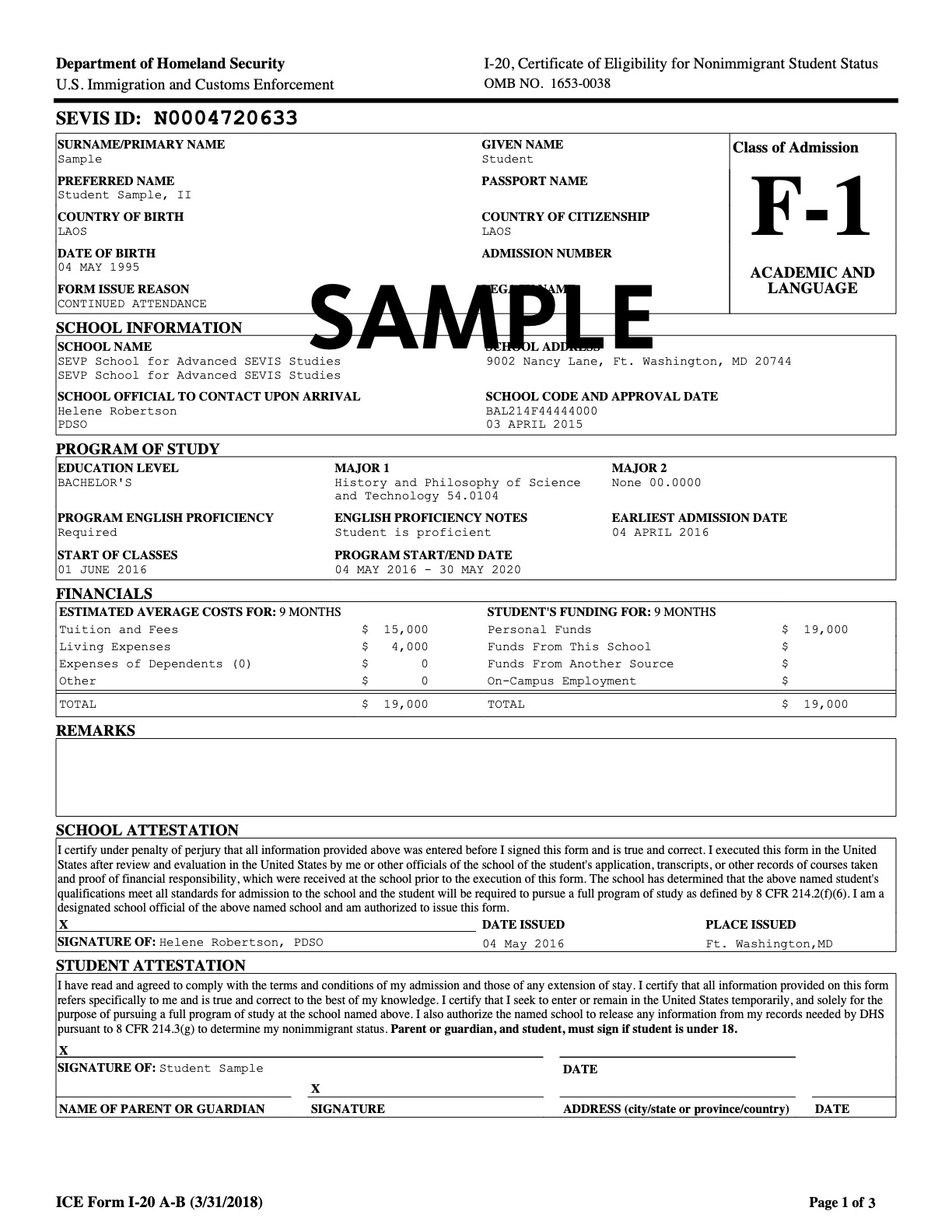
To understand the I-20, one must first view it through the lens of institutional compliance and financial accountability. Issued by a Student and Exchange Visitor Program (SEVP)-certified school, the I-20 is the foundational document for F-1 and M-1 student visas. It serves as a record that a student has been admitted to a full-time program and, crucially, has demonstrated the financial means to stay for the duration of their studies.
More Than Just a Form: A Certificate of Financial Eligibility
The I-20 is essentially a contract between the student, the university, and the U.S. Department of Homeland Security. It outlines the specific program of study, the expected duration, and a detailed breakdown of the “Estimated Average Costs” for one academic year.
From a financial perspective, the I-20 is a declaration of solvency. Before a Designated School Official (DSO) can generate this form, the student must provide evidence of liquid assets that cover at least the first year of tuition, fees, and living expenses. This requirement protects the U.S. economy from the risk of “public charge” and ensures that the student is a self-funded participant in the educational sector.
The Role of the SEVIS Fee in the Global Education Market
Embedded within the I-20 process is the SEVIS (Student and Exchange Visitor Information System) fee. This is a mandatory digital administrative fee (currently $350 for F-1 students) paid to the Department of Homeland Security.
This fee funds the technological infrastructure that tracks the financial and academic status of non-immigrants. For the student, this represents the first of many transactional costs in the journey. In the broader context of “Money” and “Business Finance,” the SEVIS system represents a massive data-driven operation that manages the “human capital” flow into the United States, contributing billions of dollars to the U.S. GDP annually.
The Economics of the I-20: Proof of Funding and Financial Solvency
The core of the I-20 application is the “Proof of Funding.” This phase is where personal finance strategy meets legal requirement. Schools do not simply take a student’s word for their wealth; they require verified, documented evidence of financial capacity.
Calculating the Total Cost of Attendance (COA)
The I-20 lists a specific dollar amount that the student must prove they have access to. This Cost of Attendance (COA) is not limited to tuition. It is an exhaustive financial profile that includes:
- Tuition and Fees: The direct cost of the educational service.
- Living Expenses: Budgeted amounts for housing, food, and transportation based on the local economy of the school’s location.
- Expenses of Dependents: If a student is bringing a spouse or children (F-2 status), the financial threshold increases significantly.
- Health Insurance: Often a mandatory and significant annual premium.
Strategic financial planning is required here, as these costs are often indexed to inflation and can rise by 3% to 7% annually, a factor many families fail to account for when looking only at the initial I-20.
Liquid Assets vs. Fixed Assets: What Schools Look For
In the world of finance, liquidity is king. For an I-20, the same rule applies. Schools generally do not accept “fixed assets” such as real estate, jewelry, or future expected business profits as proof of funding.
To secure an I-20, the “Money” must be readily available. Acceptable proof typically includes:
- Personal Bank Statements: Showing the history and availability of cash.
- Savings Accounts: Verified by bank letters.
- Approved Educational Loans: Sanction letters from reputable financial institutions.
- Scholarships and Grants: Official award letters from the university or third-party organizations.
This requirement often necessitates a “liquidation strategy” for families whose wealth is tied up in property or long-term investments, requiring them to convert assets into cash months before the I-20 is even issued.
The Role of Financial Sponsors and Affidavits of Support
Many students utilize “Sponsors”—often parents or relatives—to meet the I-20 financial requirements. This introduces the “Affidavit of Support” (Form I-134 or school-specific versions). This is a legal commitment where the sponsor pledges their personal wealth to the student’s education. For the sponsor, this is a significant financial liability that must be weighed against other personal finance goals, such as retirement planning or business reinvestment.
Strategic Financial Planning for the I-20 Process
Navigating the I-20 is not just about having money; it is about moving money efficiently across borders. International students and their families must act as amateur forex traders and international tax planners to optimize this process.
Currency Fluctuations and International Transfer Fees
Because the I-20 is denominated in U.S. Dollars (USD), students from countries with volatile currencies face significant “Exchange Rate Risk.” A 10% devaluation in a home currency can suddenly leave a student short of the required funds listed on their I-20.
Furthermore, the “cost of moving money” is a hidden drain on wealth. Traditional wire transfers involve intermediary bank fees and unfavorable exchange rate spreads. Sophisticated students now use fintech platforms like Wise, Flywire, or Convera to minimize these costs, treating their education as a business operation that requires lean financial logistics.
Budgeting for the SEVP Requirements
Beyond the tuition listed on the I-20, there are peripheral costs that are often overlooked in the initial budget. These include visa interview fees, travel costs, and the “settling-in” capital required for housing deposits and initial utility connections. Professional financial planning for an I-20 holder should include a “contingency fund” of at least 15% above the listed I-20 total to account for these systemic costs and the rising cost of living in U.S. metropolitan areas.
The Return on Investment: Leveraging the I-20 for Long-term Wealth
While the I-20 represents a massive upfront cost, it is also the primary vehicle for achieving a high Return on Investment (ROI). It is not just a permit to study; it is a permit to eventually enter the U.S. labor market through specific financial-legal channels.
CPT and OPT: Integrating Work and Finance
One of the most valuable aspects of the I-20 is its authorization of “Practical Training.” Curricular Practical Training (CPT) and Optional Practical Training (OPT) allow students to work in their field of study.
- CPT: Allows for paid internships during the degree.
- OPT: Allows for 12 to 36 months of full-time employment in the U.S. post-graduation.
From a money-management perspective, OPT is where the “educational investment” starts to pay dividends. For STEM (Science, Technology, Engineering, and Mathematics) students, the three-year OPT period can allow for the complete recovery of the capital expended on the degree, turning the I-20 into a highly profitable financial asset.
The Long-term Value of a US Degree in the Global Economy
The I-20 is the entry point into a global network of high-earners. The “Brand Value” of a U.S. degree, facilitated by the I-20, often leads to a lifetime earnings premium that far outweighs the initial proof of funds required. Whether the individual stays in the U.S. or returns to their home country, the financial “signaling” of having successfully navigated the U.S. educational and immigration system provides a competitive advantage in the global job market.

Conclusion: Navigating the Financial Compliance of Study Abroad
In summary, the I-20 is far more than a “visa document.” It is a comprehensive financial statement that validates an individual’s economic standing and their ability to participate in the high-cost, high-reward environment of American higher education.
To successfully obtain and maintain an I-20, one must be prepared for rigorous financial scrutiny, strategic asset management, and proactive budgeting. By viewing the I-20 as a financial instrument rather than just an administrative hurdle, students and their families can better manage the risks of currency fluctuation, liquidity requirements, and long-term investment strategies. Ultimately, the I-20 is the first step in a sophisticated financial journey that, if managed correctly, leads to significant global wealth and professional success.
aViewFromTheCave is a participant in the Amazon Services LLC Associates Program, an affiliate advertising program designed to provide a means for sites to earn advertising fees by advertising and linking to Amazon.com. Amazon, the Amazon logo, AmazonSupply, and the AmazonSupply logo are trademarks of Amazon.com, Inc. or its affiliates. As an Amazon Associate we earn affiliate commissions from qualifying purchases.