
The term “bro split” is a colloquialism that has permeated fitness culture, particularly within gym environments. It refers to a specific type of workout routine where an individual dedicates each training day to a single muscle group or a limited number of related muscle groups. This approach is characterized by its simplicity and its historical prevalence, often associated with bodybuilders and those focused on hypertrophy (muscle growth). While the term itself can sometimes carry a dismissive connotation, understanding the underlying principles and its evolution is crucial for anyone looking to optimize their training strategy.

The core idea behind a bro split is to provide ample rest and recovery for a muscle group before it is trained again. By isolating muscle groups, the trainee can theoretically push each muscle to its limits during its dedicated day without the interference of working other muscle groups that might be involved in compound movements. This focused intensity is often lauded for its ability to promote significant muscle growth over time.
However, the effectiveness and suitability of a bro split are subjects of ongoing debate within the fitness community. While it has been a foundational element for many successful physiques, modern training science often presents alternative perspectives that challenge its universal applicability. This article will delve into the origins of the bro split, explore its common structures, analyze its advantages and disadvantages, and discuss how it compares to contemporary training methodologies, ultimately helping you determine if it’s the right approach for your fitness journey.
The Genesis and Structure of the Bro Split
The bro split, as a concept, emerged from the early days of bodybuilding. Pioneers like Arnold Schwarzenegger and his contemporaries often employed training routines that mirrored this structure. The rationale was straightforward: to maximize the stimulus on each muscle group through high volume and intensity, allowing for dedicated recovery before the next training session. This approach aligns with the principle of progressive overload, where muscles are continually challenged to adapt and grow.
Typical Bro Split Configurations
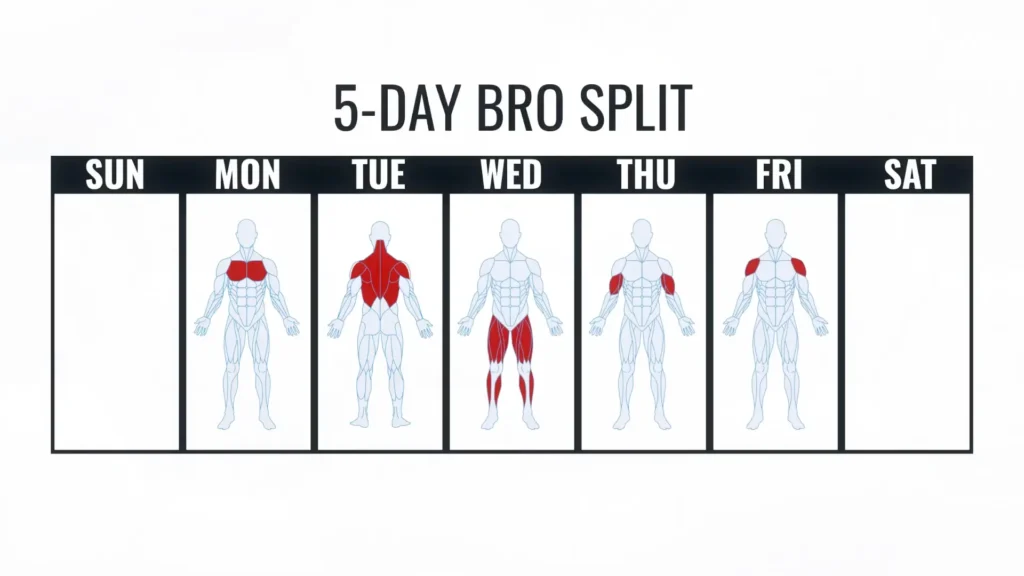
The classic bro split typically involves training each major muscle group once per week. This can manifest in various ways, but a common structure includes:
Chest Day (Monday)
Often the most anticipated day of the week for many gym-goers, chest day focuses on exercises like the bench press (barbell and dumbbell variations), incline press, decline press, chest flyes, and dips. The goal is to hit the pectoralis major and minor muscles from various angles to stimulate comprehensive growth.
Back Day (Tuesday)
This day is dedicated to the complex musculature of the back, including the latissimus dorsi, rhomboids, trapezius, and erector spinae. Exercises typically include pull-ups, lat pulldowns, rows (barbell, dumbbell, seated cable), deadlifts (though often done on leg day by some), and hyperextensions.
Leg Day (Wednesday)
Leg day is often considered the most demanding, targeting the quadriceps, hamstrings, glutes, and calves. Compound movements like squats, lunges, leg press, and Romanian deadlifts are staples, complemented by isolation exercises such as leg extensions, hamstring curls, and calf raises.
Shoulder Day (Thursday)
This day focuses on the deltoid muscles, responsible for shoulder width and definition. Overhead presses (barbell and dumbbell), lateral raises, front raises, and rear delt flyes are commonly performed to ensure all three heads of the deltoid are effectively stimulated.
Arm Day (Friday)
Often a fan favorite, arm day isolates the biceps and triceps. Exercises include bicep curls (various grips and implements), hammer curls, concentration curls, triceps pushdowns, overhead triceps extensions, and skullcrushers. Some individuals may also incorporate forearm exercises.
Rest Days (Saturday & Sunday)
The traditional bro split often incorporates one or two dedicated rest days per week, allowing for complete recovery of all muscle groups before the cycle begins anew. Some variations might include active recovery days or dedicated cardio sessions.
The Principle of Isolation vs. Compound Focus
The bro split inherently leans towards an isolation-focused approach, though it doesn’t entirely eschew compound movements. However, the emphasis is on dedicating a full session to a muscle group, allowing for a high volume of both compound and isolation exercises targeting that specific area. This contrasts with other training splits that might integrate multiple muscle groups into a single workout, often prioritizing compound movements that engage several muscles simultaneously. The rationale behind the isolation focus is to ensure that the target muscle is the primary mover and receives the most significant training stimulus.
Advantages of Adopting a Bro Split
Despite the evolution of training methodologies, the bro split still holds appeal for a significant portion of the fitness community. Its enduring popularity can be attributed to several key advantages, particularly for individuals with specific training goals and time constraints.
Dedicated Recovery and Reduced Overtraining Risk
One of the most significant benefits of a bro split is the ample recovery time afforded to each muscle group. By training a muscle group only once a week, it receives a full seven days to repair and rebuild. This significantly reduces the risk of overtraining for that specific muscle, which can lead to persistent fatigue, decreased performance, and increased susceptibility to injury. For individuals who engage in strenuous workouts, this extended recovery period can be highly beneficial for muscle repair and growth.
High Volume and Intensity Potential
Because a specific day is dedicated to a single muscle group, trainees can incorporate a substantial volume of exercises and sets. This allows for a greater accumulation of training stress on that muscle, which is a key driver of hypertrophy. The ability to focus entirely on one or two muscle groups permits a more intense and exhaustive workout for those areas. This can lead to a greater mind-muscle connection, where the trainee can better feel and contract the target muscles, further enhancing the effectiveness of the training session.
Simplicity and Ease of Programming
The bro split is remarkably straightforward to understand and implement. Its linear structure makes it easy to plan weekly workouts, and the clear demarcation of muscle groups simplifies exercise selection. For beginners or those who prefer a less complex training regimen, the bro split offers an accessible entry point into structured weight training. The predictable nature of the split also makes it easier to track progress and identify potential plateaus.
Psychological Benefits and Motivation
For some individuals, the bro split offers a psychological advantage. Dedicating an entire workout to a specific muscle group can be highly motivating. The feeling of “destroying” a muscle group on its designated day, coupled with the anticipation of its subsequent growth, can foster a strong sense of accomplishment and drive. This can be particularly important for individuals who are highly focused on aesthetic goals and see visible changes in their physique from day-to-day or week-to-week.
Criticisms and Alternatives to the Bro Split
While the bro split has its merits, it is not without its detractors. Modern sports science and training philosophies often highlight potential limitations and suggest alternative approaches that may be more effective for a broader range of individuals and goals.
Suboptimal Training Frequency for Hypertrophy
A primary criticism of the bro split is its potentially suboptimal training frequency for muscle hypertrophy. Research suggests that hitting a muscle group more than once per week, typically 2-3 times, can lead to superior muscle growth. The rationale behind this is that muscle protein synthesis, the process by which muscles repair and grow, is elevated for approximately 24-72 hours post-training. By training a muscle group only once a week, a significant portion of this anabolic window is missed.
The Case for Higher Frequency Training
Higher frequency training models, such as push-pull-legs (PPL) or full-body workouts, allow for more frequent stimulation of muscle groups. This repeated stimulation, even with slightly lower volume per session, can lead to a greater cumulative training effect over the week. For instance, a push-pull-legs split, where you train pushing muscles (chest, shoulders, triceps), pulling muscles (back, biceps), and legs on separate days, often allows each muscle group to be trained twice within a six-day training cycle.
Interference and Synergistic Effects
The bro split’s heavy reliance on isolation exercises can sometimes lead to a lack of engagement of smaller, stabilizing muscles, which are crucial for overall strength and injury prevention. Compound movements, which are often a cornerstone of higher-frequency programs, naturally engage a wider array of muscle groups. Furthermore, training muscle groups that are neurologically and biomechanically related in the same session (e.g., chest and triceps) can create synergistic effects, allowing for greater overall work capacity.
Potential for Imbalances and Neglected Muscle Groups
With a strict bro split, there’s a risk of neglecting certain muscle groups or developing imbalances if the programming isn’t carefully considered. For example, smaller muscle groups like forearms or calves might receive minimal attention if they aren’t specifically programmed into the routine. This can lead to a disproportionate physique and potentially increase the risk of injury due to a lack of balanced strength.
Addressing Weaknesses and Imbalances
While the bro split can be adapted to address weaknesses, it requires a conscious effort to include targeted exercises for often-neglected areas. In contrast, more holistic training programs, like full-body routines, naturally ensure that all major muscle groups are worked with each session, making it easier to maintain balance.
Time Commitment and Practicality
While individual bro split sessions can be highly focused, the overall time commitment for a full-body transformation can be extensive if one trains multiple times a week. For individuals with demanding careers, family obligations, or other significant time commitments, dedicating a full hour or more to a single muscle group several days a week might not be practical or sustainable.
Efficiency in Modern Training
Modern training methodologies often prioritize efficiency. Shorter, more frequent workouts that hit multiple muscle groups can be more time-effective for many individuals. For example, a full-body workout can provide a comprehensive stimulus in a single session, allowing for more flexibility in scheduling.
Is the Bro Split Right for You?
The question of whether a bro split is the optimal training strategy depends heavily on individual goals, experience level, recovery capacity, and lifestyle. It’s not a one-size-fits-all approach, and what works wonders for one person may be suboptimal for another.
Evaluating Your Fitness Goals
If your primary objective is maximal muscle hypertrophy and you are willing to dedicate a significant amount of time to training, a bro split can certainly be effective. Many successful bodybuilders have utilized this methodology to achieve impressive physiques. However, if your goals include improving strength, athletic performance, or general fitness, other training splits might offer a more balanced and efficient path. For those focused on fat loss, integrating more full-body compound movements and cardio might be prioritized.
Considering Your Training Experience
Beginners may find the simplicity of a bro split appealing, but they might also benefit more from full-body routines that teach fundamental movement patterns and build a foundational strength base across all muscle groups. As an individual progresses and develops a better understanding of their body’s response to training, they can then decide whether to stick with a bro split or transition to more advanced or higher-frequency training methods. Intermediate and advanced lifters might find they need to increase training frequency or volume beyond what a traditional bro split allows to continue making progress.
The Importance of Progressive Overload and Nutrition
Regardless of the training split chosen, the fundamental principles of progressive overload and proper nutrition remain paramount for achieving any fitness goal. Progressive overload, which involves gradually increasing the demands placed on the muscles over time (e.g., by increasing weight, reps, or sets), is the cornerstone of muscle growth and strength development. Equally important is adequate nutrition, particularly sufficient protein intake, to support muscle repair and synthesis, and a caloric surplus for those aiming for significant muscle gain.

Personalizing Your Approach
Ultimately, the best training program is one that you can adhere to consistently and that yields the desired results. While the bro split has historical significance and proven effectiveness for many, it’s essential to remain open to exploring different training methodologies. Experimenting with various splits, listening to your body, and seeking guidance from qualified fitness professionals can help you tailor a program that is uniquely suited to your individual needs and aspirations. The key is to find a sustainable, effective, and enjoyable way to challenge your body and progress towards your fitness objectives.
aViewFromTheCave is a participant in the Amazon Services LLC Associates Program, an affiliate advertising program designed to provide a means for sites to earn advertising fees by advertising and linking to Amazon.com. Amazon, the Amazon logo, AmazonSupply, and the AmazonSupply logo are trademarks of Amazon.com, Inc. or its affiliates. As an Amazon Associate we earn affiliate commissions from qualifying purchases.