
The mood ring, a cultural phenomenon that peaked in the mid-1970s, was perhaps the first mass-market attempt at “wearable tech.” While often dismissed as a psychedelic novelty, the science behind the shifting colors—specifically the elusive and highly sought-after purple hue—lays the groundwork for what we now categorize as affective computing and biometric feedback. In the context of modern technology, understanding what the color purple means on a mood ring requires a deep dive into thermochromic liquid crystals, sensor calibration, and the digital evolution of emotional monitoring.
The Engineering of Thermochromic Innovation
At the heart of a mood ring lies a sophisticated bit of material science: cholesteric liquid crystals. These are substances that exist in a state between a solid and a liquid, possessing the optical properties of crystals while maintaining the fluidity of a liquid. The “tech” of the 1970s was focused on how these crystals responded to thermal energy.
From Liquid Crystals to Digital Sensors
The original mood ring utilized a glass stone (usually a hollow quartz or glass cabochon) filled with these liquid crystals. The crystals were calibrated to react to the wearer’s peripheral body temperature. In engineering terms, this is a passive sensor system. When the temperature of the wearer’s skin changes, the molecular structure of the liquid crystals twists. This twisting alters the way the crystals reflect light, changing the visible color of the ring.
Today, this analog process has been replaced by PPG (photoplethysmography) sensors found in devices like the Oura Ring or Apple Watch. Instead of relying on a structural twist of a crystal, modern tech uses green and infrared LEDs to measure blood volume changes. However, the goal remains the same: translating physiological data into a visual representation of the user’s internal state.
Why Purple? The Physics of Spectral Shift
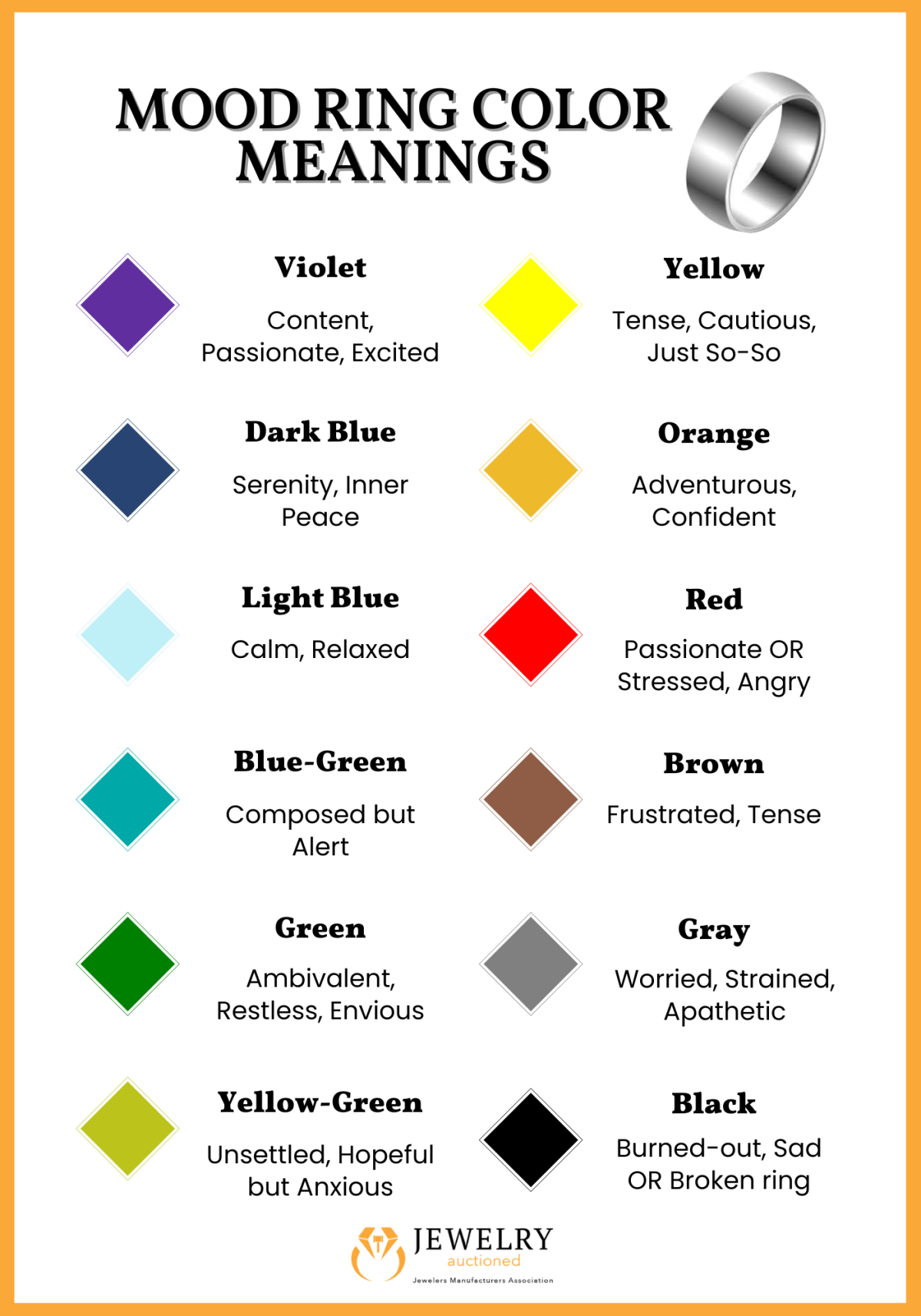
In the spectrum of a mood ring, purple (or violet) represents the highest temperature setting the ring is calibrated to display. From a physics perspective, the color purple has the shortest wavelength in the visible spectrum. When the liquid crystals are at their most “active” or twisted state—caused by a rise in surface body temperature—they reflect the violet end of the spectrum.
In tech-centric terms, purple signifies the “peak performance” of the sensor. If a mood ring is calibrated to a range of 82°F to 98°F, purple appears at the 96°F–98°F threshold. This indicates maximum vasodilation, where blood vessels are open and circulating near the surface of the skin, a biological response often triggered by intense emotion or deep relaxation.
The Evolution of Mood Tracking: From Retro Novelty to Smart Wearables
The transition from the “purple” of a mood ring to the “recovery score” of a modern fitness tracker represents a massive leap in data processing and user interface design. While the 1970s version was a standalone hardware device with no storage, modern wearables utilize cloud computing and AI to provide context to those color shifts.
The 1970s Prototype: Analog Sentiment Analysis
The mood ring was the first iteration of sentiment analysis. By assigning a color code to a physiological state—purple for “passionate” or “calm,” blue for “relaxed,” and black for “stressed”—the device attempted to provide a user interface for the human subconscious. The limitation of this early technology was its lack of “baseline” calibration. It did not account for ambient temperature or the user’s unique “normal” temperature, leading to frequent false positives (a cold room could make the ring turn black, signifying stress when the user was merely chilly).
Modern Equivalents: Oura, Whoop, and the New “Purple” State
In contemporary wearable tech, the “purple state” is no longer just a color on a ring; it is a data point in a complex algorithm. Devices like the Whoop strap or the Oura Ring 3rd Gen use skin temperature sensors to track the menstrual cycle, illness onset, and sleep stages.
When a modern smart ring detects a temperature rise similar to what would have turned an old mood ring purple, the software doesn’t just show a color. It analyzes the Heart Rate Variability (HRV) and Respiratory Rate alongside that temperature. If the temperature is high (purple) but the HRV is low, the app’s UI might shift to a “warning” color, indicating the body is fighting an infection. If both are optimized, the app displays a “Ready” or “Peak” status—the digital evolution of the purple “happy” state.
Interpreting the Data: What “Purple” Means in High-Tech Wellness

In the tech industry, “Purple” has become a design shorthand for premium states of being—flow, deep sleep, or high recovery. To understand the significance of purple on a mood ring today, we must look at how developers use this color to communicate complex biometric successes to the user.
Parasympathetic Activation and Flow States
When a mood ring turns purple, it generally signifies that the wearer is in a state of high vasodilation. Biometrically, this is often associated with the Parasympathetic Nervous System (PNS) being in control. The PNS is responsible for the “rest and digest” or “flow” states.
Tech companies have leaned into this association. For instance, many meditation apps (such as Calm or Headspace) use purple and violet hues in their UI/UX design. This isn’t accidental. It targets the user’s psychological association with the “purple” state of the mood ring—a state of being “in the zone” where body temperature is regulated and the mind is engaged but not stressed.
The Correlation Between Temperature and Cognitive Load
Recent studies in human-computer interaction (HCI) have explored how “smart” jewelry can monitor cognitive load. When a user is engaged in a difficult coding task or a complex gaming environment, their peripheral temperature often fluctuates.
If we were to apply a “mood ring” overlay to a developer’s workstation, the goal would be to stay in the “purple” zone. This indicates that while the brain is active, the body is not entering a “fight or flight” (sympathetic) response, which would cause the extremities to cool down (turning the ring yellow or black). Tech-driven “mood” monitoring is now about maintaining that purple equilibrium to prevent burnout.
The Future of Affective Computing and Sensory Feedback
As we move beyond the simple thermochromic ring, the tech industry is looking toward “Affective Computing”—systems that can recognize, interpret, and process human emotions.
AI Integration in Emotional Monitoring
The future of the “purple” state lies in machine learning. Future wearables will not just reflect your current temperature but will predict your emotional shifts before they happen. By training AI models on millions of data points involving skin conductance, pulse oximetry, and thermal shifts, tech companies are creating “Digital Twins” of our emotional selves. In this ecosystem, a “purple” notification might be sent to your smart home system to dim the lights and play lo-fi music, automating the transition into a relaxation state based on the biometric data once represented by a simple ring.
Haptic Feedback vs. Visual Cues
While the mood ring relied on visual cues (color), the next generation of mood tech is moving toward haptics. Instead of looking at your ring to see if it’s purple, a “Smart Mood Band” might use a gentle vibration or a thermal pulse to signal to your brain that you are entering a high-stress zone. This creates a closed-loop system where the tech not only monitors the “mood” but actively works to regulate it, moving the user back toward that optimal “purple” physiological state.
Security and Ethical Considerations in Biometric Data
As mood-tracking tech becomes more accurate, the “purple” state moves from a fun novelty to sensitive health data. The transition from a $2 mood ring to a $400 biometric sensor suite brings significant concerns regarding digital security.
The Privacy of Your Pulse
When a mood ring turned purple in 1975, that data stayed on your finger. Today, when your smart ring detects a “purple” state (high arousal or deep relaxation), that data is often synced to a cloud server. Tech analysts are increasingly concerned about “emotional surveillance.” If a company can track when you are in a “purple” state (passionate or excited), they can theoretically target advertisements with much higher precision. The “Tech” of the mood ring has thus shifted from material science to the ethics of data privacy.

Data Integrity in Consumer Health Tech
The final challenge for modern mood tech is accuracy. The original mood ring was notoriously unreliable, affected by everything from a drafty room to a warm cup of coffee. For modern tech to succeed, it must filter out this “noise.” Developers are currently working on multi-sensor fusion—combining thermal data (the mood ring’s specialty) with Electrodermal Activity (EDA) and AI-filtered environmental data. This ensures that when your device tells you that you are “Purple,” it is a reflection of your internal neurochemistry, not just the fact that you’re sitting in front of a heater.
In conclusion, while the color purple on a mood ring was once just a result of twisting liquid crystals, it now serves as a metaphor for the pinnacle of biometric feedback. It represents a state of physiological harmony that modern technology is desperately trying to quantify, track, and replicate through sophisticated sensors and ethical AI. The journey from the 1975 novelty to the 2024 wearable is a testament to how far we have come in our quest to decode the human experience through technology.
aViewFromTheCave is a participant in the Amazon Services LLC Associates Program, an affiliate advertising program designed to provide a means for sites to earn advertising fees by advertising and linking to Amazon.com. Amazon, the Amazon logo, AmazonSupply, and the AmazonSupply logo are trademarks of Amazon.com, Inc. or its affiliates. As an Amazon Associate we earn affiliate commissions from qualifying purchases.