
In the realm of scientific inquiry and rigorous testing, understanding the fundamental components of an experiment is paramount. Among these, the concept of “constants” plays a crucial, albeit often overlooked, role. While the spotlight frequently falls on variables – the elements that are manipulated or measured – constants represent the bedrock of a controlled and meaningful investigation. They are the silent guardians of experimental integrity, ensuring that the observed outcomes can be attributed to the intended factors and not to external or confounding influences. This article delves into the multifaceted nature of constants in experimentation, exploring their definition, their critical importance, various types, and practical considerations for their effective implementation within a technical context.

The Indispensable Role of Constants in Technical Experimentation
Within the fast-paced and iterative world of technology, where innovation hinges on precise understanding and reproducible results, constants are not merely a theoretical concept; they are a practical necessity. Whether developing new software algorithms, testing hardware prototypes, or optimizing network performance, the ability to isolate the impact of specific changes requires meticulous control over all other contributing factors.
Defining Constants in a Technical Context
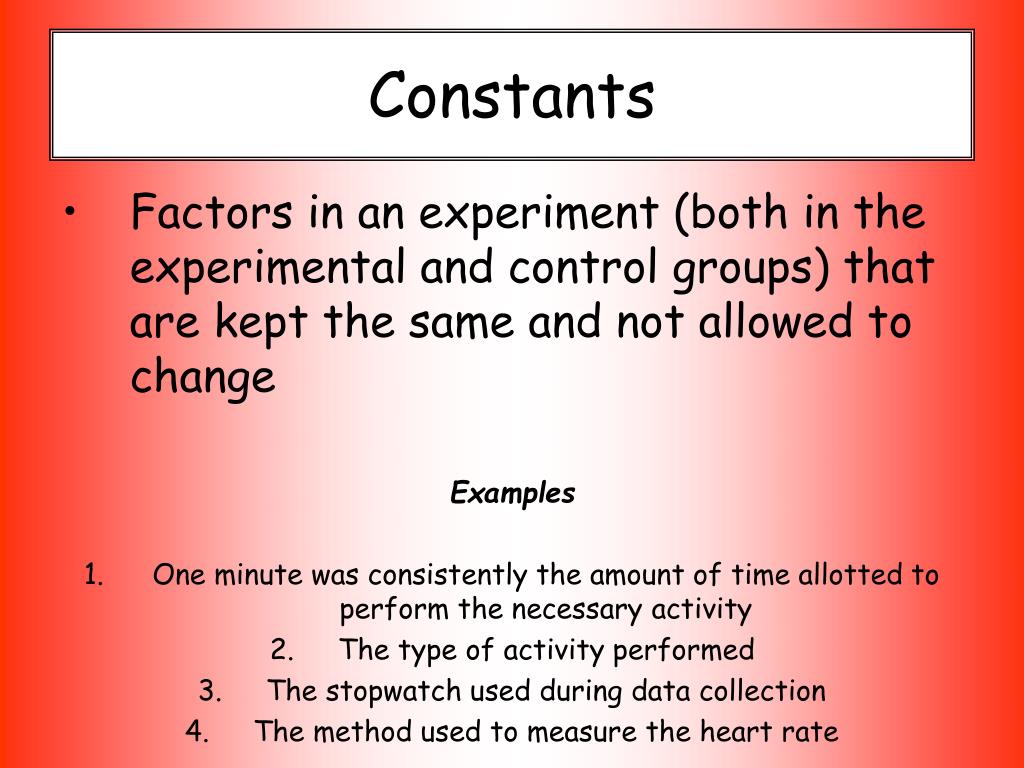
At its core, a constant in a technical experiment is a factor that is deliberately kept the same or unchanged throughout the duration of the investigation. Unlike independent variables, which are manipulated by the experimenter, and dependent variables, which are measured to observe the effect of the manipulation, constants are deliberately held invariant. Their purpose is to eliminate their potential influence on the outcome. In technical scenarios, this can encompass a wide array of elements. For example, in software testing, the operating system version, the specific hardware configuration, or even the input data structure might be treated as constants to ensure that the performance of a new algorithm is solely being evaluated under consistent conditions. Similarly, in hardware development, the ambient temperature, the power supply voltage, or the manufacturing process parameters might be held constant when testing the reliability of a new component.
Why Constants are Non-Negotiable for Valid Technical Findings
The validity of any experimental conclusion rests on the principle of attribution. If an experiment aims to determine the effect of A on B, then it is imperative that only A is allowed to change while everything else that could influence B remains constant. Without this control, any observed change in B could be due to a myriad of uncontrolled factors, rendering the experiment inconclusive or, worse, misleading. In technical fields, where decisions based on experimental results can lead to significant investments in research and development, product launches, or system deployments, the cost of flawed conclusions can be substantial.
Consider an A/B test for a new user interface element in a web application. The independent variable is the presence or absence of the new element. The dependent variable is the conversion rate. If the server load, the network latency, or the browser versions of the testing participants are allowed to fluctuate wildly, the observed difference in conversion rates might not be due to the new UI element at all, but rather due to these uncontrolled environmental factors. By keeping these elements constant (or at least within tightly controlled ranges), the experimenter can be confident that any significant difference in conversion rates is indeed attributable to the UI change. This rigor is what distinguishes credible technical research from anecdotal observations.
The Interplay Between Variables and Constants
Understanding constants necessitates a clear delineation from variables. Independent variables are the “causes” being tested, the factors the experimenter intentionally changes to observe an effect. Dependent variables are the “effects” being measured, the outcomes that are expected to change in response to the independent variable. Constants, in contrast, are the “controls.” They are the factors that could potentially influence the dependent variable but are deliberately prevented from doing so by being held stable. The success of an experiment lies in the intelligent selection and management of these three categories. A well-designed experiment has a clear independent variable, a measurable dependent variable, and a comprehensive list of carefully controlled constants.
Types of Constants in Technical Experiments
The nature of constants can vary significantly depending on the domain of the technical experiment. Recognizing these different forms allows for more precise experimental design and execution.
Environmental Constants
These are factors related to the external conditions in which the experiment is conducted. In software development, this might refer to the operational environment.
Operating System and Software Dependencies
When testing the performance of a new piece of software, the operating system version, its patch level, and all associated dependencies (libraries, frameworks, drivers) are often treated as constants. Running the same test on different operating system versions or with different dependency configurations would introduce too many confounding variables, making it impossible to isolate the software’s inherent performance characteristics. For instance, a latency measurement for a new network protocol would be meaningless if tested on a machine with an outdated network driver compared to one with the latest.
Hardware Specifications and Configuration
The underlying hardware on which a piece of software runs or a hardware component is tested can also be a critical constant. This includes the CPU, RAM, storage devices, graphics card, and network interface card. When benchmarking a new algorithm, ensuring that all tests are run on identical hardware configurations is crucial. Similarly, when testing the thermal performance of a new CPU cooler, the ambient room temperature must be kept constant, as it directly impacts the cooling efficiency.
Procedural Constants
These constants relate to the methodology and execution of the experiment itself, ensuring consistency in how the experiment is carried out.
Input Data and Test Cases
In software testing, the specific datasets or test cases used to evaluate functionality or performance are vital constants. If the input data changes between test runs, the observed behavior might simply reflect the difference in the data rather than a flaw or feature of the system under test. For example, if testing a database query optimization algorithm, the same set of queries and the same database state must be used for each iteration of the test.
Execution Parameters and Timings
Specific parameters that govern the execution of a process or algorithm are also often held constant. This could include things like the number of iterations in a loop, the timeout periods for network requests, or the sampling rate for sensor data. For example, when evaluating the efficiency of a machine learning model training process, the batch size, learning rate, and number of epochs are typically set as constants to allow for a fair comparison of different model architectures or initializations.
Measurement Constants
These constants pertain to the instruments and methods used for data collection.
Measurement Tools and Calibration
The accuracy and reliability of experimental results are directly tied to the tools used to collect data. The measurement instruments themselves – whether they are software profilers, hardware oscilloscopes, or data acquisition systems – must be consistent. Ensuring that these tools are properly calibrated and used in the same mode and settings throughout the experiment is paramount. For instance, if measuring network throughput, the bandwidth testing tool and its configuration must remain unchanged.
Data Acquisition Settings
The way data is sampled, aggregated, or recorded can also be a constant. This includes settings like the frequency of data logging, the resolution of measurements, or the format of the output data. If these settings are altered during the experiment, it can lead to incomparable data points. For example, when monitoring system resource utilization, the logging interval for CPU usage or memory consumption should be consistent across all test runs.

Strategies for Maintaining Constants in Technical Experiments
Effectively controlling constants requires a proactive and systematic approach. Simply assuming that certain factors will remain unchanged is rarely sufficient.
Rigorous Experimental Design and Documentation
The foundation of maintaining constants lies in meticulous planning. Before any experiment begins, a detailed experimental protocol should be developed. This document should explicitly list all factors intended to be held constant, the methods by which they will be controlled, and the acceptable tolerance ranges for any slight variations.
Defining Tolerances and Thresholds
It’s often impractical, and sometimes even detrimental, to demand absolute constancy. For example, slight fluctuations in ambient temperature are usually unavoidable. The key is to define acceptable tolerance levels. For instance, an experiment might stipulate that the ambient temperature must remain within ±1°C of the target value. Any deviation outside this range should trigger an investigation or, in severe cases, the invalidation of the data collected during that period. Documenting these tolerances ensures that deviations are recognized and addressed.
Version Control for Software and Configurations
In software-centric experiments, maintaining consistent versions of operating systems, libraries, dependencies, and even the experimental code itself is critical. Employing version control systems (like Git) for all relevant software components and configuration files ensures that the exact environment used for a particular test run can be replicated or verified. This is especially important for debugging and reproducing results.
Utilizing Controlled Environments and Automation
Leveraging specialized environments and automation can significantly simplify the task of maintaining constants.
Dedicated Testing Environments and Laboratories
For critical technical experiments, the use of dedicated testing environments or laboratories is often employed. These environments are specifically designed and equipped to minimize external influences. This might include climate-controlled rooms, shielded enclosures to prevent electromagnetic interference, or isolated network segments. Such dedicated spaces provide a high degree of control over environmental constants.
Scripting and Automation Tools
Many procedural and measurement constants can be effectively managed through scripting and automation. Test scripts can be written to ensure that the same sequence of operations is performed, the same input data is used, and the same measurement parameters are applied every time. Automation tools can also be used to monitor and log environmental conditions, alerting the experimenter to any deviations from the defined constants. For example, automated deployment tools can ensure that identical software builds are installed on all test machines.
Monitoring and Verification
Even with the best design, it’s crucial to actively monitor and verify that constants are indeed being maintained throughout the experiment.
Real-time Data Logging and Auditing
Implementing real-time logging of environmental conditions (temperature, humidity, network traffic) and operational parameters (CPU load, memory usage) can provide continuous assurance that constants are stable. This data can be auditable, allowing for post-experiment verification of the experimental conditions. If unexpected results occur, the logged data can help pinpoint whether a constant was inadvertently compromised.
Periodic Checks and Validation Procedures
Beyond continuous monitoring, periodic manual checks and validation procedures are also important. This might involve periodically recalibrating measurement instruments, running a known baseline test to confirm system stability, or visually inspecting the experimental setup. These checks act as a safety net to catch any subtle drifts or failures in the control mechanisms.
The Consequences of Neglecting Constants
The ramifications of failing to adequately control constants in technical experiments can be far-reaching and detrimental.
Inaccurate or Misleading Results
The most immediate consequence is the generation of inaccurate or misleading experimental results. If uncontrolled factors are influencing the dependent variable, the observed outcomes cannot be reliably attributed to the independent variable. This can lead to faulty conclusions about the performance, efficacy, or reliability of the technology being tested.
Wasted Resources and Time
Experiments are often resource-intensive, requiring significant investments in hardware, software, personnel, and time. If an experiment is compromised by uncontrolled constants, the entire effort can be rendered futile. This leads to wasted resources and necessitates repeating the experiment, further delaying progress and increasing costs.
Flawed Decision-Making and Product Development
In the fast-paced tech industry, decisions about product development, investment, and deployment are heavily reliant on experimental data. If that data is compromised by a lack of control over constants, it can lead to flawed decisions. This could manifest as launching a product with critical bugs, investing in a technology that doesn’t perform as expected, or deploying systems that are unstable or inefficient.
Erosion of Trust and Credibility
For researchers, engineers, and organizations, the ability to produce reliable and reproducible results is crucial for building trust and credibility. Consistently flawed experiments due to a disregard for constants can erode this trust among peers, stakeholders, and the wider scientific or technical community.
In conclusion, constants are the unsung heroes of technical experimentation. They provide the necessary framework of stability that allows us to isolate the effects of variables and draw meaningful conclusions. By understanding their definition, recognizing their diverse forms, implementing robust strategies for their maintenance, and appreciating the consequences of their neglect, we can significantly enhance the rigor, validity, and ultimate success of our technical investigations. In a field that thrives on precision and innovation, mastering the art of controlling constants is not just good practice; it is an essential requirement for true progress.
aViewFromTheCave is a participant in the Amazon Services LLC Associates Program, an affiliate advertising program designed to provide a means for sites to earn advertising fees by advertising and linking to Amazon.com. Amazon, the Amazon logo, AmazonSupply, and the AmazonSupply logo are trademarks of Amazon.com, Inc. or its affiliates. As an Amazon Associate we earn affiliate commissions from qualifying purchases.