
The world of exchange-traded funds (ETFs) offers investors a diverse range of options to gain exposure to various market segments. For those looking to invest in the stock market, two popular choices often come up: VGT and VOO. While both are Vanguard ETFs and are designed to track stock market indices, they represent fundamentally different investment strategies and outcomes. Understanding the distinction between VGT (Vanguard Information Technology ETF) and VOO (Vanguard S&P 500 ETF) is crucial for aligning your portfolio with your financial goals and risk tolerance. This article will delve into the core differences, exploring their underlying indices, sector focus, investment implications, and who each ETF might be best suited for.
Understanding the Core Investment Strategies
At their heart, VGT and VOO represent two distinct approaches to market participation: targeted sector investment versus broad market exposure. This foundational difference dictates their performance characteristics, risk profiles, and potential for growth.
VOO: Tracking the S&P 500 – The Benchmark of the U.S. Market
VOO is designed to replicate the performance of the S&P 500 Index. This index is one of the most widely followed benchmarks in the world and comprises approximately 500 of the largest publicly traded companies in the United States. It’s often considered a proxy for the overall health and performance of the U.S. stock market. Companies included in the S&P 500 are selected by a committee at S&P Dow Jones Indices based on criteria such as market capitalization, liquidity, and sector representation.
The S&P 500 is a market-capitalization-weighted index, meaning that companies with larger market values have a greater influence on the index’s performance. This naturally leads to a significant weighting of the largest and most established companies. Consequently, VOO provides investors with diversified exposure to a wide array of industries, including technology, healthcare, financials, consumer discretionary, and more. Its broad diversification is a key feature, as it aims to reduce the impact of any single company’s or sector’s poor performance on the overall fund.
VGT: Focusing on Information Technology – A Sector-Specific Approach
In contrast, VGT (Vanguard Information Technology ETF) is a sector-specific ETF. Its objective is to track the MSCI US Investable Market Information Technology 25/50 Index. This index focuses exclusively on companies within the information technology sector. This sector encompasses a wide range of businesses, including software development, hardware manufacturing, semiconductors, IT services, and internet-related businesses.
Unlike VOO, which offers broad diversification across multiple sectors, VGT concentrates its holdings within a single, albeit large and dynamic, sector. This concentration means that VGT’s performance is heavily influenced by the trends, innovations, and economic conditions that specifically impact the technology industry. While the technology sector has historically been a strong driver of market growth, its concentrated nature also exposes investors to higher levels of volatility and sector-specific risks.
Key Differences in Holdings and Diversification
The divergence in their investment objectives leads to significant differences in the underlying holdings and the degree of diversification offered by VGT and VOO.
Sector Concentration vs. Broad Sector Representation
The most striking difference lies in their sector composition. VOO, by tracking the S&P 500, offers a balanced exposure to all major sectors of the U.S. economy. The weighting of each sector fluctuates over time based on market performance, but it generally reflects the overall economic landscape. For instance, at any given time, VOO will have significant allocations to technology, healthcare, financials, consumer discretionary, and industrials. This broad diversification is designed to provide a more stable and less volatile investment experience compared to a sector-specific fund.
VGT, on the other hand, is entirely dedicated to the information technology sector. This means that 100% of its assets are invested in companies classified within this industry. While the technology sector itself is diverse, encompassing various sub-industries, it still represents a single economic segment. This concentration can lead to amplified gains during periods of strong technological innovation and growth but also heightened losses during technology sector downturns or when broader economic factors negatively impact the sector.
Top Holdings and Market Capitalization Focus

Another key differentiator is the concentration of top holdings and their respective market capitalizations. Both VOO and VGT are market-capitalization-weighted ETFs. However, due to the nature of the S&P 500, VOO’s top holdings tend to be some of the largest and most established companies across various sectors. These often include giants like Apple, Microsoft, Amazon, and Alphabet (Google), which are also dominant players in the tech sector.
VGT, being sector-specific, will also have many of these same technology giants as its top holdings. However, its portfolio will be exclusively comprised of technology companies. This means that while VOO might hold, for example, Apple and Microsoft, it will also hold substantial positions in companies from other sectors that are not represented in VGT. The difference in VGT is that its top holdings, while often the same as VOO’s top tech names, will constitute a much larger percentage of its overall portfolio. This increased concentration in its top holdings can amplify the impact of their individual performance on VGT’s overall returns.
Performance, Risk, and Investor Suitability
The inherent differences in their strategies translate directly into distinct performance characteristics, risk profiles, and ultimately, the types of investors for whom each ETF is most appropriate.
Historical Performance and Volatility
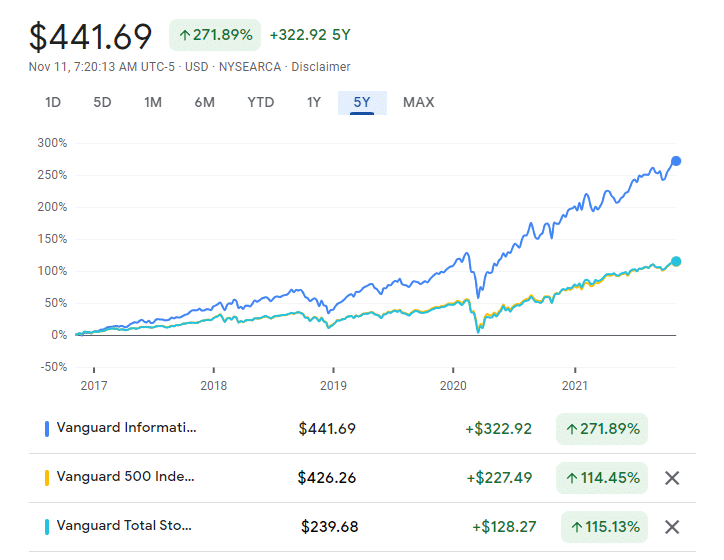
Historically, the information technology sector has been a significant growth engine for the stock market. As a result, VGT has often outperformed VOO during periods of strong technological advancement and economic expansion driven by innovation. The rapid growth of software, cloud computing, artificial intelligence, and other tech sub-sectors has propelled VGT’s returns to impressive levels.
However, this higher growth potential comes with a commensurate increase in volatility. When the technology sector faces headwinds, such as regulatory changes, increased competition, or shifts in consumer spending, VGT can experience more pronounced declines than VOO. The broad diversification of VOO, by spreading risk across multiple sectors, tends to buffer against such sector-specific downturns, resulting in a generally smoother performance trajectory. Investors in VGT must be prepared for a potentially bumpier ride, accepting the possibility of larger price swings in exchange for potentially higher long-term returns.
Risk Tolerance and Investment Horizon
The suitability of VGT versus VOO largely hinges on an investor’s risk tolerance and investment horizon. For investors with a high risk tolerance and a long-term investment horizon, VGT could be an attractive option for overweighting the technology sector, which they believe will continue to be a primary driver of future growth. Their rationale might be that the disruption and innovation within tech offer superior opportunities for capital appreciation over many years.
Conversely, investors with a moderate to low risk tolerance, or those seeking a more stable and diversified investment, would likely find VOO to be a more appropriate choice. VOO offers a well-rounded exposure to the U.S. economy, providing a solid foundation for a diversified portfolio. It’s an excellent option for those who want to participate in the broad stock market’s growth without the concentrated risk of a single sector. For investors with shorter time horizons, or those who prioritize capital preservation alongside growth, VOO’s diversification can be a significant advantage.
Portfolio Allocation Strategies
The decision between VGT and VOO, or even a combination of both, depends on how they fit into an investor’s overall portfolio allocation strategy.
-
For a Core Portfolio: VOO often serves as an excellent core holding for a diversified portfolio. It provides broad market exposure and a solid foundation for long-term wealth accumulation. Many investors may choose to allocate a significant portion of their equity holdings to an S&P 500 ETF like VOO.
-
For Sector Tilts: Investors who believe in the long-term potential of the technology sector and wish to overweight it can consider adding VGT to their portfolio alongside a broad market ETF like VOO. This “sector tilt” allows them to capitalize on their conviction in technology while still maintaining diversification through their core holdings. For example, an investor might hold 70-80% in VOO and then allocate the remaining 20-30% to VGT to express a stronger bullish view on tech.
-
For Simplification: Investors who are new to ETFs or prefer a simpler approach might opt for just one of these ETFs. If the goal is broad market participation, VOO is the clear choice. If the investor has a very strong conviction in the technology sector and a high risk tolerance, VGT could be their sole equity investment, though this is generally not recommended for most investors due to the lack of diversification.
In conclusion, while both VGT and VOO are powerful investment tools offered by Vanguard, they serve distinct purposes. VOO provides broad, diversified exposure to the U.S. large-cap stock market, making it a cornerstone for many portfolios. VGT, on the other hand, offers a concentrated bet on the growth and innovation within the information technology sector. The choice between them, or the decision to combine them, should be carefully considered based on individual financial goals, risk tolerance, and investment time horizon.
aViewFromTheCave is a participant in the Amazon Services LLC Associates Program, an affiliate advertising program designed to provide a means for sites to earn advertising fees by advertising and linking to Amazon.com. Amazon, the Amazon logo, AmazonSupply, and the AmazonSupply logo are trademarks of Amazon.com, Inc. or its affiliates. As an Amazon Associate we earn affiliate commissions from qualifying purchases.