
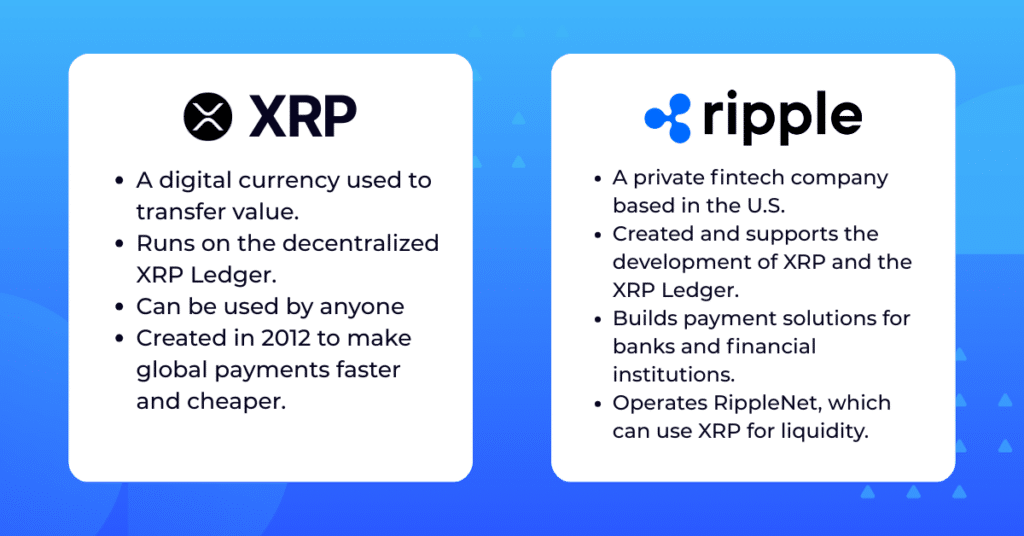
In the rapidly evolving landscape of global finance, few digital assets have sparked as much conversation, debate, and institutional interest as XRP. Often referred to colloquially as “Ripple,” it is essential for any modern investor or business leader to distinguish between the two: Ripple is the technology company, while XRP is the independent digital asset designed for the financial services industry. As we move further away from traditional legacy banking systems and toward a more digitized global economy, understanding the financial mechanics and investment potential of XRP is no longer optional—it is a necessity for anyone navigating the “Money” niche.

The Role of XRP in Modern Personal Finance and Investing
For the individual investor, XRP represents a unique entry point into the world of digital assets. Unlike Bitcoin, which was originally envisioned as a “peer-to-peer electronic cash system” to bypass banks, or Ethereum, which acts as a global computer for decentralized applications, XRP was built with a specific financial utility in mind: the bridging of currencies and the optimization of liquidity.
Understanding XRP as a Digital Asset
From a personal finance perspective, XRP is categorized as a high-liquidity digital asset. It operates on the XRP Ledger (XRPL), an open-source, decentralized blockchain technology. What sets it apart for investors is its speed and cost-efficiency. While a standard international bank transfer can take three to five business days and incur significant fees, an XRP transaction settles in roughly three to five seconds at a cost that is a fraction of a cent. For an investor, this efficiency suggests a strong “use case,” which is often a primary driver of long-term value in the digital asset market.
How XRP Differs from Traditional Cryptocurrency Investments
Most cryptocurrencies rely on “mining” (Proof of Work) or “staking” (Proof of Stake) to validate transactions. XRP, however, uses a consensus protocol. For the investor, this means there is no inflationary pressure from new coins being “mined” into existence in the traditional sense; the total supply of 100 billion XRP was created at its inception. A significant portion of this supply is held in escrow by Ripple the company, released periodically to maintain market stability and fund ecosystem growth. Understanding this supply-and-demand dynamic is crucial for anyone looking to include XRP in a diversified investment portfolio.
Revolutionizing Business Finance and Global Liquidity
The true financial power of XRP is most evident when applied to the world of corporate and institutional finance. Currently, the global financial system relies on an outdated infrastructure known as the correspondent banking network. This system requires banks to hold “pre-funded” accounts (Nostro/Vostro accounts) in local currencies around the world to ensure they can settle international trades. This results in trillions of dollars in “dead capital” that sits idle just to facilitate liquidity.
On-Demand Liquidity (ODL) and the Speed of Capital
Ripple’s flagship financial product, now often integrated into the “RippleNet” suite, utilizes XRP to provide On-Demand Liquidity (ODL). For a business or a financial institution, ODL allows them to shift from pre-funding accounts to instant settlement. By using XRP as a bridge currency, a company can convert their local currency into XRP, send it across the globe, and have it converted into the destination currency in seconds. This frees up vast amounts of capital, allowing businesses to reinvest that money into growth, R&D, or dividends rather than leaving it dormant in a foreign bank account.
Cost Reduction in Cross-Border Settlements
In the realm of business finance, the bottom line is king. Traditional cross-border payments are not only slow but also expensive, often costing between 3% and 7% of the total transaction value when all intermediary fees and currency exchange spreads are totaled. XRP slashes these costs by eliminating the need for multiple intermediary banks. For small-to-medium enterprises (SMEs) that operate internationally, this can mean the difference between a profitable quarter and a loss, making XRP a fundamental tool for modern treasury management.
Navigating the Ripple Ecosystem as an Investor
Investing in the digital asset space requires a sophisticated understanding of risk management and market sentiment. XRP has historically been one of the top digital assets by market capitalization, but its journey has been marked by significant regulatory scrutiny, particularly in the United States.
Market Volatility and Portfolio Diversification
Like any financial instrument in the nascent crypto-economy, XRP is subject to price volatility. However, from a portfolio management standpoint, it often exhibits different price correlations compared to Bitcoin. Investors frequently use XRP as a “utility play.” When the broader market moves based on speculative hype, XRP often moves based on news regarding institutional adoption, partnerships with central banks, or advancements in payment regulations. For the savvy investor, this provides a layer of diversification within the digital asset class.
Regulatory Environments and Their Impact on Value
Perhaps the most significant factor in the financial history of XRP is the legal landscape. The SEC (Securities and Exchange Commission) lawsuit against Ripple was a landmark event that focused on whether XRP should be classified as a security. For investors, this was a masterclass in “regulatory risk.” The eventual legal clarifications provided a level of certainty for XRP that many other digital assets still lack. In the world of money, certainty is a valuable commodity. Institutional investors—pension funds, hedge funds, and family offices—are far more likely to allocate capital to an asset that has a defined regulatory status.
The Economic Infrastructure: How Ripple’s Technology Powers Finance
Beyond the coin itself, the economic infrastructure supporting XRP is designed to mirror and then improve upon the existing financial systems. It is not merely about moving money; it is about the “Internet of Value,” where money moves as quickly as information moves today.
The XRP Ledger (XRPL) as a Financial Utility
The XRPL is more than just a ledger for a currency; it is a financial utility. It supports features like “Issued Currencies,” which allow users to create their own tokens representing value (such as gold, USD, or even loyalty points) that can then be traded against XRP. This creates a decentralized exchange (DEX) built directly into the protocol. For a business looking to tokenize assets, the XRPL provides a low-cost, high-speed environment that is far more economically viable than legacy alternatives.
Sustainable Finance: The Energy Efficiency Factor
In the modern financial world, ESG (Environmental, Social, and Governance) criteria are becoming vital for institutional investment. Traditional mining-based cryptocurrencies consume vast amounts of electricity, which can be a deterrent for “green” funds. XRP is inherently “green” because it does not require mining. The energy consumed to settle a transaction on the XRP Ledger is negligible compared to Bitcoin or traditional banking data centers. This sustainability makes it a more attractive financial tool for corporations aiming to meet strict carbon-neutral goals while still modernizing their financial workflows.
The Long-Term Financial Outlook for XRP
As we look toward the future of money, the move toward Central Bank Digital Currencies (CBDCs) appears inevitable. Many financial analysts believe that XRP is positioned to be the “interoperability layer” that connects different national CBDCs. If the digital dollar, digital euro, and digital yen all need a common, neutral bridge to swap value instantly, XRP is the leading candidate for that role.
For the personal investor, this represents a long-term “macro” thesis. If XRP becomes a standard part of the global financial plumbing, its utility-driven demand could potentially decouple from the speculative cycles of the broader crypto market. While no investment is without risk, the financial logic behind XRP—solving the liquidity crisis, lowering transaction costs, and enabling the instant movement of capital—aligns perfectly with the goals of the 21st-century global economy.
In conclusion, “What is Ripple XRP?” is a question that leads directly to the heart of the future of money. Whether viewed as a high-potential digital asset for a personal brokerage account or a transformative liquidity tool for a multi-national corporation, XRP stands at the intersection of traditional finance and the digital frontier. By understanding its role as a bridge currency and its potential to unlock trillions in stagnant capital, investors and business leaders can better position themselves for a world where value moves as fast as a text message.
aViewFromTheCave is a participant in the Amazon Services LLC Associates Program, an affiliate advertising program designed to provide a means for sites to earn advertising fees by advertising and linking to Amazon.com. Amazon, the Amazon logo, AmazonSupply, and the AmazonSupply logo are trademarks of Amazon.com, Inc. or its affiliates. As an Amazon Associate we earn affiliate commissions from qualifying purchases.