
The world of electronics is built upon a foundation of fundamental principles and units of measurement. Among these, the farad (F) stands as a crucial unit, defining a property that is integral to the operation of countless electronic devices. While the name might sound arcane to those outside the field, understanding the farad is key to grasping how components like capacitors function and how they are employed in everything from simple circuits to complex computing systems. This article delves into the definition of the farad, its significance in electronics, and the practical implications of capacitance.

The Core Concept: Defining Capacitance and the Farad
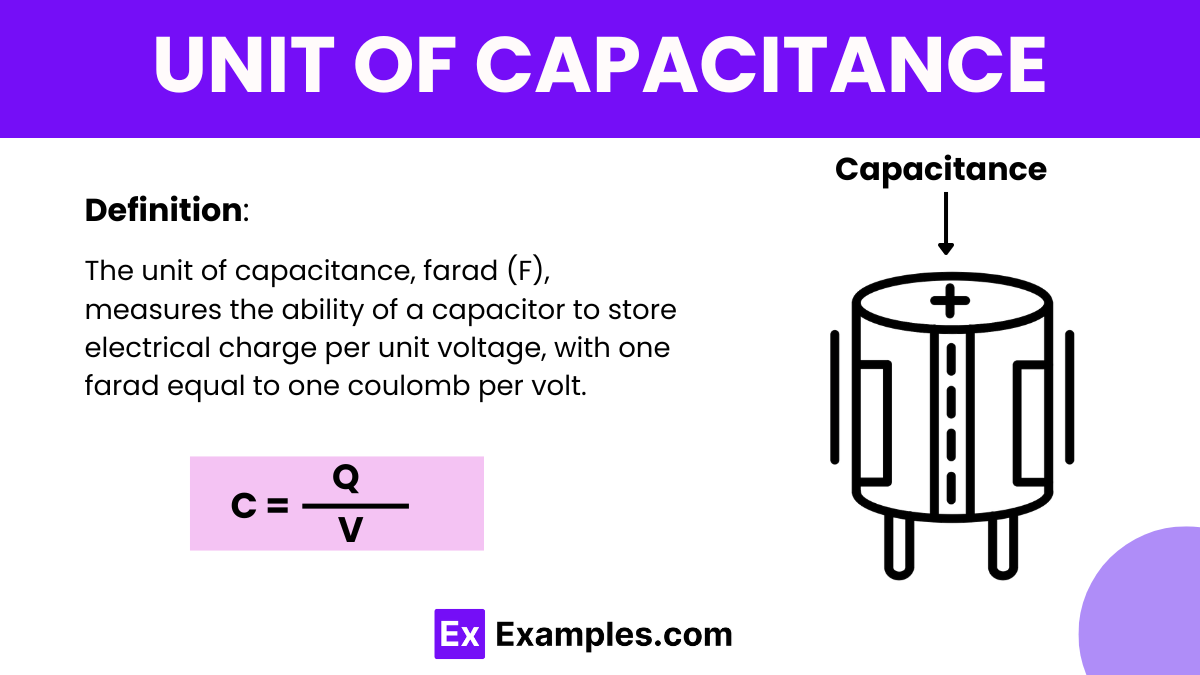
At its heart, capacitance is the ability of an object to store an electrical charge. Think of it like a tiny, temporary reservoir for electricity. When we talk about capacitance, we are quantifying this storage capability. The farad is the standard SI unit used to measure capacitance.
What Exactly is a Farad?
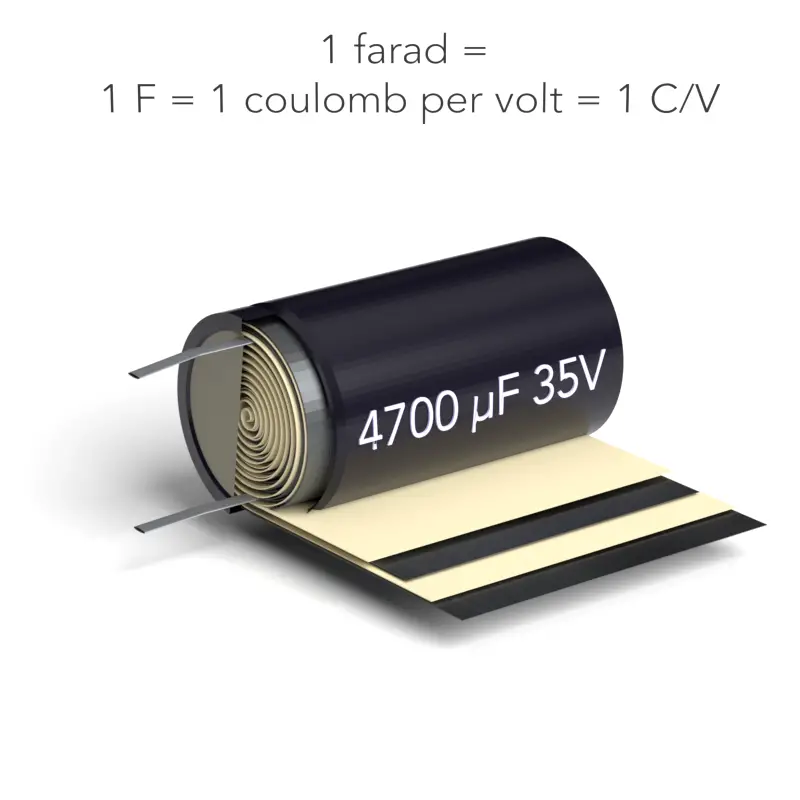
Formally, a farad is defined as the capacitance of a conductor system where an electric charge of one coulomb produces a potential difference of one volt between the conductors. This definition, while precise, can be a bit abstract. To break it down further, consider the relationship between charge (Q), voltage (V), and capacitance (C) expressed by the fundamental equation:
$Q = C times V$
This equation tells us that the amount of charge (Q) stored on a capacitor is directly proportional to its capacitance (C) and the voltage (V) applied across it. Therefore, a capacitor with a capacitance of one farad can store one coulomb of charge when one volt is applied.
However, the farad, as a unit, is exceptionally large. In practical electronic applications, the capacitance values are typically much smaller. You will frequently encounter units like:
- Microfarads (µF): One millionth of a farad ($10^{-6}$ F).
- Nanofarads (nF): One billionth of a farad ($10^{-9}$ F).
- Picofarads (pF): One trillionth of a farad ($10^{-12}$ F).
These smaller units are used because even modest capacitors in everyday devices often have capacitances in the microfarad or picofarad range.
The Physical Basis of Capacitance
Capacitance arises from the physical construction of a capacitor. The most basic capacitor consists of two conductive plates separated by a non-conductive material called a dielectric. When a voltage is applied across the plates, positive charge accumulates on one plate, and negative charge accumulates on the other. The dielectric material prevents the direct flow of charge between the plates but allows an electric field to build up, effectively storing energy.
The capacitance of such a device is influenced by several factors:
- Area of the plates: Larger plate areas generally lead to higher capacitance.
- Distance between the plates: Closer plates result in higher capacitance.
- Nature of the dielectric material: Different dielectric materials have varying abilities to support an electric field, which directly impacts capacitance. Materials with a higher dielectric constant will yield a greater capacitance for the same physical dimensions.
The farad, as the unit of this property, allows engineers and technicians to precisely specify and calculate the performance of capacitors in circuit designs.
The Farad in Practical Electronics: Applications and Significance
The farad, and by extension capacitance, is not just a theoretical concept; it is a cornerstone of modern electronics. Capacitors, measured in farads, are ubiquitous components found in virtually every electronic device. Their ability to store and release electrical energy, filter signals, and smooth voltage fluctuations makes them indispensable.
Energy Storage: Beyond Batteries
While batteries are the primary energy storage solution for long-term power, capacitors offer a different kind of energy storage. They can charge and discharge much more rapidly than batteries, making them ideal for applications requiring quick bursts of power.
Supercapacitors: These are a special class of capacitors that exhibit exceptionally high capacitance values, often in the farad or even kilofarad (kF) range. They bridge the gap between conventional capacitors and batteries, offering high power density (the rate at which energy can be delivered) and a good energy density (the total amount of energy stored). Supercapacitors are used in applications like:
- Regenerative braking in electric vehicles: They capture kinetic energy during braking and release it for acceleration.
- Backup power for memory and volatile systems: Providing a brief power source during brief power outages.
- Grid energy storage: To help stabilize power grids by smoothing out fluctuations.
The farad unit is essential for understanding the capacity of these advanced energy storage devices.
Filtering and Smoothing: The Role of Capacitance
In many electronic circuits, especially those dealing with alternating current (AC) that is converted to direct current (DC), the output is not a perfectly smooth DC voltage. It often contains ripples or unwanted fluctuations. Capacitors play a vital role in smoothing these out.
Decoupling Capacitors: These are typically small-value capacitors (often in the microfarad or nanofarad range) placed close to integrated circuits (ICs). They act as local, fast-acting reservoirs of charge. When an IC suddenly demands a surge of current, the decoupling capacitor can instantly supply it, preventing voltage drops that could disrupt the IC’s operation. The farad unit helps determine the appropriate capacitance needed to effectively “decouple” noise and provide stable power.
Filtering in Audio and Radio Frequencies: Capacitors are fundamental to the design of filters in audio systems, radio receivers, and transmitters. By strategically combining capacitors with other components like resistors and inductors, engineers can create circuits that selectively allow certain frequencies to pass while blocking others. The farad value dictates the frequency response of these filters. For example, a capacitor with a specific farad value might be chosen to block low frequencies (like hum) in an audio amplifier or to tune a radio circuit to a particular station.
Timing and Oscillation: The Rhythmic Heart of Circuits
Capacitance is also critical in circuits that rely on precise timing or generate oscillating signals.
RC Circuits: Combinations of resistors (R) and capacitors (C) form fundamental timing circuits. The time it takes for a capacitor to charge or discharge through a resistor is determined by the product of their values (the time constant, RC). This principle is used in:
- Timers: Controlling the duration of an event.
- Oscillators: Generating repeating waveforms, essential for clocks in microprocessors and for radio frequency generation.
- Pulse generators: Creating specific electrical pulse shapes.
The farad unit is paramount in calculating the precise timing characteristics of these circuits. A change in farads will directly alter the speed and frequency of the generated signals.
Measuring and Verifying Farads: Tools of the Trade
Accurately measuring and verifying capacitance, and thus the farad value of a component, is crucial for ensuring correct circuit operation and troubleshooting. This is where specialized electronic test equipment comes into play.
The Multimeter’s Role
Many modern digital multimeters (DMMs) include a capacitance measurement function. This allows technicians to quickly check if a capacitor has the correct farad value or if it has degraded over time. When using a multimeter to measure capacitance, you typically set the dial to the capacitance setting and insert the capacitor leads into designated ports. The meter will then display the capacitance, usually in microfarads or picofarads. It’s important to note that while multimeters are great for basic checks, they might not be the most accurate for very small or very large capacitance values, or for measuring under specific operating conditions.
Dedicated LCR Meters
For more precise measurements and a deeper analysis of component characteristics, an LCR meter is employed. LCR stands for Inductance, Capacitance, and Resistance, the three fundamental passive electronic components. An LCR meter provides highly accurate readings of these values and can often test components at various frequencies and voltages. This is particularly important because a capacitor’s effective capacitance can sometimes vary slightly with the test frequency.
When measuring a capacitor with an LCR meter, you can typically select the desired test frequency and voltage. The meter will then apply these conditions and measure the resulting impedance, from which it calculates the capacitance in farads (or its sub-units). This detailed analysis is vital in research and development, quality control, and advanced troubleshooting where precise component values are critical for performance.
Understanding Datasheets and Component Identification
Capacitors themselves are often marked with their capacitance value directly on their casing. However, due to space constraints, especially on smaller components, these markings can be in code. For example, a capacitor might be marked with “104.” In this common marking system, the first two digits are the significant figures, and the third digit is the multiplier (the number of zeros). So, “104” would represent 10 x $10^4$ picofarads, which equals 100,000 pF, or 0.1 µF (microfarads).
Understanding these markings and referring to component datasheets is essential. Datasheets provide detailed specifications for a component, including its rated capacitance in farads, its tolerance (how much the actual value can deviate from the rated value), its voltage rating, and other important electrical characteristics. These documents are invaluable resources for engineers and hobbyists alike when selecting and implementing capacitors in their designs.
The Farad and the Future of Electronics
As electronic devices become increasingly miniaturized and sophisticated, the role of capacitance and the precise measurement of farads continue to evolve. Innovations in capacitor technology are pushing the boundaries of what’s possible.
Miniaturization and High-Density Storage
The trend towards smaller, more powerful electronics necessitates components that are both compact and highly functional. Capacitor manufacturers are developing new dielectric materials and construction techniques to achieve higher capacitance values in smaller physical footprints. This is crucial for smartphones, wearables, and increasingly complex integrated circuits that require efficient power delivery and filtering in confined spaces. The ability to pack more farads into a smaller volume directly translates to more capable and versatile devices.
Advanced Applications and Emerging Technologies
Beyond traditional applications, capacitance is playing a role in emerging technologies:
- Touchscreens: The capacitive touchscreens found on smartphones and tablets rely on the principle of capacitance. When your finger, a conductive object, approaches the screen, it alters the local capacitance, allowing the device to detect your touch.
- Biomedical Devices: Capacitive sensors are being used in medical applications for non-invasive monitoring of various physiological parameters.
- Internet of Things (IoT): The proliferation of connected devices requires efficient power management and signal processing, areas where capacitors are fundamental.
The farad, as the unit of capacitance, remains the fundamental metric by which these capabilities are understood and engineered. As electronic technology continues its relentless march forward, the humble farad, and the capacitors it quantifies, will undoubtedly remain an indispensable element in its ongoing evolution. From the simplest blinking LED to the most advanced supercomputer, the concept of storing charge, measured in farads, is an ever-present and fundamental force.
aViewFromTheCave is a participant in the Amazon Services LLC Associates Program, an affiliate advertising program designed to provide a means for sites to earn advertising fees by advertising and linking to Amazon.com. Amazon, the Amazon logo, AmazonSupply, and the AmazonSupply logo are trademarks of Amazon.com, Inc. or its affiliates. As an Amazon Associate we earn affiliate commissions from qualifying purchases.