
In the realm of material science and industrial technology, few inventions have reshaped the modern world as profoundly as nylon. Often mistaken for a naturally occurring substance due to its ubiquity in everything from high-performance athletic gear to automotive engine components, nylon is, in fact, a triumph of chemical engineering. To understand what fibre nylon is made from, one must look beyond the loom and into the laboratory, where complex polymers are synthesized through precise technological processes.
Nylon is not a single organic fibre like cotton or wool; rather, it is a generic designation for a family of synthetic polymers known as polyamides. It represents the first successful attempt by human beings to create a fiber entirely from inorganic substances through a process of molecular manipulation. This article explores the technical composition, the sophisticated manufacturing processes, and the material engineering that defines nylon in the 21st century.
The Molecular Blueprint: Understanding Polyamide Synthesis
At its core, the question of what nylon is made from is answered by the term “polyamide.” In the language of chemical technology, a polymer is a large molecule composed of repeating structural units. For nylon, these units are linked by amide bonds, the same type of chemical bond that links amino acids in proteins. However, unlike silk—a natural polyamide—nylon is engineered for specific industrial performance.
From Coal and Petroleum to Polymer
The “raw materials” of nylon are not fibers at all, but chemical precursors derived primarily from petroleum and natural gas. The technology used to extract and refine these hydrocarbons is the foundation of synthetic fiber production. Through advanced refining, engineers isolate specific chemicals—most commonly benzene or cyclonexane—which serve as the building blocks for the monomers required to build the nylon chain.
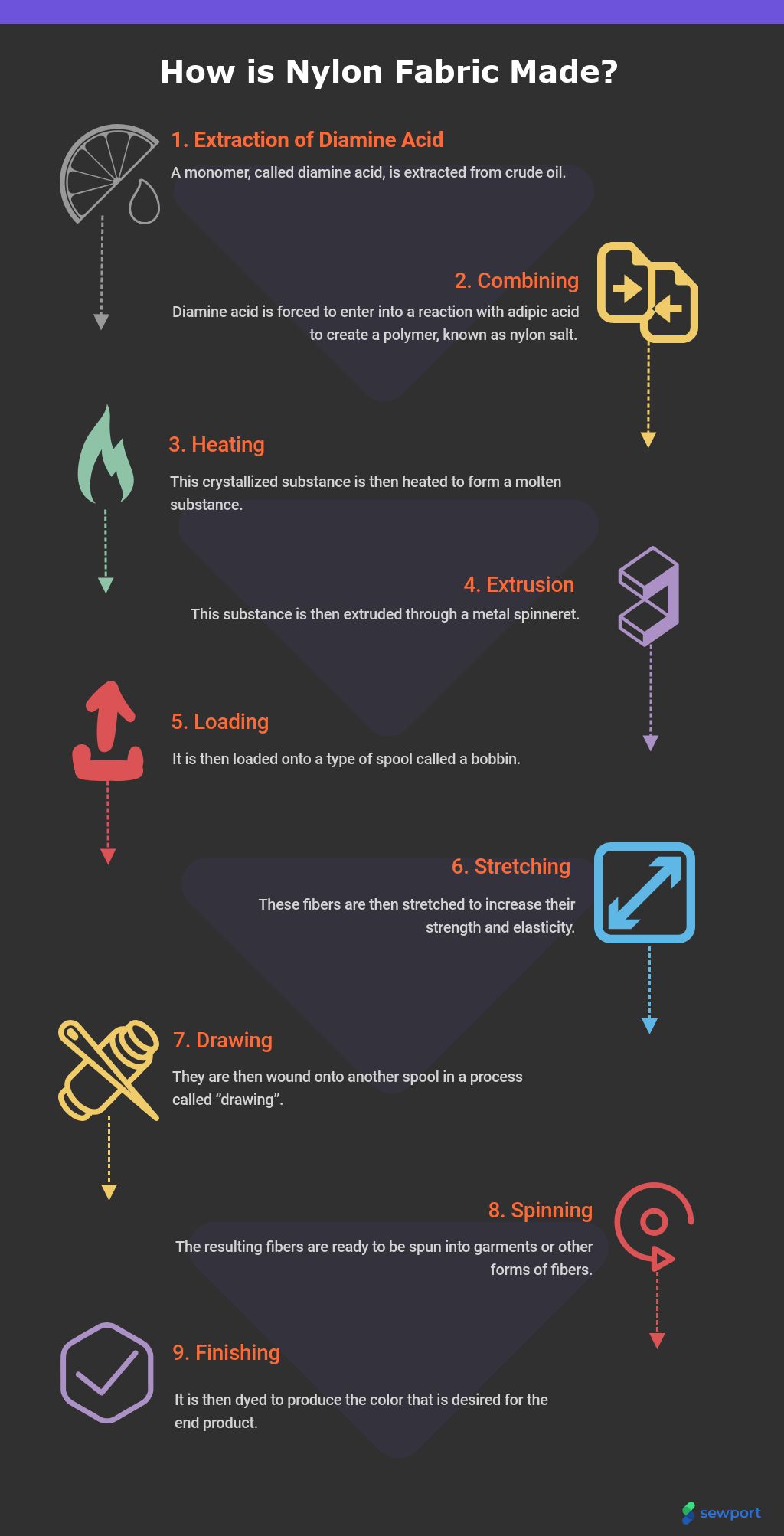
In traditional “Nylon 6,6” production (one of the most common technical variants), the process begins with two specific chemical compounds: adipic acid and hexamethylenediamine. These are not “fibres” in any traditional sense; they are crystalline solids and liquid chemicals that, when combined under specific thermal conditions, undergo a transformative reaction.
The Chemical Reaction: Condensation Polymerization
The technology used to join these chemicals is known as condensation polymerization. During this process, the diamine and the acid react to form a “nylon salt.” This salt is then heated in an autoclave—a high-pressure industrial vessel—to temperatures exceeding 280 degrees Celsius.
Under this intense heat and pressure, the molecules begin to link together into long, repeating chains. As they link, water molecules are “squeezed out” as a byproduct (hence the term “condensation”). The result is a viscous, molten plastic. This transition from liquid chemicals to a high-strength polymer is the defining technological leap that allowed synthetic textiles to compete with, and eventually surpass, natural materials in industrial applications.
Industrial Manufacturing Tech: From Chemical Soup to Textile Fibre
Once the chemical synthesis is complete, the nylon exists as a molten polymer. Converting this liquid plastic into a usable fibre requires sophisticated mechanical engineering and precision machinery. This stage of the process is where the material gains its physical characteristics, such as tensile strength, elasticity, and luster.
The Melt Spinning Process
The primary technology used to create nylon fibre is “melt spinning.” Unlike cotton, which is spun from short botanical hairs, or silk, which is extruded by larvae, nylon is extruded through a machine called a spinneret.
The molten nylon polymer is pumped at high pressure through the spinneret, which is essentially a high-precision metal plate containing hundreds of microscopic holes. As the liquid nylon emerges from these holes into a cooling chamber, it solidifies instantly into continuous filaments. The diameter of these holes, and the speed at which the polymer is pumped, determines the “denier” or thickness of the fibre. This level of technological control allows manufacturers to create fibres that are thinner than a human hair or thick enough to be used as heavy-duty industrial cordage.
Precision Engineering in Spinneret Technology
Modern spinnerets are masterpieces of micro-engineering. By changing the shape of the holes in the spinneret, engineers can alter the properties of the resulting fibre.
- Round holes produce smooth, high-luster fibres.
- Trilobal (triangular) shapes reflect light differently, hiding soil and providing a “sparkle” effect used in high-tech carpeting.
- Hollow-core designs create fibres that trap air, providing superior thermal insulation for extreme-weather gear.
Furthermore, during the spinning process, the filaments are subjected to “drawing” or “cold drawing.” In this step, the cooled fibres are stretched between rollers moving at different speeds. This mechanical tension aligns the molecular chains within the fibre, dramatically increasing its strength and durability. Without this specific technological intervention, nylon would be brittle and useless; the drawing process is what gives it the “memory” and elasticity for which it is famous.
Technological Properties and Performance Grades
In the tech sector, nylon is categorized by its “grade,” which is determined by the number of carbon atoms in its molecular structure. This numerical designation—such as Nylon 6, Nylon 6,6, or Nylon 12—signals to engineers how the material will perform under stress, heat, and chemical exposure.
Nylon 6 vs. Nylon 6,6: Engineering Differences
Nylon 6 and Nylon 6,6 are the two most prevalent types in industrial use.
- Nylon 6,6 is synthesized from two monomers (each containing 6 carbon atoms). It is engineered for high-performance environments where heat resistance and mechanical stiffness are paramount. It is the material of choice for “under-the-hood” automotive parts and high-stress industrial pulleys.
- Nylon 6 is made from a single monomer (caprolactam). While it has a slightly lower melting point than 6,6, it offers superior dyeability and impact resistance.
The choice between these fibres is a matter of technical specification. In aerospace and high-end tech manufacturing, the choice of nylon grade can mean the difference between a component that lasts for decades and one that fails under thermal expansion.
Tensile Strength and Thermal Resistance in Tech Applications
Beyond textiles, the “fibre” of nylon is used as a reinforcement in composite materials. When we ask what nylon is made from in a tech context, we are often looking at its role as a high-strength thermoplastic. Nylon’s high strength-to-weight ratio makes it an essential material for the casing of power tools, electronic connectors, and structural components in consumer electronics.
Its thermal resistance is another key technological advantage. Nylon can maintain its structural integrity at temperatures that would melt other plastics like polyethylene. This makes it an ideal “tech fibre” for components that must endure friction or proximity to heat-generating processors.
Future Tech: The Evolution of Bio-Based and Recycled Nylon
The current frontier of nylon technology is focused on decoupling the production of the fibre from fossil fuels. As digital security and hardware sustainability become interconnected, the tech industry is looking toward “Green Chemistry” to reinvent what nylon is made from.
Sustainable Polymer Engineering
New technological breakthroughs are allowing scientists to produce the precursors for nylon (like adipic acid) from renewable biomass rather than petroleum. Using engineered bacteria and fermentation processes, companies are now able to “grow” the chemical building blocks of nylon from plant sugars and waste oils. These bio-based nylons offer the same molecular performance as traditional versions but with a significantly lower carbon footprint.
Furthermore, the technology surrounding “chemical recycling” is advancing. Unlike mechanical recycling, which degrades the quality of the plastic, chemical recycling breaks nylon back down into its original monomers. This allows the material to be purified and repolymerized into “virgin quality” fibre, creating a closed-loop system that is highly attractive to tech brands aiming for carbon neutrality.
Nylon in 3D Printing and Advanced Additive Manufacturing
Perhaps the most exciting modern application of nylon is in the field of 3D printing (Additive Manufacturing). Nylon powders (specifically Nylon 12) are used in Selective Laser Sintering (SLS). In this process, a high-powered laser fuses microscopic nylon particles together layer by layer to create complex geometries that would be impossible to manufacture using traditional injection molding.
In this context, nylon is the “ink” of the future. Its toughness, flexibility, and chemical resistance make it the premier material for functional prototyping and end-use parts in the robotics and drone industries.

Conclusion
When we ask “what fibre is nylon made from,” the answer is a complex narrative of 20th-century chemistry meeting 21st-century engineering. Nylon is a fibre made from the precise molecular alignment of carbon, nitrogen, oxygen, and hydrogen atoms, synthesized through high-pressure polymerization and extruded through precision-engineered spinnerets.
It is a material that transition effortlessly from the softness of a garment to the rigidity of a mechanical gear. As technology continues to evolve, the “fibre” of nylon is evolving with it—shifting from a petroleum-based miracle to a bio-engineered, 3D-printable essential of the modern digital and industrial landscape. Understanding the tech behind nylon is essential for anyone looking to understand the materials that build, clothe, and protect our modern world.
aViewFromTheCave is a participant in the Amazon Services LLC Associates Program, an affiliate advertising program designed to provide a means for sites to earn advertising fees by advertising and linking to Amazon.com. Amazon, the Amazon logo, AmazonSupply, and the AmazonSupply logo are trademarks of Amazon.com, Inc. or its affiliates. As an Amazon Associate we earn affiliate commissions from qualifying purchases.