
In the landscape of modern audio technology, the acronym “LP” stands for “Long Play.” While the term is frequently used by audiophiles and music enthusiasts today to describe a standard vinyl record, its origins represent one of the most significant technological breakthroughs in the history of data storage and playback. Before the advent of the LP, the primary method of consuming recorded sound was plagued by storage limitations, poor frequency response, and mechanical inefficiency.
The transition to the Long Play format was not merely a change in consumer preference; it was a high-stakes engineering feat that redefined how sound is encoded onto physical media. To understand what an LP stands for is to understand the evolution of analog signal processing, the physics of rotational velocity, and the enduring legacy of high-fidelity hardware.
The Engineering of the “Long Play” Format: From Shellac to Microgrooves
The development of the LP was a response to a specific technical problem: the limited capacity of the 78 RPM (revolutions per minute) record. Made of brittle shellac, 78s could only hold about three to five minutes of audio per side. For complex compositions like symphonies or concept-heavy recordings, this necessitated constant manual intervention to flip or change discs.
From 78 to 33 1/3: The Physics of Rotational Speed
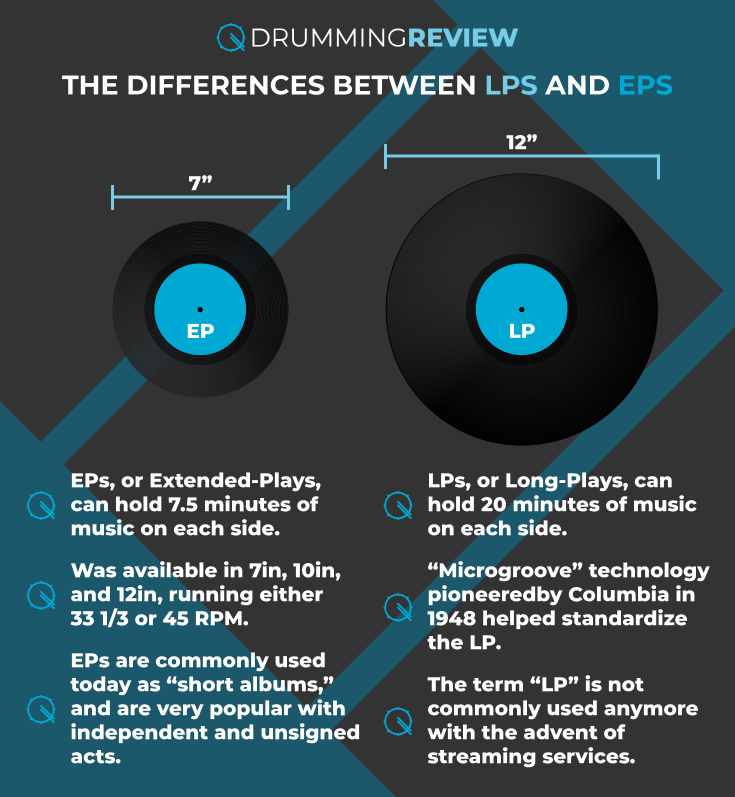
In 1948, Columbia Records introduced the 12-inch, 33 1/3 RPM Long Play record. The decision to drop the rotational speed from 78 to 33 1/3 was a strategic engineering choice. By slowing down the disc, engineers could fit more linear feet of groove onto the same surface area. However, reducing speed typically results in a loss of high-frequency fidelity. To counteract this, Columbia’s engineering team, led by Peter Goldmark, had to innovate in the realm of groove density and material science.
The shift to 33 1/3 RPM allowed for approximately 22 minutes of audio per side, a massive increase in “data density” compared to previous formats. This allowed for the “album” to become a cohesive technological unit rather than a collection of disparate singles.
Microgroove Technology: The Breakthrough in Audio Density
The true technological marvel of the LP was the “microgroove.” Previous records utilized wide grooves that required a thick, heavy stylus. The LP utilized grooves that were approximately 0.003 inches wide—roughly the thickness of a human hair.
Achieving this required a move away from shellac to a new synthetic plastic called polyvinyl chloride (vinyl). Vinyl offered a much lower “noise floor”—the background hiss produced by the friction of the needle against the groove. Because vinyl was smoother and more durable, it allowed for the precision cutting of these microscopic channels, which could carry a wider range of frequencies and dynamic levels. This transition represents one of the earliest examples of optimizing storage media for increased capacity without sacrificing signal quality.
The Hardware Ecosystem: Playback Systems and Stylus Innovation
An LP is useless without the sophisticated hardware required to decode the mechanical information etched into its surface. The technological ecosystem of the turntable is a study in precision mechanical engineering and electromagnetic induction.
The Precision of the Diamond Stylus
In the era of the LP, the “needle” evolved into the stylus—a precision-engineered component usually tipped with an industrial diamond. The shape of the stylus (conical, elliptical, or Shibata) determines how much contact is made with the walls of the microgroove.
From a tech perspective, the stylus acts as a transducer. As it travels through the undulating grooves of the LP, it vibrates. These vibrations are mechanical data. The stylus transmits these vibrations to the cartridge, where magnets and wire coils convert that mechanical energy into a low-voltage electrical signal. The technological sophistication of a modern moving-coil (MC) cartridge allows for the retrieval of minute details in the soundstage that were previously lost in coarser formats.
Turntable Mechanics: Balancing Signal-to-Noise Ratios
The turntable itself is a piece of precision machinery designed to maintain a constant speed with zero deviation. Any fluctuation in speed results in “wow and flutter”—audible pitch shifts that degrade the listening experience. High-end modern turntables utilize heavy, dampened platters and sophisticated motor controllers to ensure that the 33 1/3 RPM speed is absolute.

Furthermore, because the LP is an analog format, it is susceptible to external vibrations. The engineering challenge has always been isolation. Tech companies specializing in audio hardware have developed air-bearing platters, magnetic levitation systems, and carbon-fiber tonearms to ensure that the only movement the stylus tracks is the information inside the groove, not the vibrations of the room or the motor itself.
Digital Disruption vs. Analog Resonance: A Comparative Tech Analysis
With the rise of the Compact Disc (CD) in the 1980s and the subsequent shift to streaming and AI-driven compression algorithms, the LP was often characterized as an “obsolete” technology. However, a technical comparison reveals why the LP format has not only survived but thrived as a premium audio standard.
Sampling Rates vs. Continuous Waveforms
The primary difference between an LP and digital audio (like a WAV or MP3 file) is the method of representation. Digital audio works by “sampling” the sound wave at specific intervals (usually 44,100 times per second for CD quality). While this is highly efficient for storage and transmission, it is essentially a series of snapshots that recreate a curve.
An LP, conversely, is a continuous analog representation. The groove is a physical map of the sound wave. There is no sampling rate because the signal is uninterrupted. For tech purists, this “infinite resolution” provides a more natural and “organic” sound, free from the mathematical artifacts that can sometimes occur in digital-to-analog conversion (DAC) processes.
The Resilience of Physical Media in an Algorithmic Age
In an era where most media is accessed via the cloud, the LP stands as a “hard drive” for audio that does not require an internet connection or a software license to operate. It is a decentralized form of data storage. While digital files are subject to “bit rot” or format obsolescence, a well-maintained LP from 1950 can still be read by a turntable manufactured in 2024. This backward compatibility is a rarity in the tech world, making the LP one of the most enduring “hardware standards” in history.
The Future of High-Fidelity Audio Storage
The LP is not a static technology. Recent years have seen significant R&D aimed at bringing 21st-century precision to the pressing and manufacturing process.
Modern Pressing Tech: Precision Manufacturing
Traditionally, LPs were made by creating a lacquer master, then a metal “stamper,” which would press the vinyl. Modern innovations have introduced “Direct Metal Mastering” (DMM) and even laser-cut grooves. By using CNC (Computer Numerical Control) machining and advanced cooling systems during the pressing process, manufacturers can reduce warping and surface noise to levels that were impossible in the 1950s.
Some companies are even experimenting with “HD Vinyl.” This technology uses 3D-topography mapping and laser-engraving to create the stampers, rather than chemical etching. This allows for even higher groove density, better frequency response, and longer play times, pushing the “Long Play” definition even further.
Hybrid Tech: Integrating Smart Features with Analog Hardware
We are also seeing the rise of hybrid audio tech. Modern turntables often include high-quality built-in Analog-to-Digital Converters (ADCs) and USB outputs, allowing users to archive their analog LPs into high-resolution digital formats (like DSD or FLAC). Furthermore, some high-end tonearms now use optical sensors rather than traditional magnets to read the movement of the stylus, merging the tactile nature of the LP with the precision of optical computing.

Conclusion: The LP as a Tech Icon
When we ask what “LP” stands for, the literal answer is “Long Play.” However, in the context of technology and innovation, it stands for a milestone in human engineering. It represents the moment we mastered the ability to store vast amounts of complex acoustic data on a physical surface.
From the microgroove revolutions of the 1940s to the laser-etched precision of the 2020s, the LP remains a testament to the power of analog engineering. In a world increasingly dominated by ephemeral digital streams, the LP persists as a tangible, high-fidelity, and technologically sophisticated medium that continues to set the bar for the “warmth” and “depth” of the human listening experience. It is not merely a nostalgic relic; it is a masterclass in the enduring utility of well-engineered hardware.
aViewFromTheCave is a participant in the Amazon Services LLC Associates Program, an affiliate advertising program designed to provide a means for sites to earn advertising fees by advertising and linking to Amazon.com. Amazon, the Amazon logo, AmazonSupply, and the AmazonSupply logo are trademarks of Amazon.com, Inc. or its affiliates. As an Amazon Associate we earn affiliate commissions from qualifying purchases.