
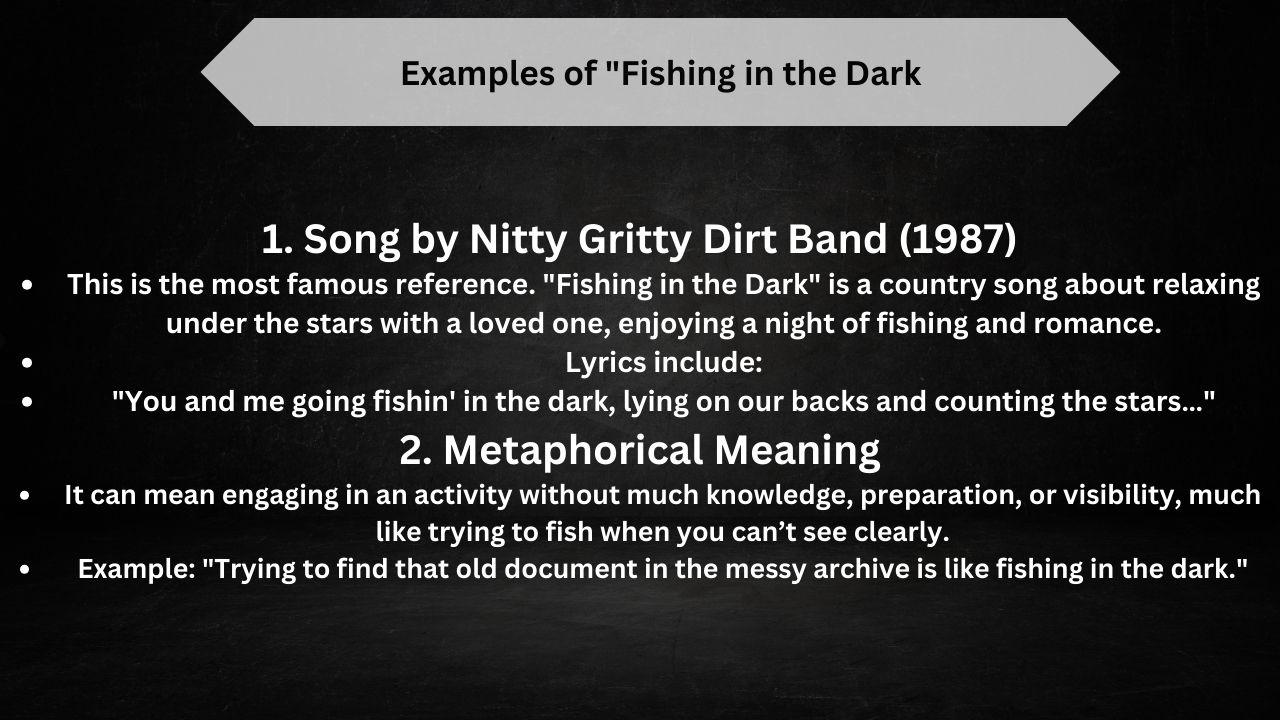
In common parlance, “fishing in the dark” often evokes images of quiet midnight lakes or the lyrics of a classic country song. However, in the rapidly evolving world of technology, this phrase has been repurposed to describe one of the most significant challenges facing the digital era: the quest to derive value from “Dark Data.”
As organizations move toward a digital-first existence, they are generating information at a rate that outpaces their ability to analyze it. To “fish in the dark” in a tech context refers to the act of searching for actionable insights, security vulnerabilities, or operational efficiencies within massive, unstructured, and often unmonitored datasets. It is the process of navigating the “Digital Dark Matter”—the 80% to 90% of data that organizations collect, process, and store during regular business activities, but generally fail to use for any other purpose.
The Anatomy of Dark Data: Understanding the Unseen Reservoir
Before we can understand the “fishing” process, we must understand the “darkness.” In the tech industry, data is generally categorized into three buckets: structured, semi-structured, and unstructured. Dark data lives primarily in the latter two.
Defining Dark Data in Enterprise Environments
Gartner defines dark data as “the information assets organizations collect, process, and store during regular business activities, but generally fail to use for other purposes.” This includes everything from server log files that provide clues about system health to old versions of documents, discarded emails, and even geolocation data from mobile devices.
In a technical sense, fishing in the dark is the attempt to cast a net into these archives to find something of value. For a software engineer, it might mean looking through years of legacy code logs to identify the root cause of a recurring bug. For a data scientist, it means applying algorithms to uncatalogued information to find a new consumer trend that wasn’t visible in the standard dashboards.
Why 80% of Data Remains “In the Dark”
The reason so much data remains “dark” is a combination of volume and velocity. As IoT (Internet of Things) devices proliferated, the sheer amount of telemetry data exploded. Many companies adopted a “save everything” mentality, facilitated by the low cost of cloud storage. However, while storing data is cheap, processing it is expensive and computationally intensive.
Consequently, most enterprises are “fishing in the dark” because they lack the metadata or the indexing required to see what they actually have. Without a proper map, data becomes a liability rather than an asset. It consumes energy, incurs storage costs, and increases the “attack surface” for cybercriminals, all while providing zero return on investment.
The Risks of Operating in the Shadows: Security and Compliance
The phrase “fishing in the dark” also carries a more ominous connotation regarding digital security. When IT administrators and security teams do not have full visibility into their networks, they are effectively blindfolded, hoping to catch threats before those threats catch them.
From Phishing to Shadow IT: The Vulnerabilities of the Unknown
There is a clever linguistic overlap between “fishing in the dark” and “phishing.” In cybersecurity, attackers often operate in the “dark” corners of the web, sending out deceptive lures to catch unsuspecting users. However, from a defensive standpoint, the “darkness” refers to Shadow IT—the use of software, hardware, or cloud services without the explicit approval or even the knowledge of the IT department.
When employees use unauthorized AI tools or personal cloud storage to move company data, that data goes dark. Security teams are then forced to “fish” for anomalies without knowing the baseline of normal activity. This lack of visibility is a primary driver of data breaches; you cannot protect what you cannot see.

Regulatory Implications of Unmonitored Data Streams
In the era of GDPR (General Data Protection Regulation) and CCPA (California Consumer Privacy Act), “fishing in the dark” is a high-stakes gamble. These regulations require companies to know exactly what personal data they hold and where it is stored.
If an organization is storing customer information in “dark” silos—such as unindexed customer service recordings or forgotten spreadsheets—they are in technical violation of “the right to be forgotten.” If a customer requests their data be deleted and the company fails to find it because it was “in the dark,” the resulting fines can be astronomical. Modern tech strategy, therefore, focuses on “turning on the lights” through rigorous data governance.
Fishing for Value: Strategies for Illuminating Dark Data
If the “dark” is a vast ocean of information, then modern software tools are the high-tech sonar and advanced nets that allow us to extract value. “Fishing in the dark” is transitioning from a desperate search to a precision science.
Leveraging AI and Machine Learning for Pattern Recognition
Artificial Intelligence (AI) is the primary tool used to illuminate dark data. Machine Learning (ML) models are uniquely suited to “fishing” because they can scan through millions of unstructured files—images, PDFs, and audio—to identify patterns that a human would never see.
For example, Natural Language Processing (NLP) can be used to “fish” through thousands of hours of customer support calls to identify a specific technical flaw in a product. Before AI, this data would have remained dark forever because it was too labor-intensive to transcribe and analyze manually. Today, AI acts as the lantern, highlighting the specific insights that matter most to the business.
The Role of Cloud-Native Observability Tools
In software development and DevOps, “fishing in the dark” has been mitigated by the rise of observability. Unlike traditional monitoring, which only tells you when something is broken, observability allows you to ask questions about your system that you didn’t know you needed to ask.
By using distributed tracing and real-time telemetry, engineers can see how data flows through a complex microservices architecture. This level of visibility ensures that no corner of the application remains “dark.” When a latency issue occurs, instead of fishing blindly for the cause, developers can use observability platforms to pinpoint the exact line of code or the specific database query that is lagging.
The Future of Data Transparency and Predictive Analytics
The goal of the modern tech industry is to eventually render the phrase “fishing in the dark” obsolete. As we move toward more integrated and transparent systems, the focus is shifting from simply finding data to predicting what that data will do next.
Transitioning from Reactive to Proactive Tech Management
The most advanced tech firms are no longer just “fishing” for past insights; they are using predictive analytics to forecast future trends. By illuminating dark data and integrating it into “data lakes” (centralized repositories), companies can move from a reactive posture—fixing problems as they arise—to a proactive one.
In cybersecurity, this means using AI to predict where an attack might happen based on subtle “dark” signals in network traffic. In product development, it means identifying a feature a user might want based on their unmapped navigation habits within an app. The “dark” is becoming the most fertile ground for innovation, provided the right tools are in place.

Building a Culture of Data Literacy
Ultimately, “fishing in the dark” is as much a human problem as a technical one. To truly illuminate the digital landscape, organizations must foster a culture of data literacy. This means training non-technical staff to understand the importance of data hygiene and ensuring that developers prioritize documentation and metadata from the start of a project.
As we look toward the future, the “darkness” will always exist—there will always be more data than we can perfectly process in real-time. However, with the advent of more sophisticated AI tools, better cloud infrastructure, and a more disciplined approach to cybersecurity, we are getting much better at seeing what lies beneath the surface. The tech world is learning that if you are going to fish in the dark, you’d better bring a very powerful light.
aViewFromTheCave is a participant in the Amazon Services LLC Associates Program, an affiliate advertising program designed to provide a means for sites to earn advertising fees by advertising and linking to Amazon.com. Amazon, the Amazon logo, AmazonSupply, and the AmazonSupply logo are trademarks of Amazon.com, Inc. or its affiliates. As an Amazon Associate we earn affiliate commissions from qualifying purchases.