
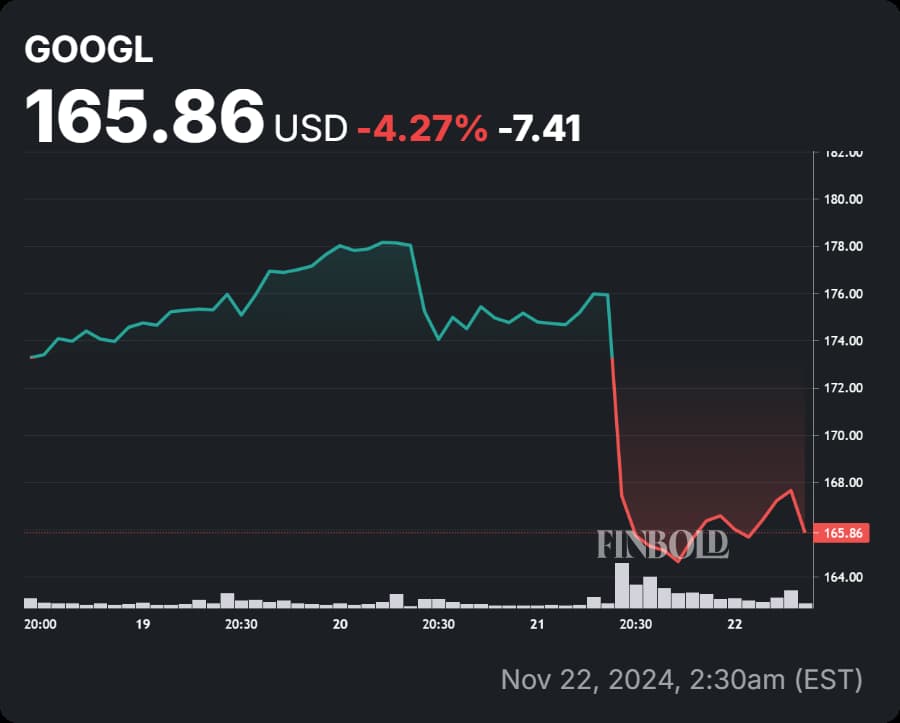
In the high-stakes arena of Big Tech, few companies have enjoyed the historic stability and growth of Alphabet Inc., the parent company of Google. For over a decade, Google’s dominance in search and digital advertising made its stock a cornerstone of institutional and retail portfolios alike. However, recent market sessions have seen Alphabet (GOOG/GOOGL) facing unexpected headwinds, leading investors to ask a critical question: Why is Google stock down?
Understanding the downward pressure on Alphabet requires a multi-faceted analysis of the current financial landscape. From the shifting dynamics of digital advertising to the immense capital requirements of the artificial intelligence (AI) revolution, the factors contributing to the stock’s recent performance are complex. This article explores the primary financial drivers, regulatory risks, and macroeconomic pressures currently weighing on one of the world’s most valuable companies.
Macroeconomic Pressures and the Advertising Landscape
At its core, Alphabet remains an advertising company. While it has diversified into cloud computing, hardware, and “Other Bets,” the vast majority of its revenue is derived from Google Search, YouTube ads, and the Google Network. Consequently, the stock is highly sensitive to the health of the global advertising market.
The Shift in Digital Ad Spend
In periods of economic uncertainty or high interest rates, corporate marketing budgets are often the first to be trimmed. Investors have expressed concern over a potential cooling in digital ad spend as companies pivot toward profitability over aggressive customer acquisition. While Google’s “intent-based” search ads are typically more resilient than social media ads, they are not immune to a broader economic slowdown. Any signal that YouTube’s growth is plateauing or that search volume is being diverted to alternative platforms immediately manifests as downward pressure on the stock price.
Interest Rates and the Tech Valuation Squeeze
The broader macroeconomic environment, characterized by fluctuating interest rates, has fundamentally changed how growth stocks are valued. Alphabet, like many of its peers in the “Magnificent Seven,” is valued based on its ability to generate future cash flows. When interest rates remain elevated, the “discount rate” applied to those future earnings increases, which naturally lowers the current valuation of the stock. Investors have become increasingly discerning, moving away from companies with high price-to-earnings (P/E) ratios unless they can prove a clear path to accelerated growth—a high bar that Google is currently struggling to clear in the eyes of some analysts.
The High Cost of the AI Arms Race
While artificial intelligence is often touted as the next great frontier for technology companies, from an investment perspective, it represents a massive and risky financial commitment. The transition from traditional search to AI-driven generative search is not just a technological shift; it is a fundamental change in Alphabet’s cost structure.
Capital Expenditure (CapEx) Concerns
One of the primary reasons Google stock has faced sell-offs following recent earnings reports is the sheer scale of its capital expenditure. Alphabet is currently spending billions of dollars per quarter on data centers, custom silicon (TPUs), and high-end GPUs from manufacturers like Nvidia. These “CapEx” requirements are essential to stay competitive with Microsoft and OpenAI, but they weigh heavily on free cash flow. Shareholders are increasingly wary of “over-investing” in infrastructure before a clear, high-margin monetization strategy for AI has been fully realized.
Profit Margin Compression in the Generative AI Era
There is a significant financial difference between a traditional Google search and an AI-generated response. A standard search query is computationally inexpensive, allowing Google to maintain incredibly high margins. However, a generative AI query (via Gemini) requires significantly more computing power, which translates to a higher “cost per query.” Investors are concerned that as Google integrates more AI into its core product, its industry-leading profit margins will be squeezed. Until Google can prove that AI will drive incremental revenue—rather than just increasing the cost of maintaining existing revenue—the stock may continue to face skepticism.
Regulatory Headwinds and Antitrust Litigation
For many institutional investors, the greatest threat to Alphabet’s long-term valuation isn’t competition or the economy, but the legal system. Google is currently embroiled in some of the most significant antitrust challenges in the history of the modern corporate world.
The DOJ vs. Google Search
The U.S. Department of Justice (DOJ) has targeted Google’s dominance in the search market, specifically focusing on the billions of dollars Alphabet pays to companies like Apple to remain the default search engine on mobile devices. If a court ruling or settlement forces Google to abandon these “default” agreements, it could lead to a sudden and significant loss in search volume and data collection capabilities. The uncertainty surrounding these legal proceedings creates a “risk premium” on the stock, causing many conservative investors to trim their positions until the legal horizon clears.
Global Regulatory Constraints and Fines
Beyond the United States, the European Union has continued its aggressive stance against Big Tech through the Digital Markets Act (DMA). These regulations aim to limit “self-preferencing”—the practice of Google promoting its own services (like Google Shopping or Travel) within search results. Constant regulatory scrutiny not only results in multi-billion dollar fines but also forces Google to change its product architecture in ways that may be less profitable. The cumulative weight of these global legal battles acts as a persistent drag on the stock’s upward momentum.
Market Sentiment and Competitive Positioning
In the stock market, perception is often as important as reality. Alphabet is currently navigating a “narrative shift” where it is no longer viewed as the unchallenged leader of the internet, but as a legacy giant being disrupted by more nimble competitors.
The Perceived Search Monopoly Erosion
For twenty years, Google Search was considered an unbreakable monopoly. However, the rise of TikTok as a search tool for Gen Z and the integration of ChatGPT into Microsoft’s Bing have created a perception that Google’s moat is narrowing. While Google still holds the vast majority of the global search market share, the mere threat of losing even 1% or 2% of that share to AI-native platforms is enough to spook investors. In a market that prizes growth and dominance, any sign of vulnerability can lead to a valuation contraction.
Investor Comparisons to Big Tech Peers
Stock performance is often relative. When investors look at the “Magnificent Seven,” they compare Alphabet’s performance and strategy to companies like Meta (which has successfully pivoted to AI-driven ad efficiency) or Microsoft (which has a perceived lead in enterprise AI). If Alphabet’s growth rates lag behind its peers even slightly, capital tends to rotate out of GOOGL and into the “winners” of the current cycle. This institutional rotation can lead to the stock being “down” even if the company’s underlying fundamentals remain relatively healthy.

Conclusion: A Period of Transition
The reason Google stock is down is not attributed to a single failure, but rather a convergence of financial pressures. Alphabet is currently in a difficult transition period: it must spend record amounts of money to build an AI future that threatens to be more expensive and less profitable than its high-margin past. Simultaneously, it is fighting existential legal battles that could reshape its business model, all while navigating a complex macroeconomic environment.
For the long-term investor, the current dip in stock price may represent a valuation correction—a return to more reasonable levels after years of meteoric growth. For others, it is a warning sign that the “Golden Age” of the Google search monopoly is evolving into a more competitive, lower-margin era. As Alphabet continues to report its quarterly earnings, the market will be looking for one thing above all else: proof that the massive investments in AI can be converted into the same kind of bottom-line growth that made Google a market titan in the first place. Until that clarity emerges, the stock is likely to remain sensitive to every headline, legal ruling, and economic shift.
aViewFromTheCave is a participant in the Amazon Services LLC Associates Program, an affiliate advertising program designed to provide a means for sites to earn advertising fees by advertising and linking to Amazon.com. Amazon, the Amazon logo, AmazonSupply, and the AmazonSupply logo are trademarks of Amazon.com, Inc. or its affiliates. As an Amazon Associate we earn affiliate commissions from qualifying purchases.