
Inherited disorders, also known as genetic disorders, are conditions passed down from parents to their children through genes. These disorders arise from alterations, or mutations, in our DNA, the complex code that dictates virtually every aspect of our biological makeup. Understanding the root causes of these disorders is not merely an academic pursuit; it is a crucial step towards diagnosis, treatment, and even prevention. In recent decades, advancements in technology have revolutionized our ability to unravel the intricate mechanisms behind inherited conditions, offering unprecedented insights into their origins and potential solutions.
The Fundamental Building Blocks: Genes and DNA
At the core of every inherited disorder lies a change in the very blueprint of life: Deoxyribonucleic Acid, or DNA. DNA is a long, double-helix molecule composed of millions of smaller units called nucleotides. These nucleotides are organized into segments called genes, which act as instructions for building and maintaining our bodies. Each gene is responsible for producing specific proteins, the workhorses that carry out a vast array of functions, from enzyme activity to structural support.
The Genetic Code and Its Variations
Our genetic code is remarkably consistent across all humans, but subtle variations are what make each individual unique. These variations, often referred to as polymorphisms, are generally harmless and contribute to traits like eye color or height. However, when these variations become significant enough to disrupt the normal function of a gene, they can lead to disease. These detrimental variations are what we commonly call mutations.
Mutations can occur in various ways. They can be point mutations, where a single nucleotide is changed, inserted, or deleted. This seemingly small alteration can have a cascading effect, altering the protein produced and its function. Larger mutations can involve the deletion, duplication, or rearrangement of entire segments of DNA, impacting multiple genes or their regulatory elements.
Chromosomes: The Packaging of Our Genes
Our genes are organized into structures called chromosomes. Humans typically have 23 pairs of chromosomes, with one set inherited from each parent. These chromosomes are essentially tightly coiled strands of DNA. Errors during the formation of reproductive cells (sperm and egg) or during embryonic development can lead to an abnormal number of chromosomes (aneuploidy) or significant structural abnormalities within chromosomes. Such chromosomal aberrations are a significant cause of many inherited disorders, including Down syndrome, which is caused by an extra copy of chromosome 21.
Mechanisms of Inheritance: How Disorders are Passed Down
The way a particular gene mutation is inherited determines the pattern of the disorder’s appearance within a family. Understanding these inheritance patterns is vital for genetic counseling and risk assessment.
Autosomal Dominant Inheritance
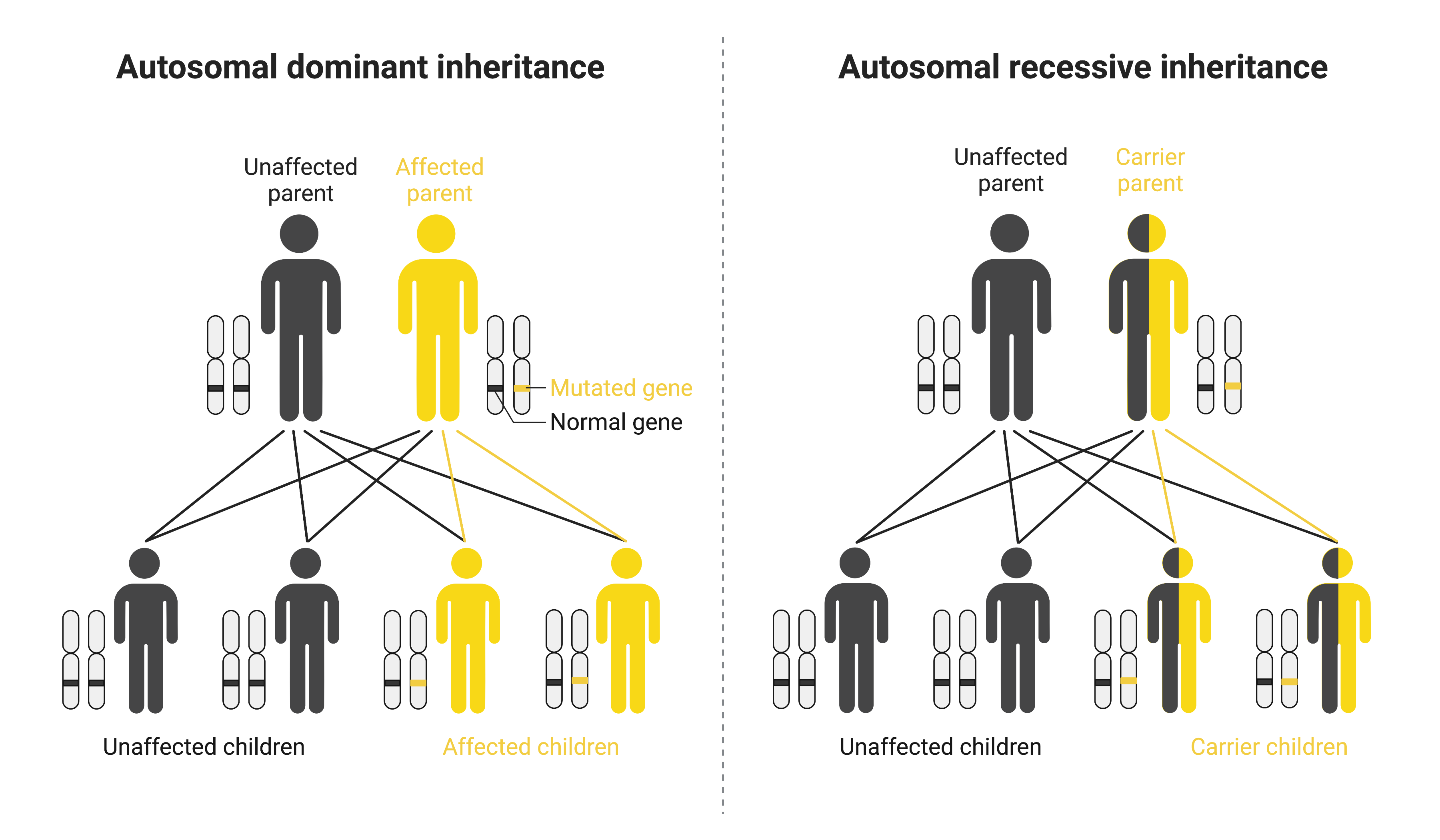
In autosomal dominant inheritance, only one copy of the altered gene is needed for a person to be affected by the disorder. The gene in question is located on one of the non-sex chromosomes (autosomes). If one parent carries a dominant gene mutation, each child has a 50% chance of inheriting the mutation and thus developing the disorder. Examples include Huntington’s disease and Marfan syndrome.
Autosomal Recessive Inheritance
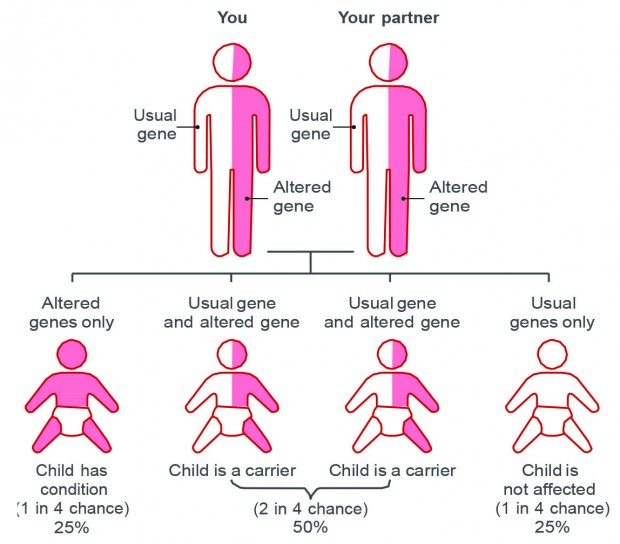
For autosomal recessive disorders, an individual must inherit two copies of the altered gene – one from each parent – to be affected. If a person inherits only one copy of the mutated gene, they are considered a carrier. Carriers typically do not exhibit symptoms of the disorder but can pass the mutation on to their children. If both parents are carriers, each child has a 25% chance of inheriting two mutated copies and developing the disorder, a 50% chance of being a carrier, and a 25% chance of inheriting two normal copies. Cystic fibrosis and sickle cell anemia are classic examples of autosomal recessive disorders.
X-Linked Inheritance
X-linked inheritance involves genes located on the X chromosome. Since males have one X and one Y chromosome, while females have two X chromosomes, the inheritance patterns for X-linked disorders differ between sexes.
X-Linked Recessive Inheritance
In X-linked recessive inheritance, the mutated gene is on the X chromosome, and a male only needs to inherit one copy of the mutated gene to be affected. Females, with two X chromosomes, generally need to inherit two copies of the mutated gene to be affected, making them carriers in most cases. This is why X-linked recessive disorders are far more common in males. Hemophilia and Duchenne muscular dystrophy are well-known examples.
X-Linked Dominant Inheritance
In X-linked dominant inheritance, a single copy of the mutated gene on the X chromosome is sufficient to cause the disorder in both males and females. However, the impact can be different; affected males will pass the mutated gene to all their daughters but none of their sons, while affected females will pass it to half of their sons and half of their daughters. Fragile X syndrome, while having complex inheritance, often exhibits X-linked dominant characteristics.
Mitochondrial Inheritance
Mitochondria are small organelles within our cells that are responsible for generating energy. Interestingly, mitochondria contain their own small circular DNA, known as mitochondrial DNA (mtDNA), which is inherited exclusively from the mother. Mutations in mtDNA can lead to a range of disorders affecting energy production, often impacting the brain, heart, and muscles. These disorders follow a maternal inheritance pattern, meaning they are passed from mother to all her children, but never from father to child.
The Role of Technology in Unraveling Inherited Disorders
The technological advancements of the past few decades have been nothing short of revolutionary in our understanding and management of inherited disorders. These tools allow us to peer into the very essence of our genetic code and identify the culprits behind these conditions.
Genetic Sequencing Technologies
The advent of DNA sequencing technologies has been a monumental leap forward. Initially, sequencing an entire human genome was an arduous and prohibitively expensive undertaking. However, with the development of Next-Generation Sequencing (NGS), the cost and speed of DNA analysis have plummeted.
Whole Genome and Exome Sequencing
Whole Genome Sequencing (WGS) provides a comprehensive readout of an individual’s entire DNA sequence, capturing all genes and the regions between them. Whole Exome Sequencing (WES), on the other hand, focuses on sequencing only the protein-coding regions of our genes, known as exomes. Since most known disease-causing mutations occur within these exonic regions, WES offers a more targeted and cost-effective approach for identifying genetic causes of many disorders. These technologies enable researchers and clinicians to pinpoint specific mutations responsible for inherited conditions, paving the way for accurate diagnoses and personalized treatment strategies.
Bioinformatics and Data Analysis
The sheer volume of data generated by genetic sequencing technologies would be overwhelming without powerful computational tools. Bioinformatics, the interdisciplinary field that combines biology, computer science, and statistics, plays a critical role in analyzing and interpreting this genetic information. Specialized algorithms and databases are used to compare an individual’s DNA sequence with reference genomes, identify variations, and assess their potential pathogenicity. Machine learning and artificial intelligence (AI) are increasingly being employed to sift through vast datasets, predict the functional impact of mutations, and identify novel disease-gene associations.
Gene Editing Technologies: A Glimpse into the Future
While not yet a widespread treatment for inherited disorders, gene editing technologies, most notably CRISPR-Cas9, hold immense promise for the future. CRISPR-Cas9 acts like molecular scissors, allowing scientists to precisely cut and modify DNA sequences. This technology opens up the possibility of correcting specific mutations that cause inherited disorders, potentially offering curative therapies. Research is ongoing, but the ethical and technical challenges are significant, requiring careful consideration and rigorous scientific validation before widespread clinical application.
Environmental Factors and Gene-Environment Interactions
While inherited disorders are fundamentally rooted in our genes, it is crucial to acknowledge that the environment also plays a significant role in the manifestation and severity of many conditions. This concept is known as gene-environment interaction.
The Impact of Lifestyle and Exposures
For some inherited predispositions, environmental factors can act as triggers or modulators. For instance, an individual might carry a genetic predisposition to a certain type of cancer. However, lifestyle choices such as diet, exercise, smoking, and exposure to environmental toxins can significantly influence whether that predisposition develops into the actual disease. Similarly, in conditions like phenylketonuria (PKU), an inherited metabolic disorder, early detection and strict dietary management can prevent the severe intellectual disability that would otherwise result.

Epigenetics: Modifications Beyond the DNA Sequence
Epigenetics refers to heritable changes in gene expression that occur without altering the underlying DNA sequence. These modifications, which can be influenced by environmental factors such as diet, stress, and chemical exposures, can switch genes on or off. In the context of inherited disorders, epigenetic alterations can sometimes exacerbate or mitigate the effects of underlying genetic mutations. Research in this area is rapidly expanding, offering new avenues for understanding the complex interplay between our genes and our environment.
In conclusion, inherited disorders are complex conditions with multifaceted origins. They arise from alterations in our DNA, orchestrated by precise mechanisms of inheritance, and are increasingly understood and potentially addressed through groundbreaking technological advancements. As our knowledge deepens and our technological capabilities expand, the prospect of effectively managing and even curing these conditions moves closer to reality, offering hope to millions worldwide.
aViewFromTheCave is a participant in the Amazon Services LLC Associates Program, an affiliate advertising program designed to provide a means for sites to earn advertising fees by advertising and linking to Amazon.com. Amazon, the Amazon logo, AmazonSupply, and the AmazonSupply logo are trademarks of Amazon.com, Inc. or its affiliates. As an Amazon Associate we earn affiliate commissions from qualifying purchases.