
Light, the fundamental force that allows us to perceive the world, is a complex phenomenon with properties that have fascinated scientists and engineers for centuries. While we often think of light as simply “illumination,” its true nature lies in its electromagnetic spectrum, a vast range of energy waves. Within this spectrum, a tiny sliver is what our eyes can detect, a phenomenon we call visible light. Understanding the visible wavelengths of light is not just an academic pursuit; it’s crucial for advancements in a multitude of technological fields, from the screens we interact with daily to the sophisticated imaging systems that underpin scientific research and industrial processes. This exploration delves into the science behind visible light, its spectral composition, and its profound implications in the realm of technology.

The Electromagnetic Spectrum: A Spectrum of Possibilities
The electromagnetic (EM) spectrum encompasses all forms of electromagnetic radiation, arranged according to their frequency and wavelength. These forms of radiation are fundamentally the same phenomenon – traveling waves of electric and magnetic fields – but they differ dramatically in their energy levels and their interactions with matter. At one end of the spectrum lie radio waves, with their long wavelengths and low frequencies, used for communication and broadcasting. As we move up in frequency and down in wavelength, we encounter microwaves, infrared radiation (heat), and then the all-important visible light. Beyond visible light, the spectrum continues with ultraviolet (UV) radiation, X-rays, and gamma rays, which possess much higher energies and are often associated with medical imaging and sterilization.
Defining Wavelength and Frequency
Before diving into the specifics of visible light, it’s essential to grasp the core concepts of wavelength and frequency. Wavelength refers to the spatial period of a wave – the distance over which the wave’s shape repeats. It is typically measured in meters, nanometers (nm), or angstroms (Å). For visible light, nanometers are the most commonly used unit. Frequency, on the other hand, is the number of wave cycles that pass a given point per unit of time, usually measured in Hertz (Hz), which represents cycles per second. There’s an inverse relationship between wavelength and frequency: as wavelength increases, frequency decreases, and vice versa. This relationship is governed by the speed of light (c), which is a constant: $c = lambda nu$, where $lambda$ is the wavelength and $nu$ is the frequency. Understanding this relationship is key to comprehending how different colors of light are distinguished.
The Invisible Majority
It’s a common misconception that visible light represents a significant portion of the electromagnetic spectrum. In reality, the visible spectrum is remarkably narrow. The vast majority of electromagnetic radiation is invisible to the human eye. Radio waves, for instance, can have wavelengths ranging from millimeters to kilometers, while gamma rays have wavelengths smaller than the nucleus of an atom. Our biological evolution has endowed us with a sensory system tuned to a very specific band of energies that are both abundant and relatively harmless, allowing us to navigate and understand our immediate environment. This limited window into the electromagnetic universe is what we perceive as color.
The Visible Spectrum: A Rainbow of Technological Innovation
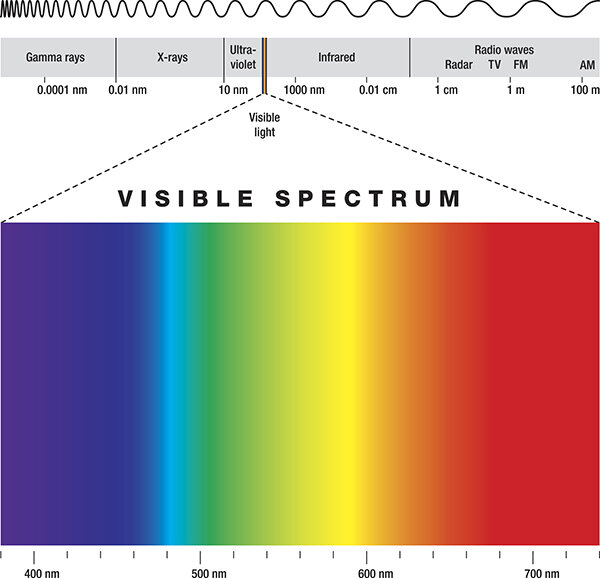
The visible light spectrum, as defined by human perception, typically spans wavelengths from approximately 400 nanometers (nm) to 700 nanometers (nm). This range is further divided into the familiar colors of the rainbow: violet, indigo, blue, green, yellow, orange, and red. Each color corresponds to a specific range of wavelengths within this visible band. The order of these colors is not arbitrary; it follows the order of decreasing wavelength (and increasing frequency/energy).
Violet and Blue: The Shorter Wavelengths
At the shortest end of the visible spectrum lie violet and blue light, typically ranging from approximately 400 nm to 490 nm. Violet light occupies the 400-450 nm range, while blue light falls between 450 nm and 490 nm. These shorter wavelengths carry more energy than their longer counterparts. In technological applications, blue light is particularly significant. For example, the development of blue light-emitting diodes (LEDs) was a groundbreaking achievement, paving the way for energy-efficient lighting, high-resolution displays, and even advanced data storage technologies like Blu-ray discs. The precise control over the emission of blue light has also been crucial in fields like laser technology and optical communication.
Green and Yellow: The Mid-Range Hues
Moving towards the center of the visible spectrum, we encounter green and yellow light. Green light typically spans wavelengths from approximately 490 nm to 570 nm, while yellow light occupies the range from 570 nm to 590 nm. These wavelengths represent a moderate amount of energy and are highly perceptible to the human eye. Green light is particularly important in the natural world, as chlorophyll in plants absorbs most other colors and reflects green light, which is why vegetation appears green. Technologically, green light plays a role in various imaging systems, medical diagnostics (e.g., in some forms of laser surgery), and the development of phosphors for displays. Yellow light, while a narrower band, is also utilized in certain lighting applications and in the creation of specific color filters for optical instruments.
Orange and Red: The Longer Wavelengths
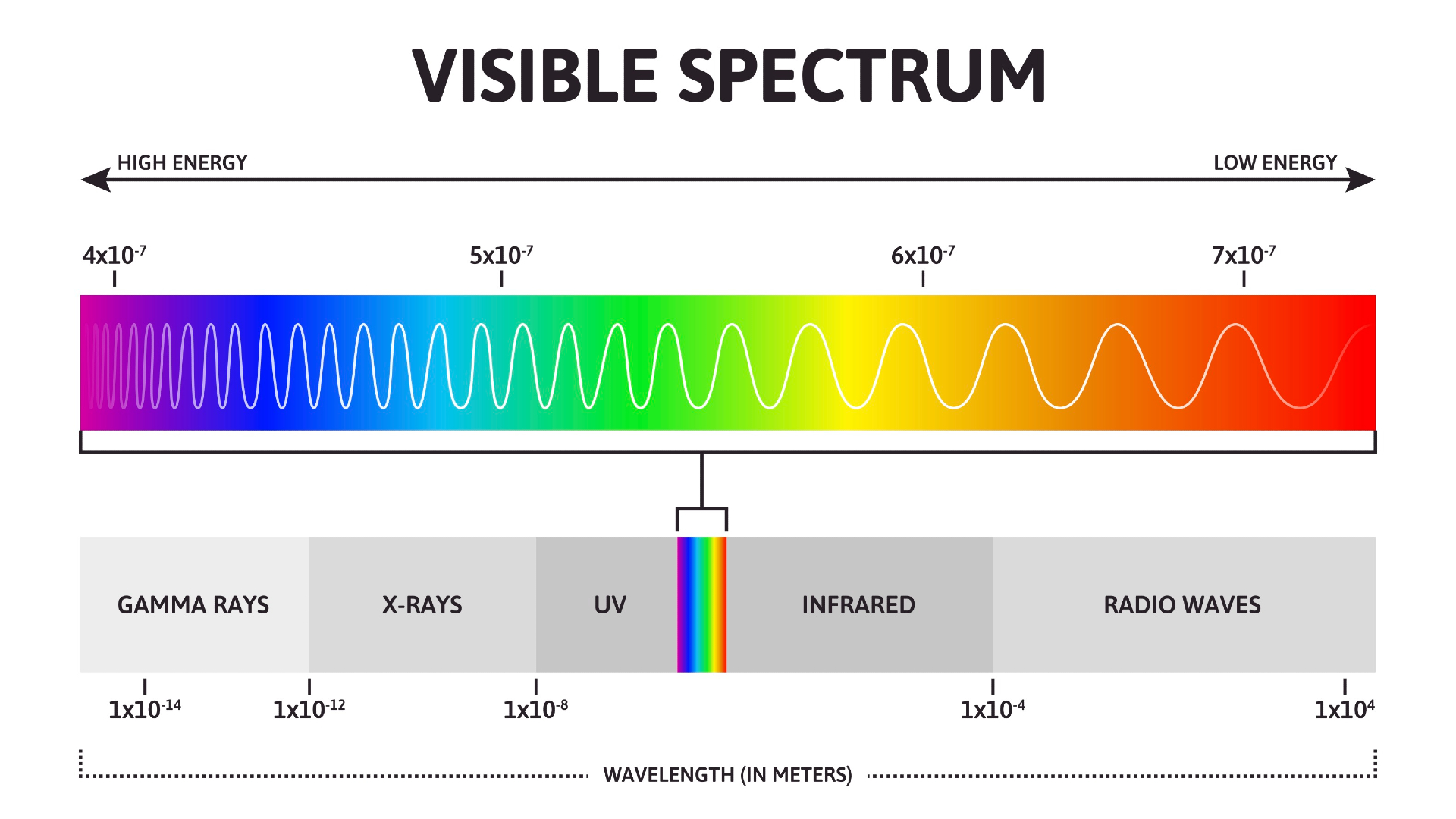
At the longest end of the visible spectrum are orange and red light, typically ranging from approximately 590 nm to 700 nm. Orange light occupies the 590-620 nm range, and red light falls between 620 nm and 700 nm. These longer wavelengths carry less energy than their shorter-wavelength counterparts. Red light is widely used in various technological applications due to its ability to penetrate fog and smoke effectively, making it ideal for traffic signals, warning lights, and infrared imaging (which borders the visible spectrum). In display technology, red LEDs and lasers are essential for creating full-color images. The precise control of red light emission is also vital in areas like optical sensors and scientific instrumentation.
Technological Applications: Harnessing the Visible Spectrum
The understanding and manipulation of visible light wavelengths have been instrumental in driving technological progress across numerous domains. From the devices we use every day to cutting-edge scientific instruments, the principles governing visible light are constantly being leveraged to create new functionalities and enhance existing ones.
Display Technologies: From Pixels to Perceptions
The most ubiquitous application of visible light technology is arguably in our electronic displays. Smartphones, televisions, computer monitors, and virtually any device with a screen rely on emitting and controlling specific wavelengths of light to create images. Historically, cathode ray tube (CRT) technology used electron beams to excite phosphors, which then emitted light. Modern displays, such as Liquid Crystal Displays (LCDs) and Organic Light-Emitting Diodes (OLEDs), offer far greater precision and efficiency. LCDs use a backlight (often LEDs) and liquid crystals to control the passage of light through color filters, effectively creating the different hues. OLED technology, on the other hand, uses organic compounds that emit light when an electric current is applied, allowing for self-emissive pixels that can create deeper blacks and more vibrant colors. The precise control over the red, green, and blue (RGB) sub-pixels in these displays, each emitting specific wavelengths, is what allows for the vast spectrum of colors we perceive on our screens. The ongoing development in display technology is focused on increasing color accuracy, reducing power consumption, and improving refresh rates, all of which are deeply rooted in manipulating visible light wavelengths.
Lighting and Illumination: Efficiency and Aesthetics
The advent of Light-Emitting Diodes (LEDs) has revolutionized the lighting industry. LEDs are semiconductor devices that emit light when an electric current passes through them. Crucially, LEDs can be engineered to emit light at very specific wavelengths or combinations of wavelengths. White light, which we perceive as the absence of color, is not a single wavelength but a mixture of wavelengths from across the visible spectrum. By combining different colored LEDs (typically red, green, and blue) or by using a blue LED with a phosphor coating that down-converts the blue light into other visible wavelengths, manufacturers can create white light with different “color temperatures” – from warm, yellowish light that mimics incandescent bulbs to cool, bluish light. This ability to precisely control the spectral output of light sources has led to more energy-efficient lighting, longer lifespans, and the ability to tailor lighting environments for specific purposes, such as in architectural design, retail spaces, and even to influence mood and productivity.
Imaging and Sensing: Seeing Beyond the Obvious
Beyond displays and lighting, the understanding of visible light wavelengths is fundamental to a wide array of imaging and sensing technologies. In digital cameras, image sensors are designed to capture the intensity of light across different parts of the visible spectrum, typically by using filters to distinguish between red, green, and blue light that falls on different pixels. This process is essential for capturing color photographs. Medical imaging techniques, such as optical coherence tomography (OCT), utilize near-infrared light (which borders the visible spectrum) to create high-resolution cross-sectional images of biological tissues. In scientific research, spectroscopy is a powerful analytical technique that involves dispersing light into its constituent wavelengths to identify the chemical composition of a substance based on how it absorbs or emits light at specific wavelengths. Lasers, which produce highly focused and monochromatic (single-wavelength) light, have numerous applications in industry for cutting, welding, and measurement, as well as in scientific research for manipulating matter at the atomic and molecular level.
The Future of Visible Light Technology
The exploration of visible light wavelengths is far from over. Researchers are continuously pushing the boundaries of what is possible, driven by the demand for more efficient, sophisticated, and versatile technologies. The quest for enhanced display technologies continues, with advancements in micro-LEDs and quantum dots promising even greater color fidelity and energy efficiency. In the realm of lighting, smart lighting systems that can dynamically adjust their color temperature and intensity based on environmental factors and user preferences are becoming increasingly sophisticated, influencing our well-being and productivity.
Beyond the Current Spectrum: Expanding Our Optical Toolkit
While the visible spectrum is what our eyes perceive, the principles of light manipulation extend beyond these boundaries. Technologies are increasingly leveraging wavelengths just outside the visible range, such as ultraviolet (UV) and infrared (IR) light, for specialized applications. UV light is used in sterilization, curing processes, and advanced material analysis, while IR light is crucial for thermal imaging, remote sensing, and communication. The seamless integration of these technologies with visible light systems is creating powerful synergistic effects. For example, combining visible light displays with IR sensors allows for gesture recognition and augmented reality experiences.
Towards More Intelligent and Interactive Optical Systems
The future of visible light technology is also heading towards greater intelligence and interactivity. Optical sensors are becoming more sensitive and capable of interpreting complex visual information, leading to advancements in robotics, autonomous vehicles, and sophisticated surveillance systems. Furthermore, the integration of artificial intelligence with optical systems is opening up new possibilities for image recognition, object detection, and predictive analysis. As our understanding of visible light and our ability to control it deepen, we can anticipate a future where light plays an even more integral role in shaping our technological landscape, enhancing our daily lives, and unlocking new frontiers of scientific discovery. The seemingly simple act of seeing is, in fact, a testament to a universe of complex electromagnetic interactions, and the visible wavelengths of light are our gateway to understanding and shaping it.
aViewFromTheCave is a participant in the Amazon Services LLC Associates Program, an affiliate advertising program designed to provide a means for sites to earn advertising fees by advertising and linking to Amazon.com. Amazon, the Amazon logo, AmazonSupply, and the AmazonSupply logo are trademarks of Amazon.com, Inc. or its affiliates. As an Amazon Associate we earn affiliate commissions from qualifying purchases.