
The physical world operates under a set of fundamental principles, often referred to as laws. Among these, Isaac Newton’s three laws of motion stand as cornerstones of classical mechanics, providing a framework for understanding how objects move and interact. The first of these, often called the law of inertia, is perhaps the most fundamental, as it sets the stage for comprehending all subsequent motion. While its roots lie in physics, the concept of inertia has profound implications and analogous applications far beyond the laboratory, extending into the realm of technology, shaping how we design, develop, and interact with the digital world.

Inertia: The Unchanging State of Motion
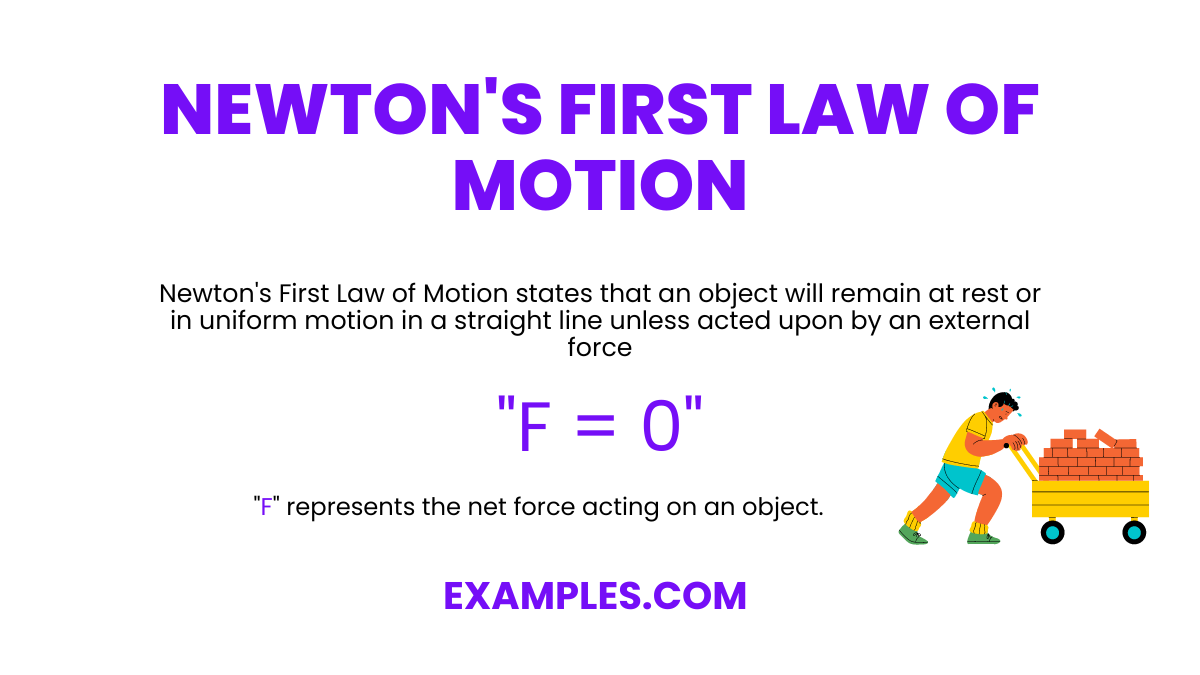
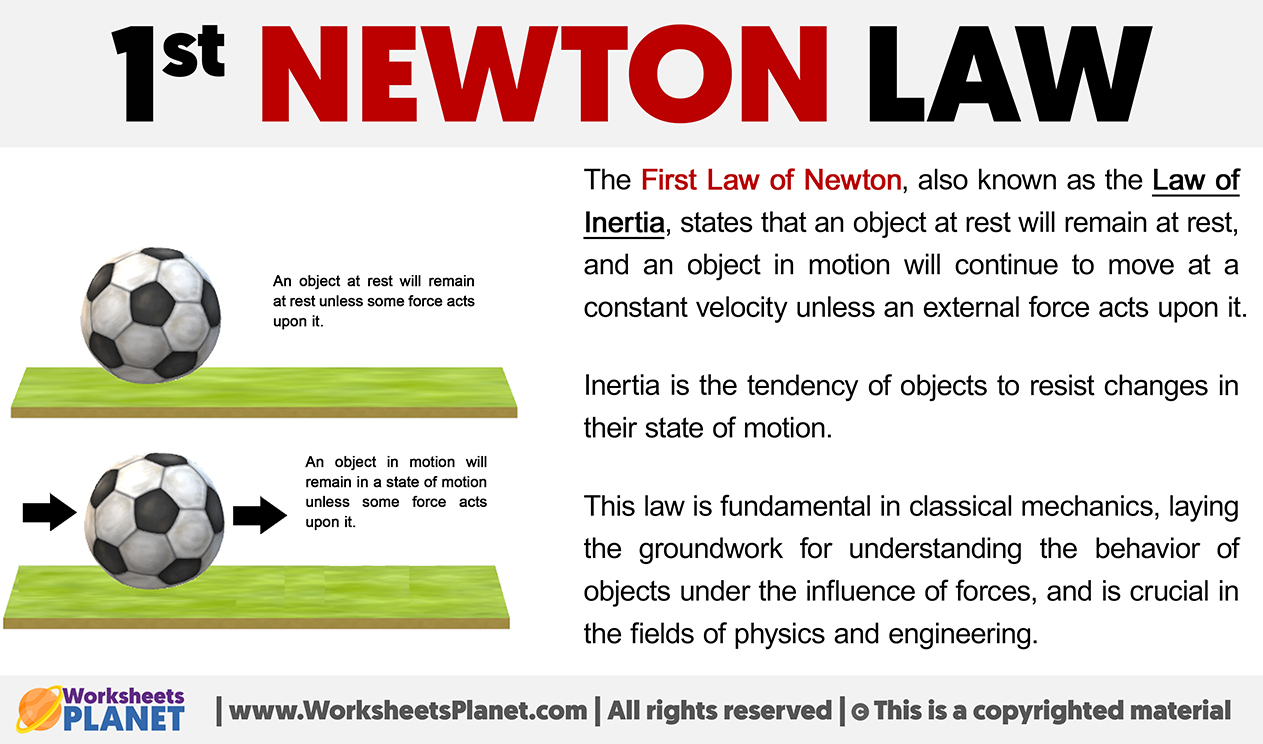
At its core, Newton’s First Law of Motion states: “An object at rest stays at rest, and an object in motion stays in motion with the same speed and in the same direction unless acted upon by an unbalanced force.” This seemingly simple statement carries immense weight. It posits that objects possess an inherent resistance to changes in their state of motion. This resistance is known as inertia.
Understanding Inertia: A Conceptual Deep Dive
Inertia isn’t a force itself; rather, it’s a property of matter. The more mass an object has, the greater its inertia. Imagine pushing a small shopping cart versus a fully loaded freight train. The shopping cart is easily set into motion and stopped. The freight train, with its immense mass, requires a colossal force to initiate movement and an equally substantial force to bring it to a halt. This difference in ease of acceleration or deceleration directly reflects their differing levels of inertia.
The law also highlights the crucial role of external forces. Without an “unbalanced force,” an object will continue its current motion indefinitely. In our everyday experience, this often seems counterintuitive because friction and air resistance are ubiquitous. A rolling ball eventually stops not because its inertia vanishes, but because these external forces oppose its motion. In the vacuum of space, however, a perfectly thrown projectile would travel in a straight line at a constant speed forever, a direct testament to the first law.
The Role of Unbalanced Forces: The Catalyst for Change
The operative phrase in the first law is “unless acted upon by an unbalanced force.” This is the agent of change. A force is a push or a pull. An unbalanced force means that the net force acting on an object is not zero. If multiple forces act on an object, they can cancel each other out, resulting in a net force of zero. In such a scenario, the object’s state of motion remains unchanged. However, when the forces do not perfectly counterbalance, a net force exists, and this net force will cause the object to accelerate – meaning its velocity (speed and direction) will change.
For an object at rest, an unbalanced force is required to initiate motion. For an object already in motion, an unbalanced force is needed to change its speed, direction, or both, ultimately bringing it to rest or altering its trajectory. This concept is fundamental to understanding everything from the trajectory of a spacecraft to the behavior of data packets across a network.
Inertia in the Digital Realm: From Software to User Experience
While Newton’s laws were formulated to describe the physical universe, the principles of inertia translate remarkably well into the digital landscape. The “objects” in this realm are not physical masses, but rather software, systems, data, and even user engagement.
Software Inertia: The Resistance to Change
Software systems, much like massive objects, often exhibit a form of inertia. Once a particular architecture, codebase, or set of user interface conventions is established, it can be incredibly difficult to change. This “software inertia” arises from several factors:
- Technical Debt: Over time, software accumulates technical debt – design decisions or implementations that are suboptimal but were made for expediency. This debt can make it challenging to introduce new features or refactor existing code without significant effort and risk. The accumulated complexity acts as a significant unbalanced force needed to overcome.
- User Adoption and Training: Users become accustomed to existing interfaces and workflows. Introducing radical changes, even if functionally superior, can encounter significant resistance. Users have invested time and effort in learning the current system, and this existing momentum (akin to motion) makes them resistant to adopting entirely new paradigms unless the benefits are overwhelmingly clear and the transition is well-managed.
- Legacy Systems: Many organizations rely on legacy systems that are deeply embedded in their operations. These systems, due to their age and complexity, are extremely resistant to change. Replacing them requires substantial investment, planning, and execution, acting as a formidable unbalanced force.
User Experience Inertia: The Comfort of the Familiar
User experience (UX) design is heavily influenced by the concept of inertia. Users develop habits and mental models based on their interactions with technology. When a new app or website behaves in a way that deviates significantly from these established patterns, users often struggle.
- Cognitive Load: A drastic departure from familiar patterns increases cognitive load. Users have to learn new ways of navigating, interacting, and achieving their goals, which requires more mental effort. This resistance to increased cognitive load is a manifestation of user inertia.
- Muscle Memory and Habits: Many interactions, especially on mobile devices, become ingrained through muscle memory and habit. Think of how instinctively you swipe to go back on a smartphone or double-click to open a file. Disrupting these deeply ingrained habits requires a compelling reason and a very smooth transition.
- The “It Just Works” Expectation: Users expect technology to be predictable and intuitive. When a system deviates unexpectedly, it breaks this expectation and can lead to frustration and abandonment. The initial state of familiarity and ease of use represents a form of inertia that designers must respect.
Overcoming Inertia in Technology Development
Understanding inertia is not just about recognizing its presence; it’s about developing strategies to effectively overcome it when necessary for innovation and improvement.
Strategic Application of Unbalanced Forces: Driving Innovation
Just as a rocket needs a powerful, sustained force to escape Earth’s gravity, technological advancements often require significant “unbalanced forces” to overcome existing inertia.
- Disruptive Technologies: True disruptive technologies are often characterized by their ability to apply a sufficiently powerful unbalanced force to overcome the inertia of established systems and user habits. Think of the shift from feature phones to smartphones. The added functionality and interconnectedness provided a compelling enough reason to overcome the inertia of existing mobile device usage patterns.
- Iterative Design and Gradual Change: While revolutionary change can be powerful, it can also be highly disruptive. Often, a more effective approach is to apply a series of smaller, well-managed unbalanced forces. This is the principle behind iterative development and agile methodologies. By releasing new features incrementally, providing clear communication, and offering robust training and support, developers can gradually shift user behavior and system architecture without triggering overwhelming resistance.
- The Power of Compelling Value Proposition: The most effective way to overcome inertia is to offer a value proposition so compelling that it naturally draws users and stakeholders towards the change. This could be a dramatic improvement in efficiency, a significant cost saving, or a revolutionary new capability that was previously impossible. The perceived benefit must outweigh the effort and discomfort of change.
Building Momentum and Sustaining Change
Once a change has been initiated, the goal shifts to building momentum and ensuring the new state of motion is sustained.
- Positive Reinforcement and Feedback Loops: Encouraging early adopters and gathering positive feedback can create a virtuous cycle. As more users embrace the new technology or approach, it becomes the norm, and the inertia of the old system weakens. Gamification and reward systems can be powerful tools in generating this positive reinforcement.
- Continuous Improvement and Adaptation: Even once a new system is in place, it’s crucial to continue refining and improving it. This prevents the accumulation of new technical debt and ensures that the system remains relevant and effective. This ongoing process of refinement can be seen as applying continuous, albeit smaller, unbalanced forces to maintain optimal performance.
- Training and Onboarding: Effective training and onboarding are critical for ensuring that users can quickly and effectively adopt new technologies. By reducing the initial learning curve and providing ongoing support, organizations can minimize the friction associated with change and help users overcome their own inertia.
The Future of Motion in Technology
As technology continues to evolve at an unprecedented pace, the principles of inertia will remain central to our understanding of its development and adoption. From the seamless integration of artificial intelligence into everyday tools to the complex dynamics of decentralized networks, understanding the resistance to change and the forces required to initiate and sustain progress will be paramount.
The first law of motion, with its emphasis on the inherent tendency of objects to maintain their state unless acted upon by an external force, serves as a profound metaphor for the technological landscape. Developers, designers, and strategists who grasp this principle are better equipped to anticipate challenges, design resilient systems, and guide the evolution of technology in a way that is both innovative and user-centric. The ongoing quest for progress in the digital world is, in essence, a continuous dance with inertia, a perpetual effort to apply the right forces at the right time to shape the future of how we live, work, and interact.
aViewFromTheCave is a participant in the Amazon Services LLC Associates Program, an affiliate advertising program designed to provide a means for sites to earn advertising fees by advertising and linking to Amazon.com. Amazon, the Amazon logo, AmazonSupply, and the AmazonSupply logo are trademarks of Amazon.com, Inc. or its affiliates. As an Amazon Associate we earn affiliate commissions from qualifying purchases.