
The term “Burned-Over District” might conjure images of devastation and loss, perhaps a forgotten chapter of industrial decline or a literal wildfire’s aftermath. However, in the context of American history, this evocative moniker refers to a specific period and region of intense religious revivalism and social reform that swept through western and central New York State in the early to mid-19th century. Understanding the “Burned-Over District” is crucial for appreciating the profound spiritual and social currents that shaped early American identity and laid the groundwork for significant movements that continue to resonate today. This phenomenon was not about physical burning, but rather the “burning over” of the spiritual landscape, leaving no room for the old ways and paving the way for fervent new beliefs and radical social experiments.

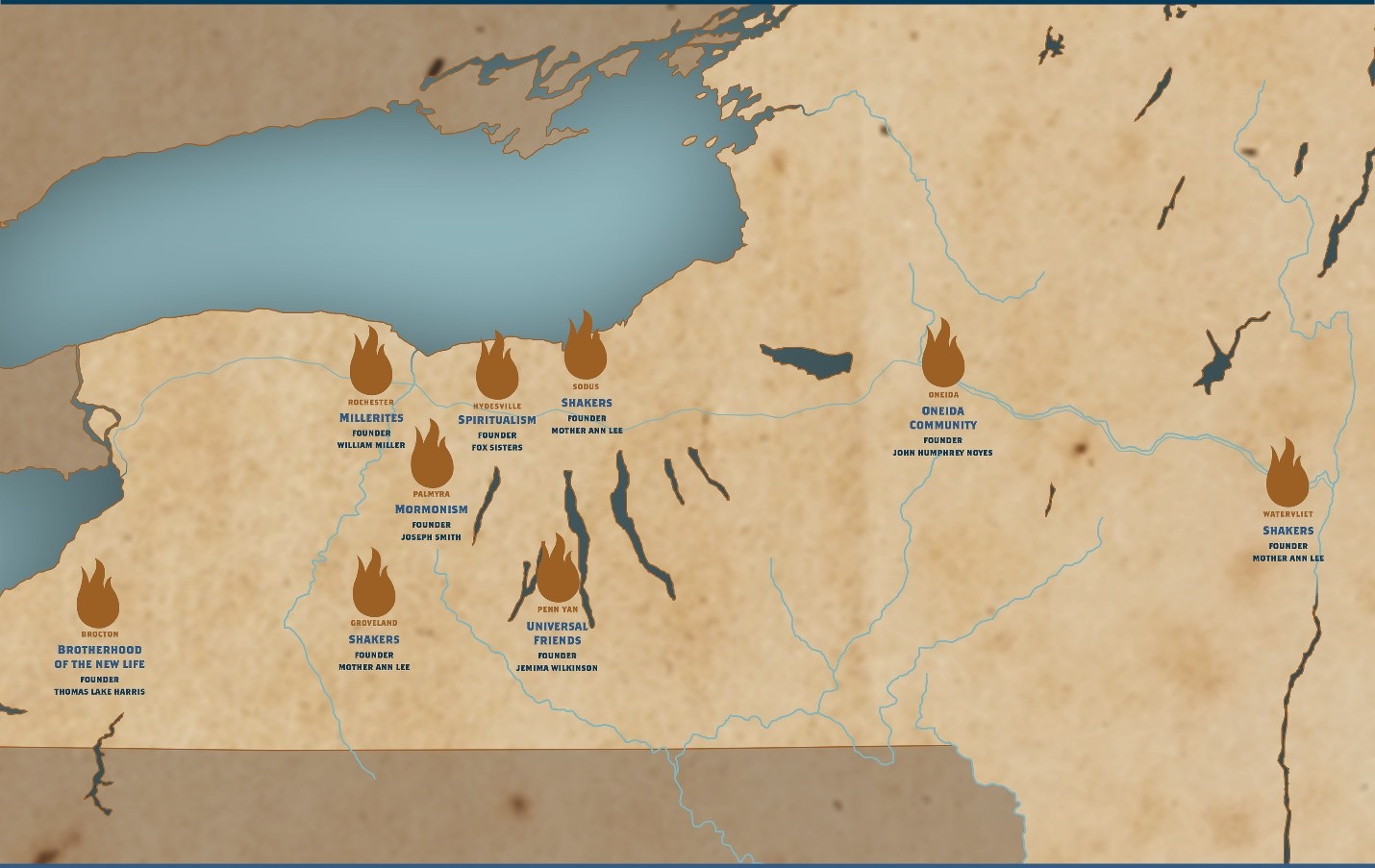
The origins of this intense religious fervor can be traced to a confluence of factors, including the aftermath of the American Revolution, westward expansion, and a developing American consciousness eager to define its unique spiritual and social identity. The Second Great Awakening, a Protestant religious revival movement that began in the late 18th century and peaked in the 1820s and 1830s, was the engine driving this transformation. The Burned-Over District, largely encompassing the Erie Canal corridor, became its epicenter, a region where religious fervor was so potent that it seemed to have “burned over” the land, leaving little room for skepticism or indifference.
The Seeds of Revival: Societal Shifts and the Second Great Awakening
The early 19th century in America was a period of immense change and dynamism. The young nation was grappling with its identity, expanding its borders westward, and experiencing rapid economic growth, particularly with the advent of new transportation technologies like the Erie Canal. This era of flux created a fertile ground for spiritual exploration and a yearning for certainty in a rapidly evolving world.
Post-Revolutionary America and the Quest for Order
Following the American Revolution, a sense of both liberation and uncertainty pervaded the new nation. The breakdown of established religious hierarchies and the emphasis on individual liberty, while empowering, also left many seeking new frameworks for meaning and moral order. Traditional Calvinist doctrines, with their emphasis on predestination and the inherent depravity of humanity, began to feel less resonant with a populace embracing ideals of self-determination and progress. This created a spiritual vacuum that the energetic preaching and emotional appeals of the Second Great Awakening were perfectly positioned to fill.
The Erie Canal: A Catalyst for Connection and Conversion
The construction and opening of the Erie Canal in 1825 were transformative for western and central New York. This engineering marvel dramatically reduced transportation costs and opened up the region to settlers and commerce. However, it also served as a conduit for ideas and people, facilitating the rapid spread of religious enthusiasm. Itinerant preachers, traveling along the canal route, found eager audiences among new settlers, many of whom were seeking community and spiritual grounding in unfamiliar territory. The canal acted as a literal highway for the spread of revivalism, allowing messages of salvation and reform to travel with unprecedented speed and reach.
The Spark Ignites: Charismatic Leaders and Evangelical Zeal
The Second Great Awakening was characterized by its impassioned preaching, large camp meetings, and a focus on individual conversion experiences. In the Burned-Over District, this manifested in a particularly potent and transformative way, leading to the emergence of influential religious movements and significant social activism.
Charles Finney and the “New Measures”
One of the most prominent figures associated with the Burned-Over District was Charles Finney, a lawyer-turned-evangelist. Finney’s preaching style was highly effective, employing direct appeals to emotion and reason. He introduced what became known as the “new measures,” a set of innovative techniques designed to facilitate conversions. These included the “anxious bench,” where individuals grappling with their faith could sit and receive focused prayer and counsel, and extended prayer meetings. Finney’s approach emphasized free will and the power of human agency in seeking salvation, a stark contrast to the deterministic views of earlier theological traditions. His revivals were marked by intense emotional displays, including shouting, weeping, and falling into trances, which contributed to the feeling of a spiritually charged environment.
The “Burnt-Over” Phenomenon: Ubiquitous Religious Activity
The intensity and pervasiveness of these revivals led to the region being dubbed the “Burned-Over District.” This term, coined by minister John W. Nevin, implied that the religious fervor had been so widespread and consuming that the spiritual landscape had been “burned over,” leaving little uncultivated ground. In many communities, church membership and participation surged dramatically. Revivals were not isolated events but ongoing occurrences, with towns and villages experiencing successive waves of religious awakening. This constant spiritual activity created a unique social environment where religious discourse and practice were central to daily life.
The Fruits of Revival: Social Reform and Radical Experimentation
The intense religious energy generated in the Burned-Over District did not remain confined to personal salvation. It spilled over into a passionate commitment to social reform, as believers felt compelled to create a more just and righteous society in anticipation of Christ’s imminent return.
Abolitionism: A Moral Imperative
One of the most significant outcomes of the revivals was the rise of the abolitionist movement. Many evangelicals viewed slavery as a profound moral sin and a direct contradiction to Christian principles of equality and brotherhood. The Burned-Over District became a hotbed for abolitionist activity, with prominent figures like William Lloyd Garrison and Frederick Douglass finding receptive audiences and active participants in the region. Churches and religious organizations became centers for abolitionist organizing, petition drives, and the dissemination of anti-slavery literature. The fervor to end slavery was often framed as a divine mission, a necessary purification of American society.
Women’s Rights: Challenging Traditional Roles
The Second Great Awakening also played a critical role in elevating the status of women and providing them with opportunities for public leadership. As women actively participated in revivals, organizing prayer meetings, and even engaging in public speaking, they began to question their traditional, subordinate roles. The Beecher sisters, particularly Harriet Beecher Stowe and Catharine Beecher, were prominent figures who emerged from this environment. While their approaches differed, they both championed education for women and advocated for women’s influence in society, albeit often within a domestic sphere. The abolitionist movement further empowered women, as many found their voices in speaking out against injustice and organizing protests, which laid the groundwork for the nascent women’s suffrage movement.
Utopian Communities and Alternative Lifestyles
The desire to create a more perfect society also led to the establishment of various utopian communities in the Burned-Over District. These communities, often religiously motivated, sought to live out their ideals of communal living, spiritual purity, and social equality outside the perceived corruption of mainstream society. The Oneida Community, founded by John Humphrey Noyes, is perhaps the most famous example, practicing “complex marriage” and communal child-rearing. Other communities, such as the Fourierist phalanxes and Shaker villages, explored different models of social organization, all driven by a profound belief in the possibility of creating divinely ordered or rationally structured societies. These experiments, while often short-lived, represent a radical engagement with the social and spiritual questions of the era.
Legacy and Lasting Impact: A Shaping Force in American Culture
The Burned-Over District was more than just a geographical location; it was a crucible of spiritual and social transformation that left an indelible mark on American history and culture. The revivals and reforms that originated or flourished there continue to influence American thought and activism.
The Enduring Influence of Evangelicalism
The intense evangelical fervor of the Second Great Awakening laid the foundation for the enduring influence of evangelical Christianity in American life. The emphasis on personal conversion, evangelism, and a commitment to social action became hallmarks of American Protestantism. While the specific forms of revivalism and reform have evolved, the underlying spirit of religiously motivated activism, from temperance movements to contemporary social justice initiatives, can trace its roots back to the Burned-Over District.
The Birthplace of Modern Social Movements
The Burned-Over District served as a crucial incubator for many of the social reform movements that defined the 19th century and continue to shape the 21st. Abolitionism, women’s rights, temperance, and various utopian experiments all gained significant momentum and developed organizational structures in this fertile ground. The very notion of organized social activism, driven by moral conviction and a desire for societal improvement, was profoundly shaped by the experiences of this region. The legacy of these movements continues to inform contemporary debates about justice, equality, and human rights.

A Historical Lens on American Spirituality and Identity
Studying the Burned-Over District provides invaluable insights into the complex interplay between religion, social change, and the formation of American identity. It demonstrates how periods of rapid societal upheaval can lead to intense spiritual searching and a desire to reshape the world according to deeply held beliefs. The story of the Burned-Over District reminds us that religious movements are not solely about individual salvation but can be powerful engines for social transformation, driving both profound personal change and radical collective action. It stands as a testament to the dynamic and often unpredictable forces that have shaped the American spiritual and social landscape.
aViewFromTheCave is a participant in the Amazon Services LLC Associates Program, an affiliate advertising program designed to provide a means for sites to earn advertising fees by advertising and linking to Amazon.com. Amazon, the Amazon logo, AmazonSupply, and the AmazonSupply logo are trademarks of Amazon.com, Inc. or its affiliates. As an Amazon Associate we earn affiliate commissions from qualifying purchases.