
Bitcoin, often hailed as the world’s first decentralized digital currency, has revolutionized our perception of money and financial systems. Far from being a mere digital token, Bitcoin is an intricate ecosystem built upon groundbreaking technological principles. Understanding “how Bitcoins work” requires delving into the ingenious blend of cryptography, distributed ledger technology, and network consensus mechanisms that give it its unparalleled security, transparency, and independence. This article will unravel the core technological components that power Bitcoin, offering an insightful look into the engineering marvel behind this digital phenomenon.
The Foundational Pillars: Cryptography and Digital Signatures
At the heart of Bitcoin’s operation lies a sophisticated application of cryptography – the science of secure communication in the presence of adversaries. Cryptography provides the fundamental building blocks for Bitcoin’s security, privacy, and the integrity of its transactions. Without strong cryptographic principles, Bitcoin would be vulnerable to fraud, counterfeiting, and manipulation, rendering it unusable as a reliable form of digital money.

Public-Key Cryptography
One of the most critical cryptographic concepts in Bitcoin is public-key cryptography, also known as asymmetric cryptography. This system relies on a pair of mathematically linked keys: a public key and a private key.
- Private Key: This is a secret, randomly generated string of alphanumeric characters. It acts as your unique signature and ultimate proof of ownership over your Bitcoin. Crucially, the private key is used to “sign” transactions, authorizing the movement of Bitcoin from your address. Keeping your private key absolutely secret is paramount, as anyone who gains access to it can control your funds.
- Public Key: Derived mathematically from your private key, the public key is shared openly. From your public key, a Bitcoin address (a shorter, more user-friendly string) is generated. This address is what you share with others to receive Bitcoin. While the public key can be used to verify that a transaction was signed by the corresponding private key, it cannot be used to deduce the private key itself, ensuring security.
This asymmetric relationship allows for secure transactions without revealing the private key. When you send Bitcoin, you use your private key to create a digital signature for the transaction. Anyone on the network can then use your public key to verify that the signature is valid and that you are indeed the owner of the Bitcoin you’re trying to send, without ever knowing your private key.
Cryptographic Hashing
Another cornerstone of Bitcoin’s technology is cryptographic hashing. A hash function is a mathematical algorithm that takes an input (or ‘message’) of any size and converts it into a fixed-size string of characters, known as a ‘hash’ or ‘digest.’ In Bitcoin, the SHA-256 (Secure Hash Algorithm 256-bit) function is primarily used.
The properties of a cryptographic hash function are vital for Bitcoin’s integrity:
- Deterministic: The same input will always produce the same output hash.
- One-Way Function: It is computationally infeasible to reverse the process—to derive the original input from its hash.
- Collision Resistant: It is extremely difficult to find two different inputs that produce the same output hash.
- Avalanche Effect: Even a tiny change in the input data results in a drastically different output hash.
These properties are leveraged throughout Bitcoin, from creating unique addresses and ensuring transaction integrity to linking blocks together in the blockchain and securing the mining process. Each block in the blockchain contains the hash of the previous block, creating an unbreakable chain that is highly resistant to tampering.
The Backbone: Blockchain and Decentralized Network
Bitcoin operates on a decentralized network, meaning there is no central authority or single point of control. Instead, it relies on a peer-to-peer (P2P) network of computers (nodes) around the world. The collective record-keeping of these nodes forms the blockchain, Bitcoin’s distributed public ledger.
Distributed Ledger Technology (DLT)
The blockchain is essentially a continuously growing list of records, called blocks, which are securely linked together using cryptography. Each block contains a timestamp and a hash of the previous block, creating a chronological and immutable chain. This forms a transparent and tamper-proof record of all Bitcoin transactions ever made.
Key characteristics of Bitcoin’s blockchain as a DLT:
- Decentralization: Copies of the entire blockchain are maintained by thousands of nodes across the globe. No single entity owns or controls the network, making it resilient to censorship and single points of failure. If one node goes offline, the network continues to function seamlessly.
- Transparency: All transactions are publicly visible on the blockchain. While the identities behind Bitcoin addresses remain pseudonymous, the flow of funds is transparent for anyone to inspect.
- Immutability: Once a transaction is recorded in a block and added to the blockchain, it is virtually impossible to alter or remove it. The cryptographic links between blocks and the distributed nature of the ledger ensure that any attempt to tamper with past records would be immediately detected and rejected by the network.
Peer-to-Peer Network
The P2P network allows Bitcoin users to send and receive transactions directly from one another without the need for intermediaries like banks. When a user initiates a Bitcoin transaction, it is broadcast to the network. Each node verifies the transaction’s legitimacy (checking cryptographic signatures, ensuring sufficient funds, etc.) before adding it to its memory pool of unconfirmed transactions.
This collective validation and distribution of information are crucial. Before a transaction can be considered final and immutable, it must be included in a new block by a “miner” and then added to the global blockchain, which is then replicated across the entire network.
The Engine: Mining and Transaction Validation
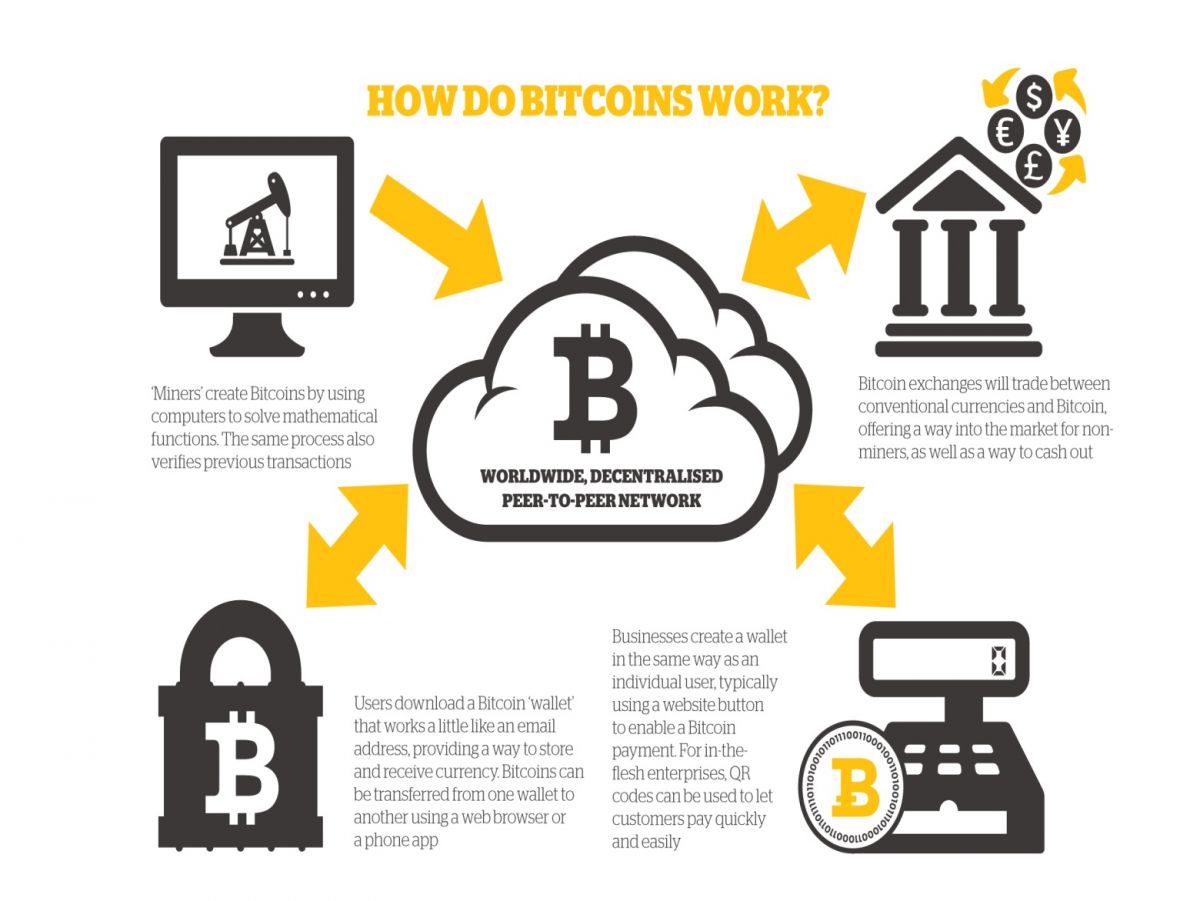
For new transactions to be added to the blockchain, they must be organized into blocks and validated through a process known as “mining.” Bitcoin mining is a competitive process that serves two critical functions: securing the network and creating new Bitcoins (block rewards).
Proof-of-Work (PoW)
Bitcoin uses a consensus mechanism called Proof-of-Work (PoW). Miners compete to solve a complex computational puzzle, which involves finding a specific hash value for a block of transaction data. This puzzle is designed to be computationally intensive to solve but easy for others to verify.
The “work” refers to the computational effort (and thus energy) expended by miners to find this specific hash. The difficulty of this puzzle adjusts roughly every two weeks to ensure that, on average, a new block is found approximately every 10 minutes.
Block Creation and Reward System
When a miner successfully solves the PoW puzzle, they are allowed to:
- Create a New Block: They compile a list of unconfirmed transactions from the network’s memory pool into a new block.
- Add to Blockchain: The new block, including the solution to the puzzle and its hash, is then broadcast to the entire Bitcoin network. Other nodes verify the solution and the validity of the transactions within the block.
- Receive Rewards: The miner who successfully mines a block is rewarded with newly minted Bitcoin (the “block reward”) and any transaction fees associated with the transactions included in that block. This incentivizes miners to dedicate their computational resources to securing the network.
This continuous process of mining, verifying, and adding blocks to the chain ensures that new transactions are regularly processed and permanently recorded, maintaining the integrity and growth of the Bitcoin blockchain.
User Interaction: Wallets, Keys, and Security
While the underlying technology of Bitcoin is complex, interacting with it from a user perspective is simplified through software applications known as “wallets.” These wallets don’t actually “store” Bitcoin in the traditional sense, but rather manage your cryptographic keys, which control access to your Bitcoin on the blockchain.
Bitcoin Wallets
A Bitcoin wallet is a software or hardware device that allows users to send, receive, and store Bitcoin by managing their private and public keys. There are several types of wallets, each with varying levels of security and convenience:
- Software Wallets (Hot Wallets): These include desktop, mobile, and web-based applications. They are convenient for frequent transactions but are generally considered less secure than hardware wallets because their private keys might be exposed to the internet.
- Hardware Wallets (Cold Wallets): These are physical electronic devices designed to store private keys offline. They offer the highest level of security for significant amounts of Bitcoin, as private keys never touch an internet-connected device, making them impervious to online threats.
- Paper Wallets: While less common now, these involve printing your private and public keys onto paper. They are completely offline but require careful handling to prevent loss or damage.
Seed Phrases and Backup
When you set up a new Bitcoin wallet, it typically generates a “seed phrase” (usually 12 or 24 words). This mnemonic phrase is an ordered list of words that can be used to deterministically generate all your private keys and addresses. It is your ultimate backup. If you lose access to your wallet device, your seed phrase is the only way to recover your funds. The security of your Bitcoin ultimately hinges on the security of your private keys and, by extension, your seed phrase.
The Future and Technological Evolution of Bitcoin
Bitcoin, as an open-source technology, is continuously evolving. While its core principles remain stable, the community and developers actively work on improvements and scaling solutions to enhance its capabilities and address challenges.
Scaling Solutions
One of the primary technological challenges for Bitcoin has been its transaction throughput. The network is designed to process a limited number of transactions per second (due to the 10-minute block time and block size limit), which can lead to higher fees and slower confirmation times during periods of high demand. To address this, various “Layer 2” scaling solutions have been developed:
- Lightning Network: This is a second layer built on top of the Bitcoin blockchain. It allows for off-chain transactions to occur almost instantly and with very low fees between participants, only settling the net result onto the main blockchain when channels are closed. This significantly increases transaction capacity for micropayments.
- Segregated Witness (SegWit): Implemented in 2017, SegWit was an upgrade to the Bitcoin protocol that effectively increased the block capacity by separating signature data from transaction data. This allowed more transactions to fit into a single block without increasing the overall block size limit, improving efficiency and paving the way for further scaling solutions like the Lightning Network.

Scripting Language and Smart Contracts
Bitcoin also possesses a simple scripting language, though it is not as robust or flexible as those found in other blockchains like Ethereum. This scripting language allows for the creation of basic “smart contracts,” which are self-executing contracts with the terms of the agreement directly written into code. While not designed for complex decentralized applications (dApps), Bitcoin’s scripting capabilities enable features like multi-signature addresses (requiring multiple private keys to authorize a transaction) and time-locked transactions, enhancing its utility and security.
In conclusion, “how Bitcoins work” is a testament to the power of distributed systems, advanced cryptography, and economic incentives. It is a meticulously engineered digital commodity and payment network that operates without central oversight, relying instead on a global consensus mechanism. By understanding its foundational technological components – from cryptographic keys and hashing to the decentralized blockchain and proof-of-work mining – one gains a profound appreciation for the ingenuity and resilience that underpin this transformative digital asset. Bitcoin is not just a form of money; it is a complex, living technology continually secured and evolved by a global network of participants.
aViewFromTheCave is a participant in the Amazon Services LLC Associates Program, an affiliate advertising program designed to provide a means for sites to earn advertising fees by advertising and linking to Amazon.com. Amazon, the Amazon logo, AmazonSupply, and the AmazonSupply logo are trademarks of Amazon.com, Inc. or its affiliates. As an Amazon Associate we earn affiliate commissions from qualifying purchases.