
Filing taxes can often feel like navigating a dense jungle of forms, deadlines, and jargon. Yet, it’s an essential annual ritual for most individuals and businesses, impacting everything from your personal finances to your long-term financial planning. Understanding the process, leveraging available tools, and knowing your obligations for the 2023 tax year can transform a daunting task into a manageable and even financially advantageous endeavor. This comprehensive guide aims to demystify tax filing, offering insights and actionable advice to help you file accurately, efficiently, and with confidence.
The 2023 tax year (which you’ll file in 2024) comes with its own set of nuances, standard deduction updates, and credit adjustments. Whether you’re a first-time filer, a seasoned taxpayer, or a small business owner, an organized approach is your best ally. From gathering the right documents to choosing the optimal filing method and maximizing your deductions, every step in the process holds financial implications. Let’s delve into the specifics to ensure your tax season is as smooth and beneficial as possible.

Understanding Your Tax Filing Obligations for 2023
Before you even think about forms, it’s crucial to understand if you need to file, when you need to file, and what documents are necessary. This foundational knowledge prevents missteps and ensures you meet your legal requirements.
Who Needs to File?
Not everyone is required to file a federal income tax return. The obligation generally depends on your gross income, filing status, and age. For the 2023 tax year, the IRS sets specific income thresholds. For instance, if you’re a single individual under 65, you generally need to file if your gross income was at least $13,850. These thresholds increase for married couples, heads of household, and those over 65.
However, even if your income falls below these thresholds, you might still want to file. Why? Because filing is often the only way to claim a refund for taxes withheld from your paychecks or to claim refundable tax credits, such as the Earned Income Tax Credit or the Child Tax Credit. This is particularly relevant for those with low to moderate incomes.
Self-employed individuals face different rules. If your net earnings from self-employment were $400 or more, you are generally required to file, regardless of your gross income from other sources. This is because you’ll likely owe self-employment taxes (Social Security and Medicare taxes).
Key Deadlines to Remember
The primary deadline for filing federal income tax returns for the 2023 tax year is typically April 15, 2024. If April 15 falls on a weekend or holiday, the deadline shifts to the next business day. It’s imperative to mark this date on your calendar. Missing the deadline can result in penalties and interest charges on any unpaid taxes.
If you can’t file on time, you can request an extension to file, which typically grants you an additional six months, moving the deadline to October 15, 2024. It’s crucial to understand that an extension to file is not an extension to pay. If you expect to owe taxes, you must estimate and pay those taxes by the original April deadline to avoid penalties and interest. State tax deadlines often mirror federal deadlines but can vary, so always check your state’s specific requirements.
Required Documents: A Checklist
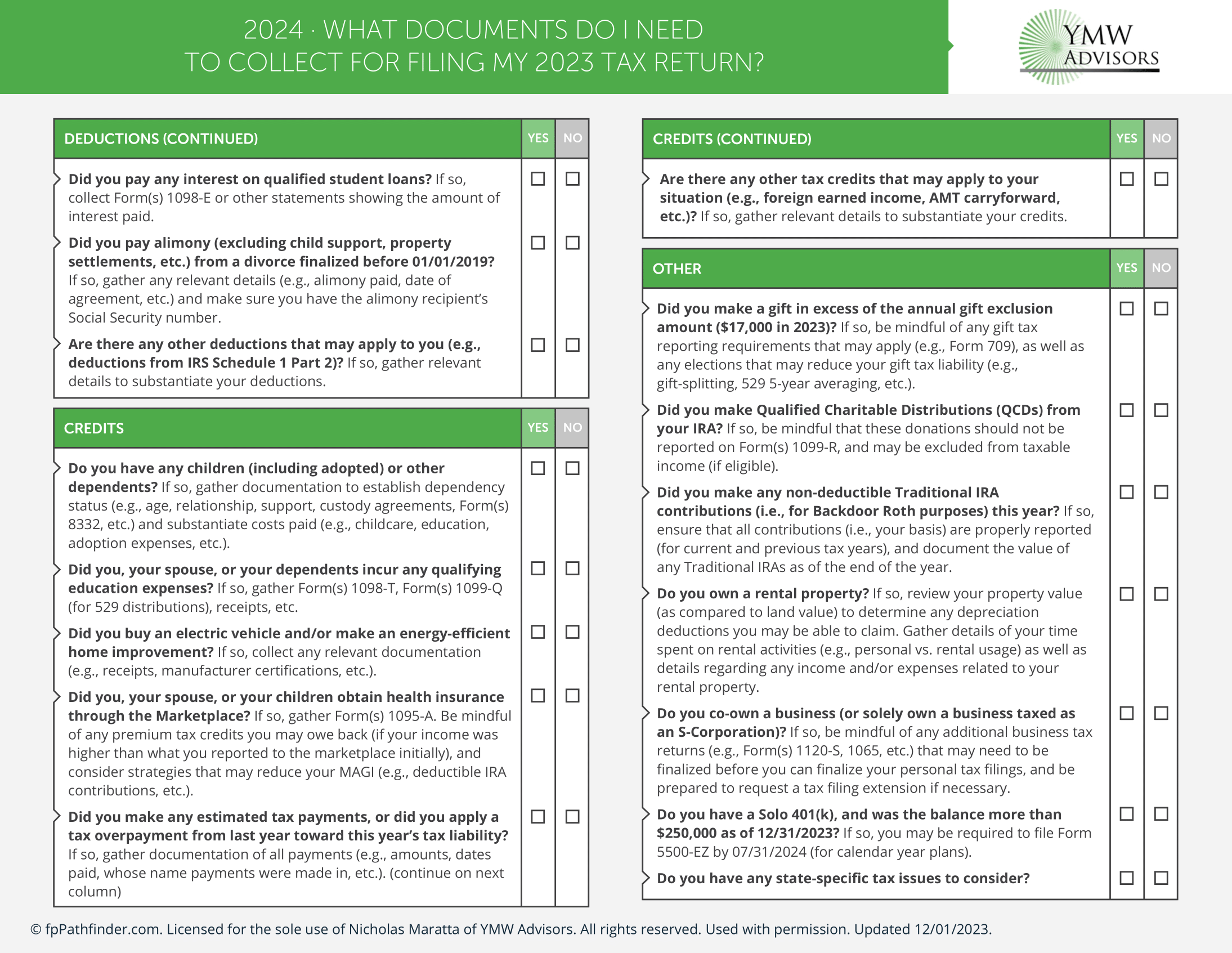
Organization is key to a stress-free tax season. Start gathering your documents well in advance. Here’s a general checklist of what you’ll need:
- Personal Information: Social Security numbers (or ITINs) for yourself, your spouse, and all dependents.
- Income Statements:
- Form W-2: From your employer(s), showing wages, tips, and other compensation.
- Form 1099-NEC: For non-employee compensation (freelancers, contractors).
- Form 1099-MISC: For miscellaneous income.
- Form 1099-INT: For interest income from banks.
- Form 1099-DIV: For dividends from stocks or mutual funds.
- Form 1099-B: For proceeds from brokerage transactions (stock sales).
- Form 1099-R: For distributions from IRAs or retirement plans.
- Form W-2G: For gambling winnings.
- Schedule K-1: For income from partnerships, S corporations, and trusts.
- Form 1099-G: For unemployment compensation or state tax refunds.
- Deduction & Credit Information:
- Form 1098-E: For student loan interest paid.
- Form 1098: For mortgage interest paid.
- Receipts for medical expenses, charitable contributions, childcare expenses, and business expenses (if self-employed).
- Property tax statements.
- Records of education expenses (Form 1098-T).
- Records of health insurance premiums, especially if you purchased through the marketplace (Form 1095-A, B, or C).
Having these documents neatly organized will streamline the filing process, whether you’re doing it yourself or working with a professional.
Choosing the Right Filing Method
Once you have your documents in hand, the next decision is how you’ll prepare and submit your return. There are several options, each with its own advantages, depending on your financial situation and comfort level.
DIY: Software vs. Paper Forms
Many taxpayers opt to prepare their returns themselves, a cost-effective choice for those with straightforward tax situations.
- Tax Software: This is the most popular DIY method. Programs like TurboTax, H&R Block Tax Software, TaxAct, and FreeTaxUSA guide you through the process with user-friendly interfaces, asking questions and populating forms automatically. They often include audit support and error checking. Many offer free versions for simple returns, with tiered pricing for more complex scenarios (e.g., self-employment, investment income). This method combines convenience with relative affordability.
- Paper Forms: While still an option, manually filling out paper IRS forms (Form 1040 and accompanying schedules) is time-consuming and prone to mathematical errors. The IRS encourages electronic filing for accuracy and faster processing of refunds. This method is generally recommended only for those who are highly familiar with tax laws and forms, or who have no access to computers.
Professional Assistance: When to Hire an Expert
For many, the complexity of tax law warrants professional help. Tax preparers, CPAs (Certified Public Accountants), and enrolled agents can offer invaluable expertise.
- When to Consider a Professional:
- Complex Financial Situations: If you own a business, have significant investment income, multiple rental properties, or recently experienced a major life event (marriage, divorce, birth of a child, home purchase/sale).
- High-Income Earners: Those with substantial income often have more opportunities for deductions and credits that an expert can identify.
- International Income: If you have income from foreign sources or live abroad.
- Audit Concerns: If you’ve been audited before or anticipate potential issues.
- Peace of Mind: Many simply prefer the assurance that their taxes are handled correctly, minimizing stress and potential errors.
A good tax professional can not only prepare your return but also offer strategic advice for future tax planning, helping you optimize your financial position year-round. Always choose a reputable professional, check their credentials, and understand their fee structure upfront.
Free Filing Options
Cost shouldn’t be a barrier to accurate tax filing. Several free options are available for eligible taxpayers.
- IRS Free File: This program allows taxpayers with an Adjusted Gross Income (AGI) below a certain threshold (typically around $79,000 for 2023) to use guided tax software from various tax preparation companies at no cost. The IRS partners with these companies to offer free federal filing and often free state filing too. If your income is above the threshold, you can still use Free File Fillable Forms, which are electronic versions of paper forms with no guidance.
- VITA and TCE Programs: The Volunteer Income Tax Assistance (VITA) program and Tax Counseling for the Elderly (TCE) program offer free tax help to qualifying individuals.
- VITA: Primarily serves people who make $64,000 or less, persons with disabilities, and limited English-speaking taxpayers.
- TCE: Specifically for taxpayers aged 60 and over, specializing in pensions and retirement-related issues.
Both programs utilize IRS-certified volunteers who provide free basic income tax return preparation. These services are invaluable for communities and individuals needing assistance.
Navigating Deductions and Credits to Maximize Your Refund
This is where smart tax planning truly pays off. Deductions and credits directly reduce your taxable income or your tax liability, leading to a lower tax bill or a larger refund. Understanding the difference and knowing which ones apply to you is crucial.
Standard vs. Itemized Deductions

Every taxpayer gets to choose between taking the standard deduction or itemizing their deductions. You should choose the method that results in a lower taxable income.
- Standard Deduction: This is a fixed dollar amount that reduces your taxable income, based on your filing status. For 2023, the standard deduction is $13,850 for single filers, $27,700 for married couples filing jointly, and $20,800 for heads of household. These amounts are higher for those over 65 or blind. The vast majority of taxpayers take the standard deduction as it’s often simpler and results in a larger deduction than itemizing.
- Itemized Deductions: This involves listing out specific eligible expenses to reduce your taxable income. Common itemized deductions include:
- State and local taxes (SALT) paid, capped at $10,000 per household.
- Mortgage interest (Form 1098).
- Medical expenses exceeding 7.5% of your Adjusted Gross Income (AGI).
- Charitable contributions.
You should only itemize if your total eligible itemized deductions exceed your standard deduction amount. Keep meticulous records for any expenses you plan to itemize.
Common Tax Credits to Explore
Tax credits are particularly valuable because they directly reduce the amount of tax you owe, dollar-for-dollar. Some are even “refundable,” meaning you can get money back even if you don’t owe any tax.
- Child Tax Credit (CTC): For 2023, this credit is up to $2,000 per qualifying child under age 17, with up to $1,600 of it potentially refundable (Additional Child Tax Credit).
- Earned Income Tax Credit (EITC): A refundable credit for low-to-moderate income working individuals and families. The amount varies significantly based on income, filing status, and number of children.
- Education Credits:
- American Opportunity Tax Credit (AOTC): Up to $2,500 per eligible student for the first four years of post-secondary education, with 40% of it refundable.
- Lifetime Learning Credit (LLC): Up to $2,000 for courses taken towards a degree or to acquire job skills.
- Credit for Other Dependents: A non-refundable credit of up to $500 for qualifying dependents who are not eligible for the Child Tax Credit.
- Child and Dependent Care Credit: For expenses paid for the care of a qualifying child or dependent to allow you to work or look for work.
- Residential Clean Energy Credit: For investments in renewable energy improvements for your home, like solar panels or wind turbines.
It’s crucial to understand the eligibility requirements for each credit, as they often have income phase-outs and specific conditions. Tax software or a professional can help identify which credits you qualify for.
Special Considerations for Self-Employed Individuals
If you’re a freelancer, independent contractor, or small business owner, tax filing involves additional layers.
- Self-Employment Tax: You’re responsible for both the employer and employee portions of Social Security and Medicare taxes (15.3% on net earnings up to a certain limit, then 2.9% for Medicare beyond that). You can deduct one-half of your self-employment taxes paid from your gross income.
- Estimated Taxes: Since taxes aren’t withheld from your income, you typically need to pay estimated taxes quarterly (Form 1040-ES) to cover your income tax and self-employment tax obligations. Missing these payments can result in penalties.
- Business Expenses: You can deduct a wide array of ordinary and necessary business expenses, such as home office expenses, business travel, professional development, software, supplies, and health insurance premiums (if not offered through an employer).
- Retirement Contributions: Self-employed individuals have excellent opportunities to save for retirement with tax advantages through plans like a SEP IRA, Solo 401(k), or SIMPLE IRA. Contributions to these plans are tax-deductible, reducing your taxable income.
Careful record-keeping of all income and expenses throughout the year is paramount for self-employed individuals to ensure accurate tax reporting and maximize deductions.
Common Pitfalls and How to Avoid Them
Even with the best intentions, mistakes can happen. Being aware of common pitfalls can help you steer clear of them.
Overlooking Income Sources
It’s easy to focus on your W-2, but forgetting other income sources is a frequent error. This includes freelance income, interest from savings accounts, dividends, capital gains from stock sales, rental income, or even state tax refunds. The IRS receives copies of many of these forms (1099s, W-2Gs), so if you don’t report the income, it’s a red flag.
Errors in Calculations or Information
Mistakes in simple math, transposing numbers, or entering incorrect Social Security numbers are common. Using tax software significantly reduces these errors as it automates calculations and cross-references data. Double-checking all personal information, especially Social Security numbers for you and your dependents, is vital.
Missing Deadlines
As mentioned, failing to file or pay on time can lead to penalties and interest. If you truly cannot meet the April deadline, always file for an extension, but remember to pay any estimated tax due. Procrastination is the enemy of timely and accurate tax filing.
Failing to Keep Good Records
The IRS operates on a “trust but verify” principle. If your return is audited, you’ll need documentation to back up every claim. This includes receipts for deductions, mileage logs for business travel, bank statements, and copies of all forms. Keep tax records for at least three years from the date you filed the return, or two years from the date you paid the tax, whichever is later. For certain assets, like property, records should be kept even longer.
Post-Filing Best Practices
Your tax journey doesn’t necessarily end the moment you hit “submit.” A few final steps and considerations can ensure long-term financial health and preparedness.
What to Do After You File
Once your return is submitted:
- Keep a Copy: Always save a copy of your completed tax return and all supporting documents (W-2s, 1099s, receipts) in a safe, accessible place. Digital copies are excellent, but a physical backup can also be wise.
- Track Your Refund: If you’re expecting a refund, you can track its status using the IRS “Where’s My Refund?” tool. Most refunds are issued within 21 days for e-filed returns.
- Respond to IRS Notices: If you receive a letter from the IRS, don’t ignore it. Many notices are simply requests for more information or clarification. Respond promptly and accurately. If you don’t understand the notice, seek professional help.
Amending Your Return
Made a mistake or discovered a new piece of information after you’ve filed? You can amend your tax return by filing Form 1040-X, Amended U.S. Individual Income Tax Return. You typically have three years from the date you filed your original return, or two years from the date you paid the tax (whichever is later), to file an amended return to claim a refund. It’s essential to correct errors to avoid future issues with the IRS.
Planning for Next Year
Tax planning is an ongoing process, not just an annual event. Use your current tax filing experience to inform your strategy for the upcoming year:
- Adjust Withholding (Form W-4): If you received a large refund, you might be having too much tax withheld from your paycheck, essentially giving the government an interest-free loan. Conversely, if you owed a lot, you might not be withholding enough. Adjusting your Form W-4 with your employer can optimize your take-home pay versus tax liability.
- Estimated Tax Payments: If you’re self-employed or have significant non-wage income, re-evaluate your estimated tax payments to avoid underpayment penalties.
- Retirement Contributions: Increase your contributions to 401(k)s, IRAs, or self-employed retirement plans. These contributions often reduce your taxable income.
- Tax-Loss Harvesting: If you have investments, consider strategically selling investments at a loss to offset capital gains and potentially ordinary income.
- Record-Keeping System: Establish a robust system for keeping track of all income and expenses throughout the year. This could be a digital spreadsheet, a dedicated folder, or accounting software. This proactive approach will make next year’s tax season significantly easier.
Conclusion
Filing taxes for 2023, while intricate, doesn’t have to be overwhelming. By understanding your obligations, choosing the right filing method, diligently seeking out deductions and credits, and avoiding common errors, you can navigate tax season successfully. Remember that taxes are a critical component of your overall financial health. Taking the time to understand and manage them effectively is an investment in your financial future, leading to peace of mind, minimized liabilities, and maximized returns. Equip yourself with knowledge, stay organized, and approach your taxes with confidence.
aViewFromTheCave is a participant in the Amazon Services LLC Associates Program, an affiliate advertising program designed to provide a means for sites to earn advertising fees by advertising and linking to Amazon.com. Amazon, the Amazon logo, AmazonSupply, and the AmazonSupply logo are trademarks of Amazon.com, Inc. or its affiliates. As an Amazon Associate we earn affiliate commissions from qualifying purchases.