
The Dow Jones Industrial Average (DJIA), often simply called “the Dow,” is arguably the most recognized stock market index in the world. Its daily fluctuations are headline news, a quick temperature check for the health of the U.S. economy, and a common topic among investors and the general public alike. Yet, despite its pervasive influence, a fundamental question often arises: exactly how many companies make up this storied index?
The simple answer, which often surprises those unfamiliar with its specific construction, is 30 companies.
This seemingly small number for an index that purports to represent “industrial” America raises a host of other questions. Why 30? How are these companies chosen? And what does this relatively narrow selection mean for its role as a market barometer and an investment tool? To truly understand the Dow, one must look beyond the headline number and delve into its history, methodology, and its enduring, albeit sometimes debated, significance in the financial world.

The Anatomy of the Dow: More Than Just a Number
Conceived in 1896 by Charles Dow, a pioneer of financial journalism and co-founder of Dow Jones & Company, the DJIA initially comprised 12 companies, primarily railroads and industrial firms. Over more than a century, it has evolved significantly, expanding its constituents and adapting to the changing landscape of American industry. Today, it stands as a unique reflection of a segment of the U.S. stock market.
The “Industrial” Misnomer: Evolution Over Time
The “Industrial” in its name is largely a historical artifact. While its origins were firmly rooted in heavy industry, the Dow today is far more diversified. Its 30 constituents represent a broad cross-section of sectors, including technology (Apple, Microsoft), healthcare (Johnson & Johnson, UnitedHealth Group), finance (JPMorgan Chase, Goldman Sachs), consumer goods (Procter & Gamble, Coca-Cola), and even retail (Walmart). The index has continually adapted, shedding companies that are no longer dominant or representative of the modern economy and adding new leaders from emerging sectors. This dynamic evolution ensures its continued relevance, even if its name hints at a bygone era.
How Companies are Selected and Replaced
Unlike other major indices that follow strict quantitative rules for inclusion (e.g., market capitalization, liquidity), the selection of companies for the DJIA is more discretionary. S&P Dow Jones Indices, a joint venture that maintains the index, makes the decisions. The primary criteria include:
- Reputation and Growth: Companies must have an excellent reputation, demonstrate sustained growth, and be of interest to a large number of investors.
- Size and Influence: They must be large, well-established “blue-chip” companies with a significant track record of profitability and representing a substantial portion of their respective industries.
- Broad Investor Interest: The chosen companies should generate widespread interest among investors and be seen as leaders in their fields.
Changes to the Dow’s composition are infrequent but significant, usually occurring when a company undergoes a major corporate event (like a merger or bankruptcy), loses significant market relevance, or when an addition can improve the index’s overall representation of the U.S. economy. When a company is removed, another is added to maintain the count of 30. These changes often make headlines, as inclusion in the Dow is considered a prestigious honor for any corporation.
The Price-Weighted Methodology Explained
Perhaps the most distinctive and sometimes criticized aspect of the DJIA is its price-weighted methodology. Unlike the S&P 500, which is market-capitalization weighted (meaning larger companies by market value have a greater impact on the index), the Dow assigns influence based solely on the stock price of each constituent.
This means that a $1 increase in the share price of a stock trading at $300 will have a greater impact on the index’s overall value than a $1 increase in a stock trading at $50. To account for stock splits, dividends, and other corporate actions that change share prices without affecting a company’s underlying value, the Dow uses a “Dow Divisor.” This divisor is a constantly adjusted number that ensures the index’s continuity and comparability over time.
While simple to calculate, this price-weighted approach means that higher-priced stocks, regardless of their total market value, exert a disproportionately larger influence on the index’s movement. Critics argue this can distort the Dow’s representation of the broader market, as a high-priced but relatively smaller company could move the index more than a lower-priced but massive company.
Why the DJIA Matters to Investors
Despite its unique construction and the criticisms leveled against its methodology, the DJIA continues to hold immense sway in the financial world. Its longevity, the caliber of its constituents, and its historical significance ensure its continued relevance.
A Barometer of the U.S. Economy
For many, the Dow is a simple, accessible shorthand for understanding the U.S. stock market’s performance and, by extension, the health of the American economy. While it’s not a perfect indicator, a consistently rising Dow often correlates with economic optimism, strong corporate earnings, and investor confidence. Conversely, sharp declines can signal economic headwinds or broader market anxieties. Its daily movements are scrutinized by policymakers, economists, and analysts looking for clues about market sentiment.
Tracking Blue-Chip Performance
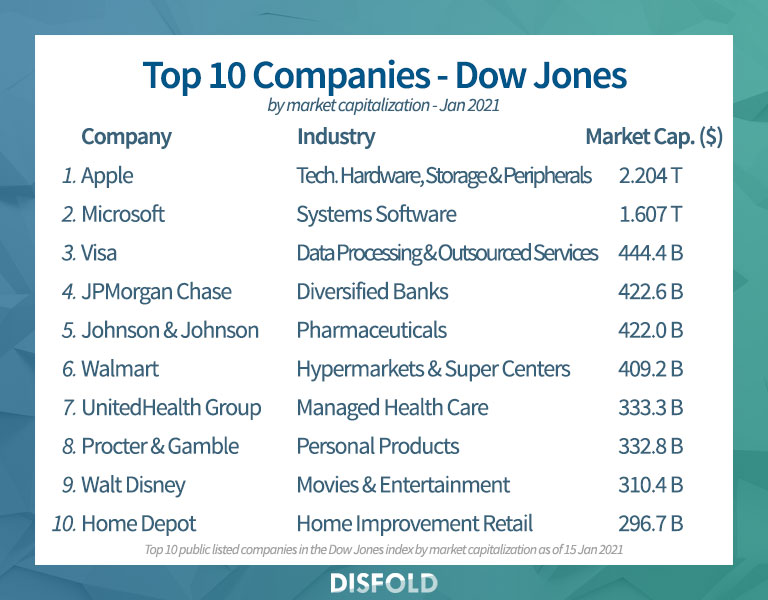
The 30 companies in the DJIA are, by design, some of the most established, financially sound, and influential corporations in the United States. They are often referred to as “blue-chip” stocks due to their history of stability, consistent earnings, and strong market leadership. For investors seeking exposure to this segment of the market, the Dow offers a concentrated look at these titans of industry. Investing in Dow companies, either individually or through index funds, is often seen as a relatively conservative approach to growth, focusing on proven performers.
Complementing Broader Market Indices
While the Dow provides a snapshot, it’s crucial for investors to understand its place within the broader ecosystem of market indices. The S&P 500, which tracks 500 large U.S. companies by market capitalization, is generally considered a more comprehensive and accurate representation of the overall U.S. stock market. The Nasdaq Composite, heavily weighted towards technology and growth companies, offers a different perspective.
Savvy investors don’t rely solely on the Dow. Instead, they use it in conjunction with other indices to gain a multifaceted understanding of market trends. The Dow can offer insights into the performance of established industrial and consumer giants, while the S&P 500 provides a broader economic view, and the Nasdaq highlights the performance of the tech sector. Together, they paint a more complete picture.
Investing in the Dow: Strategies and Considerations
For investors interested in the performance of the Dow’s 30 companies, there are several avenues to consider, each with its own advantages and risks.
Direct Stock Ownership vs. Index Funds/ETFs
One approach is to purchase individual shares of the 30 companies in the Dow. This requires significant capital and ongoing management to rebalance the portfolio as companies are added or removed, or as their relative performance shifts. It also exposes the investor to the specific risks of each individual company.
A more practical and diversified approach for most investors is to utilize exchange-traded funds (ETFs) or index mutual funds that track the DJIA. These funds automatically hold the 30 underlying stocks in the correct proportions, providing instant diversification across the index with a single investment. Popular examples include the SPDR Dow Jones Industrial Average ETF Trust (DIA), which aims to replicate the price and yield performance of the Dow. These funds offer convenience, lower transaction costs (compared to buying 30 individual stocks), and professional management of rebalancing.
Diversification and Risk Management
While the Dow represents 30 leading companies, it’s essential to remember that it is a concentrated index. Relying solely on the Dow for all your equity exposure might not provide adequate diversification across all market sectors or company sizes. A well-diversified portfolio typically includes exposure to a broader range of companies (e.g., through S&P 500 index funds), international markets, and different asset classes like bonds.
The risk associated with investing in the Dow is that it is heavily weighted toward large-cap U.S. companies. While these are often stable, they are not immune to market downturns or specific industry challenges. Understanding the concentration risk and balancing it with other investments is key to sound financial planning.
Understanding Sector Representation
Before investing, it’s insightful to examine the sector breakdown of the current Dow components. While “Industrial” is in its name, the largest sectors by weight can vary, often including significant portions of Information Technology, Financials, Healthcare, and Consumer Discretionary. Understanding this composition helps investors see what segments of the economy they are primarily exposed to when investing in the Dow, allowing them to make informed decisions about how it fits within their overall investment strategy.
The Future of the DJIA in a Dynamic Market
The Dow Jones Industrial Average has survived wars, recessions, technological revolutions, and market crashes. Its ability to adapt and remain relevant over such a long period is a testament to its enduring design.
Adapting to Economic Shifts
The ongoing dynamism of the global economy ensures that the DJIA will continue to evolve. As new industries emerge and old ones transform, the index committee will face the challenge of selecting companies that best reflect the leading edge of American enterprise. This adaptability is crucial for the Dow to maintain its status as a meaningful indicator. The recent inclusions of tech giants and healthcare innovators underscore this commitment to mirroring the modern economic landscape.
Its Relevance in the Age of Technology
In an era dominated by rapid technological change and the rise of highly specialized market sectors, some question whether a 30-company, price-weighted index can truly capture the complexity of today’s markets. However, its simplicity and the caliber of its constituents ensure it remains a powerful narrative tool. For many, the Dow’s performance serves as an immediate, understandable headline, even if deeper analysis requires looking at broader indices.

Beyond the Daily Fluctuation: Long-Term Perspective
Ultimately, the number of companies in the DJIA—a stable 30—is less important than what those 30 companies represent. They are a collection of America’s most established, influential, and often innovative corporations. For investors, the Dow provides a window into the performance of these blue-chip entities, offering a historical perspective and a reliable, albeit limited, benchmark for market health. Understanding its composition, methodology, and limitations allows investors to use the Dow intelligently, integrating it into a broader, well-diversified financial strategy for long-term growth and wealth preservation.
aViewFromTheCave is a participant in the Amazon Services LLC Associates Program, an affiliate advertising program designed to provide a means for sites to earn advertising fees by advertising and linking to Amazon.com. Amazon, the Amazon logo, AmazonSupply, and the AmazonSupply logo are trademarks of Amazon.com, Inc. or its affiliates. As an Amazon Associate we earn affiliate commissions from qualifying purchases.