
In the world of finance, percentages are the universal language. Whether you are tracking the growth of a retirement portfolio, calculating the interest on a mortgage, or determining the impact of inflation on your purchasing power, understanding how to find a percent is a fundamental skill. Financial literacy is built upon the ability to interpret these numbers accurately, as a single percentage point can represent the difference between wealth accumulation and financial stagnation over a long-term horizon.
This guide explores the essential calculations every investor and saver should master, moving beyond basic arithmetic into the strategic application of percentages in personal and business finance.
1. The Fundamentals of Financial Percentages: Basic Calculations
Before diving into complex investment strategies, one must master the core mechanics of percentage calculations. In a financial context, a percentage is simply a way to express a number as a fraction of 100, providing a standardized way to compare disparate financial figures.
The Basic Formula: Part Over Whole
The most frequent calculation you will perform involves finding what percentage one value is of another. The formula is:
(Part / Whole) × 100 = Percentage
For example, if you are analyzing your monthly budget and want to know what portion of your $5,000 income is spent on a $1,500 rent payment, you divide 1,500 by 5,000 to get 0.3, then multiply by 100 to find that your housing costs are 30% of your total income. This simple calculation is the bedrock of expense tracking and cash flow analysis.
Calculating Percentage Increases and Decreases
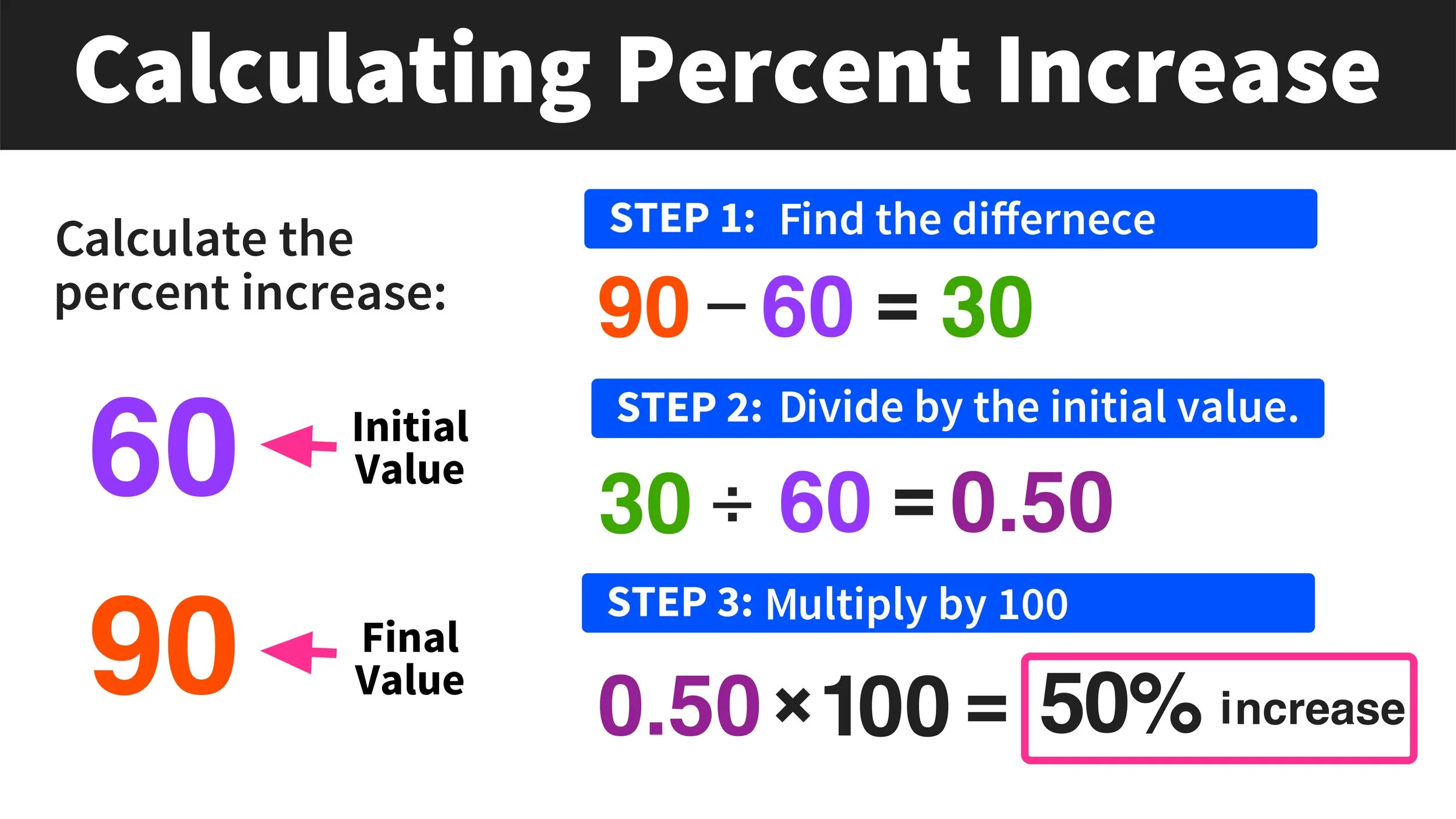
In the stock market or real estate, values are rarely static. Understanding the “percentage change” is vital for assessing performance. To find the percentage increase or decrease, use the following formula:
[(New Value – Old Value) / Old Value] × 100
If a share of stock rises from $120 to $150, the “New Value” is $150 and the “Old Value” is $120. The difference is $30. Dividing $30 by the original $120 gives 0.25, or a 25% gain. Conversely, if the stock drops to $90, the calculation results in a 25% loss. Recognizing these shifts allows investors to strip away the “noise” of raw dollar amounts and evaluate the actual growth rate of their assets.
Understanding Basis Points (BPS) in Finance
When dealing with interest rates, bond yields, or management fees, the term “basis points” is frequently used. One basis point is equal to 1/100th of 1 percent (0.01%). Therefore, 100 basis points equals 1%.
Professionals use basis points to avoid ambiguity. If a central bank raises interest rates from 3% to 3.5%, some might say the rate increased by 0.5%. However, it is more precise to say the rate increased by 50 basis points. In large-scale investing, where millions of dollars are at stake, even 5 or 10 basis points can result in significant financial shifts, making this granular understanding of percentages essential for high-level money management.
2. Evaluating Investment Performance: ROI and Growth
Once the basics are mastered, percentages become the primary tool for evaluating the health of an investment portfolio. Without these metrics, it is impossible to compare the efficiency of a real estate investment against a diversified stock portfolio.
Calculating Return on Investment (ROI)
Return on Investment (ROI) is perhaps the most critical percentage in the world of money. It measures the gain or loss generated on an investment relative to the amount of money invested. The formula is:
[(Current Value of Investment – Cost of Investment) / Cost of Investment] × 100
While ROI is a powerful snapshot, it is important to remember that it does not inherently account for the time the investment was held. A 50% ROI is impressive if achieved in one year, but much less so if it took 20 years to realize. Therefore, ROI should always be viewed alongside the duration of the investment.
Compound Annual Growth Rate (CAGR)
Because investments rarely grow at a steady rate, the Compound Annual Growth Rate (CAGR) provides a “smoothed” annual return. This percentage tells you what your investment would have returned annually if it had grown at a steady rate each year with profits reinvested.
CAGR is particularly useful for comparing the performance of volatile assets, such as cryptocurrencies or growth stocks, against more stable benchmarks like the S&P 500. By finding this specific percentage, you can determine if your risk-taking is actually yielding a premium over safer, traditional investments.
Dividend Yield and Payout Ratios
For income-focused investors, two specific percentages are paramount: the dividend yield and the payout ratio.
- Dividend Yield: This is calculated by dividing the annual dividend per share by the stock’s price per share. It allows you to see how much “cash flow” you are getting for every dollar invested.
- Dividend Payout Ratio: This percentage represents the proportion of earnings a company pays out as dividends to shareholders. A ratio that is too high (e.g., over 90%) might suggest that the company is not reinvesting enough in its own growth or that the dividend is unsustainable.

3. Strategic Budgeting and Personal Finance Ratios
Percentages are not just for the stock market; they are the framework for a healthy household budget. Using percentages instead of fixed dollar amounts allows your financial plan to scale as your income grows.
The 50/30/20 Rule: Allocating Your After-Tax Income
A popular and effective budgeting framework is the 50/30/20 rule. This strategy suggests allocating your net income into three percentage-based categories:
- 50% for Needs: Housing, groceries, utilities, and insurance.
- 30% for Wants: Dining out, travel, hobbies, and entertainment.
- 20% for Financial Goals: Debt repayment, emergency funds, and retirement contributions.
By viewing your budget through these percentages, you can quickly identify where your spending is out of alignment. If your “Needs” are consuming 70% of your income, you are likely “house poor” or over-leveraged on a vehicle, necessitating a strategic shift.
Debt-to-Income (DTI) Ratio and Loan Eligibility
When you apply for a mortgage or a personal loan, lenders look at your Debt-to-Income (DTI) ratio. This is the percentage of your gross monthly income that goes toward paying debts. The formula is:
(Total Monthly Debt Payments / Gross Monthly Income) × 100
Most lenders prefer a DTI ratio below 36%, with no more than 28% of that debt going toward a mortgage or rent. Knowing how to calculate this percentage yourself allows you to understand your “borrowing power” before ever stepping foot in a bank.
Savings Rate: The Most Important Number in Wealth Building
Your savings rate is the percentage of your disposable income that you set aside for the future. Many financial experts argue that this is the single most important number in personal finance—more important even than your investment returns.
If you earn $100,000 and save $10,000, your savings rate is 10%. If you can find ways to reduce expenses and increase that to 20%, you effectively double the speed at which you reach financial independence. Tracking this percentage monthly keeps you focused on the variables you can control.
4. Taxes, Interest Rates, and Inflation
Percentages also define the relationship between your money and the external forces of the economy, such as the government and the central bank.
Effective vs. Marginal Tax Rates
Understanding the difference between these two percentages is vital for tax planning. Your marginal tax rate is the percentage of tax applied to your last dollar of income (the “bracket” you fall into). Your effective tax rate, however, is the actual percentage of your total income that goes to the IRS after all deductions and credits.
Calculation: (Total Tax Paid / Total Taxable Income) × 100
Knowing your effective rate helps you make better decisions regarding tax-advantaged accounts like 401(k)s or IRAs.
Calculating Annual Percentage Rate (APR) on Loans
When borrowing money, the “interest rate” and the “APR” are often different. The APR is a more comprehensive percentage because it includes both the interest rate and any additional fees or costs associated with the loan. By comparing the APRs of different loan products, you can find the true percentage cost of borrowing and avoid hidden fees that would otherwise erode your net worth.
Adjusting for Inflation: Real vs. Nominal Returns
Inflation is a percentage that represents the rate at which the general level of prices for goods and services is rising. To find your “Real Return” on an investment, you must subtract the inflation percentage from your “Nominal Return.”
Nominal Return (%) – Inflation Rate (%) = Real Return (%)
If your savings account pays 4% interest, but inflation is running at 5%, your “Real” return is actually -1%. This means that while your balance is increasing in numerical terms, your actual purchasing power is shrinking.
5. Leveraging Digital Tools for Financial Accuracy
While manual calculations are excellent for understanding the logic, digital tools can ensure precision and save time when managing complex financial data.
Spreadsheet Mastery: Excel and Google Sheets Functions
Modern financial management relies heavily on spreadsheets. To find a percent in Excel, you don’t always need to multiply by 100. If you divide a part by a whole, you can simply click the “Percent Style” button in the formatting toolbar.
Useful formulas include:
- Percentage Change:
=(New_Value - Old_Value) / Old_Value - Percentage of Total:
=B2 / SUM($B$2:$B$10)(using absolute references to keep the total constant).

Using Online Financial Calculators Wisely
There are thousands of specialized calculators available online for mortgage amortization, compound interest, and retirement planning. However, these tools are only as good as the data entered. By understanding the underlying “how to find percent” logic, you can vet these tools for accuracy and interpret the results with a critical eye.
In conclusion, mastering percentages is not just about math; it is about gaining a clear, objective view of your financial health. From the micro-level of daily budgeting to the macro-level of global investment yields, the ability to calculate and interpret percentages is the ultimate tool for anyone looking to build and sustain wealth. By consistently applying these formulas to your personal finances, you move from guesswork to a data-driven strategy that ensures long-term fiscal success.
aViewFromTheCave is a participant in the Amazon Services LLC Associates Program, an affiliate advertising program designed to provide a means for sites to earn advertising fees by advertising and linking to Amazon.com. Amazon, the Amazon logo, AmazonSupply, and the AmazonSupply logo are trademarks of Amazon.com, Inc. or its affiliates. As an Amazon Associate we earn affiliate commissions from qualifying purchases.