
In the vast and intricate world of finance, few concepts are as ubiquitous and fundamental as percentages. From calculating a discount on a new purchase to understanding the returns on an investment, deciphering interest rates, or analyzing a company’s profit margins, percentages are the universal language that translates raw numbers into actionable insights. For anyone navigating personal finance, investing, or business operations, a firm grasp of how to figure out percentages isn’t just helpful—it’s absolutely essential.
This guide will demystify percentages, breaking down the core calculations and illustrating their pervasive applications across the financial landscape. By the end, you’ll not only understand the mechanics but also appreciate the power of percentages in making informed money decisions.

The Foundation: Understanding What a Percentage Really Means
At its core, a percentage is a way of expressing a number or a ratio as a fraction of 100. The word “percent” literally means “per hundred” or “out of one hundred.” It provides a standardized way to compare parts of different wholes, making complex financial data digestible and comparable.
Defining the Basics: Part, Whole, and Rate
Every percentage calculation involves three key components:
- The Whole (Base): This is the total amount, the original figure, or the complete quantity that you are taking a percentage of. For example, if you’re calculating a 10% discount on a $100 item, the $100 is the whole.
- The Part: This is the portion or amount that represents a specific percentage of the whole. In the discount example, the actual dollar amount of the discount would be the part.
- The Rate (Percentage): This is the fraction of 100 that the part represents. It’s usually expressed with the “%” symbol. In our example, 10% is the rate.
The beauty of percentages lies in their ability to relate these three elements. If you know any two, you can always find the third.
The Fundamental Formulas
There are three primary ways percentages are typically used in calculations, each corresponding to finding one of the three components:
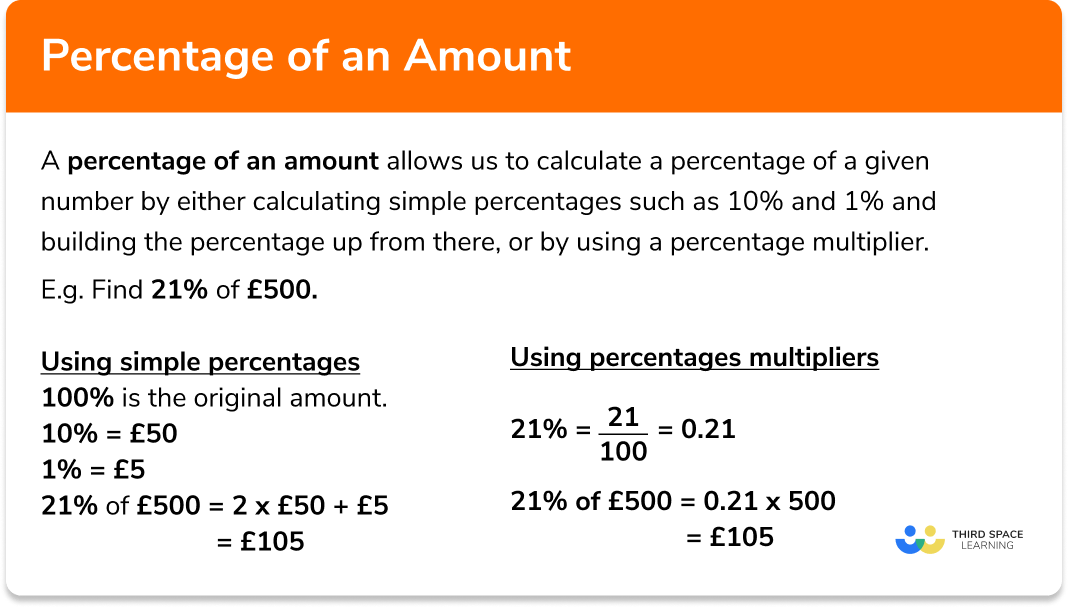
1. Finding the Part (What is X% of Y?):
This is the most common use case. You have a total (the whole) and a percentage rate, and you want to find the specific amount that percentage represents.
- Formula:
Part = (Rate / 100) × Whole - Example: What is 15% of $200?
Part = (15 / 100) × 200Part = 0.15 × 200Part = $30
2. Finding the Rate (What Percentage is X of Y?):
Here, you have a part and a whole, and you want to determine what percentage the part represents of the whole.
- Formula:
Rate = (Part / Whole) × 100 - Example: What percentage is $50 of $250?
Rate = (50 / 250) × 100Rate = 0.2 × 100Rate = 20%
3. Finding the Whole (If X is Y% of Something, What is the Something?):
This scenario involves knowing a part and the percentage rate it represents, then working backward to find the original total (the whole). This is particularly useful for things like calculating original prices before a discount or understanding market size from a known segment.
- Formula:
Whole = Part / (Rate / 100) - Example: If $40 is 10% of a total amount, what is the total amount?
Whole = 40 / (10 / 100)Whole = 40 / 0.10Whole = $400
Converting Decimals and Fractions
To perform percentage calculations, it’s often easiest to convert the percentage into a decimal. Simply divide the percentage by 100 (or move the decimal point two places to the left).
- 15% = 0.15
- 75% = 0.75
- 2.5% = 0.025
Conversely, to convert a decimal back to a percentage, multiply by 100 (or move the decimal point two places to the right) and add the “%” symbol.
- 0.33 = 33%
- 1.25 = 125%
Understanding these fundamental conversions is critical for accurate financial calculations.
Practical Applications in Personal Finance
Percentages are not abstract mathematical constructs; they are the bedrock of everyday personal financial decisions. Mastering them empowers you to manage your money more effectively.
Discounts and Sales: Saving Money
One of the most common encounters with percentages is during shopping. A “20% off” sale means you save 20% of the original price.
- Example: An item costs $75, and there’s a 20% discount.
Discount Amount = (20 / 100) × $75 = 0.20 × $75 = $15New Price = $75 - $15 = $60- Alternatively, if you’re saving 20%, you’re paying 80% of the original price:
0.80 × $75 = $60.
Calculating Tips and Taxes
Whether it’s tipping at a restaurant or calculating sales tax, percentages are involved.
- Example (Tip): A dinner bill is $60, and you want to leave an 18% tip.
Tip Amount = (18 / 100) × $60 = 0.18 × $60 = $10.80Total Bill = $60 + $10.80 = $70.80
- Example (Sales Tax): A purchase is $30, and the sales tax is 7.5%.
Tax Amount = (7.5 / 100) × $30 = 0.075 × $30 = $2.25Total Cost = $30 + $2.25 = $32.25
Understanding Interest Rates (Loans, Savings, Investments)
Interest rates are perhaps the most financially impactful application of percentages. They determine how much you pay to borrow money (loans, credit cards) and how much you earn on savings and investments.
- Simple Interest: If you borrow $1,000 at 5% simple interest per year, you pay $50 in interest annually (
0.05 × $1,000). - Compound Interest: This is where interest itself earns interest. The “percentage of something” principle is applied repeatedly to a growing principal. Understanding this is vital for evaluating savings accounts, bonds, and mortgage payments. A small percentage difference in an interest rate can equate to thousands, even tens of thousands, of dollars over the lifetime of a loan or investment.
Budgeting and Expense Tracking
Effective personal budgeting relies heavily on percentages to allocate income and track spending.
- Example: You earn $4,000 per month, and you want to allocate 50% to needs, 30% to wants, and 20% to savings.
Needs = 0.50 × $4,000 = $2,000Wants = 0.30 × $4,000 = $1,200Savings = 0.20 × $4,000 = $800
- Tracking your expenses as a percentage of your income helps identify where your money is going and areas for potential savings.
Essential for Investing and Business Finance
Beyond personal spending, percentages form the backbone of investment analysis and business financial health.
Return on Investment (ROI)
ROI is a critical metric for evaluating the efficiency of an investment. It measures the gain or loss generated relative to the amount of money invested.
- Formula:
ROI = ((Current Value of Investment - Original Cost of Investment) / Original Cost of Investment) × 100 - Example: You invest $1,000 in a stock, and it grows to $1,200.
ROI = (($1,200 - $1,000) / $1,000) × 100ROI = ($200 / $1,000) × 100ROI = 0.2 × 100 = 20%
A higher ROI indicates a more profitable investment.
Profit Margins and Markups
Businesses use percentages extensively to price products, analyze profitability, and manage costs.
- Gross Profit Margin:
((Revenue - Cost of Goods Sold) / Revenue) × 100tells a company what percentage of its revenue is left after covering direct production costs. - Net Profit Margin:
((Net Income / Revenue) / Revenue) × 100indicates the percentage of revenue remaining after all expenses, including taxes and interest, have been deducted. - Markup:
((Selling Price - Cost) / Cost) × 100is used to determine how much to increase a product’s cost to reach a desired selling price.
Market Share and Growth Rates
In business strategy, percentages help companies understand their position within an industry and track their performance over time.
- Market Share:
(Company's Sales / Total Market Sales) × 100shows a company’s proportion of the total sales in its market. - Growth Rate:
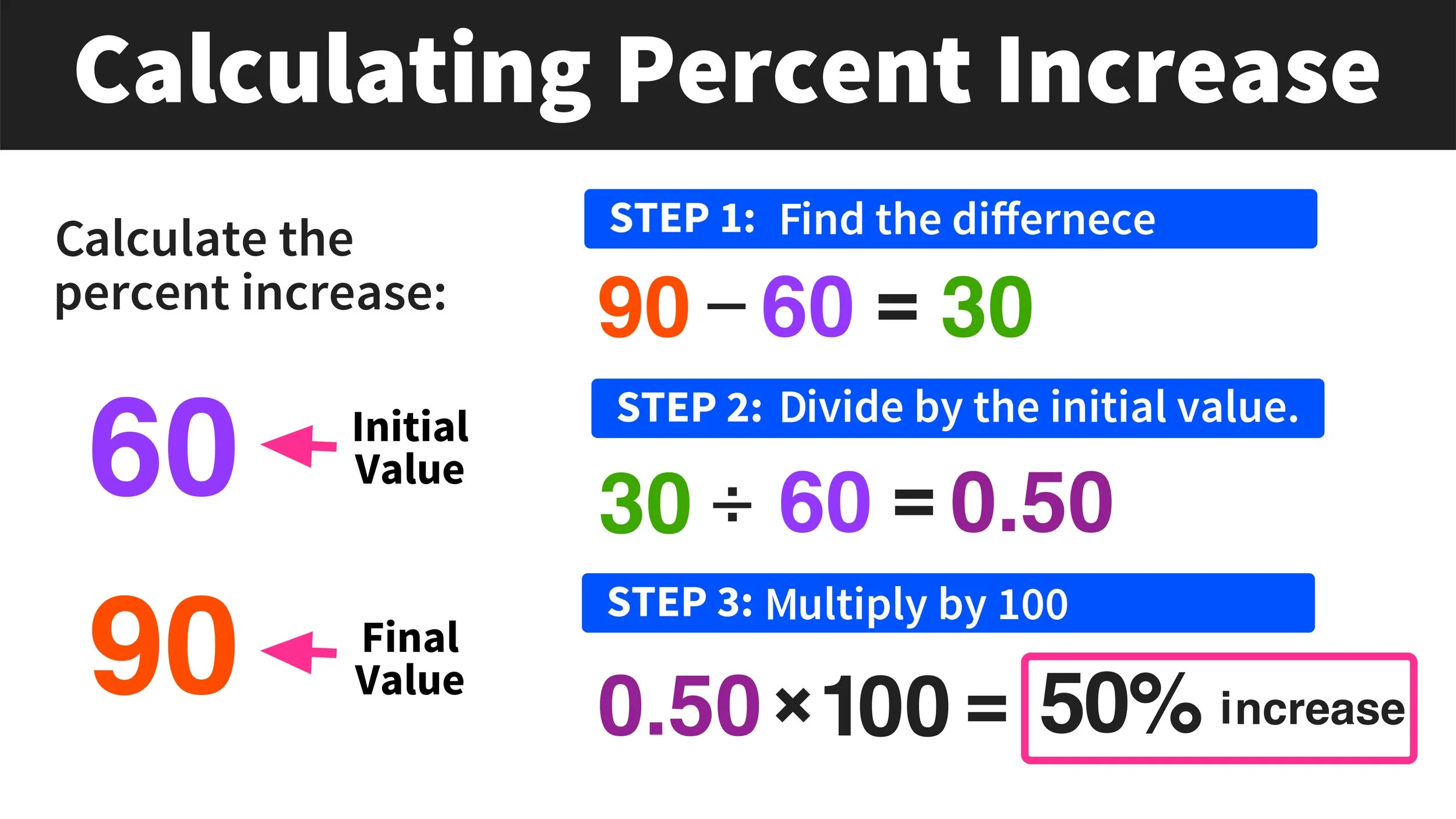
((Current Period Value - Previous Period Value) / Previous Period Value) × 100measures the percentage increase or decrease in a metric (e.g., sales, profits, customer base) over a specific period.
Inflation and Cost of Living Adjustments
Inflation, typically expressed as a percentage, measures the rate at which the general level of prices for goods and services is rising. Understanding inflation percentages is crucial for assessing the real return on investments and the true purchasing power of your money over time. Cost of living adjustments (COLAs) are also percentage-based increases in salaries or benefits designed to keep pace with inflation.
Common Pitfalls and How to Avoid Them
While percentages are powerful, misinterpretations can lead to significant financial errors.
Understanding the “Base” or “Whole” Correctly
The most common mistake is misidentifying the “whole” or “base” from which the percentage is calculated.
- Example: A stock drops 10% from $100 to $90. If it then rises by 10%, it does not return to $100.
- Rise:
10% of $90 = $9 - New Price:
$90 + $9 = $99
The base for the second calculation was $90, not the original $100. Always be clear about what amount the percentage is being applied to.
- Rise:
Percentage Points vs. Percentage Change
These terms are often confused, but they mean different things.
- Percentage Change: This is what we’ve been discussing – the relative change between two numbers expressed as a percentage of the original number. (e.g., a stock increasing from $100 to $110 is a 10% increase).
- Percentage Points: This refers to the absolute difference between two percentage values. (e.g., if an interest rate increases from 5% to 7%, it’s an increase of 2 percentage points, not a 2% increase, which would be
(7-5)/5 * 100 = 40%). This distinction is vital in finance, especially when discussing interest rates or survey results.
The Impact of Compounding
For long-term financial planning, the power of compound interest (or the detrimental effect of compound debt) is staggering. Even small percentage rates, compounded over many periods, can lead to substantial gains or losses. Ignoring this cumulative effect can severely impact retirement planning, loan repayments, and investment strategies.
Tools and Techniques for Calculation
While the fundamental formulas are straightforward, real-world financial calculations often involve larger numbers or multiple steps.
Mental Math Shortcuts
For quick estimations, knowing common percentages can be useful:
- 10%: Move the decimal one place to the left (e.g., 10% of $250 is $25).
- 1%: Move the decimal two places to the left (e.g., 1% of $250 is $2.50).
- 5%: Half of 10% (e.g., 5% of $250 is $12.50).
- 20%: Double 10% (e.g., 20% of $250 is $50).
These shortcuts are perfect for calculating tips, sales tax, or quick discounts.
Using Calculators and Spreadsheets (Excel/Google Sheets)
For precision and more complex calculations, a calculator or spreadsheet program is indispensable.
- Basic Calculator: Allows direct entry of numbers and percentage functions.
- Spreadsheets (Excel, Google Sheets): Offer unparalleled power for financial analysis. You can set up dynamic models where changing one percentage rate instantly updates an entire budget, investment projection, or financial statement.
- To calculate 15% of $200 in Excel:
=0.15*200or=A1*B1(if 0.15 is in A1 and 200 in B1). - To find what percentage $50 is of $250:
=(50/250)*100or=(A1/B1)*100.
- To calculate 15% of $200 in Excel:
Online Percentage Calculators
Many websites offer free, user-friendly percentage calculators that can quickly perform the three main types of percentage calculations, often with specialized options for tips, taxes, discounts, or loan interest. These are convenient for quick, one-off calculations without needing to remember the exact formulas.
Conclusion
Understanding “how you figure out the percentage of something” is more than just a mathematical exercise; it’s a critical life skill for financial literacy and informed decision-making. From the daily minutiae of personal budgeting and shopping to the strategic complexities of investing and managing a business, percentages provide clarity, context, and a universal language to assess financial performance and opportunities.
By mastering the core formulas, recognizing their widespread applications, and being mindful of common pitfalls, you equip yourself with a powerful analytical tool. Whether you’re using mental math, a trusty calculator, or a sophisticated spreadsheet, the ability to confidently work with percentages will undoubtedly enhance your financial acumen, helping you make smarter choices that impact your wealth and well-being. Embrace the power of percentages, and unlock a deeper understanding of your financial world.
aViewFromTheCave is a participant in the Amazon Services LLC Associates Program, an affiliate advertising program designed to provide a means for sites to earn advertising fees by advertising and linking to Amazon.com. Amazon, the Amazon logo, AmazonSupply, and the AmazonSupply logo are trademarks of Amazon.com, Inc. or its affiliates. As an Amazon Associate we earn affiliate commissions from qualifying purchases.