
In the vast landscape of personal and business finance, few mathematical concepts hold as much power and prevalence as the humble percentage. From calculating a discount on a new purchase to understanding the interest on your savings account or the return on an investment, percentages are an indispensable tool for navigating the financial world. Yet, for many, the phrase “calculate a percentage” can evoke a sense of trepidation. This guide aims to demystify percentages, breaking down their calculation into clear, actionable steps, and illustrating their profound importance across various financial contexts. Mastering percentages isn’t just about crunching numbers; it’s about unlocking a deeper understanding of your financial health and making smarter, more confident decisions.
The Fundamentals of Percentage Calculation: Laying the Groundwork
Before we delve into complex financial scenarios, let’s establish a solid understanding of what a percentage is and how it’s fundamentally calculated. This foundational knowledge will serve as your compass for all subsequent applications.
What is a Percentage? An Intuitive Definition
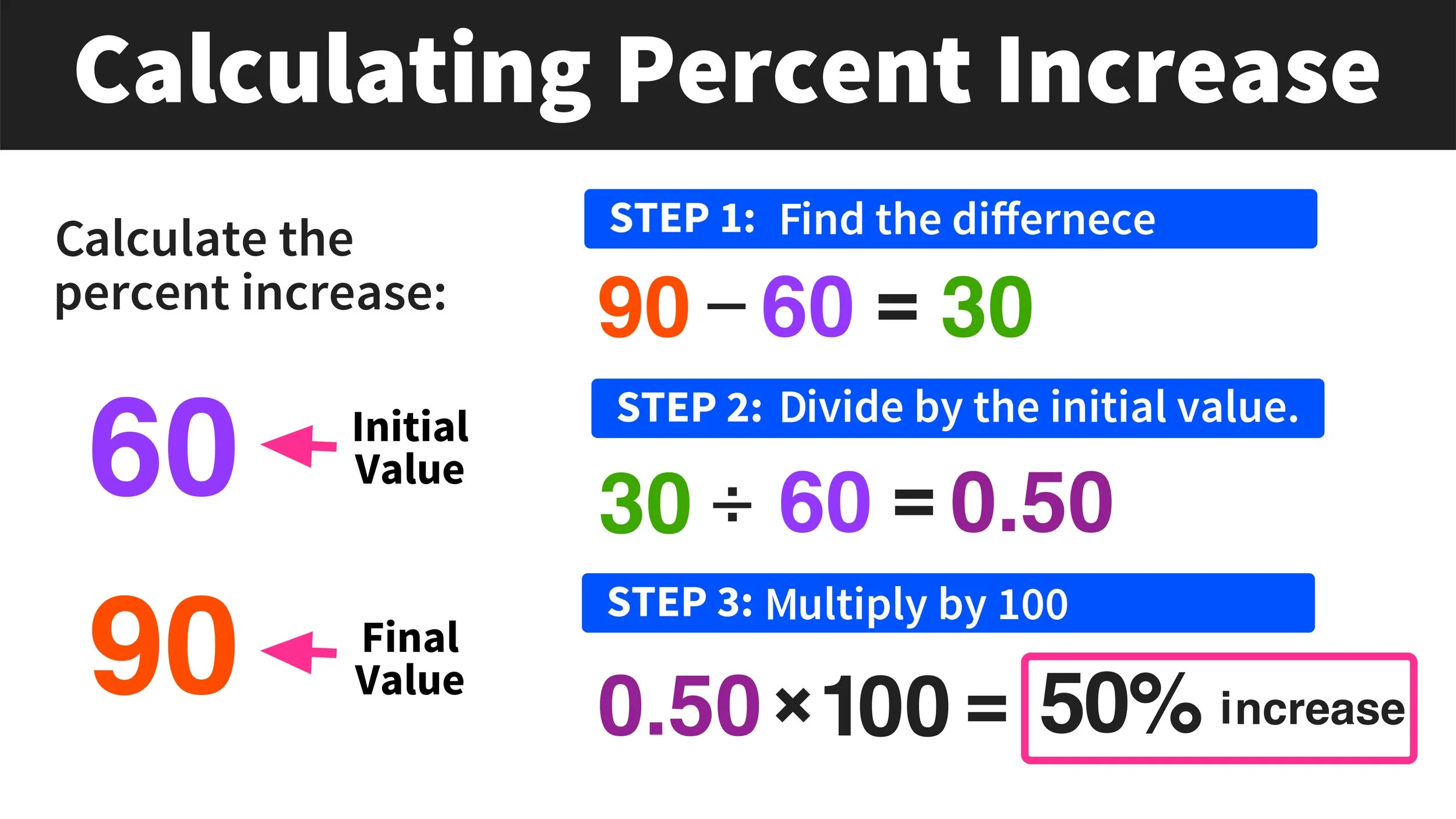
At its core, a percentage is simply a way of expressing a number as a fraction of 100. The word “percent” literally means “per hundred” or “out of one hundred.” When we say 50 percent, we mean 50 out of 100, which is equivalent to 1/2 or 0.50. It’s a standardized way to compare parts of a whole, regardless of the size of the whole itself. This standardization makes it incredibly useful for financial comparisons.
The Basic Formula: Part / Whole × 100
The most fundamental formula for calculating a percentage is remarkably straightforward:
Percentage = (Part / Whole) × 100
Let’s break down the components:
- Part: This is the specific amount or quantity you are interested in expressing as a percentage.
- Whole: This is the total amount, the entire quantity from which the “part” is drawn.
- × 100: Multiplying by 100 converts the resulting decimal or fraction into its percentage form.
Example: If you spent $30 on groceries from a total budget of $200, what percentage of your budget did you spend?
Percentage = ($30 / $200) × 100 = 0.15 × 100 = 15%.
Converting Decimals and Fractions to Percentages
Often, you’ll encounter numbers in decimal or fractional form that you need to express as percentages.
- Decimal to Percentage: Simply multiply the decimal by 100.
- 0.25 = 0.25 × 100 = 25%
- 1.5 = 1.5 × 100 = 150%
- Fraction to Percentage: First, convert the fraction to a decimal by dividing the numerator by the denominator, then multiply by 100.
- 1/4 = 1 ÷ 4 = 0.25 = 0.25 × 100 = 25%
- 3/5 = 3 ÷ 5 = 0.60 = 0.60 × 100 = 60%
Working Backwards: Finding the Part or the Whole
Sometimes, you know the percentage and need to find either the “part” or the “whole.”
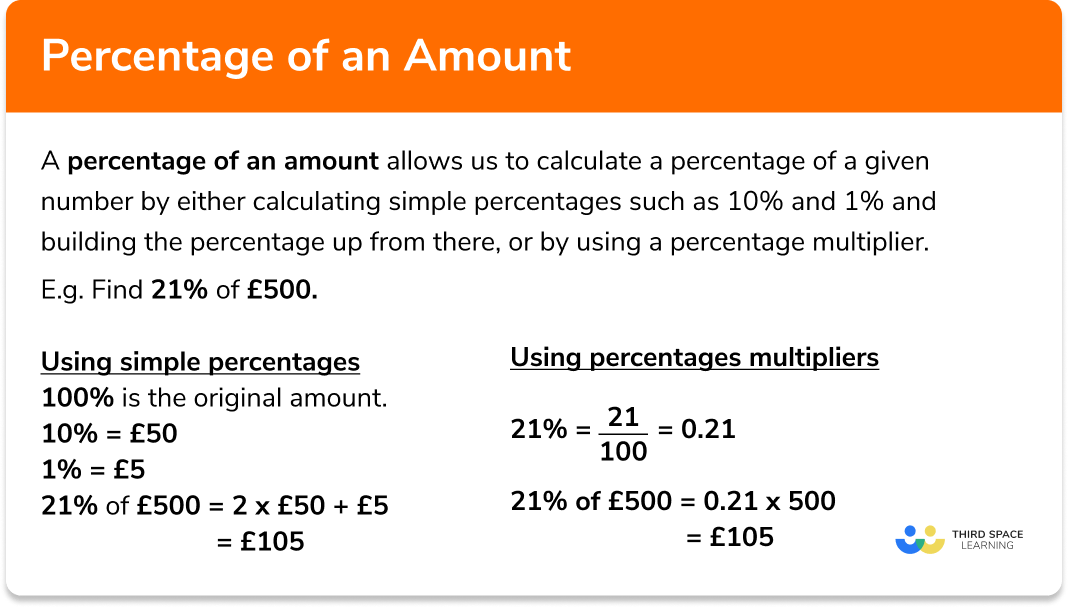
- Finding the Part: If you know a percentage of a whole, you can find the actual amount.
- Formula: Part = (Percentage / 100) × Whole
- Example: You want to save 20% of your $3,000 monthly income. How much should you save?
Part = (20 / 100) × $3,000 = 0.20 × $3,000 = $600.
- Finding the Whole: If you know a part represents a certain percentage, you can find the total whole.
- Formula: Whole = Part / (Percentage / 100)
- Example: A discount of $50 represents 10% off the original price. What was the original price?
Whole = $50 / (10 / 100) = $50 / 0.10 = $500.
Percentages in Personal Finance: Everyday Applications
For most individuals, percentages are an integral part of daily financial management. From managing your budget to understanding loan terms, a solid grasp of percentage calculations empowers smarter decision-making.
Budgeting and Expense Tracking
Budgeting is fundamentally about allocating percentages of your income to different categories.
- Allocating Income: You might decide to spend 50% of your income on needs, 30% on wants, and 20% on savings and debt repayment (the 50/30/20 rule). Calculating these percentages helps you know the exact dollar amounts for each category.
- Tracking Spending: If your grocery budget is $400 and you’ve spent $250, you can quickly see what percentage of your budget you’ve utilized ($250 / $400 × 100 = 62.5%) and how much remains.
Understanding Discounts, Sales Tax, and Tips
- Discounts: A common financial scenario. A shirt originally priced at $50 is on sale for 20% off.
- Discount amount = (20 / 100) × $50 = $10.
- Final price = $50 – $10 = $40.
- Sales Tax: Added to the price of goods and services. If an item costs $100 and the sales tax is 7%.
- Tax amount = (7 / 100) × $100 = $7.
- Total cost = $100 + $7 = $107.
- Tips and Gratuities: Customary in service industries. To leave a 15% tip on a $60 meal:
- Tip amount = (15 / 100) × $60 = $9.
- Total bill = $60 + $9 = $69.
Interest Rates: Loans, Savings, and Credit Cards
Interest is essentially the cost of borrowing money or the reward for lending/saving it, expressed as a percentage.
- Annual Percentage Rate (APR): The annual cost of a loan (credit card, mortgage, car loan), including fees, expressed as a percentage. Understanding how to calculate interest on your loan principal helps you grasp your total repayment obligations.
- Annual Percentage Yield (APY): The real rate of return earned on an investment or savings account over a year, taking into account the effect of compounding interest. A higher APY means more earnings for savers.
- Loan Payments: While complex loan calculations often involve specific financial formulas, understanding the percentage breakdown of principal and interest within each payment is vital.
Investment Returns and Growth
Investing is heavily reliant on percentage calculations to measure performance.
- Return on Investment (ROI): Measures the profitability of an investment as a percentage of its initial cost.
- ROI = ((Current Value – Initial Cost) / Initial Cost) × 100
- If you invested $1,000 and it’s now worth $1,200, your ROI is (($1,200 – $1,000) / $1,000) × 100 = 20%.
- Compound Interest: The magic behind long-term wealth building, where interest is earned on both the initial principal and the accumulated interest from previous periods. Understanding this exponential growth, driven by percentage rates, is key to retirement planning.
Percentages in Business Finance: Driving Decisions and Measuring Success

For businesses, percentages are far more than just mathematical curiosities; they are critical metrics that drive strategic decisions, measure performance, and communicate financial health to stakeholders.
Profitability Ratios: Gross, Operating, and Net Margins
Profitability is often expressed as a percentage of revenue, providing a standardized way to compare performance across different periods or against competitors.
- Gross Profit Margin: Measures the percentage of revenue left after deducting the cost of goods sold (COGS). A higher gross margin indicates efficient production.
- Gross Profit Margin = (Gross Profit / Revenue) × 100
- Operating Profit Margin: Reflects the percentage of revenue remaining after covering both COGS and operating expenses (like salaries, rent). This indicates the efficiency of core operations.
- Operating Profit Margin = (Operating Profit / Revenue) × 100
- Net Profit Margin: The ultimate indicator of profitability, showing the percentage of revenue left after all expenses, including taxes and interest.
- Net Profit Margin = (Net Profit / Revenue) × 100
Growth Rates and Market Share
Businesses use percentages to track growth and position in the market.
- Sales Growth Rate: Measures the percentage increase or decrease in sales over a period.
- Sales Growth = ((Current Period Sales – Prior Period Sales) / Prior Period Sales) × 100
- Market Share: The percentage of the total sales in an industry generated by a particular company. This metric is crucial for understanding competitive position.
Financial Health and Efficiency Ratios
Various financial ratios, all expressed as percentages, offer insights into a company’s financial stability and operational efficiency.
- Debt-to-Equity Ratio: While often expressed as a decimal, it can be seen as a percentage, indicating the proportion of debt financing relative to equity. A high percentage can signal higher risk.
- Return on Assets (ROA) / Return on Equity (ROE): These percentages measure how efficiently a company is using its assets or shareholder equity to generate profits.
Commission Structures and Payroll Percentages
Many sales roles involve commissions, which are calculated as a percentage of sales. Similarly, payroll deductions for taxes, benefits, and retirement contributions are often expressed as percentages of gross pay. Accurate percentage calculations are essential for correct compensation and compliance.
Avoiding Common Percentage Pitfalls
While percentages are powerful, they can be easily misinterpreted if one isn’t careful. Being aware of common pitfalls can prevent costly errors in judgment.
Percentage Change vs. Percentage Point Change
This is a crucial distinction. If an interest rate increases from 4% to 5%, that’s a 1 percentage point increase. However, it’s a ((5-4)/4) * 100 = 25% percentage change (a 25% increase in the rate itself). Confusing these can lead to significant misinterpretations, particularly in financial news and analysis.
Misinterpreting Base Values and Successive Discounts
When dealing with multiple percentage changes, the order and the base value matter. For instance, a 10% discount followed by another 10% discount is not a 20% discount.
- Original price: $100
- First 10% discount: $100 – (0.10 × $100) = $90
- Second 10% discount (on the new base of $90): $90 – (0.10 × $90) = $90 – $9 = $81
- Total discount = $100 – $81 = $19, which is 19% not 20%.
The Power (and Danger) of Compounding
Compound interest is often called the “eighth wonder of the world” for its ability to build wealth over time. However, it works both ways. Compound interest on debt (like credit card debt) can quickly snowball, turning small balances into unmanageable sums if not carefully managed. Understanding the percentage rates and compounding frequency is vital for both saving and debt management.
Tools and Resources for Percentage Calculations
While mental math and basic calculators suffice for simple percentages, various tools can streamline more complex calculations and provide greater accuracy.
Using Standard and Financial Calculators
A basic calculator can handle the (Part / Whole) × 100 formula. For more intricate financial calculations involving interest rates, present values, and future values, a financial calculator (or its app equivalent) is invaluable, as it has built-in functions for these scenarios.
Spreadsheet Software: Excel and Google Sheets
Spreadsheets are perhaps the most powerful and versatile tools for financial percentage calculations.
- You can set up columns for “Part,” “Whole,” and “Percentage.”
- Use formulas like
=(A2/B2)*100to automatically calculate percentages across hundreds or thousands of rows. - They are excellent for budgeting, tracking investments, analyzing business metrics, and performing “what-if” scenarios.
Online Calculators and Apps
Numerous free online percentage calculators are available for quick, specific tasks (e.g., tip calculators, loan payment calculators, discount calculators). Many personal finance apps also incorporate percentage tracking for budgeting and investment performance.
Conclusion
Mastering how to calculate a percentage is far more than a mere mathematical exercise; it’s a fundamental skill for financial literacy. From navigating personal budgets and understanding consumer discounts to analyzing investment returns and dissecting business profitability, percentages are the universal language of money. By understanding the core formulas, recognizing their widespread applications, and being mindful of common pitfalls, you equip yourself with the confidence and insight needed to make informed, intelligent financial decisions. Embrace the power of the percentage, and watch as your financial clarity grows exponentially.
aViewFromTheCave is a participant in the Amazon Services LLC Associates Program, an affiliate advertising program designed to provide a means for sites to earn advertising fees by advertising and linking to Amazon.com. Amazon, the Amazon logo, AmazonSupply, and the AmazonSupply logo are trademarks of Amazon.com, Inc. or its affiliates. As an Amazon Associate we earn affiliate commissions from qualifying purchases.