
At first glance, the question “What is 3/4 of 1 1/2?” might seem like a simple arithmetic problem, a relic from school days. However, beneath its unassuming surface lies a fundamental concept that is absolutely critical to navigating the complex world of finance, whether personal or business-related. From budgeting and investments to profit sharing and debt management, understanding how to work with fractions – and specifically, how to calculate a fraction of a mixed number – is not just an academic exercise; it’s a vital skill for financial literacy and empowerment.
In the realm of money, every percentage, every share, every discount, and every allocation can be expressed as a fraction of a whole. Misinterpreting these proportional relationships can lead to costly errors, missed opportunities, or an inability to truly comprehend one’s financial standing. This article will delve into the solution of this specific mathematical problem and then meticulously unpack its profound relevance across various facets of finance, demonstrating why such foundational understanding is indispensable for anyone managing money.
The Foundation of Fractional Thinking in Finance
Before we explore the practical applications, let’s establish a clear understanding of the core mathematical operation. This calculation serves as a building block for many more intricate financial scenarios.
Deconstructing the Problem: A Mathematical Primer
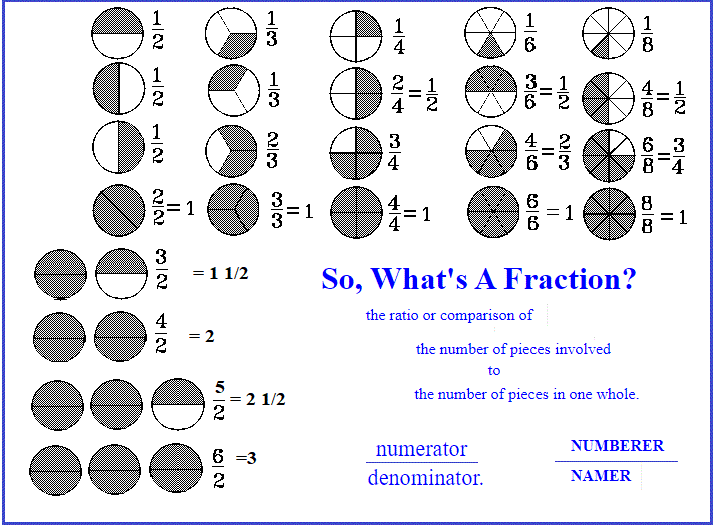
To solve “3/4 of 1 1/2,” we first need to convert the mixed number (1 1/2) into an improper fraction. A mixed number consists of a whole number and a proper fraction.
The whole number 1 can be expressed as 2/2 when dealing with halves.
So, 1 1/2 is equivalent to 1 (which is 2/2) + 1/2, totaling 3/2.
Now, the problem becomes: What is 3/4 of 3/2?
The word “of” in mathematics signifies multiplication.
So, we multiply the two fractions:
(3/4) * (3/2)
To multiply fractions, we multiply the numerators (the top numbers) together and the denominators (the bottom numbers) together:
Numerator: 3 * 3 = 9
Denominator: 4 * 2 = 8
This gives us the improper fraction 9/8.
While 9/8 is the mathematically correct answer, it’s often more intuitive in financial contexts to convert it back to a mixed number or a decimal.
To convert 9/8 to a mixed number, divide 9 by 8:
9 ÷ 8 = 1 with a remainder of 1.
So, 9/8 is equal to 1 and 1/8.
Alternatively, as a decimal, 1/8 is 0.125. Therefore, 1 1/8 is 1.125.
The answer: 3/4 of 1 1/2 is 1 1/8 (or 9/8, or 1.125).
Why Fractions Matter Beyond the Classroom
This simple calculation reveals a deeper truth: understanding fractions is about grasping proportions, parts of a whole, and how different components relate to each other. In finance, this translates directly to comprehending:
- Percentages: Which are essentially fractions with a denominator of 100 (e.g., 25% is 1/4).
- Ratios: Comparing different quantities, often expressed as fractions.
- Proportional Allocation: Dividing resources, profits, or expenses based on predefined shares.
Without this foundational understanding, interpreting financial statements, making sound investment decisions, or even managing a household budget becomes significantly more challenging and prone to error. Accuracy in these calculations is paramount, as even small misinterpretations can lead to substantial financial discrepancies over time.
Practical Applications in Personal Finance
The ability to perform fractional calculations directly impacts how effectively individuals manage their personal finances, from everyday budgeting to long-term wealth building.
Budgeting and Expense Allocation
One of the most immediate applications of fractional thinking is in personal budgeting. Many financial advisors recommend allocating specific fractions or percentages of your income to different categories.
- Example: If you aim to save 1/4 (25%) of your income, and dedicate 1/2 (50%) to housing and essentials, what fraction of your income remains for discretionary spending? You’d add 1/4 + 1/2 = 1/4 + 2/4 = 3/4. This means 1/4 (25%) is left.
- Applying the original problem: Imagine your ‘discretionary income’ is $1,500 (which is 1 1/2 thousand dollars). If you decide to spend 3/4 of that on a specific hobby or purchase, knowing that 3/4 of $1,500 is $1,125 ($1.125 thousand) helps you immediately understand the impact on your remaining funds. This precision prevents overspending and ensures you stay within your financial goals.
- Tracking Spending: When reviewing expenses, you might find that 3/4 of your entertainment budget was spent on dining out, or 1/2 of your transportation costs went to fuel. Understanding these fractions allows for targeted adjustments.
Understanding Investments and Returns
Fractions are ubiquitous in the world of investments, influencing everything from stock ownership to dividend distributions and portfolio allocation.
- Partial Ownership: When you buy shares in a company, you own a fraction of that company. If a company has 10 million shares outstanding and you own 10,000 shares, you own 10,000/10,000,000 = 1/1,000 of the company.
- Calculating Returns: If an investment promised a return equal to 3/4 of the S&P 500’s performance, and the S&P 500 returned 10% (or 10/100, which simplifies to 1/10), your return would be (3/4) * (1/10) = 3/40, or 7.5%.
- Dividend Income: Many companies pay dividends, which are a fraction of their profits distributed to shareholders. If a stock pays a dividend of $1.50 per share (1 1/2 dollars), and you own 3/4 of a share (perhaps through fractional share investing), your dividend payout would be 3/4 of $1.50, which is $1.125.
- Portfolio Rebalancing: Investors often allocate their portfolios in fractional or percentage terms (e.g., 60% stocks, 30% bonds, 10% cash). Rebalancing involves adjusting these fractions as market values change.
Debt Management and Loan Calculations
Managing debt effectively often requires a clear understanding of fractions and percentages, particularly concerning interest and repayment strategies.
- Interest Rates: Annual Percentage Rates (APRs) are essentially fractions that dictate how much interest you pay on borrowed money. Understanding that an 18% APR means you pay 18/100 of the outstanding balance annually (or 1.5% monthly) is crucial.
- Principal vs. Interest: A significant portion of early loan payments goes towards interest, with only a fraction reducing the principal. Visualizing these proportions helps borrowers understand the long-term cost of debt.
- Early Repayment: Deciding to pay an extra 1/4 or 1/2 of your regular payment can significantly reduce the total interest paid and shorten the loan term. Calculating the impact of paying an extra $1.50 (1 1/2 dollars) each month on a large debt, and how much faster you’d pay it off if you consistently applied 3/4 of an extra payment towards the principal, demonstrates the power of fractional contributions.
Fractional Finance in Business and Entrepreneurship
For businesses, accurate fractional calculations are not just helpful; they are fundamental to profitability, operational efficiency, and equitable partnerships.
Profit Sharing and Partnerships
Many business ventures operate as partnerships or involve profit-sharing agreements, where earnings are distributed based on predetermined fractions or percentages.
- Partnership Agreements: In a business with two partners, one might own 3/4 of the company, while the other owns 1/4. If the company generates a profit of $1,500,000 (1 1/2 million dollars), the partner owning 3/4 would receive $1,125,000. This directly applies the “3/4 of 1 1/2” calculation but on a larger scale.
- Employee Bonuses and Commissions: Sales commissions might be calculated as a fraction of total sales or profit. Performance bonuses could be a fraction of an employee’s annual salary.
- Royalty Payments: Authors, artists, and inventors often receive royalties, which are a fraction of the sales generated by their work.
Inventory Management and Resource Allocation
Businesses must carefully manage their resources, from raw materials to manufacturing capacity, often in fractional terms.
- Material Usage: A manufacturing process might require 3/4 of a unit of raw material A for every 1 1/2 units of raw material B. Understanding this ratio is critical for efficient procurement and avoiding waste. If you have 1 1/2 tons of raw material B, and you need 3/4 of that for a specific production run, you’d calculate 1 1/8 tons.
- Capacity Utilization: A factory might operate at 3/4 of its maximum capacity, indicating room for growth or areas where efficiency could be improved.
- Shelf Space Allocation: Retailers often allocate shelf space or display areas as fractions of total available space to different product categories based on sales performance or strategic importance.
Discounts, Markups, and Sales Calculations
Pricing strategies, promotional offers, and sales targets heavily rely on fractional and percentage calculations.
- Discounts: A common scenario is offering a “3/4 off” sale (which means 75% off, or you pay 1/4 of the original price). More often, you see “1/4 off” or “1/2 off”. If an item originally costs $1.50 (1 1/2 dollars) and it’s 3/4 off, the discount is 3/4 of $1.50 = $1.125. The final price would be $1.50 – $1.125 = $0.375.
- Markups: Businesses apply markups to the cost of goods to determine their selling price. A common markup might be 1/2 (50%) of the cost. If an item costs $1.50, a 1/2 markup means adding $0.75, making the selling price $2.25.
- Sales Targets and Commissions: Sales teams often have quotas, and their commissions are calculated as a fraction or percentage of the sales they achieve beyond a certain threshold. Understanding these fractions is crucial for forecasting revenue and motivating staff.
The Broader Implications: Financial Literacy and Empowerment
Beyond specific calculations, a firm grasp of fractional mathematics fosters a deeper sense of financial literacy, empowering individuals and businesses to make more informed and strategic decisions.
Avoiding Financial Pitfalls
A lack of understanding of basic fractional and proportional relationships can lead to significant financial mistakes.
- Misinterpreting Loan Terms: Not fully comprehending the fractional nature of interest rates, fees, or repayment schedules can lead to underestimating the true cost of borrowing, potentially trapping individuals in cycles of debt.
- Ignoring Hidden Costs: Many financial products or services have fees or charges expressed as small fractions or percentages. Overlooking these can erode returns or increase expenses unexpectedly.
- Poor Investment Choices: Without the ability to evaluate fractional returns or risk proportions, investors might make suboptimal decisions, failing to diversify adequately or taking on more risk than intended.
Building Confidence and Informed Decisions
Conversely, proficiency in fractional finance builds confidence and enables proactive decision-making.
- Negotiation Power: Understanding the financial implications of different proposals, whether it’s a salary negotiation, a property deal, or a business contract, gives individuals and businesses a stronger position to negotiate favorable terms.
- Strategic Planning: For personal budgets, retirement planning, or business expansion, accurately projecting future financial states requires the ability to work with proportions and growth rates, which often manifest as fractions.
- Spotting Opportunities: Being able to quickly calculate the value of a partial discount, the proportional return on an investment, or the fractional ownership of an asset allows for quick evaluation and seizing beneficial opportunities.

Embracing Tools and Technology (While Retaining Understanding)
While modern financial tools, spreadsheets, and calculators can automate complex calculations, they do not negate the need for foundational understanding. These tools are powerful aids, but they operate on principles that must be understood by the user. If you input the wrong fraction or misinterpret the output, even the most sophisticated software will lead you astray. A calculator can tell you that 3/4 of 1 1/2 is 1.125, but it’s your financial literacy that tells you what that means for your budget, your investment, or your business’s profit margin.
In conclusion, the seemingly simple question “What is 3/4 of 1 1/2?” serves as a powerful reminder of the enduring importance of foundational mathematical skills in finance. The answer, 1 1/8, is more than just a number; it’s a gateway to understanding how portions, percentages, and proportions shape our financial realities. From making wise personal spending choices to orchestrating complex business transactions, a clear grasp of fractional finance is not merely a convenience—it is an absolute necessity for achieving financial acumen and sustained prosperity.
aViewFromTheCave is a participant in the Amazon Services LLC Associates Program, an affiliate advertising program designed to provide a means for sites to earn advertising fees by advertising and linking to Amazon.com. Amazon, the Amazon logo, AmazonSupply, and the AmazonSupply logo are trademarks of Amazon.com, Inc. or its affiliates. As an Amazon Associate we earn affiliate commissions from qualifying purchases.