
In an increasingly data-driven and technologically advanced world, foundational mathematical skills remain crucial. Among these, the ability to work with fractions is paramount, underpinning everything from financial calculations and engineering specifications to data analysis and software development. While the manual process of multiplying fractions has been a staple of education for centuries, the advent of sophisticated digital tools, software, and AI has revolutionized how we approach, understand, and execute these operations. This article delves into the mechanics of multiplying fractions, not merely as a theoretical exercise, but as a practical application empowered by modern technology. We’ll explore how digital platforms enhance accuracy, speed, and comprehension, making complex fractional arithmetic accessible to a broader audience and indispensable in professional tech environments.

The Digital Edge in Fractional Arithmetic: Why Technology Makes Fractions Easier
The traditional methods of multiplying fractions, while essential for conceptual understanding, can often be prone to human error, particularly with complex or large numbers. In a tech-centric landscape, efficiency and precision are not just desired—they are expected. Digital tools offer a distinct advantage, streamlining the process and allowing users to focus on the application of fractional results rather than the mechanics of calculation.
Beyond Pen and Paper: The Evolution of Calculation Aids
For centuries, mathematical computations relied solely on mental arithmetic or physical aids like abacuses. The invention of logarithms, slide rules, and eventually electronic calculators marked significant evolutionary steps, each contributing to greater speed and accuracy. Today, dedicated math software, programming languages, and AI-driven platforms represent the zenith of this evolution. These tools don’t just compute; they can often visualize, simplify, and even explain the steps involved, offering a richer learning and problem-solving experience. From simple calculator apps on smartphones to powerful symbolic computation software, the digital ecosystem provides a diverse array of resources tailored to different levels of mathematical need and technical proficiency.
Accuracy and Speed: The Benefits of Digital Computation
One of the primary benefits of leveraging technology for fractional arithmetic is the unparalleled level of accuracy it provides. Digital calculators and software eliminate the common pitfalls of manual calculation, such as miscopying numbers, errors in simplification, or incorrect conversion. For critical applications in engineering, scientific research, or financial modeling, where even minute inaccuracies can lead to significant repercussions, this reliability is non-negotiable.
Furthermore, digital tools offer exponential gains in speed. What might take minutes or even hours to calculate manually, especially when dealing with numerous fractions or multi-step problems, can be resolved in milliseconds by a computer program. This speed is crucial in dynamic environments like real-time data analysis, algorithmic trading, or rapid prototyping, where quick iterations and immediate results are vital for decision-making and innovation.
Essential Software and Apps for Fraction Multiplication
The market is replete with technological solutions designed to assist with mathematical operations, including fraction multiplication. Choosing the right tool depends on the user’s specific needs, whether for educational purposes, professional work, or advanced research.
Dedicated Math Software and Online Calculators
For comprehensive mathematical problem-solving, dedicated software platforms like Wolfram Alpha, Symbolab, and Mathway stand out. These aren’t just calculators; they are computational knowledge engines that can interpret complex queries, show step-by-step solutions, and even graph functions involving fractions.
- Wolfram Alpha: Acts as a vast computational knowledge engine. You can simply type “multiply 3/4 by 5/7” or more complex expressions, and it provides the answer, often with alternative forms, numerical approximations, and steps. Its strength lies in its ability to understand natural language queries and its depth of mathematical algorithms.
- Symbolab & Mathway: These platforms are particularly strong for step-by-step explanations, making them invaluable for students or anyone looking to understand the process behind the answer. They break down fraction multiplication into its component parts: multiplying numerators, multiplying denominators, and then simplifying the resulting fraction.
These online tools often integrate advanced features like LaTeX support for input, which is particularly useful for publishing mathematical content or collaborating on scientific documents.
Scientific Calculators (Digital Versions and App Integrations)
While physical scientific calculators have been a staple for decades, their digital counterparts, often available as smartphone apps or integrated into operating systems, offer enhanced functionality. These apps frequently include dedicated fraction buttons (e.g., a b/c key) that allow users to input mixed numbers and improper fractions directly, simplifying the multiplication process.
Key features often include:
- Fraction Mode: Displays results as fractions rather than decimals, maintaining precision.
- Simplification: Automatically simplifies fractions to their lowest terms.
- Mixed Number Conversion: Converts between improper fractions and mixed numbers.
- Graphical Interface: Some advanced apps offer a graphical display of operations, which can be helpful for visualizing the process.
Examples include apps like “Calculator++” or built-in calculators on iOS/Android, many of which have a scientific mode that supports fractional input and output.
Spreadsheets: A Versatile Tool for Tabular Math
For scenarios involving large datasets or repetitive fractional calculations, spreadsheet software like Microsoft Excel, Google Sheets, or LibreOffice Calc becomes an indispensable tool. While not designed specifically for fractions in the same way a math engine is, spreadsheets excel at tabular calculations, making them ideal for financial modeling, inventory management, or engineering calculations where quantities are often expressed as fractions or ratios.
To multiply fractions in a spreadsheet:
- Represent Fractions: Represent fractions as two separate cells (e.g., A1 for numerator, B1 for denominator) or as text strings. For calculations, it’s often easier to convert them to decimals or work with numerators and denominators separately.
- Formula Application: If you have 3/4 and 5/7, you might have
NUM1=3, DEN1=4andNUM2=5, DEN2=7. The resulting numerator would be=A1*C1and denominator=B1*D1. - Simplification (Manual/Formulaic): Spreadsheets don’t inherently simplify fractions. You’d need to write additional formulas using functions like
GCD(Greatest Common Divisor) to simplify the resulting fraction manually, or use a custom function written in VBA/Apps Script. - Formatting: Cells can be formatted to display numbers as fractions, which aids readability, though the underlying value might still be a decimal.
The power of spreadsheets lies in their ability to automate calculations across hundreds or thousands of rows, allowing for complex fractional analysis with minimal manual intervention once the initial formulas are set up.
Understanding the Underlying Algorithms: How Computers Multiply Fractions
While digital tools make fraction multiplication seem effortless, understanding the algorithms that power these calculations provides deeper insight into computational logic and mathematical principles. At its core, fraction multiplication in a computer mirrors the manual process but with specific considerations for handling data and ensuring accuracy.
Numerator-Denominator Logic: The Core Computational Step
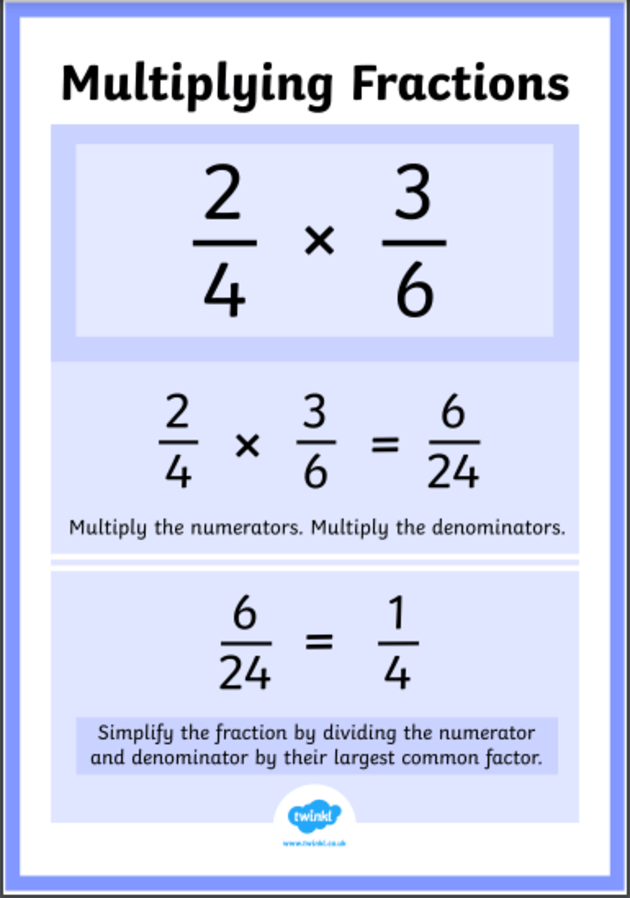
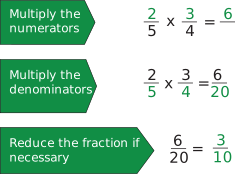
The fundamental rule for multiplying fractions is simple: multiply the numerators together to get the new numerator, and multiply the denominators together to get the new denominator.
For example, to multiply ( frac{a}{b} ) by ( frac{c}{d} ):
Resulting Numerator = ( a times c )
Resulting Denominator = ( b times d )
So, ( frac{a}{b} times frac{c}{d} = frac{a times c}{b times d} )
Computers execute this operation directly. In programming languages, if fractions are represented as a pair of integers (numerator, denominator), the multiplication is a straightforward two-step process.
Simplification and Common Denominators: Algorithmic Considerations
After multiplying, the resulting fraction almost always needs to be simplified to its lowest terms. This involves finding the Greatest Common Divisor (GCD) of the new numerator and denominator and dividing both by it.
Algorithmically, simplification typically involves:
- Euclidean Algorithm for GCD: Most computer programs use the Euclidean algorithm to efficiently find the GCD of two numbers.
- Division: Both the numerator and denominator are then divided by the calculated GCD.
Example: ( frac{2}{3} times frac{3}{4} = frac{2 times 3}{3 times 4} = frac{6}{12} )
Using GCD(6, 12) = 6: ( frac{6 div 6}{12 div 6} = frac{1}{2} )
While common denominators are crucial for adding and subtracting fractions, they are not required for multiplication. However, an algorithm might internally cross-cancel factors before multiplication to simplify the intermediate numbers and prevent overflow with very large numerators/denominators, leading to faster and more memory-efficient computation. This “pre-simplification” effectively reduces the size of the numbers being multiplied.
The Role of AI and Advanced Calculators in Complex Fractional Problems
Beyond basic arithmetic, AI and advanced computational algorithms contribute significantly to solving complex fractional problems. AI-powered math solvers, for instance, can interpret handwritten or scanned equations, recognize fractional expressions, and apply not only the multiplication rule but also principles of algebra, calculus, and other advanced mathematics. They can handle symbolic fractions (fractions with variables), simplify rational expressions, and solve equations where fractional multiplication is a component.
Machine learning models are also being trained to identify patterns in complex mathematical expressions, potentially optimizing the order of operations or identifying the most efficient methods for simplification, especially in symbolic computation systems like Mathematica or Maple. These advanced tools don’t just calculate; they often employ heuristic search and pattern matching to derive elegant solutions, mimicking the reasoning process of a human mathematician.
Practical Applications & Best Practices in a Digital Workflow
Understanding how to multiply fractions using technology is not just an academic exercise; it has tangible applications across various tech-driven industries and daily digital tasks.
Engineering & Design: Precision in Digital Models
In engineering disciplines, from civil to mechanical to software, fractions represent precise measurements, ratios, and proportions that are critical for design accuracy. Digital tools are indispensable for these calculations:
- CAD/CAM Software: Engineering drawings and 3D models often require fractional dimensions (e.g., 1/8 inch tolerance). When scaling models or converting units, multiplying these fractions accurately ensures structural integrity and functional performance.
- Signal Processing: In digital signal processing, filter coefficients and sampling rates often involve fractions. Software like MATLAB or Python with NumPy is used to perform high-precision fractional arithmetic to design stable and efficient systems.
- Resource Allocation: Project management in tech often involves allocating fractional resources (e.g., 0.5 FTE for a project). Multiplying these fractions helps in budgeting and workload planning using spreadsheet software.
Data Analysis: Handling Proportions and Ratios Digitally
Data scientists and analysts frequently work with percentages, proportions, and ratios, all of which are essentially fractions. Multiplying these is a common operation in statistical analysis:
- Probability Calculations: When calculating the probability of multiple independent events, you multiply their individual probabilities, often expressed as fractions. Statistical software (R, Python with SciPy/Pandas) handles these computations seamlessly.
- Financial Ratios: In finance, ratios like debt-to-equity or current ratio involve fractions. When modeling different scenarios or combining financial metrics, fractional multiplication is used. Spreadsheets are a primary tool here for building financial models.
- Recipe Scaling (Conceptual): While not strictly “tech,” consider scaling a recipe in a digital cookbook app. If a recipe calls for 3/4 cup of an ingredient and you want to make 1.5 times the recipe, the app would internally multiply 3/4 by 3/2 (or 1.5) to give you the new quantity.
Educational Tech: Interactive Learning of Fractions
Educational technology platforms leverage digital tools to make learning fractions more engaging and intuitive. Interactive apps and online courses use visualization, gamification, and step-by-step guidance to teach fraction multiplication:
- Virtual Manipulatives: Apps that allow students to “drag and drop” fractional pieces to visualize multiplication (e.g., showing 1/2 of 1/4).
- Interactive Exercises: Platforms like Khan Academy or Prodigy generate endless practice problems, instantly checking answers and providing corrective feedback.
- Adaptive Learning: AI-driven educational platforms can identify a student’s weaknesses in fraction multiplication and provide tailored exercises and explanations, accelerating mastery.
Future of Fractional Calculations: Emerging Tech and Advanced Tools
The trajectory of technological advancement suggests even more sophisticated ways to handle fractional calculations are on the horizon, further integrating these fundamental operations into complex digital ecosystems.
AI-Powered Math Assistants
Future AI assistants will go beyond simple computation. Imagine a voice-activated assistant that can not only solve “what is three-quarters of five-eighths?” but also explain why and how in an intuitive manner, adapting its explanation to your learning style. These assistants could be integrated into smart glasses, augmented reality environments, or even directly into professional software, offering on-demand mathematical expertise. They might predict common errors, suggest alternative solution paths, or even derive novel methods for simplifying complex fractional expressions encountered in research.
Augmented Reality for Visualizing Fractions
Augmented Reality (AR) holds immense potential for education and practical application of fractions. Imagine using an AR app to visualize fractional parts of a physical object—seeing one-third of a wall highlighted, or overlaying 3D representations of fractions to grasp multiplication concepts in a tangible, interactive way. For engineers, AR could project fractional measurements onto components during assembly, ensuring precise alignment and minimizing errors. In data visualization, AR could transform abstract fractional data into immersive 3D charts that are easier to interpret and manipulate.
Integration with Quantum Computing (Conceptual)
While a nascent field, quantum computing could eventually offer unprecedented computational power for problems involving extremely large numbers or highly complex symbolic mathematics, where classical computers might struggle with precision or speed. Although direct fractional arithmetic is not a primary target for current quantum computers, their ability to handle vast numerical states could indirectly impact the efficiency of certain algorithms involving fractional calculus or advanced number theory, pushing the boundaries of what’s computationally feasible in the realm of fractions.
In conclusion, “how to multiply fractions” has evolved from a basic arithmetic skill into a gateway to understanding and leveraging digital computation. From everyday calculator apps to sophisticated AI-driven platforms, technology has transformed the process, enhancing accuracy, speed, and comprehension. As technology continues to advance, our interaction with and mastery of foundational mathematical concepts like fraction multiplication will only become more intuitive, powerful, and deeply integrated into our digital lives.
aViewFromTheCave is a participant in the Amazon Services LLC Associates Program, an affiliate advertising program designed to provide a means for sites to earn advertising fees by advertising and linking to Amazon.com. Amazon, the Amazon logo, AmazonSupply, and the AmazonSupply logo are trademarks of Amazon.com, Inc. or its affiliates. As an Amazon Associate we earn affiliate commissions from qualifying purchases.