
The question of “how much is enough” for retirement is one of the most pressing financial dilemmas facing individuals today. It’s a complex query without a one-size-fits-all answer, deeply intertwined with personal aspirations, current financial health, and future economic realities. Far from being a simple numerical target, your retirement nest egg is a culmination of careful planning, consistent saving, and strategic investing, all aimed at securing financial independence and peace of mind in your later years. This comprehensive guide will dissect the factors influencing your ideal retirement savings, provide actionable strategies, and help you chart a course towards a secure financial future.

Understanding Your Retirement Goals and Lifestyle
Before you can put a number on your retirement savings, you must first envision what retirement looks like for you. This critical first step sets the foundation for all subsequent financial planning.
Defining Your Ideal Retirement Age
Your desired retirement age significantly impacts the amount of time you have to save and the number of years your savings will need to support you. Retiring at 60 versus 70 has vastly different implications. An earlier retirement means fewer years of accumulating savings and more years of drawing down your funds, typically requiring a larger overall nest egg. Conversely, working longer allows your investments more time to grow through compounding and reduces the period over which you’ll need to rely solely on your savings. Consider not just your preference, but also your health, career satisfaction, and family commitments when setting this goal.
Envisioning Your Retirement Lifestyle (Expenses, Hobbies, Travel)
This is where the dream becomes tangible. Will your retirement be a period of global travel and luxury cruises, or a quiet life focused on gardening and local community involvement? Your envisioned lifestyle directly dictates your expected annual expenses. Create a detailed picture:
- Housing: Will you stay in your current home, downsize, or move to a different city or country? Factor in mortgage payments (if any), property taxes, insurance, and maintenance.
- Healthcare: A significant and often underestimated cost. Consider premiums for Medicare supplements, long-term care insurance, and out-of-pocket expenses.
- Utilities & Necessities: Food, transportation, internet, phone – these foundational costs will remain, though their specifics might change.
- Discretionary Spending: This includes hobbies, dining out, entertainment, and travel. Be realistic about how much you anticipate spending on these activities.
- Inflation: Always remember that the cost of living will increase over time. What $50,000 buys today will likely require more in 20 or 30 years.
A common rule of thumb suggests you’ll need 70-80% of your pre-retirement income to maintain your lifestyle, but this can vary wildly based on individual circumstances. Some may need less if their mortgage is paid off and work-related expenses disappear, while others might need more if they plan for extensive travel or new hobbies.
Accounting for Inflation and Longevity
Two major variables that can significantly impact your retirement calculations are inflation and longevity. Inflation erodes the purchasing power of your money over time. A dollar today won’t buy as much in 30 years, so your savings need to grow at a rate that at least outpaces inflation. Longevity, or how long you expect to live, is another crucial factor. With medical advancements, people are living longer, healthier lives. It’s wise to plan for your savings to last into your late 80s or even 90s, especially if you have a family history of longevity. Overestimating your lifespan is a safer bet than running out of money too soon.
Key Benchmarks and Rules of Thumb
While personalized planning is essential, several widely accepted rules of thumb can offer a starting point or a quick check on your progress.
The 4% Rule: A Classic Withdrawal Strategy
The “4% Rule” is a widely cited guideline for retirement withdrawals. It suggests that you can safely withdraw 4% of your initial retirement portfolio balance in your first year of retirement, and then adjust that amount for inflation in subsequent years, with a high probability of your money lasting for at least 30 years. For example, if you aim to withdraw $40,000 in your first year of retirement, the 4% rule suggests you would need a portfolio of $1 million ($40,000 / 0.04 = $1,000,000). While a useful guide, it’s not without its critics and assumptions (e.g., market returns, portfolio allocation, inflation rates). It serves best as a general benchmark rather than a rigid rule.
Multiples of Salary: A Simple Savings Target
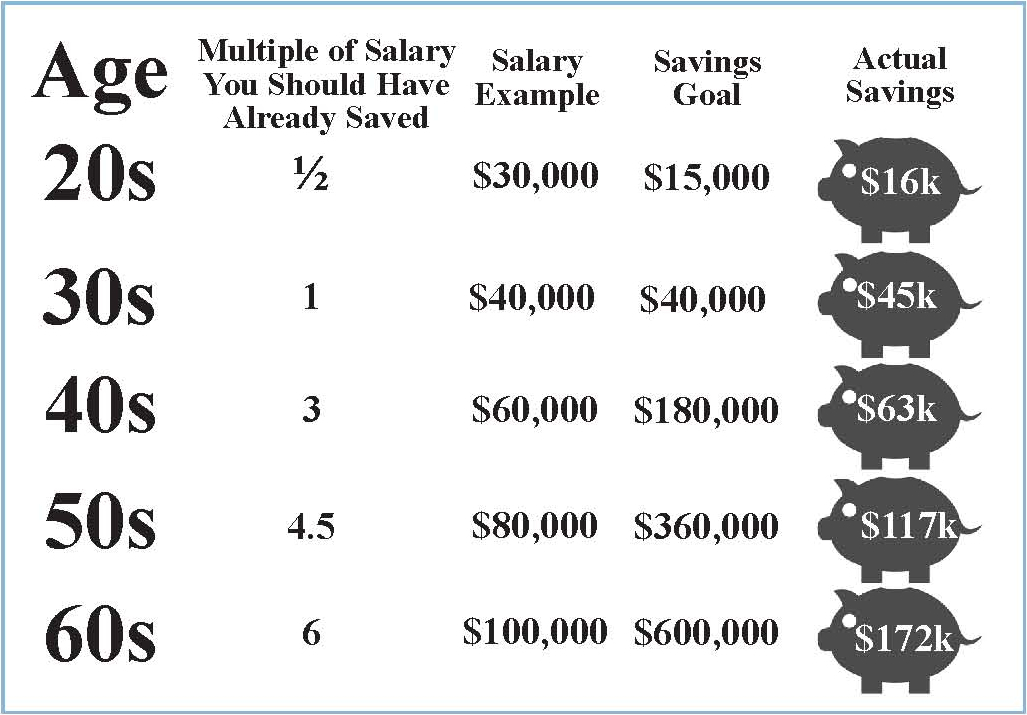
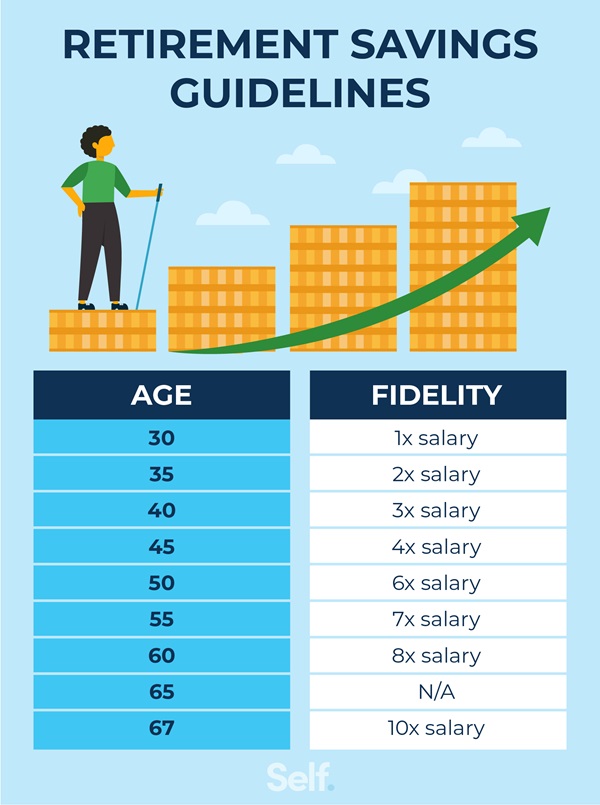
Many financial institutions and advisors provide targets based on multiples of your annual salary at different life stages. While these are broad generalizations, they offer an easy way to gauge if you’re broadly on track:
- Age 30: 1x your annual salary
- Age 40: 3x your annual salary
- Age 50: 6x your annual salary
- Age 60: 8x your annual salary
- Retirement (Age 67): 10x your annual salary
So, if you earn $100,000 at age 67, this rule suggests you should have $1,000,000 saved. These benchmarks are helpful for motivational purposes and to provide a quick sanity check, but they don’t account for individual spending habits or other income sources.
The Importance of Early Savings and Compounding
Perhaps the most powerful financial principle for retirement planning is compounding interest. The earlier you start saving, the more time your money has to grow exponentially. Even small, consistent contributions made in your 20s can far outweigh larger contributions started later in life, thanks to the magic of “interest on interest.” For instance, someone who saves $5,000 a year from age 25 to 35 (10 years, $50,000 total) could end up with more at retirement than someone who saves $5,000 a year from age 35 to 65 (30 years, $150,000 total), assuming a consistent rate of return. This highlights the immense value of time in investing.
Calculating Your Personal Retirement Number
Moving beyond rules of thumb, a more precise calculation helps you determine your truly personal retirement number.
Estimating Annual Retirement Expenses
Start by creating a detailed budget for your expected retirement years. This can be done by taking your current monthly expenses and adjusting them.
- Subtract: Work-related costs (commuting, professional attire, lunches out), current mortgage payments if you expect to pay it off, children’s expenses if they’ll be independent.
- Add: New hobbies, increased travel, higher healthcare costs, long-term care insurance, potential expenses for aging parents, or a desired second home.
- Inflate: Apply an average annual inflation rate (e.g., 3%) to project what these expenses will be in future dollars.
Once you have an estimated annual expense, you’ll have a target income needed from your portfolio.
Factoring in Social Security and Other Income Sources
It’s crucial not to rely solely on your personal savings. Social Security benefits can provide a significant portion of your retirement income, though they are generally not enough to cover all expenses. You can get an estimate of your future Social Security benefits by creating an account on the Social Security Administration’s website. Also, consider other potential income streams: pensions, part-time work, rental income from properties, annuities, or even reverse mortgages. Subtract these anticipated income sources from your total estimated annual retirement expenses to determine the “gap” that your personal savings will need to cover.
Utilizing Retirement Calculators and Financial Planners
Sophisticated online retirement calculators can help you run various scenarios, adjusting for investment returns, inflation, taxes, and longevity. Tools like those provided by Vanguard, Fidelity, Schwab, or even government sites offer valuable insights. For a truly tailored and expert perspective, consider consulting a Certified Financial Planner (CFP). A CFP can help you analyze your specific situation, build a personalized plan, optimize your investments, and navigate complex tax implications, especially if your financial situation is unique or particularly complicated. They can provide peace of mind and help ensure you’re on the most efficient path.
Strategies to Reach Your Retirement Savings Goals
Once you have a target, the next step is implementing strategies to achieve it.
Maximizing Tax-Advantaged Accounts (401k, IRA, HSA)
These accounts are your best friends in retirement planning.
- 401(k) / 403(b): Offered by employers, these allow pre-tax contributions to grow tax-deferred. Many employers offer a matching contribution, which is essentially free money – always contribute enough to get the full match.
- IRA (Traditional & Roth): Individual Retirement Accounts offer tax benefits. Traditional IRA contributions may be tax-deductible, with taxes paid upon withdrawal in retirement. Roth IRA contributions are made with after-tax money, but qualified withdrawals in retirement are tax-free. The choice often depends on your current and projected future tax bracket.
- HSA (Health Savings Account): If you have a high-deductible health plan, an HSA offers a triple tax advantage: tax-deductible contributions, tax-free growth, and tax-free withdrawals for qualified medical expenses. It can be an excellent way to save for future healthcare costs in retirement.
Maximize your contributions to these accounts annually, especially if you can hit the maximum limits.
Diversifying Your Investment Portfolio
A well-diversified portfolio is crucial for growth and risk management. This typically means a mix of stocks (for growth potential) and bonds (for stability and income). The appropriate allocation between stocks and bonds depends on your age, risk tolerance, and time horizon. Younger investors with a long time horizon can generally afford to take on more risk with a higher allocation to stocks. As you approach retirement, gradually shifting towards a more conservative portfolio with a higher bond allocation can protect your accumulated wealth. Consider low-cost index funds or ETFs for broad market exposure and diversification.
Considering Catch-Up Contributions and Downsizing
If you’re over 50 and feel behind on your savings, the IRS allows “catch-up contributions” to 401(k)s and IRAs, letting you contribute extra amounts beyond the standard limits. This can be a powerful way to accelerate your savings in the final years before retirement. Additionally, evaluate your current lifestyle. Could downsizing your home, reducing discretionary spending, or paying off high-interest debt free up more funds for retirement savings? Every extra dollar saved in your 50s and 60s has less time to compound but a greater immediate impact on your final nest egg.
Maintaining and Adapting Your Retirement Plan
Retirement planning isn’t a one-time event; it’s an ongoing process that requires regular review and adaptation.
Regular Review and Adjustment
Your life circumstances, financial goals, and the economic landscape are constantly changing. Review your retirement plan annually. Assess your progress towards your goals, re-evaluate your investment performance, and adjust your contributions or asset allocation as needed. Life events like marriage, divorce, children, job changes, or an inheritance all necessitate a review of your plan. Staying flexible and proactive ensures your plan remains relevant and effective.
Planning for Healthcare Costs
Healthcare will likely be one of your largest expenses in retirement. Even with Medicare, there will be premiums, deductibles, co-pays, and services not covered. Consider supplemental insurance (Medigap), Medicare Advantage plans, or long-term care insurance. Factor these potential costs realistically into your retirement budget to avoid being caught off guard. An HSA, as mentioned earlier, can be an excellent vehicle for this.
Estate Planning and Legacy
While the primary focus is on funding your own retirement, don’t overlook estate planning. Once you’ve accumulated significant wealth, it’s important to consider how those assets will be distributed after you’re gone. A well-structured will, trusts, and beneficiary designations can ensure your assets pass to your chosen heirs efficiently and according to your wishes, minimizing taxes and probate hassles. This final step ensures your financial legacy aligns with your overall life goals.
In conclusion, determining “how much should I have for retirement” is a journey unique to each individual. By carefully defining your goals, understanding key financial principles, diligently calculating your needs, implementing smart savings and investment strategies, and consistently reviewing your plan, you can confidently build the financial foundation for the retirement you envision. It’s a Marathon, not a sprint, but with consistent effort and informed decisions, your golden years can indeed be golden.
aViewFromTheCave is a participant in the Amazon Services LLC Associates Program, an affiliate advertising program designed to provide a means for sites to earn advertising fees by advertising and linking to Amazon.com. Amazon, the Amazon logo, AmazonSupply, and the AmazonSupply logo are trademarks of Amazon.com, Inc. or its affiliates. As an Amazon Associate we earn affiliate commissions from qualifying purchases.