
In the dynamic world of personal finance, business operations, and investment strategies, understanding percentages isn’t just a useful skill — it’s an indispensable one. From calculating a discount at your favorite store to assessing investment returns, deciphering loan interest, or analyzing market growth, percentages serve as the universal language of financial comparison and change. While the concept might seem straightforward, accurately working out percentages, especially in complex financial scenarios, requires precision and a reliable tool. That tool, for many, is the humble calculator. Far more than a device for basic arithmetic, a calculator, when wielded with insight, transforms into a powerful financial instrument, demystifying the numbers that shape our economic lives.

This guide will navigate the essentials of percentage calculations, specifically through the lens of a calculator. We’ll explore why percentages are so critical in various financial contexts, break down the core methods for tackling them on your device, and delve into more advanced applications that can empower your financial decision-making. Whether you’re a student grasping financial fundamentals, a professional managing budgets, or an individual aiming to optimize personal wealth, mastering your calculator for percentage calculations is a cornerstone of financial literacy.
The Ubiquity of Percentages in Finance
Percentages are not abstract mathematical constructs; they are the bedrock upon which many financial decisions are made. They provide a standardized way to express proportions, changes, and comparisons, making complex financial data more digestible and actionable. Understanding their omnipresence is the first step towards leveraging your calculator effectively as a financial tool.
Personal Finance Scenarios
For the individual, percentages permeate daily financial interactions. Consider the following:
- Discounts and Sales Tax: Every time you shop, you encounter discounts (e.g., “20% off”) and sales tax (e.g., “7% sales tax”). Knowing how to quickly calculate these helps you verify totals and understand the true cost.
- Tips and Gratuities: When dining out, calculating a fair tip (typically 15-20%) is a common percentage application.
- Loan Interest and Credit Card Rates: Understanding the annual percentage rate (APR) on loans or credit cards is crucial for managing debt. Percentages dictate how much extra you pay for borrowing money.
- Budgeting and Savings Goals: Allocating a percentage of your income to savings, housing, or discretionary spending is a fundamental budgeting strategy. Tracking how much of your budget you’ve spent or saved involves percentages.
- Inflation: The rate at which prices for goods and services rise over time is expressed as a percentage, directly impacting your purchasing power.
Business Finance Applications
In the business world, percentages are vital for measuring performance, setting prices, and making strategic decisions.
- Profit Margins: Gross profit margin, operating profit margin, and net profit margin are all expressed as percentages, providing insights into a company’s profitability and efficiency.
- Markups and Markdowns: Retailers use percentages to set prices (markup from cost) and to advertise sales (markdowns).
- Sales Growth and Market Share: Businesses track sales growth year-over-year or quarter-over-quarter using percentages. Market share is often expressed as a percentage of the total market.
- Commissions: Sales professionals often earn a percentage of the sales they generate.
- Operating Expenses: Expressing various expenses as a percentage of revenue helps businesses identify areas for cost reduction.
Investing and Wealth Management
For investors, percentages are the language of returns, risk, and portfolio composition.
- Investment Returns: Whether it’s the annual return on a stock, bond, or mutual fund, performance is universally quoted as a percentage.
- Portfolio Allocation: Investors distribute their assets across different categories (stocks, bonds, real estate) based on percentages to manage risk and optimize returns.
- Dividend Yield: The percentage return on an investment in terms of dividends paid is a key metric for income-focused investors.
- Expense Ratios: Mutual funds and ETFs charge annual fees expressed as a percentage of assets under management. These percentages directly impact your net returns.
- Capital Gains/Losses: The percentage increase or decrease in the value of an investment provides a clear picture of its performance over time.
Mastering the Basics: Core Percentage Calculations on Your Calculator
Now that we appreciate the critical role of percentages in finance, let’s turn our attention to the practical “how-to” using your calculator. While specific button layouts may vary slightly, the underlying logic remains consistent across most calculators, from basic models to scientific and financial ones.
Finding a Percentage of a Number
This is perhaps the most fundamental percentage calculation, used for discounts, taxes, and commission earnings.
Scenario: You want to find 20% of $150.
Method:
- Enter the number: Type
150. - Press the multiplication button:
x - Enter the percentage: Type
20. - Press the percentage button:
%(On most calculators, this automatically converts 20 into 0.20 and performs the multiplication). - Press the equals button:
=
Result:30(So, 20% of $150 is $30).
Alternative Method (if your calculator doesn’t have a ‘%’ button or you prefer fractions):
- Convert percentage to a decimal: Divide the percentage by 100 (e.g., 20 / 100 = 0.20).
- Multiply the number by the decimal:
150 x 0.20 =
Result:30
Calculating Percentage Increase or Decrease
This calculation is essential for tracking growth, price changes, or performance fluctuations.
Scenario 1: Percentage Increase
You buy a stock for $50, and it later sells for $65. What is the percentage increase?
Formula: ((New Value - Original Value) / Original Value) x 100
Method on Calculator:
- Calculate the difference:
65 - 50 = 15 - Divide by the original value:
15 / 50 = 0.3 - Multiply by 100 to get percentage:
0.3 x 100 = 30
Result: The stock increased by30%.
Scenario 2: Percentage Decrease
An item originally priced at $200 is now on sale for $160. What is the percentage decrease?
Formula: ((Original Value - New Value) / Original Value) x 100
Method on Calculator:
- Calculate the difference:
200 - 160 = 40 - Divide by the original value:
40 / 200 = 0.2 - Multiply by 100 to get percentage:
0.2 x 100 = 20
Result: The item has a20%discount.
Determining the Whole from a Part and Percentage
This is useful when you know a part of a total and what percentage it represents, and you want to find the total. For example, finding the original price of an item before tax, or understanding a full budget from a partial expense.
Scenario: You paid $7.50 in sales tax, and the sales tax rate is 5%. What was the original price of the item before tax?
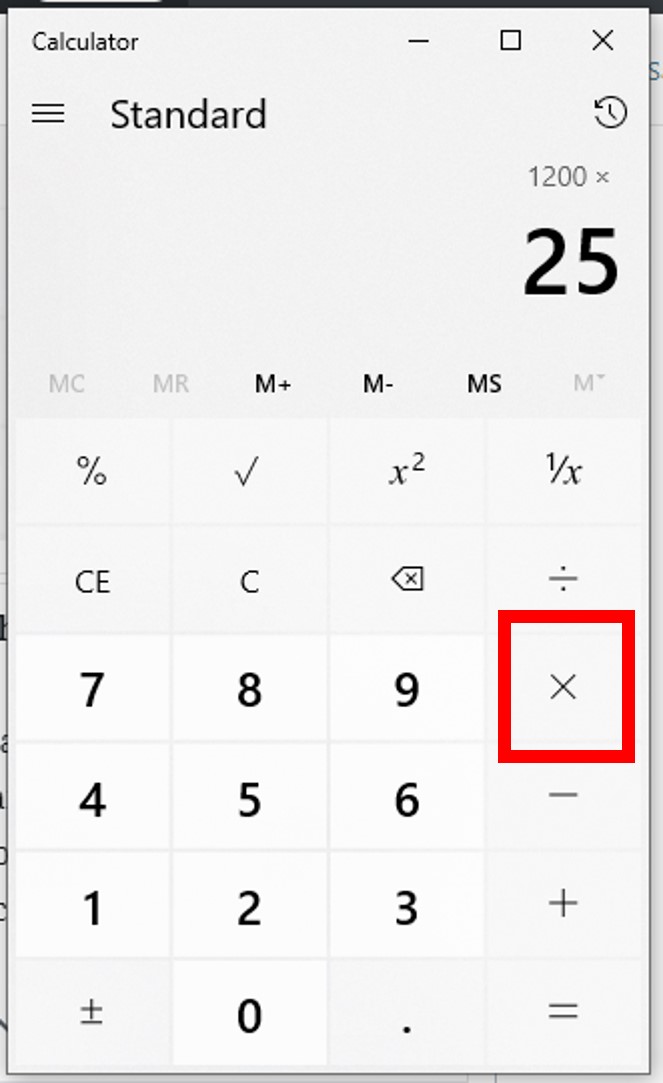
Formula: (Part / Percentage as Decimal) = Whole
Method on Calculator:
- Convert the percentage to a decimal:
5 / 100 = 0.05 - Divide the part by the decimal:
7.50 / 0.05 = 150
Result: The original price of the item was$150.
Advanced Financial Calculations with Percentages and Your Calculator
Beyond the foundational calculations, your calculator becomes an even more powerful ally when tackling complex financial scenarios. While some financial calculators have dedicated functions for these, understanding the underlying percentage mechanics allows you to perform them on any standard calculator.
Compound Interest and Loan Amortization
Compound interest is the engine of wealth growth and the burden of long-term debt. It means earning (or paying) interest on both the initial principal and the accumulated interest from previous periods.
Compound Interest Formula: A = P (1 + r/n)^(nt)
Where:
A= the future value of the investment/loan, including interestP= the principal investment amount (the initial deposit or loan amount)r= the annual interest rate (as a decimal)n= the number of times that interest is compounded per yeart= the number of years the money is invested or borrowed for
Scenario: You invest $1,000 at an annual interest rate of 5%, compounded annually, for 3 years.
Method on Calculator:
- Convert rate to decimal:
5 / 100 = 0.05 - Calculate (1 + r/n):
1 + (0.05 / 1) = 1.05(since n=1 for annual compounding) - Calculate (nt):
1 x 3 = 3 - Raise (1 + r/n) to the power of (nt):
1.05 ^ 3 = 1.157625(Use they^xorx^ybutton) - Multiply by the principal:
1000 x 1.157625 = 1157.625
Result: After 3 years, you will have approximately$1,157.63.
Loan amortization schedules, which break down how loan payments cover interest and principal over time, also rely heavily on complex percentage calculations. While a standard calculator can help with individual steps, dedicated financial calculators or online tools are often preferred for full amortization schedules.
Understanding Financial Ratios
Businesses use financial ratios, often expressed as percentages, to analyze performance, liquidity, and solvency. Your calculator helps you derive these key indicators from raw financial statements.
Scenario: Gross Profit Margin
A company has revenues of $500,000 and a cost of goods sold (COGS) of $300,000.
Formula: ((Revenue - COGS) / Revenue) x 100
Method on Calculator:
- Calculate Gross Profit:
500,000 - 300,000 = 200,000 - Divide by Revenue:
200,000 / 500,000 = 0.4 - Multiply by 100:
0.4 x 100 = 40
Result: The gross profit margin is40%. This indicates that for every dollar of revenue, 40 cents is left after accounting for the direct costs of producing goods.
Similarly, other ratios like Net Profit Margin, Debt-to-Equity Ratio, and Return on Equity (ROE) all involve careful percentage calculations that your calculator can facilitate.
Budgeting and Financial Planning
Effective budgeting involves allocating income and tracking spending, often expressed as percentages to maintain balance and achieve financial goals.
Scenario: You earn $4,000 per month and want to allocate 30% to housing, 15% to food, and 20% to savings.
Method on Calculator:
- Housing:
4000 x 30% = $1,200 - Food:
4000 x 15% = $600 - Savings:
4000 x 20% = $800
Your calculator makes it easy to quickly see the dollar amounts corresponding to your percentage allocations, ensuring you stay within your financial plan. Tracking actual spending against these percentages also helps identify overspending or opportunities for additional savings.
Choosing and Utilizing Your Financial Calculator Effectively
While the mathematical principles for percentages remain constant, the type of calculator you use can influence efficiency and capability, especially in complex financial tasks.
Different Types of Calculators and Their Financial Utility
- Basic Calculator: Excellent for simple percentage calculations (discounts, tips, basic increases/decreases). Most feature a dedicated
%button. - Scientific Calculator: Offers advanced functions like powers (
y^xor^), parentheses, and memory functions, making it suitable for compound interest and more complex formulas. While not specifically financial, its versatility is a big advantage. - Financial Calculator: Designed specifically for financial calculations. These calculators have dedicated buttons and functions for time value of money (TVM) problems (present value, future value, interest rate, number of periods, payment), amortization, bond calculations, and more. Brands like HP (e.g., HP 12c) and Texas Instruments (e.g., BA II Plus) are popular in finance. For serious financial professionals or students, a financial calculator is an invaluable investment.
- Online Calculators/Smartphone Apps: Numerous free online calculators and smartphone apps provide specialized tools for mortgage payments, retirement planning, loan comparisons, and investment growth, often incorporating percentage calculations seamlessly. These can be incredibly user-friendly and offer visual representations of data.
Tips for Accuracy and Efficiency
- Understand Your Calculator’s ‘%’ Button: Some calculators automatically divide by 100 when you press
%after a number (e.g.,500 x 20 % = 100). Others might require500 x 0.20 =. Familiarize yourself with your specific model. - Use Parentheses: For complex formulas, especially with scientific calculators, parentheses (
(and)) are crucial for ensuring the correct order of operations. - Utilize Memory Functions (M+, M-, MR/MC): These allow you to store intermediate results, which is incredibly useful for multi-step calculations, preventing errors from re-entering numbers.
- Clear and Reset: Always start complex calculations by clearing the calculator (
CorAC) to avoid using leftover values from previous operations. - Double-Check Your Work: Especially for significant financial decisions, it’s always wise to perform the calculation twice, or use a different method (e.g., manually converting to decimal) to verify the result.
- Practice with Real-World Scenarios: The best way to become proficient is to practice. Use your calculator to verify discounts, calculate loan interest, or determine investment returns on a regular basis.
Conclusion
The ability to accurately work out percentages on a calculator is more than just a mathematical skill; it’s a fundamental pillar of financial literacy. From navigating everyday consumer choices to making informed business decisions and optimizing long-term investments, percentages provide the crucial insights needed to understand and control your financial destiny. Your calculator, whether a basic model or a sophisticated financial instrument, is an extension of your financial intelligence. By understanding the underlying principles, mastering the core calculations, and leveraging its capabilities for advanced financial analysis, you transform a simple gadget into an indispensable partner in managing, growing, and securing your wealth. Embrace the power of percentages and let your calculator be your guide through the numbers that shape your financial world.
aViewFromTheCave is a participant in the Amazon Services LLC Associates Program, an affiliate advertising program designed to provide a means for sites to earn advertising fees by advertising and linking to Amazon.com. Amazon, the Amazon logo, AmazonSupply, and the AmazonSupply logo are trademarks of Amazon.com, Inc. or its affiliates. As an Amazon Associate we earn affiliate commissions from qualifying purchases.